

Class 7 Science Study Guide: Class 7 Science Important Questions for exams
Review targeted academic resources with the Class 7 Science Important Questions for exams. Built according to official CBSE standards for the 2026-27 term, these downloadable Class 7 Science study materials support effective daily practice and deeper conceptual understanding for All Chapters.
Download All Chapters Study Material PDF
View or download the dedicated Class 7 Science Important Questions for exams resource below. Engaging with these advanced study guides under focused conditions ensures continuous academic progress and mastery of the 2026-27 curriculum for All Chapters.
Class 7 Science Important Questions for exams. Please refer to the examination notes which you can use for preparing and revising for exams. These notes will help you to revise the concepts quickly and get good marks.
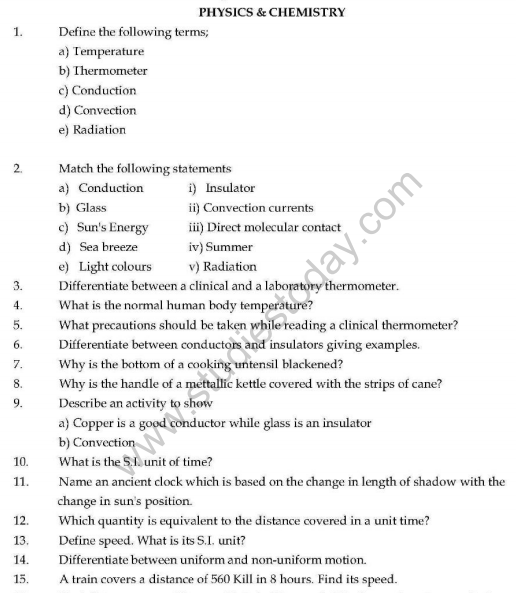
Question Bank
Biology
Q.3. Define photosynthesis. Support your answer with a suitable word equation.
Q.4. Give reasons for the following:
- Cows can digest cellulose but humans cannot.
- Gardeners prefer soil with plenty of humus content.
Q.5. a. Give one difference between clayey soil and sandy soil. b. Name one crop that grows best in loamy soil.
Q.6. Explain the saprotrophic mode of nutrition in fungi.
Q.7. a. Observe the given diagram and label the parts A, B, C and D.
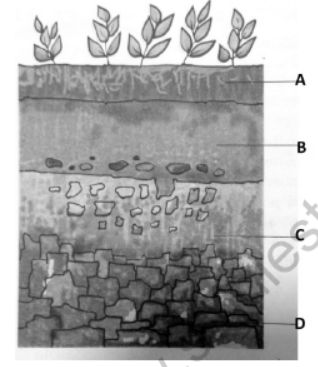
- In a given soil sample, it took 10 minutes for 200ml of water to percolate. Calculate the rate of percolation in your soil sample.
Q.8. Complete the following table:
Part of alimentary canal | Associated Gland | Secretion | Function |
Small intestine | A | Bile | D |
Pancreas | B | E | |
Wall of the small intestine | C | F |
Q.9. a. Use of plastic bags should be banned completely. Why?
- Explain the mode of feeding and digestion in Amoeba. Support your answer with a well labelled diagram.
QUESTION BANK FOR SECOND TERM PHYSICS/CHEMISTRY
- Give one word answer
- a) Path of an electric current
- b) A group of cells joined c) Magnet produced by electricity.
- d) A safety device that protects
- Match the column
- Electromagnet a) Indicates current
- Insulator b) Hearing effect
- Galvanometer c) Magnetic effect
- Electric heater d) Tempn at}I'J
- Microphone e) Rubber
- Differentiate between an open and a closed circuit with the help of diagrams.
- What is a fuse wire? Vvhat are the characteristics of the material used to make a fuse wire?
- Describe a simple ex\ eriment to show that a wire carrying current has a magnetic field.
- Draw a lahele(j. diagram and explain the working of an electric bell.
- Define the following term:
- a) Ref lection
- b) Angle of incidence c) Angle of retlection
- Give one word answer
- a) A line representing the direction of b) An image that caJ.mot be put on screen.
- c) A piece of glass with one or both sides curved allows the light to pass throug
QUESTION BANK BIOLOGY
Q1. Fill in the blanks:
- a) helps in the transport of glucose in plan
- b) is a component of blood which helps in formation of a clo c) Circulation in takes place with the help of water.
- d) and are eliminated during sweatin e) Insects have for breathing.
- f) Anaerobic respiration of is used in wine and beer making industr g) The amount of nitrogen in inhaled and exhaled air is
- h) Earthworms take in oxygen from their surroundings through. Q2. Name of following :
- Underground stem with buds
- Type of reproduction in algae c. Male organs of a flower
- Fusion of male and female gamete. Q3. Differentiate between the following a. Self and cross pollination
- Asexual and sexual production
- Wind and animal dispersed seed. d. Arteries and Veins.
- Inhalation and exhalation
- f. Anaerobic and aerobic respiration.
Q4. Explain the transport of water and minerals in plants
Q5. Explain the circulation of blood in the human body. Support your answer with a well labelled diagram.
Q6. Give reasons
- Insects prove very beneficial to flowering plants.
- Only one plant of mint is required for a garden full of mint. c. Seeds must go far from the parent plants.
Q7. Explain how the roots of the plants also show respiration. Support your answer with a suitable diagram.
Q8. Draw the diagram of a human respiratory system and label the following in the diagram:
- a) Trachea b) Lungs
- c) Alveoli
- d) Diaphragm
Q9. Draw the following a) Pistil
- b) Stamen
- c) Human excretory system
Holiday Home Work
Physics
“Ashes were already falling, not as yet very thickly. I looked round: a dense black cloud was coming up behind us, spreading over the earth like a flood. 'Let us leave the road while we can still see,' I said, or we shall be knocked down and trampled underfoot in the dark by the crowd behind.”- Written by 18 year old to a friend after seeing Mt.
Vesuvius erupt on August 24, 79 AD. Dear Students of Grade 7,
It could be any of us in place of this kid, who was an eye witness to a volcanic eruption. We hear about natural disasters striking Mother Earth without any obvious warnings. Giving a serious thought to natural disasters that can completely turn our lives topsyturvy ,we want you to choose any one natural disaster from the following list and work on a special project demonstrating what you have learnt, in a fun and interesting way.
♦ Floods
♦ Cyclonic Storms
PHYSICS PROJECT
Prepare a Handwritten Information booklet consisting of 8 pages( Use A-4 sheets) highlightingpagewise, the following information. The information should be very brief but relevant.
Please click the link below to download pdf file of Class 7 Science Important Questions for exams.
Free study material for Science
Useful Resources and Notes for Class 7 Science All Chapters
Core Study Kit: Class 7 Science All Chapters
Access comprehensive study material for All Chapters, including revision notes, concept maps, and high-probability questions. These resources are designed in alignment with the latest 2026 CBSE syllabus for Class 7 Science to support effective exam preparation.
NCERT-Aligned Solutions for All Chapters
Built using official NCERT guidelines for Class 7 Science, these materials provide reliable academic support. Integrating past examination questions and step-by-step solutions helps students understand official CBSE grading criteria.
Next Steps in Your Exam Preparation
Maximize your grade potential by utilizing Class 7 Science practice papers in tandem with these structured notes. All printable assignments and interactive mock tests on our platform are updated for the 2026 session and available free of charge.
FAQs
Our advanced study package for All Chapters includes detailed concepts, diagrams, Mind Maps, and explanation of complex topics to ensure Class 7 students learn as per syllabus for 2026 exams.
The Mind Maps provided for All Chapters act as visual anchors which will help faster recall during high-pressure exams.
Yes, teachers use our Class 7 Science resources for lesson planning as they are in simple language and have lot of solved examples.
Yes, You can download the complete, mobile-friendly PDF of the Science All Chapters advanced resources for free.
Yes, our subject matter experts have updated the All Chapters material to align with the rationalized NCERT textbooks and have removed deleted topics and added new competency-based questions.