

Class 7 Science Study Guide: Class 7 Physical and Chemical Changes Important Questions for exams
Explore structured advanced study materials through the Class 7 Physical and Chemical Changes Important Questions for exams. Tailored for Class 7 learners, utilizing these Science resources ensures thorough preparation and strengthens foundational knowledge before final CBSE evaluations.
Download Chapter 06 Physical and Chemical Changes Study Material PDF
Access the complete useful resource PDF for Class 7 Science below. Regular practice with these targeted academic notes builds familiarity with complex topics and helps secure higher marks in final school evaluations.
Class 7 Physical and Chemical Changes Important Questions for exams. There are many more useful educational material which the students can download in pdf format and use them for studies. Study material like concept maps, important and sure shot question banks, quick to learn flash cards, flow charts, mind maps, teacher notes, important formulas, past examinations question bank, important concepts taught by teachers. Students can download these useful educational material free and use them to get better marks in examinations. Also refer to other worksheets for the same chapter and other subjects too. Use them for better understanding of the subjects.
Chapter: Physical and Chemical Changes
Smart Notes
Difference between physical and chemical changes
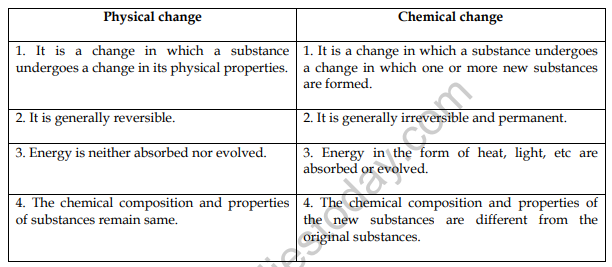
| Physical change | Chemical change |
|---|---|
| It is a change in which a substance undergoes a change in its physical properties. | It is a change in which a substance undergoes a change in which one or more new substances are formed. |
| It is generally reversible. | It is generally irreversible and permanent. |
| Energy is neither absorbed nor evolved. | Energy in the form of heat, light, etc. is absorbed or evolved. |
| The chemical composition and properties of substances remain the same. | The chemical composition and properties of the new substances are different from the original substances. |
The properties such as __________, __________, __________ and __________ of a substance are called its physical properties.
Answer: colour, shape, size and texture (other physical properties are smell, hardness, density, melting point and boiling point).
During a chemical change / reaction, when new products are formed, it is usually accompanied by
- release or absorption of energy in the form of heat, light, etc.
- production of sound
- change in smell
- change in colour
- formation of gas
Classify the following changes into physical and chemical changes:
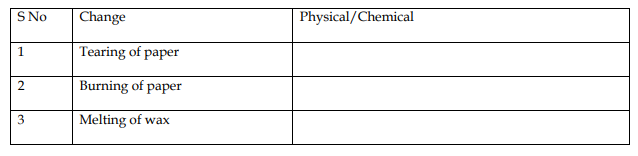

| Change | Physical/Chemical (Answer) |
|---|---|
| Tearing of paper | Physical |
| Burning of paper | Chemical |
| Melting of wax | Physical |
| Burning of wax | Chemical |
| Formation of curd from milk | Chemical |
| Melting of ice | Physical |
| Boiling of water | Physical |
| Heating of an iron nail | Physical |
| Rusting of iron | Chemical |
| Burning of magnesium ribbon | Chemical |
| Photosynthesis | Chemical |
| Dissolving salt in water | Physical |
| Burning of coal | Chemical |
| Crushing of a chalk | Physical |
| Digestion of food | Chemical |
| Cutting a log of wood | Physical |
| Keeping iron filings in CuSO4 solution | Chemical |
| Formation of manure from leaves | Chemical |
| Stretching of a rubber band | Physical |
| Bursting of cracker | Chemical |
| Crystallisation of CuSO4 solution | Physical |
| Adding a pinch of baking soda to vinegar | Chemical |
| Passing carbon dioxide through lime water | Chemical |
| Souring of milk | Chemical |
| Beating aluminium to make aluminium foil | Physical |
Rusting: Rusting is the process in which iron reacts with oxygen and moisture in the air to form a reddish brown coating, called rust, on its surface. The presence of common salt speeds up rusting. If either oxygen or moisture is absent, rusting does not occur.
Conditions required for rusting to take place:- Presence of oxygen (air)
- Presence of moisture (water)
Rusting is faster when the content of salt is high in air.
Rusting can be prevented by
- applying a coat of paint or grease / oil
- depositing a layer of a metal like zinc or chromium on iron.
Why do ships suffer a lot of damage from rusting?
Answer: In spite of ships being painted, they suffer a lot of damage because a part of the ship is always in water and water droplets cling on the part which is above water. Ships sail in the sea and sea water contains salts. Salt makes rusting faster.
Galvanisation – It is the process of depositing a layer of molten zinc on iron.Practice exercise: Physical and chemical changes
Fill in the blanks:
- Chemical reactions are accompanied by absorption or evolution of energy.
- Matter can be classified as solid, liquid and gas.
- New substances are formed in a chemical reaction.
- A change in physical state of a substance is called physical change.
Complete the following table giving reasons, whether the classification in column B is correct or not:
| A | B | C |
|---|---|---|
| Sublimation of iodine | Physical Change | Correct. Solid iodine turns directly into vapour and back again; no new substance is formed. |
| Mixing of salt and water | Chemical Change | Not correct. Salt only dissolves and can be got back by evaporating the water; no new substance is formed, so it is a physical change. |
| Burning a piece of paper | Physical Change | Not correct. Ash and gases (new substances) are formed, so it is a chemical change. |
| Formation of compound | Chemical Change | Correct. A compound is a new substance with properties different from its elements. |
| Heating of iron filings and sulphur powder | Physical Change | Not correct. Iron sulphide, a new substance, is formed, so it is a chemical change. |
| Respiration | Physical Change | Not correct. Food (glucose) reacts with oxygen to give carbon dioxide, water and energy; it is a chemical change. |
| Passing of CO2 gas in lime water | Chemical Change | Correct. Calcium carbonate is formed, which turns the lime water milky. |
| Formation of biogas | Physical Change | Not correct. Bacteria break down cattle dung into methane and other gases, so it is a chemical change. |
Write word equations for the following chemical changes:
- The oxide of magnesium is dissolved in water to form magnesium hydroxide.
- Baking soda is added to an aerated drink to form bubbles of carbon dioxide and other substances.
- Carbon dioxide is exhaled in lime water to form carbonic acid.
- Zinc granules are added to hydrochloric acid to form zinc chloride and liberate hydrogen gas.
Answer:
- Magnesium oxide + water → magnesium hydroxide
- Sodium hydrogencarbonate (baking soda) + acid in the drink (e.g. citric acid) → a salt (sodium citrate) + water + carbon dioxide
- Carbon dioxide + calcium hydroxide (lime water) → calcium carbonate + water
- Zinc + hydrochloric acid → zinc chloride + hydrogen
(The source said part (c) forms “carbonic acid”; carbon dioxide and lime water actually form calcium carbonate, which makes the lime water milky, so the question and answer are written that way.)
Which of the following changes is useful?
- Burning of paper
- Rusting
- Formation of curd
- Cutting of trees
Answer: (c) Formation of curd. Curd is a useful food made from milk, whereas rusting and cutting of trees cause loss, and burning of paper wastes the paper.
Define the following terms:
- Crystallisation
- Galvanisation
- Rusting
Answer:
- Crystallisation: the process of getting pure crystals of a solid from its saturated solution on cooling or slow evaporation.
- Galvanisation: the process of depositing a layer of zinc on iron to protect it from rusting.
- Rusting: the process in which iron reacts with oxygen and moisture in the air to form a reddish brown coating called rust.
Study the diagram and answer the questions:
In which case would the iron nails get rusted fastest and why?
Answer: In tube 4 (salt solution). The nails get both water and air, and salt speeds up rusting.
In which case would the iron nails not get rusted and why?
Answer: In tube 1, because anhydrous calcium chloride absorbs moisture, so there is only dry air and no water; and in tube 2, because boiled water has no dissolved air and the oil layer stops air from dissolving in it, so there is no oxygen.
Food items like apples, if cut and exposed to air, become brownish. Explain why.
Answer: The cut surface of the apple comes in contact with oxygen of the air. Substances in the apple react with oxygen (helped by enzymes) to form new brown-coloured substances. This is a chemical change.
H.O.T.S.
When you buy a new water bottle, you find a little pouch of silica gel inside. Why is it kept in a water bottle? Can you use it at other places also?
Answer: Silica gel absorbs moisture. It keeps the inside of the bottle dry so that the bottle does not get a damp smell, fungus or (for a metal bottle) rust before it is sold. Yes, it is also used in packets of shoes, bags, medicines, electronic goods and food items to keep them dry.
A change may be both physical and chemical. Do you agree? Justify.
Answer: Yes. Some changes have both parts. For example, when a candle burns, the wax first melts (a physical change, as the wax can solidify again) and then the wax vapour burns to form carbon dioxide and water vapour (a chemical change).
Let us do: Magic with Chemistry
Secret message: On a blank paper, write a secret message to your friend with lemon juice. How does your friend read the message? Hold the paper above a lighted candle. The message will appear by itself.
Magical drink: Take some soap solution in a container. Dip a clean handkerchief (dipped in turmeric and dried beforehand) into the container. Lo and behold, your handkerchief will turn red.
Greeting card: You can design your own T-shirt or make a personalised greeting card with a difference for your friend. Apply a paste of turmeric on a piece of paper and let it dry completely. Now dip a brush in soap solution and paint a freehand drawing on the paper.
Free study material for Science
Science Class 7 Exam Resources: Chapter 06 Physical and Chemical Changes
Comprehensive Study Resources for Chapter 06 Physical and Chemical Changes
Review targeted study resources for Chapter 06 Physical and Chemical Changes tailored for Class 7 learners. Utilizing these structured notes and quick-revision tools ensures complete alignment with current CBSE evaluation standards.
Understanding Marking Schemes
Designed around the official curriculum, these study guides guarantee standard compliance. Reviewing step-by-step solutions clarifies complex sub-topics within Chapter 06 Physical and Chemical Changes and demystifies standard marking schemes for Science evaluations.
Complete Revision for Science
Wrap up your chapter revision by testing your knowledge against standard objective question formats. Explore our full library of free, up-to-date sample papers and online assessments to secure top grades in your CBSE examinations.
FAQs
Our advanced study package for Chapter 06 Physical and Chemical Changes includes detailed concepts, diagrams, Mind Maps, and explanation of complex topics to ensure Class 7 students learn as per syllabus for 2026 exams.
The Mind Maps provided for Chapter 06 Physical and Chemical Changes act as visual anchors which will help faster recall during high-pressure exams.
Yes, teachers use our Class 7 Science resources for lesson planning as they are in simple language and have lot of solved examples.
Yes, You can download the complete, mobile-friendly PDF of the Science Chapter 06 Physical and Chemical Changes advanced resources for free.
Yes, our subject matter experts have updated the Chapter 06 Physical and Chemical Changes material to align with the rationalized NCERT textbooks and have removed deleted topics and added new competency-based questions.