

Download CBSE Class 7 Science Useful Resources
Explore structured advanced study materials through the Class 7 Science Nutrition in Animals Exam Notes. Tailored for Class 7 learners, utilizing these Science resources ensures thorough preparation and strengthens foundational knowledge before final CBSE evaluations.
Access CBSE Study Guides and Summaries
Access the complete useful resource PDF for Class 7 Science below. Regular practice with these targeted academic notes builds familiarity with complex topics and helps secure higher marks in final school evaluations.
Covers following topics:
• Assimilation : Food absorbed by amoeba is used to obtain energy for maintaining life process.
• Egestion : When a sufficient amount of undigested food collects inside amoeba, then its cell membrane suddenly ruptures at any place & the undigested food is thrown of the cell.
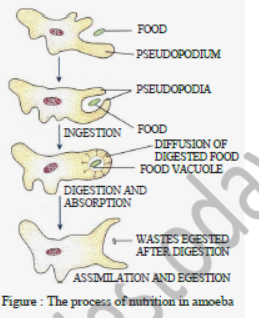
→NUTRITION IN HUMAN
• Nutrition in human is holozoic. The food ingested through the mouth passes through a number of organ in our body which constitute the alimentary canal.
• The alimentary canal along with digestive glands known as digesttive system.
• The digestive system of human consists of following organs -
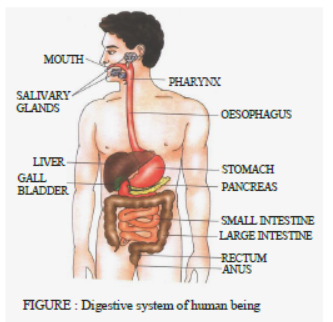
(i) Mouth : It is a transvers slit & also called opening of alimentary canal. Mouth opens into buccle cavity.
(ii) Buccle cavity : Mouth open into a cavity which contain teeth, tongue & salivary glands. Salivary glands secrete saliva which contain salivary amylase enzyme & convert the starch into simple sugar.
(iii) Teeth : Teeth are hard structures held in sockets of the jaws. Teeth cut, chew and break food into smaller pieces.
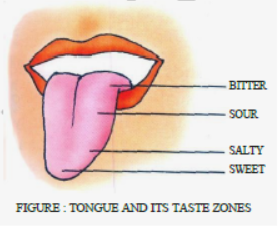
(iv) Tongue : Tongue is the organ used for taste. It contains taste buds to distinguish whether a type of food is sweet, sour, bitter or hot (figure). It also helps in rolling and pushing the food into the pharynx. It mixes the saliva with the food and also helps us in speaking.
(v) Oesophagus or Food Pipes : It is a connecting tube between the mouth and stomach. The food is pushed down towards the stomach by the movement of the muscles of the food pipe.
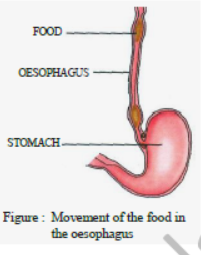
(vi) Stomach : Stomach is a J-shaped bag-like structure made of muscles. The stomach secretes gastric juice and hydrochloric acid. Hydrochloric acid kills microorganisms and provides an acidic medium for effective digestion.
In the stomach food is throughly mixed with the gastric juice secreted by the gastric glands present in the stomach. The gastric juice contians an enzyme called pepsin which helps to break down proteins into simpler substances.
(vii) Small Intestine : It is a coiled tube and is about 7 metres in length. It consists of three parts, namely dueodenum, jejunum and ileum. In the small intestine the food is mixed with bile juice and pancreatic juice.
These are secreted by the liver and the pancreas, respectively. Bile juice breaks down fats into fatty acids and glycerol. The pancreatic juice breaks down starch into simple sugar and proteins into amino acids. Digestion of all the components of food gets completed here and the end products are ready for absorption.
Absorption of food occurs through millions of small projections in the inner walls of the part of small intestine called ileum. These projections are known as villi. The incorporation of absorbed nutrients into the cell
components is called assimilation.
The food that remains undigested and unabsorbed then enters the large intestine.
(viii) Large intestine : It is the last organ of the digestive system. It is about 1.5 m in length. It consists of three parts, namely caecum, colon and rectum. It helps in absorbing water and in removing undigested solid wastes from the body in the form of faeces through an opening called anus.
(ix) Anus : It is the last part of the alimentary canal. Its main function is to expel solid faceces out of the body.
(x) Digestive Glands :
(a) Salivary Glands : There are three pairs of salivary glands located in the mouth. Salivary glands secrete saliva which contains amylase enzyme. Amylase works on starch and converts it into simple sugar.
(b) Liver : It is reddish brown gland and is located in the upper part of the abdomen. It secretes bile juice that is stored in gallbladder. The bile helps in breaking down fat into simpler substances.
(c) Pancreas : It is a cream-coloured gland and is located just below the stomach. It secretes pancreatic juice into a small intestine. It acts on carbohydrates and protein and converts them into simpler substances.
→NUTRITION IN A RUMINANT
A ruminant is an herbivours animal which regurgitates its food & digest it in step. For example- Cow, goats, sheep etc.
The 2 steps involved in digestion of ruminants are -
(1) The ruminant first eats the foods & regurgitates a semi digested food called cud.
(2) The ruminant then eats the cud when at rest. This process of eating the cud is called ruminating.
Ruminants have a special stomach with 4 chambers, which are as follows -
• Rumen : This is the largest chamber of the stomach. It is namely used for storing food.
• Reticulum : It helps in moving the food bakc to the mouth when needed.
• Omasum : This is the smallest chamber of the stomach. Its main function is to absorb excess water.
• Abomasum : This is a true stomach where gastric juices are secreted to help digestion. Here the food is digested just like in the human stomach.
Disgestion of food in ruminants :
The ruminants mostly eat grasses and leaves which are rich in cellulose, The ruminants can digest cellulose becuase celluose-digesting bacteria and protozoa are present in their stomach.
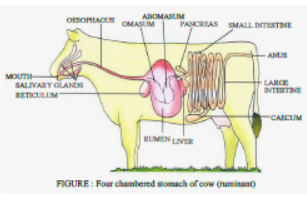
Half-chewed grass travels from the mouth to the first chamber of the stomach called rumen where it is acted upon by bacteria and microorganism. It then goes into the reticulum from where it is returned to the mouth as cud for through chewing called rumination. It enters a third chamber called omasum. Here it is broken down
into still smaller pieces. Finally, it enters the fourth chmaber called abomasum where enzymes act upon it and digestion is completed. It is finally sent to the small intestine where the absorption of the nutrients takes place.
Question. Some carbohydrate-rich foods, like bread, can be digested almost immediately to glucose. Others, like brown rice, are digested much more slowly. Foods that quickly get digested to glucose are said to have a high glycemic index. Which of these conclusions can be correctly drawn from the table showing high and low glycemic foods?
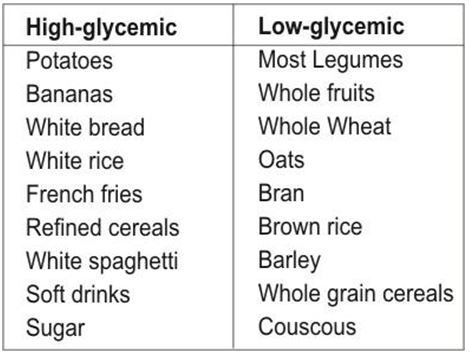
(a) Cereals are high glycemic foods
(b) Fruits are low glycemic foods
(c) Processed foods are high glycemic foods
(d) Foods made from rice are low glycemic foods
Answer : C
Question. The list below gives the items that Sam decided to have for his dinner: 1. Curry with beans and spinach (palak), 2. Salad with raw fruits and vegetables like carrot and beetroot, 3. Curd, 4. Sprouted moong dal. From the food items given below, what should Sam add to have a balanced diet for his dinner?
(a) Curry with cauliflower
(b) Chapatti
(c) Onion pakoda
(d) Butter milk
Answer : B
Question. Water is removed from foods because dried foods can be stored for longer periods without getting spoilt. The graphs given below show the water content originally in four different foods. Water was almost completely removed by passing dry air through each of these four foods. If the weight of each of them after that was 50 grams, which one was the heaviest to start with?

(a) Cucumber
(b) Apple
(c) Bread
(d) Butter
Answer : A
Question. In which part of the digestive system does a piece of bread which is eaten get completely broken down into simple sugars?
(a) Stomach
(b) Liver
(c) Large intestines
(d) Small intestines
Answer : B
Question. Given below is a label found on a food item.
Study it and answer the question.
On which of the following food items may this food label be found?

(a) oil bottle
(b) milk container
(c) salt packet
(d) bottle of cola
Answer : B
Question. Given below is a label found on a food item.
Study it and answer the question.
Which nutrient is NOT provided by the food item having the above label?
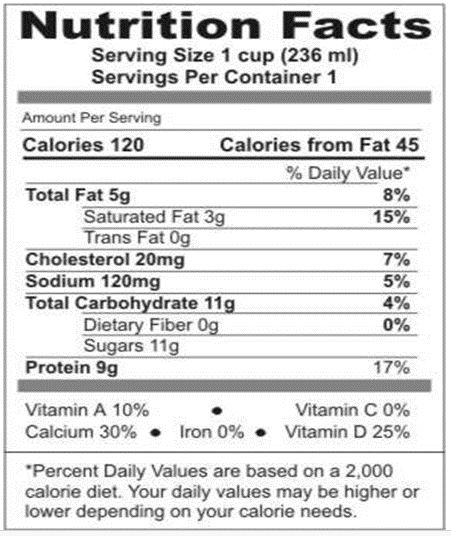
(a) Calcium
(b) Vitamin A
(c) Sugars
(d) Iron
Answer : D
Question. Which of the following could be 'X' in the table below?
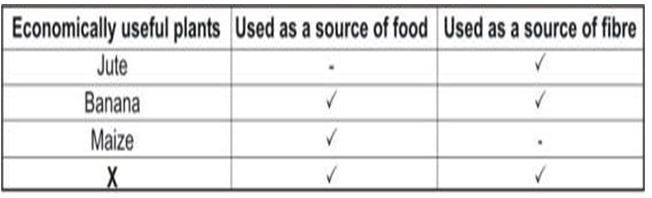
(a) Ground nut
(b) Mango
(c) Flax
(d) Coconut
Answer : D
Question. What is dry cleaning" of clothes?"
(a) putting out the clothes to dry in the sun
(b) using a liquid other than water to clean
(c) using water vapour to clean the clothes
(d) using warm air to clean the clothes
Answer : B
Question. The figure shown here represents which of the following processes?
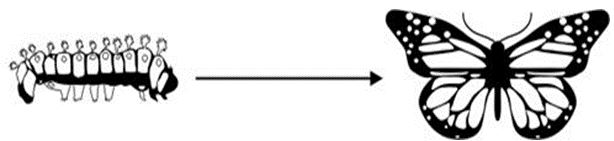
(a) Reproduction
(b) Metamorphosis
(c) Food chain
(d) Adaptation
Answer : B
Question. Study the containers P, Q, R, and S shown below. The temperature of the water in each container is recorded every minute. This experiment is studying the variation in the temperature of water over time for different …..
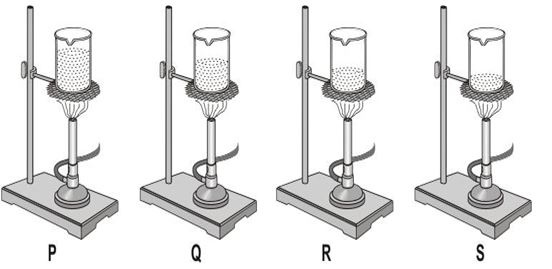
(a) shapes of the container
(b) intensities of the burner
(c) volumes of water heated
(d) exposed surface areas
Answer : C
Question. The maximum and minimum temperature during a 24 hour period in four cities A, B, C and D are shown below. Which of the following is likely to be in or nearest to a desert?
| City | Maximum | Minimum |
| A | 42oC | 35 |
| B | 39oC | 18oC |
| C | 25oC | 18oC |
| D | 20oC | 18oC |
(a) A
(b) B
(c) C
(d) D
Answer : B
Question. Materials expand upon heating. How much a material expands upon heating is given by its coefficient of expansion. There are three metals P, Q and R. Of them, P has the largest coefficient of expansion, and R has the smallest. When a thermostat is made with P and R, this is the shape it takes when heated: Three pieces of P, Q and R are fused together as shown . What shape will it take when heated?
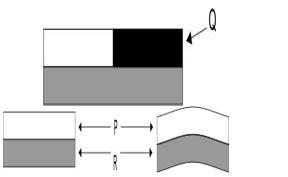

Answer : A
Question. The specific heat capacity of a substance is the amount of heat required to raise the temperature of 1kg of the substance by 10C. The specific heat capacities of a few substances are also given here. Using this information, answer the question….
For STORING thermal energy in solar heating systems, we would need a material that retains heat the longest. Which of these would be most suited
| Substance | Specific heat (J/Kg' C x 1000) |
| Water Vegetable oil Kerosene Alcohol Aluminum Copper Iron Lead | 4.18 1.96 2.11 2.40 0.90 0.38 0.53 |
(a) Aluminum
(b) Water
(c) Copper
(d) Iron
Answer : B
Question. The specific heat capacity of a substance is the amount of heat required to raise the temperature of 1kg of the substance by 10C. The specific heat capacities of a few substances are also given here. Using this information, answer the question .If equal masses each of water, vegetable oil, aluminium and copper are heated uniformly for five minutes, which one of them will record the maximum rise in temperature?
| Substance | Specific heat (J/Kg' C x 1000) |
| Water Vegetable oil Kerosene Alcohol Aluminum Copper Iron Lead | 4.18 1.96 2.11 2.40 0.90 0.53 0.13 |
(a) Water
(b) Vegetable oil
(c) Aluminium
(d) Copper
Answer : D
Question. The boiling point of water is 1000C at sea level. The boiling point of butane is -1.50 C. If we leave liquid butane in a bowl on a table in a room where the temperature is 240C, butane will -
(a) Evaporate
(b) Condense
(c) Freeze
(d) Melt
Answer : A
Please click on below link to download pdf file for Class 7 Science Nutrition in Animals Exam Notes.
Free study material for Science
Useful Resources and Notes for Class 7 Science Chapter 02 Nutrition in Animals
Comprehensive Study Resources for Chapter 02 Nutrition in Animals
Access comprehensive study material for Chapter 02 Nutrition in Animals, including revision notes, concept maps, and high-probability questions. These resources are designed in alignment with the latest 2026 CBSE syllabus for Class 7 Science to support effective exam preparation.
Understanding Marking Schemes
Each resource draws directly from authorized textbooks to maintain academic accuracy. Evaluating solved examples allows Class 7 students to master the formal presentation and answer-writing standards expected in upcoming school exams.
Complete Revision for Science
For peak performance in upcoming evaluations, integrate official Science sample papers directly into your study schedule. Follow up your revision by attempting online MCQ tests for Chapter 02 Nutrition in Animals to refine calculation speed and precision.
FAQs
Our advanced study package for Chapter 02 Nutrition in Animals includes detailed concepts, diagrams, Mind Maps, and explanation of complex topics to ensure Class 7 students learn as per syllabus for 2026 exams.
The Mind Maps provided for Chapter 02 Nutrition in Animals act as visual anchors which will help faster recall during high-pressure exams.
Yes, teachers use our Class 7 Science resources for lesson planning as they are in simple language and have lot of solved examples.
Yes, You can download the complete, mobile-friendly PDF of the Science Chapter 02 Nutrition in Animals advanced resources for free.
Yes, our subject matter experts have updated the Chapter 02 Nutrition in Animals material to align with the rationalized NCERT textbooks and have removed deleted topics and added new competency-based questions.