

Class 7 Science Study Guide: Class 7 Science Nutrition in Plants Exam Notes
Review targeted academic resources with the Class 7 Science Nutrition in Plants Exam Notes. Built according to official CBSE standards for the 2026-27 term, these downloadable Class 7 Science study materials support effective daily practice and deeper conceptual understanding for Chapter 01 Nutrition in Plants.
Download Chapter 01 Nutrition in Plants Study Material PDF
View or download the dedicated Class 7 Science Nutrition in Plants Exam Notes resource below. Engaging with these advanced study guides under focused conditions ensures continuous academic progress and mastery of the 2026-27 curriculum for Chapter 01 Nutrition in Plants.
Class 7 Science Nutrition in Plants Exam Notes. Please refer to the examination notes which you can use for preparing and revising for exams. These notes will help you to revise the concepts quickly and get good marks.
Covers following topics:
1.Mechanism of Photosynthesis
2.Site of Photosynthesis
3.Nutrition in non green plants
Plants play role of producers in nature. are producers, which produce food for all living organic. They utilize sun's radiant energy & convert into chemical energy. In this way, they also plays role of converter. Plants use sunlight in photosynthesis. During photosynthesis in the presence of sunlight CO2 & H2O convert in to carbohydrate & O2 molecules.
Mechanism Of Photosynthesis
6CO2 + 6H2O Light—→C6H12O6 + 6O2
Steps of photosynthesis :
1.Chlorophyll traps the sunlight.
2.CO2 & water molecule used as raw material.
3.Now the chlorophyll convert the raw material into carbohydrate.
4.Oxygen is generated as a by product in this process.
Requirement Of photosynthesis
Green plants need the following things to prepare their own food :
1.Carbon Dioxide : Plants take up carbon dioxide from the atmospheric air through stomata present on the undersurface of the leaves. Guard cells around stomata regulate their opening and closing.
2.Chlorophyll : It is the green pigment presents in the leaf. The green colour of leaves is due to the presence of chlorophyll. It is usually present in special cell organelle called chloroplast. Chlorophyll captures solar energy during photosynthesis.
3.Sunlight : Sunlight comes from the sun. It is essential as it provides the energy required for the reaction.
4.Water and Minerals : Roots of the plants absorb water along with minerals from the soil and transport them to the leaves for photosynthesis.
Site Of photosynthesis
Photosynthesis occurs in the chlorophyll of leaves & sometimes in the stem which are green in colour.
◊ Importance of photosynthesis :
♦ It is primary source of food production for all other living organisms.
♦ It maintain balance oxygen & CO2 in the atmosphere.
→NUTRITION IN NON GREEN PLANTS
Non green plants like bacteria & fungi do not contain chlorophyll. So they cannot prepare their food by photosynthesis. These types of plants are heterotrophic plants.
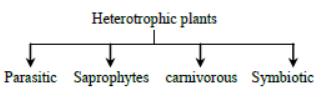
(1) Parasites : Plants which depends on other living organism for their nutritional requirement known as parasitic
plants. Dodder (Amarbel) is a plant parasite which produces special sucking roots called haustoria. For absorption of food from the host plant.
(2) Saprophytes : Plants which depends on dead organic matter for their nutrition, known as saprophytic plants.
For example – Bacteria & fungi.
(3) Carnivorous & insectivorous plants : Some plants also take food just like animals. Their food consists of small insects. For example – Pitcher plants.
In a pitcher plant leaf is modified into a pitcher like structure when any insects sits on it, the lid is closed & the
insect is trapped in pitcher. It is then digested by the secretion of enzymes.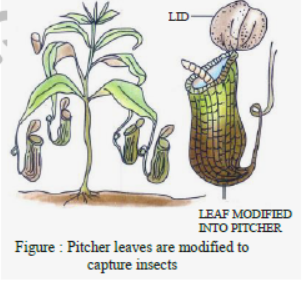
(4) Symbiosis : It is a partnership between two organisms in which both partner get benefited from each other.
Lichen is a combination of an alga & a fungus. In which, the fungus provides water & minerals to the alga whereas the alga supplies organic food to fungus.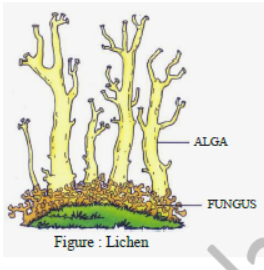
→ HETEROTROPHICNUTRITIONINANIMAL
Animals and non-green plants like fungi, etc. cannot manufacture their own food. For their food, they depend upon green plants, directly or indirectly. Therefore, they are called heterotopous and their mode of nutrition is known as heterotrophic nutrition.
All animals are divided into three categories on the basis of their eating habits :
♦ Herbivorous Animals : Animals which feed directly on plants are called herbivorous animals or herbivores.
Examples are cow, buffalo, goat, etc.
♦ Carnivorous Animals : Animals which eat the flesh of other animals are called carnivorous animals or carnivores. Examples are lion, tiger, etc.
♦ Omnivorous Animals : Animals which eat both plants and flesh of other animals are called omnivorous animals or omnivorous. Examples are human beings, pig, crow, cockroach, etc.
Please click on below link to download pdf file for Class 7 Science Nutrition in Plants Exam Notes.
Free study material for Science
Free CBSE Study Guides: Class 7 Science Chapter 01 Nutrition in Plants
Comprehensive Study Resources for Chapter 01 Nutrition in Plants
Explore essential learning tools for Class 7 Science Chapter 01 Nutrition in Plants. This curated collection features in-depth notes and targeted practice questions built around the active 2026 curriculum to streamline your daily revision.
Understanding Marking Schemes
Each resource draws directly from authorized textbooks to maintain academic accuracy. Evaluating solved examples allows Class 7 students to master the formal presentation and answer-writing standards expected in upcoming school exams.
Complete Revision for Science
Maximize your grade potential by utilizing Class 7 Science practice papers in tandem with these structured notes. All printable assignments and interactive mock tests on our platform are updated for the 2026 session and available free of charge.
FAQs
Our advanced study package for Chapter 01 Nutrition in Plants includes detailed concepts, diagrams, Mind Maps, and explanation of complex topics to ensure Class 7 students learn as per syllabus for 2026 exams.
The Mind Maps provided for Chapter 01 Nutrition in Plants act as visual anchors which will help faster recall during high-pressure exams.
Yes, teachers use our Class 7 Science resources for lesson planning as they are in simple language and have lot of solved examples.
Yes, You can download the complete, mobile-friendly PDF of the Science Chapter 01 Nutrition in Plants advanced resources for free.
Yes, our subject matter experts have updated the Chapter 01 Nutrition in Plants material to align with the rationalized NCERT textbooks and have removed deleted topics and added new competency-based questions.