

Advanced Study Material for Class 7 Science: Chapter 13 Motion and Time
Explore structured advanced study materials through the Class 7 Science Motion and Time Exam Notes. Tailored for Class 7 learners, utilizing these Science resources ensures thorough preparation and strengthens foundational knowledge before final CBSE evaluations.
Practice Class 7 Science Resources: Chapter 13 Motion and Time
View or download the dedicated Class 7 Science Motion and Time Exam Notes resource below. Engaging with these advanced study guides under focused conditions ensures continuous academic progress and mastery of the 2026-27 curriculum for Chapter 13 Motion and Time.
Class 7 Science Motion and Time Exam Notes. Please refer to the examination notes which you can use for preparing and revising for exams. These notes will help you to revise the concepts quickly and get good marks.
Covers the following topics:
1.Unit
2.Physical quantities
3.Rest & motion
4.Types of motion
5.Uniform & non-uniform motion
6.Terms used to define motion
7.Measurements
8.Distance time graph
Unit
Measurement of any physical quantity is expressed in terms of an internationally accepted certain basic standard called unit.
Length, time & mass are measured in meter, sec, and kilogram
physical Quantites
The quantities which can be measured by an instrument and by means of which we can describe the laws of physics are called physical quantities.
Eg. length, velocity, acceleration, force, time, pressure, mass, density etc.
Rest And Motion
An object is said to be at rest if it does not change its position with respect to its surrounding with the passage of time.
A body is said to be in motion if its position changes continuously with respect to the surroundings (or with respect to an observer) with the passage of time.
Ø TYPES OF MOTION
(a) Linear motion : The motion of a moving car, a person running, a stone being dropped.
(b) Rotational motion : The motion of an electric fan, motion of earth about its own axis.
(c) Oscillatory motion (to and fro motion) : The motion of a simple pendulum, a body suspended from a spring etc are the examples of oscillatory motion.
Ø UNIFORM & NON UNIFORM MOTION
(a) Uniform Motion :
A body has a uniform motion if it travels equal distances in equal intervals of time, no matter how small these time intervals may be.
For example, a car running at a constant speed of say, 10 m/s, will cover equal distances of 10 metres, in every second, so its motion will be uniform.
(b) Non-Uniform motion :
A body has a non-uniform motion if it travels unequal distance in equal intervals of time.
For example, if we drop a ball from the roof of a building, we will find that it covers unequal distances in equal intervals of time.
It covers :
4.9 meters in the 1st second
14.7 metres in the 2nd second
24.5 metres in the 3rd second and so on.
Ø TERMS USED TO DEFINE MOTION
(a) DISTANCE & DISPLACEMENT :
(i) Distance : Distance is the actual path travelled by a body in a given time.
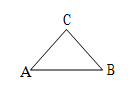
Consider a body travelling from A to B along any path between A and B. The actual length of the path that a body travels between A and B is known as the distance. Here if the body goes from A to B via C, the distance travel will be ACB.
The distance travelled will be different for different paths between A and B. It is a scalar quantity.
(ii) Displacement : The distance travelled in a given direction is the displacement. Thus displacement is the shortest distance between the given points.
S.I. unit of distance and displacement is metre.
Ex. When an object moves from O to B and then from B to A. Then displacement = x2 – x1.
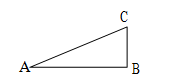
Ex. Suresh walks from point A to B and then again from B to C.
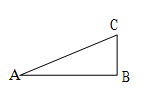
Distance he has travelled is A to B + B to C. Displacement he has travelled is line A to C
Note : If a body travels in such a way that it comes back to its starting position, then the displacement is zero. However distance travelled never zero.
(b) SPEED :
(i) Speed : Speed of a body is the distance travelled by the body in one second
sp eed = Distance travelled / Time taken
Distance travelled is measured in metre and time in second. Therefore, the unit of speed is metre/second.[(m/s)].
It can also be expressed in kilometer/hour [km/h]
If we know the speed of an object we can find out the distance covered by it in a given time. Distance covered= speed × time.
(ii) Average speed :
The speed of a bus during a journey may vary. When the bus is nearing a bus stop, its speed decreases. On the highways the bus travels with greater speed but in a city or town it travels with less speed due to
heavy traffic.
The bus has different speeds at different times. So we say that it has variable speed.
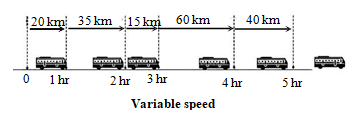
for such bodies, we can calculate the average speed.
Average sp eed = Total distance travelled / Total time taken
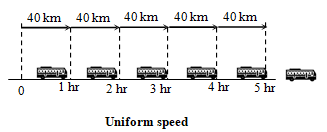
If a body moves with the same speed at all times we say that it has uniform speed.
(c) VELOCITY :
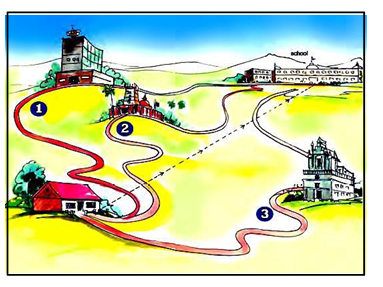
Every day when you go to school from your house, you could take path 1 or path 2 or path 3. Do these paths have the same distance? No, the distance is not the same; it varies with the path taken. Imagine that you travel from your house to school in a straight line. This will be the shortest distance between them, called displacement. In the picture, it is represented by a dotted line. Displacement is the shortest distance between two points.
Velocity is the displacement of a body in one second.
Velocity = Disp laceme nt
Time taken
its unit is m/s
Velocity is nothing but speed in a definite direction.
(d) ACCELERATION :
Do you ride a bicycle to school? If you are late, what would you do? you would increase your velocity or accelerate.
Acceleration is the change of velocity in one second
Accelerati on = Change in velocity
Time taken
Its unit is m/s2 .
If car has an acceleration of 5 m/s2 every second its velocity increases by 5 m/s. If the velocity of a moving body decreases, we say that it has negative acceleration or retarding or deceleration.
ACCELERATION DUE TO GRAVITY :
Let us see what happens when a ball is thrown up vertically? As it rises, its velocity gradually decreases till it becomes zero i.e., the ball is retarded. As the ball falls down its velocity gradually increases i.e., it is accelerated. The retardation or acceleration is due to the earth’s gravitational force. It is known as acceleration due to gravity. This means that the velocity of a body decreases by 9.8 m/s every second when it is thrown up and the velocity increases by 9.8 m/s every second when it falls down.
Please click on below link to download pdf file for Class 7 Science Motion and Time Exam Notes.
Free study material for Science
Science Class 7 Exam Resources: Chapter 13 Motion and Time
Comprehensive Study Resources for Chapter 13 Motion and Time
Access comprehensive study material for Chapter 13 Motion and Time, including revision notes, concept maps, and high-probability questions. These resources are designed in alignment with the latest 2026 CBSE syllabus for Class 7 Science to support effective exam preparation.
Understanding Marking Schemes
Each resource draws directly from authorized textbooks to maintain academic accuracy. Evaluating solved examples allows Class 7 students to master the formal presentation and answer-writing standards expected in upcoming school exams.
Complete Revision for Science
Maximize your grade potential by utilizing Class 7 Science practice papers in tandem with these structured notes. All printable assignments and interactive mock tests on our platform are updated for the 2026 session and available free of charge.
FAQs
Our advanced study package for Chapter 13 Motion and Time includes detailed concepts, diagrams, Mind Maps, and explanation of complex topics to ensure Class 7 students learn as per syllabus for 2026 exams.
The Mind Maps provided for Chapter 13 Motion and Time act as visual anchors which will help faster recall during high-pressure exams.
Yes, teachers use our Class 7 Science resources for lesson planning as they are in simple language and have lot of solved examples.
Yes, You can download the complete, mobile-friendly PDF of the Science Chapter 13 Motion and Time advanced resources for free.
Yes, our subject matter experts have updated the Chapter 13 Motion and Time material to align with the rationalized NCERT textbooks and have removed deleted topics and added new competency-based questions.