

Class 7 Science Study Guide: Class 7 Science Electric Current and its Circuits Chapter Notes
Access comprehensive study materials and useful resources for Chapter 14 Electric Current and Its Effects using the Class 7 Science Electric Current and its Circuits Chapter Notes. Designed to align with the 2026-27 CBSE academic guidelines, these advanced resources help Class 7 Science students reinforce core concepts beyond standard textbooks.
Download Chapter 14 Electric Current and Its Effects Study Material PDF
Navigate directly to the advanced Science study materials using the digital viewer below. Each resource pack includes detailed conceptual summaries and solved practice questions, allowing students to instantly reinforce their learning.
Class 7 Science Electric Current and its Circuits Chapter Notes. There are many more useful educational material which the students can download in pdf format and use them for studies. Study material like concept maps, important and sure shot question banks, quick to learn flash cards, flow charts, mind maps, teacher notes, important formulas, past examinations question bank, important concepts taught by teachers. Students can download these useful educational material free and use them to get better marks in examinations. Also refer to other worksheets for the same chapter and other subjects too. Use them for better understanding of the subjects.
Electric Current and its Circuits
4.1 Introduction
Electricity is important in our daily life. Our household contains television, fan, AC, tubelights etc. These all appliances need electricity to work.
4.2 Symbols of Electric Components
Some common electric components can be represented by symbols. In Table 4.1 some electric components and their symbols are shown. An electric cell has a positive terminal and a negative terminal. In the symbol of the electric cell, the longer line represents the positive terminal and the thicker, shorter line represents the negative terminal.
For a switch the ‘ON’ position and the ‘OFF’ position are represented by the symbols as shown. The wires used to connect the various components in a circuit are represented by lines.
Table 4.1 Symbols for some electric circuit components

Notice that the positive terminal of one cell is connected to the negative terminal of the next cell. Such a combination of two or more cells is called a battery.
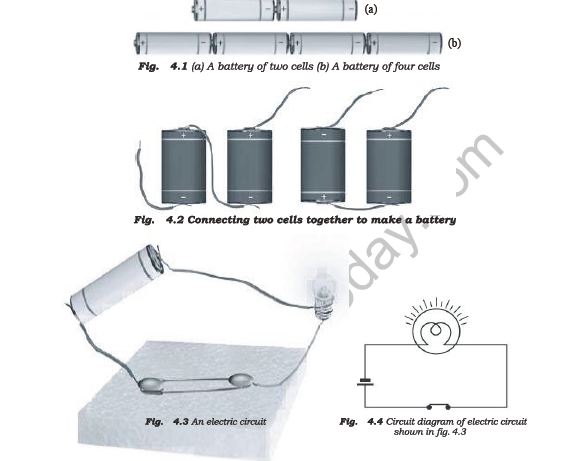
In the bulb there is a thin wire, called the filament which glows when an electric current passes through it. When the bulb gets fused, its filament is broken.
4.3 Electrical circuit : Electrical circuit is an electrical network which provides an electrical path for the flow electrical current and electrical charge. An electrical circuit generally consists of various electrical components and electrical load
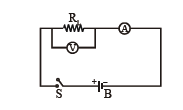
In the above figure, various electrical components have been shown.
(i) Battery/Cell (B) : A cell or battery acts as the source of charge/current in an electrical circuit.
(ii) Electrical switch (S) : An electrical switch is a device which is used to either make or break the path for the flow of current.
(iii) Electrical load (RL) : The external element or object across which all the electrical measurements or calculation are made. This is the chief element which is used for the conversion of the electrical energy into the required form of energy for use. Example : bulb, heater, etc.
(iv) Voltmeter (V) : This is an electrical instrument that is used to measure the potential difference between the two points in an electrical circuit. It is to be noted that voltmenter is always connected in parallel to the two points, across which the potential difference is to be calculated.
(v) Ammeter (A) : This is an electrical instrument that is used to measure the electrical current flowing through a load or electrical path. An ammeter is always connected in series with the electrical path through the electrical current is to be measured.
Note :–
(i) In a battery, the positive terminal is considered to be the starting point of charge/current while negative terminal as the ending point.
(ii) Outside the battery current flows from positive to negative terminal whereas the direction is reversed inside the battery.
(iii) The switch may be in ‘ON’ or ‘OFF’ state depending on whether it is closed or open.

(iv) Whether the current/charge will flow through the electrical load or not, is decided by the topology of the elecrical circuit and position of electrical switch.
4.4 (i) Electric Charge : Electric charge can be defined as the physical factor that arives due to deficiency or excess of electrons in a substance. This factor is responsible for the electrical effects.
(ii) Electric Current : The electric current is defined as rate of flow of charge. Mathematically, Electric current,I = Charge (Q) /Time (t) Electric current is scalar quantity. Its unit is Ampere (A).
4.5 Electrical Potential Difference : The electrical potential difference between two points is the compelling force which causes the electrical charges and hence the electric current to flow through an electrical path. Theoretically, it is defined as the amount of work done in moving a unit positive charge between two points without imparting any kinetic energy in it.
i.e., VA - VB = WAB/q
; where, VA – VB = Potential difference between two points A and B
q = unit positive charge, WAB = Amount of work done in moving the charge between the point A and B.
S.I. unit of electrical potential difference in volt (V).
Electrical potential : The electric potential at a point is defined as the amount of work done in bringing a unit positive charge from infinity to the point of consideration. S.I. unit of electric potential is same as that of potential difference i.e., Volt (V).
Note :
(i) Electrical potential difference is a practical term whereas the electric potential is a referential term in which one of the pont is considered to be as infinity.
(ii) Electric current and positive charges flows from the high potential to low potential in an electrical circuit, outside the battery.
(iii) Electrons (negative charge) flows from low potential to high potential. Therefore, the direction of flow of current is taken to be opposite to the direction of flow of electrons.
Please click the link below to download Class 7 Science Electric Current and its Circuits Chapter Notes.
Free study material for Science
Useful Resources and Notes for Class 7 Science Chapter 14 Electric Current and Its Effects
Core Study Kit: Class 7 Science Chapter 14 Electric Current and Its Effects
Access comprehensive study material for Chapter 14 Electric Current and Its Effects, including revision notes, concept maps, and high-probability questions. These resources are designed in alignment with the latest 2026 CBSE syllabus for Class 7 Science to support effective exam preparation.
NCERT-Aligned Solutions for Chapter 14 Electric Current and Its Effects
Each resource draws directly from authorized textbooks to maintain academic accuracy. Evaluating solved examples allows Class 7 students to master the formal presentation and answer-writing standards expected in upcoming school exams.
Next Steps in Your Exam Preparation
Maximize your grade potential by utilizing Class 7 Science practice papers in tandem with these structured notes. All printable assignments and interactive mock tests on our platform are updated for the 2026 session and available free of charge.
FAQs
Our advanced study package for Chapter 14 Electric Current and Its Effects includes detailed concepts, diagrams, Mind Maps, and explanation of complex topics to ensure Class 7 students learn as per syllabus for 2026 exams.
The Mind Maps provided for Chapter 14 Electric Current and Its Effects act as visual anchors which will help faster recall during high-pressure exams.
Yes, teachers use our Class 7 Science resources for lesson planning as they are in simple language and have lot of solved examples.
Yes, You can download the complete, mobile-friendly PDF of the Science Chapter 14 Electric Current and Its Effects advanced resources for free.
Yes, our subject matter experts have updated the Chapter 14 Electric Current and Its Effects material to align with the rationalized NCERT textbooks and have removed deleted topics and added new competency-based questions.