

Advanced Study Material for Class 7 Science: Chapter 05 Acids Bases and Salts
Explore structured advanced study materials through the Class 7 Acids Bases and Salts Important Questions VBQs. Tailored for Class 7 learners, utilizing these Science resources ensures thorough preparation and strengthens foundational knowledge before final CBSE evaluations.
Practice Class 7 Science Resources: Chapter 05 Acids Bases and Salts
Access the complete useful resource PDF for Class 7 Science below. Regular practice with these targeted academic notes builds familiarity with complex topics and helps secure higher marks in final school evaluations.
Class 7 Acids Bases and Salts Important Questions VBQs. There are many more useful educational material which the students can download in pdf format and use them for studies. Study material like concept maps, important and sure shot question banks, quick to learn flash cards, flow charts, mind maps, teacher notes, important formulas, past examinations question bank, important concepts taught by teachers. Students can download these useful educational material free and use them to get better marks in examinations. Also refer to other worksheets for the same chapter and other subjects too. Use them for better understanding of the subjects.
ACIDS, BASES AND SALTS
ASSIGNMENT 5.1
Q1. Classify the following as acidic, basic or neutral-
Lime juice, baking soda, soap solution, lime water, water, fizzy drink, common salt
Q2. Fill in the blanks-
- _______________ acid is found in tamarind.
- CH3COOH is commonly known as __________________.
- Most mineral acids are ______________ acids.
- ______________ acid is also called the king of chemicals.
- Water soluble bases are called _________________.
- Calamine lotion contains _________________.
- A metal oxide dissolves in water to form a _____________.
- ____________________ is also called milk of magnesia.
Q3. Correct and rewrite the following statements-
- All bases are alkali.
- Saliva is neutral in nature.
- Acids obtained from unripe mangoes and grapes are mineral acids.
- A mineral acid can be diluted by adding sufficient amount of water to it.
- Lemon juice is best stored in metal jars.
Q4. Complete the following table-
| Indicator | Colour in acid | Colour in base |
|---|---|---|
| Blue Litmus | _____________ | Blue |
| Red litmus | _____________ | ____________ |
| Phenolphthalein | ______________ | Pink |
| _______________ | Pink | Yellow |
| _______________ | Dark pink | Green |
| Turmeric | ____________ | Red |
Q5. Differentiate between an organic and a mineral acid.
Q6. Write an activity to show that-
- Non metal oxides are acidic in nature.
- Water is a neutral substance
Q7. Give reasons for the following-
- A turmeric stain on your shirt turns reddish brown when soap is applied on it.
- Common salt is added to pickles.
- Working tables and shelves in your chemistry laboratory are covered with tiles and not wood or metals.
- Acids taste sour. However, they must not be tasted in order to be identified.
- Factory waste must be treated before discarding.
Q8. Write the chemical names of the following substances-
- Vinegar- _____________________
- Baking soda- _____________________
- Washing soda- _____________________
- Quick lime- _____________________
- Milk of magnesia- _____________________
- Slaked lime- _____________________
H.O.T.S.
Q1. It is a common practice to rub onion peel or a metal key on a bee sting. How does it help?
Q2. Hydrochloric acid is a strong, corrosive mineral acid. Why then is it present in your body?
Q3. Why is common salt added to ice creams?
MISCELLANEOUS EXERCISE
Acids, bases and salts
Q1. Classify the following as mineral or organic acid–
Sulphuric acid, phosphoric acid, acetic acid.
Mineral- ____________________
Organic- ____________________
Q2. Solutions of two substances A and B were tested with litmus paper. Solution of A turned red in litmus while that of B turned blue. Classify A and B as metal and non-metal.
A - ____________________ B - _____________________
Q3. Give one word for the following-
- Substances which change color in acidic and basic medium-____________________.
- The gas released when a metal combines with dilute acids-___________________.
- Substances which remain unaffected by indicators-___________________.
- Acid which helps in digestion- ___________________.
- Acid present in vinegar -___________________.
- Acid which makes soft drinks fizzy- ___________________.
- Common name of sodium chloride-___________________.
- Other name for soluble bases-___________________.
- Chemical name of baking soda-___________________.
Q4. Ammonia is found in many household products, such as window cleaners. It turns red litmus blue. What is its nature?
CHAPTER – ACIDS, BASES & SALTS
Activity No. 01
Aim: To test which out of the two given solutions is an acid or a base with the help of indicators.
Material Required:
Chemicals Required:
Theory:
Procedure:
Diagram:
Observations:
| Sl. No. | Indicator Type | Acid (dilHCl) | Base (NaOH) |
|---|---|---|---|
| 01. | Blue Litmus Solution | ||
| 02. | Red Litmus Solution | ||
| 03. | Methyl Orange | ||
| 04. | Phenophthalein |
Results:
Precautions:
As both acids and bases can cause damage to skin and they are corrosive, a lot of care should be exercised while putting them in the test tubes.
Rinse the test tubes properly with water before using them.
At no point of time, in the laboratory, should the acids and bases be mixed as they can cause a lot of heat production and accidents.
LET US DO
Making pH Indicators
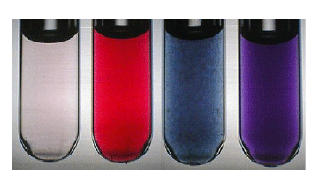
Introduction: A pH indicator is a chemical compound that is added in small amounts to a solution so that the pH (acidity or alkalinity) of the solution can be determined easily. pH indicators are usually weak acids or bases themselves. They detect the presence of hydronium ions (H3O+) or hydrogen ions (H+).
A procedure known as titration can be used to determine the presence of an acid or base. Titration uses the reaction between an acid and a base known as neutralization to determine the pH.
A strong acid reacts with a strong base to form a neutral (pH=7) solution.
A strong acid reacts with a weak base to form an acidic (pH<7) solution.
A weak acid reacts with a strong base to form a basic (pH>7) solution.
Objective: Students will create various pH indicators that can be used to test unknown solutions to determine if they are an acid or a base.
Materials per Group:
- Knife to slice veggies
- Measuring cup
- Hot plate
- Pan
- Two dropper bottles
- Electronic balance
- Distilled water
- Rubbing alcohol
- Red cabbage
- Fresh beet
- Laxative containing phenolphthalein
- Tumeric (dried spice)
- Coffee filters
- Bowl
- Cookie sheet
- Scissors
- Ziplock bags
- Measuring spoons
- Ammonia (unknown A)
- Vinegar (unknown B)
- Marking pencil
- pH indicator chart
- 4 small, clear plastic cups
Prelab: Review safety procedures such as using caution when working with acidic and basic solutions since they can irritate the skin. Goggles and aprons must be worn throughout the experiment. All solutions can be washed down the drain with plenty of water.
Also review the pH scale. The scale goes from 0 to 14 with a pH of 7 being neutral. A pH from 0 up to 7 is acidic with 0 being the strongest acids. A pH above 7 to 14 would be basic or alkaline with 14 being the strongest base.
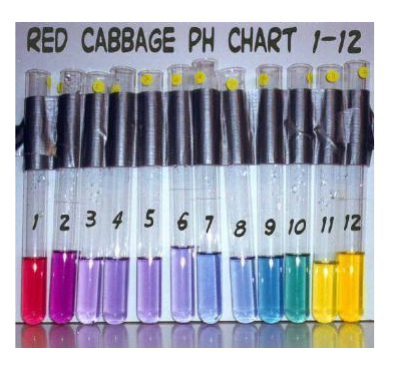
pH Indicator Chart
Fig.: pH Indicator Chart
Procedure (Part A) – Making Natural Indicators:
Beet Juice Indicator Solution #1
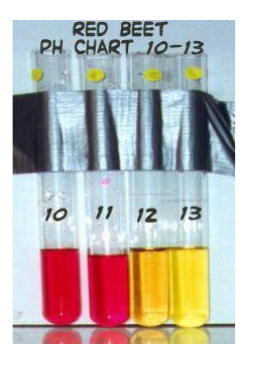
Wash and slice a fresh beet. Place about four slices of beet into a pan containing one cup of water. Heat until boiling and continue boiling for about five minutes. Remove the beet slices and allow the red liquid to cool. Store juice in dropper bottles. Beet juice is red in acidic solutions and blue in basic solutions. Beets contain a pigment known as anthocyanin that will change from red to yellow somewhere between pH 11 and 12.
Phenolphthalein Indicator Solution #2
Purchase any laxative that contains phenolphthalein. With the back of a spoon, mash four to six tablets in a saucer. Pour the powder into a small cup. Add about ten milliliters of rubbing alcohol. Let this mixture stand for fifteen minutes. Pour off the liquid and store in a dropper bottle. Phenolphthalein is purple in very basic solutions and colorless in acidic solutions.
Turmeric Indicator Solution #3
Obtain a package of turmeric from the spice section of the grocery store. Add 1/4 teaspoon of turmeric to four tablespoons of rubbing alcohol. Stir to mix. Store in dropper bottle. Turmeric solution stays yellow in the presence of acids and changes to purple-brown in the presence of bases. Turmeric solution can also be made into indicator paper (see Cabbage Paper). Dry turmeric paper is bright yellow and changes to red in the presence of bases.
Red Cabbage Indicator #4
Tear five leaves of red cabbage into small pieces. Place the cabbage pieces in a small pan. Add four cups of hot water. Let the leaves soak for about half an hour until the water is a deep purple and cooled to room temperature. Strain the liquid into a storage bottle. Cover and store in the refrigerator. Red cabbage juice indicator is red in acid solutions, purple in neutral solutions, and greenish-yellow in basic solutions. Red cabbage contains a pigment molecule called flavin (an anthocyanin). This water-soluble pigment is also found in apple skin, plums, poppies, cornflowers, and grapes. Red cabbage juice will function over a wide pH range, from as low as pH 1 up to pH 12.
Cabbage Indicator Paper (optional)
Pour one cup of cabbage indicator (above) into a bowl. Dip one or two coffee filters into the indicator. Place the wet filter paper on a cookie sheet or flat pan. Continue to soak the paper until saturated. Allow the paper to dry (this will take more time than your class time, so use it the next day or for another activity). The paper will be pale blue. Cut the dry papers into strips about 1.25 by 7.5 centimeters (0.5 by 3 inches). Store the strips in a zip-lock plastic bag. Cabbage paper turns green in the presence of bases and pink to red in the presence of acids. NOTE: Beetroot indicator paper can be made in the same way.
Procedure (Part B) – Testing the Natural Indicators:
- Label two dropper bottles with UNKNOWN A on one and UNKNOWN B on the other.
- Fill each labeled dropper bottle with the correct unknown. These solutions will be used to test the indicators you made.
- Obtain 8 small, clear plastic cups. Label these 1A -4A and 1B – 4B for the indicator solutions you made.
- Correctly place a small amount of each indicator in the bottom of each labeled cup using the following table as a guide.
| 1A | 2A | 3A | 4A | 1B | 2B | 3B | 4B |
|---|---|---|---|---|---|---|---|
| Beet juice | phenolphthalein | Tumeric solution | Cabbage juice | Beet juice | phenolphthalein | Tumeric solution | Cabbage juice |
- Record the name of the indicator and its initial color on the data table.
- Add one drop at a time of UNKNOWN A to the indicator in cup 1A. Record the unknown being used on the data table --- A or B.
- Stir with a toothpick or carefully swirl the cup after each drop.
- Continue adding one drop at a time followed by stirring until the color changes from the original color.
- Discard the toothpick and use a new toothpick for each indicator solution.
- Record the color change (final color) in the data table.
- Repeat steps 5 - 10 with each of the other indicators 2A – 4A.
- Using the color change information found in the recipe for the indicator, place a check mark in the Acid OR Base column on the data table for each of the color changes you found.
- Repeat steps 6 – 11 with cups 1B – 4B using UNKNOWN B.
Data and Results:
| INDICATING ACIDS & BASES | ||||||
|---|---|---|---|---|---|---|
| Cup # | Unknown # A or B? | Indicator Solution | Initial Color | Final Color | Acid? | Base? |
| 1 | ||||||
| 2 | ||||||
| 3 | ||||||
| 4 | ||||||
| 5 | ||||||
| 6 | ||||||
| 7 | ||||||
| 8 | ||||||
Questions:
- When an acid and base combined what reaction results?
- What ion found in a solution would make it acidic?
- What scale is used to determine whether a solution is acidic or basic?
- A pH of less than 7 indicates the solution is a/an ___________________.
- A pH greater than 7 would indicate the solution was a/an _________________.
- A neutral Solution has a pH of _____.
- Phenolphthalein indicator solution will turn what color in the presence of bases?
- Phenolphthalein indicator solution will turn what color in the presence of acids?
- Turmeric indicator solution stays yellow in the presence of acids and turns what color in the presence of bases?
EXTRA BIT!
How elements can become Corrosive
Acid rain is rain consisting of water droplets that are unusually acidic because of atmospheric pollution - most notably the excessive amounts of sulfur and nitrogen released by cars and industrial processes. Acid deposition can occur via natural sources like volcanoes but it is mainly caused by the release of sulfur dioxide and nitrogen oxide during fossil fuel combustion. When these gases are discharged into the atmosphere they react with the water, oxygen, and other gases already present there to form sulfuric acid, ammonium nitrate, and nitric acid. These acids then disperse over large areas because of wind patterns and fall back to the ground as acid rain or other forms of precipitation.
Acid rain causes acidification of lakes and streams and contributes to the damage of trees at high elevations (for example, red spruce trees above 2,000 feet) and many sensitive forest soils. In addition, acid rain accelerates the decay of building materials and paints, including buildings, monuments, statues, and sculptures that are part of our nation's cultural heritage.
When the freshwater becomes highly alkaline, the effects on fish may include: death, damage to outer surfaces like gills, eyes, and skin and an inability to dispose of metabolic wastes. High level of alkalies may also increase the toxicity of other substances. For example, the toxicity of ammonia is ten times more severe when the amount of bases is more. It is directly toxic to aquatic life when it appears in alkaline conditions.
Now based on your understanding, answer the following questions:
- Some acids and alkalis are corrosive. What does corrosive mean?
- Write the word equation to show the chemical reaction taking place during acid rain
- This symbol is used as a warning sign for corrosive acids and alkalis.
Where might you see this safety symbol?
What does the symbol mean?
When we use acids and alkalis, what must we always wear? Why ? - How is highly alkaline nature corrosive?
HOTS
- The use of diesel vehicles causes a lot of SO2 gas emissions. On a rainy day, due to heavy traffic jams on the city roads, the emissions were higher than normal. The emissions dissolved in the rain, causing acid rains.
What would be the nature of SO2 gas? - Near a factory, the river was found having dead aquatic life. What could be the reason for this. Why do you think so?
- If a drain is clogged at home, what home remedy would you use to unclog it?
- Name the acid that can even attack glass.
- What is the chemical nature of healthy blood?
- Name the chemical names for caustic soda and caustic potash
- When a few drops of coke were put in methyl orange, it turned pink in color. What conclusions can you make from this observation.
b) Baking soda- _____________________
c) Washing soda- _____________________
d) Quick lime- _____________________
f) Slaked lime- _____________________
Students can use this material to practise the chapter Acids, Bases and Salts.
Free study material for Science
Free CBSE Study Guides: Class 7 Science Chapter 05 Acids Bases and Salts
Essential Notes for Class 7 Science
Explore essential learning tools for Class 7 Science Chapter 05 Acids Bases and Salts. This curated collection features in-depth notes and targeted practice questions built around the active 2026 curriculum to streamline your daily revision.
Verified Solutions for Class 7 Science
Each resource draws directly from authorized textbooks to maintain academic accuracy. Evaluating solved examples allows Class 7 students to master the formal presentation and answer-writing standards expected in upcoming school exams.
Enhance Accuracy with Online Tests
Maximize your grade potential by utilizing Class 7 Science practice papers in tandem with these structured notes. All printable assignments and interactive mock tests on our platform are updated for the 2026 session and available free of charge.
FAQs
Our advanced study package for Chapter 05 Acids Bases and Salts includes detailed concepts, diagrams, Mind Maps, and explanation of complex topics to ensure Class 7 students learn as per syllabus for 2026 exams.
The Mind Maps provided for Chapter 05 Acids Bases and Salts act as visual anchors which will help faster recall during high-pressure exams.
Yes, teachers use our Class 7 Science resources for lesson planning as they are in simple language and have lot of solved examples.
Yes, You can download the complete, mobile-friendly PDF of the Science Chapter 05 Acids Bases and Salts advanced resources for free.
Yes, our subject matter experts have updated the Chapter 05 Acids Bases and Salts material to align with the rationalized NCERT textbooks and have removed deleted topics and added new competency-based questions.