

Download CBSE Class 7 Science Useful Resources
Access comprehensive study materials and useful resources for Chapter 15 Light using the Class 7 Light Important Questions for exams. Designed to align with the 2026-27 CBSE academic guidelines, these advanced resources help Class 7 Science students reinforce core concepts beyond standard textbooks.
Access CBSE Study Guides and Summaries
Navigate directly to the advanced Science study materials using the digital viewer below. Each resource pack includes detailed conceptual summaries and solved practice questions, allowing students to instantly reinforce their learning.
Class 7 Light Important Questions for exams. There are many more useful educational material which the students can download in pdf format and use them for studies. Study material like concept maps, important and sure shot question banks, quick to learn flash cards, flow charts, mind maps, teacher notes, important formulas, past examinations question bank, important concepts taught by teachers. Students can download these useful educational material free and use them to get better marks in examinations. Also refer to other worksheets for the same chapter and other subjects too. Use them for better understanding of the subjects.
CLASS 7 SCIENCE CHAPTER 15 LIGHT
IMPORTANT QUESTIONS, ACTIVITIES AND ASSIGNMENTS
Activity 1
Aim: To study reflection of light
Answer:
Materials required: A plane mirror, a torch or a ray box, a sheet of white paper, a pencil, a scale and a protractor.
Teacher's Note:
a) Keep the mirror upright on the paper so the normal can be drawn accurately.
b) Mark the incident and reflected rays with pin marks for a clean diagram.
Theory and Diagram
Answer:
1. Light travelling from a source falls on a polished surface and bounces back.
2. The ray that strikes the mirror is the incident ray, and the ray that bounces back is the reflected ray.
3. The angle of incidence is equal to the angle of reflection.
[Figure: Ray diagram of a plane mirror with the normal drawn at the point of incidence. The incident ray and the reflected ray make equal angles with the normal on either side of it.]
Teacher's Note:
a) The normal is always drawn at right angles to the mirror surface.
b) Students often measure the angles from the mirror surface; measure them from the normal instead.
c) Equal angles on both sides of the normal is the key result of reflection.
Procedure, Observation and Conclusion
Answer:
1. Place the plane mirror upright on a sheet of white paper.
2. Direct a thin ray of light from the torch towards the mirror and mark the incident ray.
3. Mark the reflected ray and measure both angles with a protractor.
4. Observation: the angle of incidence and the angle of reflection are equal.
5. Conclusion: light is reflected from a polished surface and the angle of incidence is equal to the angle of reflection.
Teacher's Note:
a) Use a thin ray; a wide beam makes the marks blurred.
b) Repeat with three different angles to confirm the rule.
Activity 3
To study the characteristics of the image formed by a plane mirror
a) Stand in front of a plane mirror and answer the following questions: Is your image in the mirror upright or inverted?
Answer: The image is upright (erect).
Teacher's Note:
a) A plane mirror always forms an erect image of the object.
b) The image is erect but laterally inverted.
b) Raise your right hand. What do you observe in the mirror?
Answer: The image shows the left hand raised. The right hand of the person appears as the left hand of the image.
Teacher's Note:
a) This reversal of left and right is called lateral inversion.
b) Up and down are not reversed in the image.
c) Stand at a distance from the plane mirror and start walking towards the mirror. What happens to your image?
Answer: The image also moves towards the mirror. It does not become bigger or smaller; it stays the same size as the person.
Teacher's Note:
a) The image is always at the same distance behind the mirror as the object is in front of it.
b) The size of the image does not change with distance.
d) When you stand in front of the mirror and look at your image, what can you say about the height of the image as compared to your height?
Answer: The height of the image is the same as the height of the person.
Teacher's Note:
a) A plane mirror forms an image of the same size as the object.
b) This is why a full length plane mirror is enough to see the whole body.
e) Take a new stainless steel spoon and bring its both sides towards your face and observe.
Answer:
Observation 1: The image of the face seen in the inner (concave) side of the spoon is enlarged and erect when the face is close to the spoon.
Observation 2: The image seen on the outer (convex) side of the spoon is smaller and erect.
Teacher's Note:
a) The inner side of a spoon acts as a concave mirror.
b) The outer side of a spoon acts as a convex mirror.
c) Both images are virtual.
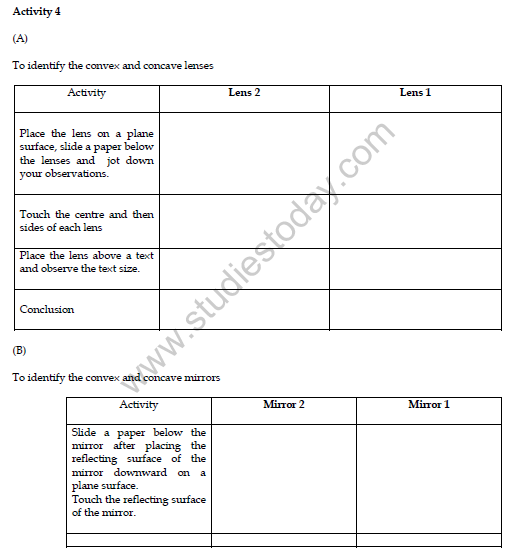
Activity 4
(A) To identify the convex and concave lenses
Answer:
| Activity | Lens 2 | Lens 1 |
|---|---|---|
| Place the lens on a plane surface, slide a paper below the lenses and jot down your observations. | Text is seen clearly and enlarged, so this lens is thick at the centre and is a convex lens. | Text is seen smaller and the edges are thick, so this lens is a concave lens. |
| Touch the centre and then sides of each lens. | The centre is thicker than the sides. | The centre is thinner than the sides. |
| Place the lens above a text and observe the text size. | Text appears magnified. | Text appears smaller. |
Conclusion: Lens 2 is a convex lens and Lens 1 is a concave lens.
Teacher's Note:
a) A convex lens is thicker in the middle and converges light.
b) A concave lens is thinner in the middle and spreads light out.
(B) To identify the convex and concave mirrors
Answer:
| Activity | Mirror 2 | Mirror 1 |
|---|---|---|
| Slide a paper below the mirror after placing the reflecting surface of the mirror downward on a plane surface. Touch the reflecting surface of the mirror. | The surface curves inwards (dips in the middle), so it is a concave mirror. | The surface bulges outwards, so it is a convex mirror. |
| Bring your face close to the mirror and observe your image. | The image is large and erect when the face is close. | The image is small and erect. |
Conclusion: Mirror 2 is a concave mirror and Mirror 1 is a convex mirror.
Teacher's Note:
a) A concave mirror has a reflecting surface that curves inwards.
b) A convex mirror bulges outwards and gives a wider view.
Assignment 15.1
1. Fig 1 shows a ______________ lens and fig 2 shows a ______________ lens.
[Figure: Fig 1 shows parallel rays passing through a lens labelled convex lens; the rays converge at the focal point, and the focal length is marked. Fig 2 shows parallel rays passing through a lens labelled concave lens; the rays spread out, and the focal point and focal length are marked.]
Answer: Fig 1 shows a convex lens and Fig 2 shows a concave lens.
Teacher's Note:
a) Parallel rays meet at a point after a convex lens.
b) Parallel rays spread out after a concave lens.
2. Convex lens is also called ______________ lens.
Answer: Convex lens is also called a converging lens.
Teacher's Note:
a) It converges light rays to a point.
3. Concave lens is also called _______________ lens.
Answer: Concave lens is also called a diverging lens.
Teacher's Note:
a) It spreads out the light rays that pass through it.
b) Do not confuse it with the converging lens.
4. PQR is a _____________. When ______________________ falls on a ________, the _______________ splits into the _____________ colours. This phenomena of splitting of ________________ into seven colours is called _______________. The band of seven colours obtained is called _______________.
[Figure: Triangular glass prism PQR with vertices P, Q and R. White light enters the prism and emerges as a band of colours that falls on a white screen. The colours are labelled Red, Orange, Yellow, Green, Blue, Indigo and Violet. The labels Least deviation (red) and Maximum deviation (violet) are shown.]
Answer:
PQR is a prism. When white light falls on a prism, the white light splits into seven colours. This phenomenon of splitting of white light into seven colours is called dispersion. The band of seven colours obtained is called a spectrum.
Teacher's Note:
a) A glass prism separates white light because each colour bends by a different amount.
b) Violet bends the most and red bends the least.
c) The seven colours in order are VIBGYOR, which is a useful memory aid.
5. Why is AMBULANCE written like this?
[Figure: Photograph of the front of an ambulance with the word AMBULANCE written in mirror-reversed letters across the top of the vehicle.]
Answer: The word is written in laterally inverted form so that it appears correctly when seen in the rear view mirror of a vehicle ahead.
Teacher's Note:
a) A plane mirror reverses left and right in the image.
b) Drivers read the word correctly in their mirror, so they can move aside quickly.
Assignment 15.2
I. Fill in the blanks:-
a) Any polished shiny surface acts as a ____________________.
Answer: mirror
Teacher's Note:
a) A polished surface reflects most of the light falling on it.
b) Plane, concave and convex mirrors are all mirrors.
b) _______________ image can be obtained on a screen.
Answer: Real
Teacher's Note:
a) Only real images can be caught on a screen.
c) _______________ image cannot be obtained on a screen.
Answer: Virtual
Teacher's Note:
a) A virtual image is formed where rays only appear to meet, so a screen cannot receive it.
b) Images in a plane mirror are virtual.
d) Images formed by ______________ lenses are real and inverted.
Answer: convex
Teacher's Note:
a) A convex lens forms real and inverted images when the object is beyond its focus.
b) A concave lens never forms a real image.
e) ________________ light is composed of seven colors.
Answer: White
Teacher's Note:
a) Sunlight appears white but contains seven colours.
f) A magnifying glass is a _______________ lens.
Answer: convex
Teacher's Note:
a) A magnifying glass gives an enlarged, erect image when placed close to the object.
b) Its middle is thicker than its edges.
g) The headlights of cars and scooters are ___________ in shape.
Answer: concave (parabolic)
Teacher's Note:
a) The reflector of a headlight is a concave mirror.
b) The light source sits at the focus, so the reflected light forms a strong parallel beam.
II. Choose the correct option(s) and write in the space provided:-
1. An image is seen when light is reflected from
(a) all surfaces
(b) plane mirror
(c) highly polished surface
(d) cardboard
Answer: (c) highly polished surface
Teacher's Note:
a) Only a smooth, polished surface gives a clear image.
b) A cardboard surface scatters light and does not form an image.
2. A plane mirror produces a/an __________ image.
(a) laterally inverted
(b) erect
(c) virtual
(d) all of these
Answer: (d) all of these
Teacher's Note:
a) The image from a plane mirror is laterally inverted, erect and virtual.
b) Choose "all of these" only when every option is true.
3. All rays of light travel in a ____________ line.
(a) Straight
(b) Curved
(c) haphazard
(d) both (a) and (b)
Answer: (a) Straight
Teacher's Note:
a) Light travels in straight lines; this is called rectilinear propagation.
b) Option (d) is wrong because light does not travel in curved paths in a uniform medium.
4. Newton's disc, if rotated rapidly appears
(a) bluish
(b) greenish
(c) whitish
(d) yellowish
Answer: (c) whitish
Teacher's Note:
a) The seven colours on the disc blend together when it spins fast.
b) The blended colours appear white.
Assignment 15.3
1. Differentiate between real and virtual images.
Answer:
Real and Virtual Images
| Real Image | Virtual Image |
|---|---|
| Formed when light rays actually meet at a point. | Formed when light rays only appear to meet at a point. |
| Can be obtained on a screen. | Cannot be obtained on a screen. |
| Usually inverted. | Always erect. |
Teacher's Note:
a) Ask whether the rays really meet; that single test separates the two types.
b) A screen catches only real images.
c) Virtual images are seen by looking into a mirror or lens.
2. Name the type of mirror which produces
a) real and magnified image
b) virtual and same sized image
c) virtual and diminished image
Answer:
a) Concave mirror
b) Plane mirror
c) Convex mirror
Teacher's Note:
a) A concave mirror gives a real, magnified image when the object is between the focus and the centre of curvature.
b) A plane mirror gives a virtual image of the same size as the object.
c) A convex mirror always gives a virtual, erect and diminished image.
3. Why are convex mirrors used as rear view mirrors?
Answer: Convex mirrors are used as rear view mirrors because they give an erect and diminished image. This gives a wider field of view of the traffic behind the vehicle.
Teacher's Note:
a) A wide field of view helps the driver see more vehicles at once.
b) The image looks smaller, so the vehicles behind appear farther than they are.
4. Which type of mirrors is used in making periscopes and kaleidoscopes?
Answer: Plane mirrors are used in making periscopes and kaleidoscopes.
Teacher's Note:
a) A periscope uses two plane mirrors held parallel at 45 degrees.
b) A kaleidoscope uses several plane mirrors placed at an angle to each other.
5. Which mirror causes lateral inversion of image?
Answer: A plane mirror causes lateral inversion of the image.
Teacher's Note:
a) Lateral inversion means left and right are interchanged in the image.
6. On the basis of images formed, state one similarity and one difference between a plane mirror and convex mirror.
Answer:
Similarity: Both mirrors form virtual and erect images.
Difference: A plane mirror forms an image of the same size as the object, whereas a convex mirror forms a diminished image.
Teacher's Note:
a) Both images are virtual and cannot be caught on a screen.
b) The curved surface of a convex mirror makes the image smaller.
7. Which type of images can be formed on the screen?
Answer: Real images can be formed on the screen.
Teacher's Note:
a) Only real images can be caught on a screen.
8. The following are the names of some devices and instruments. Place them in the correct column:-
Spectacles, magnifying glass, telescope, photographic camera, microscope, shaving mirror, torches, projectors, automobile head lamps, rear view mirror, on sharp turn of roads, binoculars, dentist's mirror, in malls to check shoplifters, dressing table, kaleidoscope, periscope.
| Plane Mirror | Convex Mirror | Concave Mirror | Convex Lens | Concave Lens |
|---|---|---|---|---|
| Dressing table Kaleidoscope Periscope | Rear view mirror On sharp turn of roads In malls to check shoplifters | Shaving mirror Dentist's mirror Automobile head lamps Torches | Magnifying glass Telescope Photographic camera Microscope Binoculars Projectors | Spectacles (for short sight) |
Teacher's Note:
a) Spectacles appear in two columns because convex lenses correct long sight and concave lenses correct short sight.
b) Shaving and dentist's mirrors are concave because they enlarge the image of the face or tooth.
c) Shop mirrors used in malls are convex because they give a wide view.
Assignment 15.4
1. Classify the following surfaces as reflecting or non - reflecting:-
1. stainless steel plate (new) -
2. newspaper
3. wood
4. glass sheet
5. polished metal sheet
Answer:
1. Stainless steel plate (new): reflecting
2. Newspaper: non-reflecting
3. Wood: non-reflecting
4. Glass sheet: reflecting
5. Polished metal sheet: reflecting
Teacher's Note:
a) Smooth, polished surfaces reflect light regularly.
b) Rough surfaces like paper and wood scatter light in all directions.
c) A smooth glass sheet also reflects some of the light falling on it.
2. A girl is standing 2m away in front of a plane mirror.
(a) What is the distance between the girl and the mirror?
Answer: 2 m
Teacher's Note:
a) The distance is measured from the girl to the mirror surface.
(b) What is the distance between the girl's image and the mirror?
Answer: 2 m
Teacher's Note:
a) The image is as far behind the mirror as the girl is in front of it.
(c) What is the distance between the girl and her image?
Answer:
1. Distance of girl from mirror = 2 m
2. Distance of image from mirror = 2 m
3. Distance between girl and image = 2 m + 2 m = 4 m
Teacher's Note:
a) Add the two distances; do not subtract them.
b) The answer is twice the distance of the girl from the mirror.
c) Students often answer 2 m here, forgetting that the image is behind the mirror.
3. You are given three mirrors - a plane mirror, a convex mirror and a concave mirror. How will you identify them without touching them?
Answer:
1. Stand at a distance and look at your face in each mirror.
2. The mirror that gives an erect image of the same size is the plane mirror.
3. The mirror that gives a small erect image is the convex mirror.
4. The mirror that gives a large erect image when the face is close is the concave mirror.
Teacher's Note:
a) Keep the face close to each mirror for the concave test.
b) A concave mirror gives an inverted image when the face is far from it.
4. Irrespective of where you stand in front of a mirror, your image is always erect. What type of mirror is it?
Answer: Plane mirror
Teacher's Note:
a) A plane mirror always gives an erect image.
b) A concave mirror can give an inverted image, so it is not the answer.
5. Is the image formed real or virtual - in a plane mirror and on a cinema screen?
Answer:
Plane mirror: virtual image
Cinema screen: real image
Teacher's Note:
a) The image on a cinema screen is caught on the screen, so it is real.
b) A plane mirror image is only seen, not caught.
6. What are the uses of a plane mirror? [mention at least 3]
Answer:
1. Used as a dressing mirror to see the full body.
2. Used in a periscope to see over obstacles.
3. Used in a kaleidoscope to make patterns.
Teacher's Note:
a) A plane mirror gives the true size of the object.
b) Shaving and make-up mirrors are other common uses.
7. Can we obtain the image formed by a plane mirror on a screen?
Answer: No, the image formed by a plane mirror is virtual and cannot be obtained on a screen.
Teacher's Note:
a) Only real images can be caught on a screen.
8. Match the following:-
| Column A | Column B |
|---|---|
| Real image | polished surface |
| Virtual image | irregular surface |
| Rectilinear propagation | plane mirror |
| Regular reflection | travels in straight line |
| Periscope | seen on screen |
| Diffused reflection | cannot be formed on screen |
Answer:
1. Real image - seen on screen
2. Virtual image - cannot be formed on screen
3. Rectilinear propagation - travels in straight line
4. Regular reflection - polished surface
5. Periscope - plane mirror
6. Diffused reflection - irregular surface
Teacher's Note:
a) Regular reflection happens on smooth surfaces; diffused reflection happens on rough surfaces.
b) A periscope works with plane mirrors.
ACTIVITY No.-2
LIGHT
Aim: To observe rectilinear propagation of light.
Materials Required: A lighted candle or a bulb and a drinking straw.
Theory: The light always travels in a straight line. This property is known as rectilinear propagation of light.
Procedure:
1. Stretch the straw straight and try to look at the candle or bulb on the other side.
2. Now bend the tube and try to look through.
Observations: The best shape of the straw that helps you to see the flame is ____________________.
Inference: The light travels in a ____________________, which is also known as ____________________.
DIAGRAM :-
Answer:
Observations: The best shape of the straw that helps you to see the flame is straight.
Inference: The light travels in a straight line, which is also known as rectilinear propagation of light.
Assignment 15.5
1. Give one word for the following:-
a) A plane highly polished reflecting surface -
b) An image which can be obtained on a screen -
c) An image which cannot be obtained on a screen -
d) A mirror which produces real, inverted and diminished image of a far off object -
e) A mirror which always produces virtual, erect and diminished image -
f) A mirror which always produces virtual, erect and same size object -
Answer:
a) Mirror
b) Real
c) Virtual
d) Concave
e) Convex
f) Plane
Teacher's Note:
a) A concave mirror gives a real, inverted and diminished image only when the object is far away.
b) A convex mirror always gives a virtual, erect and diminished image.
c) The plane mirror is the only mirror that gives the same size image.
2. Solve the crossword below:-
[Figure: Blank crossword grid with numbers 1 to 10 placed as printed in the PDF. The answers are given below by clue.]
ACROSS
1. Type of lens in which image is always virtual, erect and smaller in size than the object (7)
2. Type of mirror used in dressing table (5)
3. Property where left appears right and right appears left in the image (7, 9)
4. ___________ images are always erect (7)
5. Used in rear view mirrors (6)
DOWN
6. Property of light (11,11)
7. ________ images can be obtained on a screen (4)
8. Sunlight is also called ______ ______ (5,5)
9. A disc of seven colours (7,4)
10. Bouncing back of rays of light from a plane, polished surface (10)
Answer:
Across: 1. CONCAVE, 2. PLANE, 3. LATERAL INVERSION, 4. VIRTUAL, 5. CONVEX
Down: 6. RECTILINEAR PROPAGATION, 7. REAL, 8. WHITE LIGHT, 9. NEWTON'S DISC, 10. REFLECTION
Teacher's Note:
a) Count the letters carefully; the bracket gives the number of letters in each word.
b) Two-word answers like LATERAL INVERSION and WHITE LIGHT fill two boxes in a row.
c) Rectilinear propagation means light travels in straight lines.
High Order Thinking Skills
1. Can you show dispersion using beaker of water, a plane mirror, a sheet of paper and sunlight?
Answer:
1. Fill a beaker with water and place it in direct sunlight near a window.
2. Place a plane mirror inside the beaker, tilted so that it faces the sunlight.
3. Hold a sheet of paper in a shaded place so that the reflected light falls on it.
4. A band of seven colours appears on the paper, which shows dispersion.
Teacher's Note:
a) Water and the mirror together act like a prism.
b) Adjust the angle of the mirror until the colours are clearly seen.
2. Why does the blue box look blue? Is it always blue? What about in the dark or under a red light?
Answer:
1. A box looks blue because it reflects blue light and absorbs the other colours.
2. It is not always blue, because its colour depends on the light falling on it.
3. In the dark, no light falls on the box, so it cannot be seen in colour.
4. Under red light, the box absorbs the red light and looks black or dark.
Teacher's Note:
a) An object's colour is the colour it reflects.
b) Under a single colour of light, an object shows only that colour or appears dark.
3. An air bubble formed inside water acts like a lens. Is it concave or convex?
Answer: It is a concave lens.
Teacher's Note:
a) Air is less dense than water, so the air bubble spreads light out.
b) A glass lens works in the opposite way in air.
4. How is a rainbow formed? Can a complete circular rainbow be formed?
Answer:
1. Sunlight enters raindrops and gets refracted.
2. Inside the drop, the light is reflected and dispersed into seven colours.
3. The light leaves the drop and reaches the eye of the observer.
4. A complete circular rainbow can be seen only from an aeroplane or a high place, because the ground blocks the lower part.
Teacher's Note:
a) Refraction, internal reflection and dispersion all take part in forming a rainbow.
b) Usually only a semicircle is seen from the ground.
5. If earth had no atmosphere, what would have been the colour of the sky?
Answer: The sky would look black (dark).
Teacher's Note:
a) The blue colour of the sky comes from scattering of light by air particles.
b) Without air particles, no light is scattered towards our eyes.
6. What types of lenses are used in microscopes and telescopes?
Answer: Convex lenses are used in microscopes and telescopes.
Teacher's Note:
a) A convex lens forms a magnified image in both instruments.
b) Concave lenses are used only in some special telescope designs.

Please click the link below to download Class 7 Light Important Questions for exams.
Free study material for Science
Free CBSE Study Guides: Class 7 Science Chapter 15 Light
Essential Notes for Class 7 Science
Explore essential learning tools for Class 7 Science Chapter 15 Light. This curated collection features in-depth notes and targeted practice questions built around the active 2026 curriculum to streamline your daily revision.
Verified Solutions for Class 7 Science
Built using official NCERT guidelines for Class 7 Science, these materials provide reliable academic support. Integrating past examination questions and step-by-step solutions helps students understand official CBSE grading criteria.
Enhance Accuracy with Online Tests
For peak performance in upcoming evaluations, integrate official Science sample papers directly into your study schedule. Follow up your revision by attempting online MCQ tests for Chapter 15 Light to refine calculation speed and precision.
FAQs
Our advanced study package for Chapter 15 Light includes detailed concepts, diagrams, Mind Maps, and explanation of complex topics to ensure Class 7 students learn as per syllabus for 2026 exams.
The Mind Maps provided for Chapter 15 Light act as visual anchors which will help faster recall during high-pressure exams.
Yes, teachers use our Class 7 Science resources for lesson planning as they are in simple language and have lot of solved examples.
Yes, You can download the complete, mobile-friendly PDF of the Science Chapter 15 Light advanced resources for free.
Yes, our subject matter experts have updated the Chapter 15 Light material to align with the rationalized NCERT textbooks and have removed deleted topics and added new competency-based questions.