

Download CBSE Class 7 Science Useful Resources
Access comprehensive study materials and useful resources for Chapter 09 Soil using the Class 7 Science Soil Exam Notes. Designed to align with the 2026-27 CBSE academic guidelines, these advanced resources help Class 7 Science students reinforce core concepts beyond standard textbooks.
Access CBSE Study Guides and Summaries
View or download the dedicated Class 7 Science Soil Exam Notes resource below. Engaging with these advanced study guides under focused conditions ensures continuous academic progress and mastery of the 2026-27 curriculum for Chapter 09 Soil.
◊
Class 7 Science Soil Exam Notes. Please refer to the examination notes which you can use for preparing and revising for exams. These notes will help you to revise the concepts quickly and get good marks.
Covers the following topics:
1.Composition of Soil
2.Soil profile
3.Soil as a natural resources
4.Soil erosion
5.Soil pollution
6.Types of soil
Soil is the upper most layer of earth crust.
Composition Of Soil
Mineral Particles : Soil contains mainly three types of particles : Gravel, sand and clay. These particles determine the texture as well as type of the soil.
Inorganic Substances : Soil contains nitrates, sulphates, phosphates and carbonates of potassium, magnesium, sodium and iron. These salts are derived from the parent rock from which the soil is formed.
Organic substances (Humus) : Organic substances are added to the soil by the activities of plants and animals. Their death and decomposition add organic material to the soil. The completely decomposed product of plants and animals is called humus. It makes the soil fertile and improves its water holding capacity. It also encourages the growth of useful microbes in the soil.
Water : All types of soils generally contain water in the spaces present between the soil particles. Water is needed for plant growth. The type of soil determines its water holding capacity or the amount of water contained in that type of soil.
Air : Air is also present in the soil in the spaces between the soil particles. It is needed for respiration of plants as well as for other living organisms in the soil.
Soil Profile
A side view of the vertical section cut through the soil to the underlying solid through the soil to the underlying solid rocks shows a soil profile (fig.). Most of the soil profiles consist of three layers which are called horizons. These horizons are lettered as A, B and C, the details of which are given below :
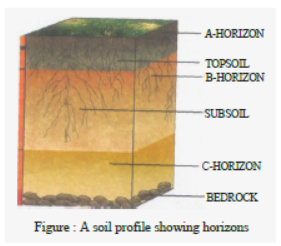
◊ A-Horizon :
It is the uppermost layer and is usually the darkest in colour. It contains a lot of humus. Humus makes the soil fertile. Many living microorganisms are also seen in this layer. The soil here is porous, soft and has more water holding capacity than the other layers. The roots of many plants absorb their food from this layer. This layer of soil is also known as the topsoil.
◊ B-Horizon :
It lies under the layer of topsoil and is comparatively harder and more compact. This is also called the subsoil. It is lighter in colour and is often grey or red. It contains more sand and also some stones. Only a few plants or trees have roots long enough to reach the subsoil. Subsoil is not suitable for plant growth as it contains very little organic matter.
◊ C-Horizon :
It is the lowermost part of the soil and lies beneath the subsoil. It is made of stones and rocks. It contains no organic matter. However, minerals are found in this layer. Beneath this layer lies solid rock called bedrock.
→ SOIL AS A NATURAL RESOURCE
Soil is the most important natural resource available to man. It is considered a valuable resource because of the following reasons :
◊ A Base for Growing Crops :
◊ Storehouse of Minerals :
A large number of minerals are present in the soil. These minerals are extracted and made use of in a large number of industries. Some of the common minerals found in the soil are saltpetre, rocksalt, gypsum, bauxite, haematite and calcite.
◊ Allows Activities that are a source of employment :
Soil is used for various purposes. It is used for the construction of buildings, roads, bridges, industries, dams, etc. It is also used for cultivation of crops. All these activities give employment to thousands of people.
◊ Soil as a Raw Material :
Soil is used as a raw material for making bricks, mortar, pottery and other materials. It is also used in building huts and sheds.
◊ Habitat for Microorganisms :
Soil makes a very good natural habitat for various microorganisms. These microorganisms form humus and make the soil fertile.
Among the animals living in the soil are insects, while ants, grasshoppers, centipedes, millipedes, scorpions, beetles, earthworms and sandworms. Big animals like moles, rats and rabbits build their homes in the soil. Earthworm is popularly known as the farmer's friend or as nature's ploughman because of its activities in the soil. It makes burrows into the soil, thus mixing the soil, well, and its excreta called wormcast enriches the soil with nitrogen.
◊ Water storage :
Rainwater percolates through the soil and accumulates above bedrock to form the water table. This water is pumped out by us for domestic or agricultural uses.
→ SOIL EROSION
◊ Causes of soil Erosion :
♦ Large scale cutting of trees (deforestation)
♦ Overgrazing by animals in forest.
♦ Improper farming practices.
♦ Heavy rains or floods.
♦ Forest fires.
◊ Prevention of soil Erosion :
♦ Grow more trees on a large scale (afforestation)
♦ Flood control.
♦ Allow restricted animal grazing.
♦ Follow terrace farming.
♦ Construct bunds.
◊ SOIL POLLUTION
The contamination of soil with excess use of fertilizers, insecticides, herbicides, weedicides etc., and dumping of industrial waste, sewage and garbage is called soil pollution. Any substance which lowers the fertility of the soil is a soil pollutant.
◊ Causes of soil pollution :
♦ Excessive use of chemical fertilisers and pesticides.
♦ Dumping of garbage and sewage waste in the soil.
♦ Chemical wastes from industries, mines, and factories, etc.
♦ Waste materials likes plastics and metals.
◊ Preventing soil Pollution :
♦ Dispose off sewage properly.
♦ Recycle waste.
♦ Use organic manure or vermicompost.
♦ Treat industrial effluents before discharge.
◊ TYPES OF SOIL
♦ Sandy soil :
This contains more than 60 per cent sand along with some clay. The water holding capacity of sandy soil is very poor. There is a lot of air present in this type of soil. This type of soil is not suited for the growth of plants as it does not retain water of humus in it and is poor in nutrients. Usually, gram, barley, jowar and maize are grown in sandy soils as rained crops.
◊ Clayey Soil :
It consists mostly of clay particles, the sand particles being far less in proportion. Clayey soil is very sticky and so tilling is difficult. It is usually used for making pots and toys.
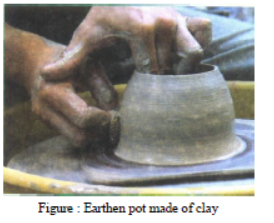
This soil has very good water holding capacity. It is badly aerated and is easily water logged. However, clayey soil is rich in minerals which make it good for the growth of plants. This type of soil is good of crops like paddy which required a lot of water.
◊ Loamy Soil :
It consists of a good mixture of sand, clay and humus. It has good water holding capacity. It has sufficient aeration. Plants get sufficient mineral salts from this soil. Therefore, loamy soil is the best soil for growing plants. Crops like wheat, barley, mustard, pulses, cotton, fruits and vegetables can be profitably grown in loamy soils.
Please click on below link to download pdf file for Class 7 Science Soil Exam Notes.
Free study material for Science
Free CBSE Study Guides: Class 7 Science Chapter 09 Soil
Essential Notes for Class 7 Science
Access comprehensive study material for Chapter 09 Soil, including revision notes, concept maps, and high-probability questions. These resources are designed in alignment with the latest 2026 CBSE syllabus for Class 7 Science to support effective exam preparation.
Verified Solutions for Class 7 Science
Each resource draws directly from authorized textbooks to maintain academic accuracy. Evaluating solved examples allows Class 7 students to master the formal presentation and answer-writing standards expected in upcoming school exams.
Enhance Accuracy with Online Tests
Wrap up your chapter revision by testing your knowledge against standard objective question formats. Explore our full library of free, up-to-date sample papers and online assessments to secure top grades in your CBSE examinations.
FAQs
Our advanced study package for Chapter 09 Soil includes detailed concepts, diagrams, Mind Maps, and explanation of complex topics to ensure Class 7 students learn as per syllabus for 2026 exams.
The Mind Maps provided for Chapter 09 Soil act as visual anchors which will help faster recall during high-pressure exams.
Yes, teachers use our Class 7 Science resources for lesson planning as they are in simple language and have lot of solved examples.
Yes, You can download the complete, mobile-friendly PDF of the Science Chapter 09 Soil advanced resources for free.
Yes, our subject matter experts have updated the Chapter 09 Soil material to align with the rationalized NCERT textbooks and have removed deleted topics and added new competency-based questions.