

Download Class 12 Physics Practice Worksheets
Review targeted academic worksheets with the CBSE Class 12 Physics Semiconductor Devices Worksheet Set 02. Built according to official educational standards for the 2026-27 term, these downloadable Class 12 Physics resources support effective daily practice and detailed self-evaluation for Chapter 14 Semiconductor Electronics Materials Devices and Simple Circuits.
Access Chapter 14 Semiconductor Electronics Materials Devices and Simple Circuits Practice Papers and Solutions
View or download the dedicated CBSE Class 12 Physics Semiconductor Devices Worksheet Set 02 resource below. Engaging with these practice papers under focused study conditions ensures continuous academic progress and mastery of the 2026-27 curriculum for Chapter 14 Semiconductor Electronics Materials Devices and Simple Circuits.
Important Questions for NCERT Class 12 Physics Semiconductor Devices
Question. An amplifier has a voltage gain Av = 1000. The voltage gain in dB is:
(a) 30 dB
(b) 60 dB
(c) 3 dB
(d) 20 dB
Answer: A
Question. If the highest modulating frequency of the wave is 5 kHz, the number of stations that can be accomdated in a 150 kHz bandwidth are
(a) 15
(b) 10
(c) 5
(d) none of these
Answer: A
Question. Number of atom per unit cell in B.C.C.
(a) 9
(b) 4
(c) 2
(d) 1
Answer: C
Question. The cations and anions are arranged in alternate form in
(a) metallic crystal
(b) ionic crystal
(c) covalent crystal
(d) semi-conductor crystal.
Answer: B
Question. Distance between body centred atom and a corner atom in sodium (a = 4.225 Å) is
(a) 2.99 Å
(b) 2.54 Å
(c) 3.66 Å
(d) 3.17 Å.
Answer: C
Question. Diamond is very hard because
(a) it is covalent solid
(b) it has large cohesive energy
(c) high melting point
(d) insoluble in all solvents.
Answer: B
Question. Which one of the following is the weakest kind of the bonding in solids?
(a) ionic
(b) metallic
(c) van der Waals
(d) covalent
Answer: C
Question. In p-type semiconductor major current carriers are :
(a) negative ions
(b) holes
(c) electrons
(d) all of these
Answer: B
Question. In a diode, when there is a saturation current, the plate resistance will be
(a) data insufficient
(b) zero
(c) some finite quantity
(d) infinite quantity
Answer: D
Question. When the two semiconductors p- and n-type are brought into contact they form a p-n junction, which acts like a/an :
(a) rectifier
(b) amplifier
(c) conductor
(d) oscillator
Answer: A
Question. The transfer ratio b of a transistor is 50. The input resistance of the transistor when used in the common emitter configuration is 1kW. The peak value of the collector A.C. current for an A.C. input voltage of 0.01 V, is
(a) 500 μA
(b) 0.25 μA
(c) 0.01 μA
(d) 100 μA
Answer: A
Question. When n-p-n transistor is used as an amplifier, then
(a) electrons move from base to collector
(b) holes move from emitter to base
(c) electrons move from collector to base
(d) holes move from base to emitter
Answer: A
Question. Boolean algebra is essentially based on:
(a) Numbers
(b) Symbol
(c) Logic
(d) Truth
Answer: C
Question. A triode valve has an amplification factor of 20 and its plate is given a potential of 300 V. The grid voltage to reduce the plate current to zero, is
(a) 25 V
(b) 15 V
(c) 12 V
(d) 10 V
Answer: B
Question. Diode is used as a/an
(a) modulator
(b) rectifier
(c) oscillator
(d) amplifier
Answer: B
Question. In n-type semiconductor, majority charge carriers are
(a) electrons
(b) neutrons
(c) holes
(d) protons
Answer: A
Question. In a common emitter (CE) amplifier having a voltage gain G, the transistor used has transconductance 0.03 mho and current gain 25. If the above transistor is replaced with another one with transconductance 0.02 mho and current gain 20, the voltage gain will be
(a) 1.5 G
(b) 1/3 G
(c) 5/4 G
(d) 2/3 G
Answer: D
Question. An oscillator is nothing but an amplifier with
(a) positive feedback
(b) large gain
(c) no feedback
(d) negative feedback
Answer: A
Question. The conductivity of a semiconductor increases with increase in temperature because
(a) number density of free current carries increases
(b) relaxation time increases
(c) both number density of carries and relaxation time increase
(d) number density of carries increases, relaxation time decreases but effect of decrease in relaxation time is much less than increase in number density
Answer: D
Question. Barrier potential of a P-N junction diode does not depend on
(a) doping density
(b) diode design
(c) temperature
(d) forward bias
Answer: B
Question. The real time variation of input signals A and B are as shown below. If the inputs are fed into NAND gate, then select the output signal from the following. 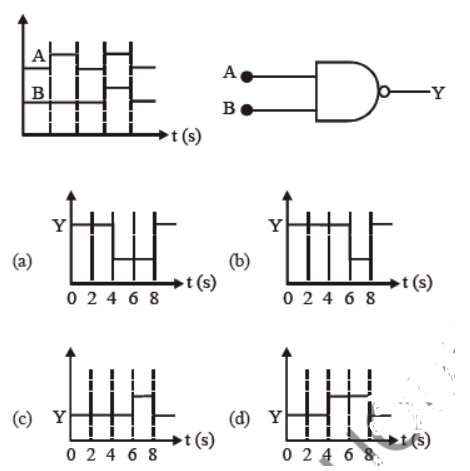
Answer: B
Question. Reverse bias applied to a junction diode
(a) increases the minority carrier current
(b) lowers the potential barrier
(c) raises the potential barrier
(d) increases the majority carrier current
Answer: C
Question. In semiconductors at a room temperature
(a) the conduction band is completely empty
(b) the valence band is partially empty and the conduction band is partially filled
(c) the valence band is completely filled and the conduction band is partially filled
(d) the valence band is completely filled
Answer: C
Question. One serious drawback of semi-conductor devices is
(a) they do not last for long time.
(b) they are costly
(c) they cannot be used with high voltage.
(d) they pollute the environment.
Answer: C
Question. The peak voltage in the output of a half-wave diode rectifier fed with a sinusoidal signal without filter is 10V. The d.c. component of the output voltage is
(a) 20/π V
(b) 10/√2 V
(c) 10/π V
(d) 10V
Answer: C
Question. In a p-n junction photo cell, the value of the photoelectromotive force produced by monochromatic light is proportional to
(a) the voltage applied at the p-n junction
(b) the barrier voltage at the p-n junction
(c) the intensity of the light falling on the cell
(d) the frequency of the light falling on the cell
Answer: C
Question. Of the diodes shown in the following diagrams, which one is reverse biased ? 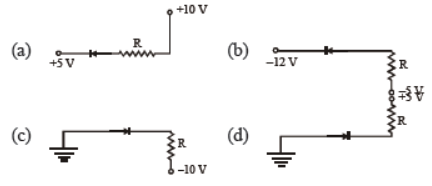
Answer: D
Question. Choose the only false statement from the following.
(a) In conductors the valence and conduction bands may overlap.
(b) Substances with energy gap of the order of 10 eV are insulators.
(c) The resistivity of a semiconductor increases with increase in temperature.
(d) The conductivity of a semiconductor increases with increase in temperature.
Answer: C
Question. Which one of the following statement is false ?
(a) Pure Si doped with trivalent impurities gives a p-type semiconductor
(b) Majority carriers in a n-type semiconductor are holes
(c) Minority carriers in a p-type semiconductor are electrons
(d) The resistance of intrinsic semiconductor decreases with increase of temperature
Answer: B
Question. The figure shows a logic circuit with two inputs A and B and the output C. The voltage wave forms across A, B and C are as given. The logic gate circuit is: 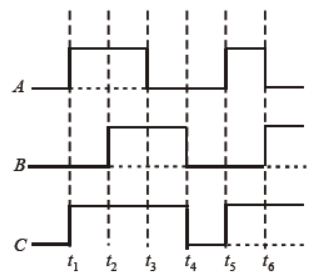
(a) OR gate
(b) NOR gate
(c) AND gate
(d) NAND gate
Answer: A
Question. In a P -N junction
(a) the potential of P & N sides becomes higher alternately
(b) the P side is at higher electrical potential than N side.
(c) the N side is at higher electric potential than P side.
(d) both P & N sides are at same potential.
Answer: B
Question. The time variations of signals are given as in A, B and C. Point out the true statement from the following :
(a) A, B and C are analogue signals
(b) A and B are analogue, but C is digital signal
(c) A and C are digital, but B is analogue signal
(d) A and C are analogue, but B is digital signal
Answer: D
Question. A common emitter amplifier has a voltage gain of 50, an input impedance of 100Ω and an output impedance of 200Ω. The power gain of the amplifier is
(a) 500
(b) 1000
(c) 1250
(d) 50
Answer: C
Question. A npn transistor is connected in common emitter configuration in a given amplifier. A load resistance of 800 Ω is connected in the collector circuit and the voltage drop across it is 0.8 V. If the current amplification factor is 0.96 and the input resistance of the circuit is 192Ω, the voltage gain and the power gain of the amplifier will respectively be:
(a) 4, 3.84
(b) 3.69, 3.84
(c) 4, 4
(d) 4, 3.69
Answer: A
Question. In common emitter amplifier, the current gain is 62. The collector resistance and input resistance are 5 kΩ an 500Ω respectively. If the input voltage is 0.01 V, the output voltage is
(a) 0.62 V
(b) 6.2 V
(c) 62 V
(d) 620 V
Answer: B
Question. The output(X) of the logic circuit shown in figure will be 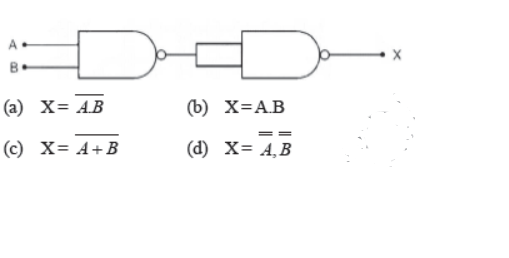
Answer: B
Chapter 10: Wave Optics
Wave Optics Summary Notes
Wave optics deals with the wave nature of light. It explains various optical phenomena such as interference, diffraction, and polarization, which cannot be explained by ray optics.
- Wavefront: The continuous locus of all particles of a medium vibrating in the same phase is called a wavefront.
- A ray of light is always perpendicular to the wavefront at any given point.
- The direction of propagation of light is given by rays, while a wavefront is a surface of constant phase.
- Huygens' Principle:
- Every point on a given wavefront acts as a fresh source of new disturbance, generating secondary wavelets that spread out in all directions with the speed of light.
- The forward envelope (tangential surface) of these secondary wavelets at any later instant gives the new wavefront at that instant.
- Interference of Light: The phenomenon of non-uniform redistribution of light energy when two light waves from coherent sources superimpose on each other.
- Coherent sources are those that emit light waves of the same frequency and have a zero or constant phase difference. They are necessary to obtain a stable, sustained interference pattern.
- Diffraction of Light: The phenomenon of bending of light waves around the edges of obstacles or apertures into the region of geometrical shadow.
- Diffraction is prominent only when the size of the obstacle or aperture is of the order of the wavelength of the light wave.
- Polarization of Light: The phenomenon of restricting the vibrations of the electric field vector of a light wave to a single plane perpendicular to the direction of wave propagation.
- It conclusively proves the transverse wave nature of light waves.
Question 601. Define a wavefront. How is it different from a ray ?
Answer: A wavefront is defined as the continuous locus of all the particles of a medium vibrating in the same phase.
Differences between a wavefront and a ray of light:
(i) A ray of light is always perpendicular to the wavefront at each point.
(ii) A ray represents the direction of propagation of the light wave, whereas a wavefront is a surface characterized by a constant phase.
In simple words: A wavefront is a surface where all light waves are in step (vibrating in phase). A ray is a line that shows where the light is travelling and is always perpendicular to this surface.
Exam Tip: Always state that a ray is normal to a wavefront at every point to get full marks on the difference part of the question.
Question 602. State Huygen’s principle.
Answer: Huygens' principle is a geometric construction used to determine the position and shape of a wavefront at any later instant. It is based on the following two postulates:
(i) Each point on a given wavefront acts as a fresh source of new disturbance, generating secondary wavelets that spread out in all directions with the same velocity as the original wave.
(ii) The forward envelope (tangential surface) of these secondary wavelets drawn at any later instant gives the shape and position of the new wavefront at that instant.
In simple words: Huygens' principle says that every point on a light wave acts like a tiny new bulb making its own small waves. The combined forward edge of all these tiny waves forms the next big wave.
Exam Tip: Be sure to write both postulates clearly. Highlighting terms like "secondary wavelets" and "forward envelope" helps attract full marks.
Question 603. (i) Sketch the wavefront that will emerge from a distance source of light like a star.
(ii) Sketch the shape of wavefront emerging/diverging from a point source of light and also mark the rays.
(iii) Sketch the wavefront that will emerge from a linear source of light like a slit.
Answer: Depending on the nature and distance of the light source, wavefronts can have different shapes:
(i) Plane Wavefront: Wavefronts originating from a highly distant source (like a star) are flat plane wavefronts when they reach us.
(ii) Spherical Wavefront: Wavefronts emerging from a point source of light diverge outward as concentric spheres.
(iii) Cylindrical Wavefront: Wavefronts originating from a linear source of light (like a slit) form concentric cylinders.
In simple words: A point source makes spherical waves (like a balloon expanding). A linear slit makes cylindrical waves. A very distant source like a star produces flat, parallel plane waves by the time they reach us.
Exam Tip: When drawing these sketches, always show the light rays as arrows perpendicular to the wavefront lines to illustrate the direction of wave travel.
Question 606. What is interference of light ? Give one example of interference in daily life.
Answer: Interference of light is the physical phenomenon of non-uniform redistribution of resultant light intensity in a medium due to the superposition of light waves originating from two coherent sources.
Example in daily life:
The bright, beautiful color patterns observed in soap bubbles or thin oil films floating on water when illuminated by white light are caused by the interference of light waves reflecting from their front and back surfaces.
In simple words: Interference is what happens when light waves from two matching sources overlap. They combine to make bright and dark spots. This overlapping is what makes soap bubbles show rainbow colors.
Exam Tip: Make sure to mention that the superimposing waves must come from "coherent" sources, as this is a vital condition for interference.
Question 607. What are coherent sources of light ? Why are coherent sources necessary to produce a sustained interference pattern?
Answer: Two light sources are said to be coherent if they emit light waves of the same frequency (or wavelength) and have zero or a constant phase difference over time.
Necessity of coherent sources:
Coherent sources produce light waves with a constant phase difference. This ensures that the positions of constructive interference (maxima) and destructive interference (minima) on the screen remain fixed with time. If the sources are incoherent, the phase difference changes rapidly, causing the fringe pattern to shift and wash out, leaving a uniform, average illumination instead.
In simple words: Coherent sources make waves that stay perfectly in step with each other. If they are not in step, the bright and dark lines on the screen will shift so fast that our eyes will only see a steady, blurry glow.
Exam Tip: A stable, sustained interference pattern is only possible if the phase difference between the waves remains constant over time.
Question 612. Does the appearance of bright and dark fringes in the interference pattern violate, in any way, law of conservation of energy ? Explain.
Answer: No, the appearance of bright and dark fringes does not violate the law of conservation of energy.
In an interference pattern, light energy is not created at the bright fringes, nor is it destroyed at the dark fringes. The phenomenon is simply a redistribution of light energy. The energy that disappears from the dark regions (where interference is destructive) is shifted to the bright regions (where interference is constructive). The total energy across the entire interference pattern remains constant and equal to the sum of the energies of the individual waves.
In simple words: Energy is not created or destroyed. The light energy is just moved around, shifting from the dark lines to the bright lines so that the total amount of light stays the same.
Exam Tip: Clearly state that the total energy is conserved, and explain the phenomenon as a simple redistribution of energy to secure full marks.
Question 616. In the Young’s double slit experiment, how does the fringe width get affected if the entire experimental apparatus is immersed in water ?
Answer: When the entire Young's double slit experimental apparatus is immersed in water, the fringe width decreases.
The formula for fringe width is:
\( \beta = \frac{D\lambda}{d} \)
When the apparatus is immersed in water, the wavelength of light decreases to \( \lambda_{\text{water}} = \frac{\lambda}{\mu} \), where \( \mu \) is the refractive index of water (\( \mu > 1 \)).
Since \( D \) and \( d \) remain unchanged:
\( \beta_{\text{water}} = \frac{D\lambda_{\text{water}}}{d} = \frac{D\lambda}{\mu d} = \frac{\beta}{\mu} \)
\( \implies \) The fringe width decreases by a factor equal to the refractive index of water.
In simple words: Immersing the setup in water shortens the wavelength of the light. Since the fringe width depends directly on the wavelength, the bands on the screen will shrink and get closer together.
Exam Tip: Use the formula \( \beta' = \frac{\beta}{\mu} \) to show a clear mathematical relationship, which helps examiner grade your answer quickly.
Question 617. In the Young’s double slit experiment, how does the fringe width get affected if the entire experimental apparatus is immersed in water (refractive index \( \frac{4}{3} \)) ?
Answer: Let \( \beta \) be the fringe width in air, and \( \mu = \frac{4}{3} \) be the refractive index of water.
As derived from wave theory, the fringe width of an interference pattern is directly proportional to the wavelength of light. Upon immersion in a medium of refractive index \( \mu \), the wavelength decreases to:
\( \lambda' = \frac{\lambda}{\mu} \)
Consequently, the new fringe width \( \beta' \) is:
\( \beta' = \frac{\beta}{\mu} \)
Substituting \( \mu = \frac{4}{3} \):
\( \beta' = \frac{\beta}{4/3} = \frac{3}{4}\beta \)
\( \implies \) The fringe width decreases to \( \frac{3}{4} \) of its original value in air.
In simple words: The water slows down the light, making its waves closer together. This shrinks the width of the fringes to three-quarters of what they were in air.
Exam Tip: Be sure to write the final answer as a fraction (decreases to \( \frac{3}{4} \) times), as it is more precise than writing a decimal equivalent.
Question 619. What is diffraction of light ? State the essential condition for diffraction of light.
Answer: Diffraction of light is the physical phenomenon of bending of light waves around the sharp corners of obstacles or narrow apertures, spreading into the region of their geometrical shadow.
Essential condition for diffraction:
The size of the obstacle or aperture (\( a \)) must be comparable to the wavelength of the light wave (\( \lambda \)) used:
\( a \approx \lambda \).
In simple words: Diffraction is when light waves bend around corners or squeeze through narrow openings into shadows. This only happens clearly when the opening is roughly as small as the light's own wavelength.
Exam Tip: State the relation \( a \approx \lambda \) mathematically, as this is the single most important condition examiners look for.
Question 620. Why do secondary maxima get weaker in intensity with increasing the order ?Explain.
OR
Explain how the intensity of diffraction pattern changes as the order (n) of the diffraction band varies.
Answer: In a single-slit diffraction pattern, the central maximum is formed by wavelets from the entire width of the slit, which arrive in phase at the center of the screen, resulting in maximum intensity.
For the first secondary maximum (\( n = 1 \)), the slit is effectively divided into 3 equal parts. The wavelets from the first two parts interfere destructively and cancel each other out. Thus, only the remaining \( \frac{1}{3} \) part of the slit contributes to the intensity of this maximum.
For the second secondary maximum (\( n = 2 \)), the slit is divided into 5 equal parts. The wavelets from 4 parts cancel out, and only the remaining \( \frac{1}{5} \) part of the slit contributes to the intensity.
With each successive higher order, the contributing width of the slit decreases to \( \frac{1}{2n+1} \).
\( \implies \) Because of this rapid decrease in the contributing area of the slit, the intensity of secondary maxima drops off very quickly with increasing order.
In simple words: The central bright spot gets light from the whole slit. The first side spot only gets light from one-third of the slit because the rest cancels out. The next spot only gets light from one-fifth of the slit, making the spots get dimmer very fast.
Exam Tip: Use the fraction sequence (\( 1 \), \( \frac{1}{3} \), \( \frac{1}{5} \), \( \frac{1}{7} \)) in your explanation to clearly show the division of the slit wavelets.
Question 630. What is polarization of light ?
Answer: Polarization of light is the optical phenomenon of restricting the transverse vibrations of the electric field vector of a light wave to a single plane perpendicular to the direction of wave propagation.
In simple words: Normal light waves vibrate in all directions perpendicular to their path. Polarization is the process of filtering this light so that the waves only vibrate in one single direction.
Exam Tip: Mention that polarization is only exhibited by transverse waves (such as light waves) and not by longitudinal waves (such as sound waves).
Question 631. Define the term ‘linearly polarised light’ and ‘unpolarised light’.
Answer:
(i) Linearly Polarised Light: A light wave in which the vibrations of the electric field vector are restricted to a single direction in a plane perpendicular to the direction of wave propagation is called plane or linearly polarized light.
(ii) Unpolarised Light: Ordinary light having equal vibrations of the electric field vector in all possible directions in a plane perpendicular to the direction of wave propagation is called unpolarized light.
In simple words: Unpolarized light has waves vibrating in every direction like a starburst. Linearly polarized light has been cleaned up so that all its waves are aligned, vibrating in only one direction.
Exam Tip: Draw a simple schematic diagram showing unpolarized light (with double-headed arrows and dots) and plane polarized light (with double-headed arrows only) to make your answer visually complete.
Question 636. (i) State law of Malus.
(ii) Draw a graph showing the variation of intensity (I) of polarised light transmitted by an analyser with angle (\( \theta \)) between polariser and analyser
Answer:
(i) Law of Malus: When a beam of completely plane polarized light is incident on an analyzer, the intensity (\( I \)) of the transmitted light varies as the square of the cosine of the angle (\( \theta \)) between the transmission axes of the polarizer and the analyzer.
Mathematically:
\( I \propto \cos^2 \theta \)
Or:
\( I = I_0 \cos^2 \theta \)
where \( I_0 \) is the maximum intensity of the polarized light entering the analyzer.
(ii) The intensity graph varies from a maximum value of \( I_0 \) at \( \theta = 0^\circ, 180^\circ, 360^\circ \) to a minimum value of zero at \( \theta = 90^\circ, 270^\circ \).
In simple words: Malus' law says that as you rotate a polaroid filter, the brightness of the light passing through depends on the square of the cosine of the rotation angle. The light is brightest at 0° and goes completely dark at 90°.
Exam Tip: Be sure to mark key points on the angle axis (\( 0^\circ \), \( 90^\circ \), \( 180^\circ \), \( 270^\circ \), \( 360^\circ \)) on your graph to show a complete, correct curve.
Question 639. The vibrations in a beam of polarised light make an angle of \( 60^\circ \) with the axis of the Polaroid sheet. What percentage of light is transmitted through the sheet ?
Answer: Let the intensity of the incident polarized light beam be \( I_0 \).
According to Malus' law, the transmitted intensity \( I \) is:
\( I = I_0 \cos^2 \theta \)
We are given the angle \( \theta = 60^\circ \). Substituting this value:
\( I = I_0 \cos^2(60^\circ) \)
Since \( \cos(60^\circ) = \frac{1}{2} \):
\( I = I_0 \left(\frac{1}{2}\right)^2 = \frac{I_0}{4} \)
Now, we calculate the percentage of transmitted light:
\( \text{Percentage Transmitted} = \left(\frac{I}{I_0}\right) \times 100 \% \)
\( \implies \text{Percentage} = \frac{1}{4} \times 100 \% = 25 \% \).
In simple words: Since the angle is 60°, the cosine of 60° is 1/2. Squaring this value gives 1/4. This means exactly 25% of the light gets through.
Exam Tip: Show the step-by-step substitution of \( \cos(60^\circ) = 1/2 \) and its squaring to secure full computational marks in numerical sections.
Question 640. Unpolarised light of intensity I is passed through a Polaroid. What is intensity of light transmitted by the Polaroid ?
Answer: When a beam of unpolarized light of intensity \( I \) is passed through a single Polaroid sheet, the transmitted light becomes plane polarized.
Since unpolarised light has vibrations in all directions, the Polaroid only allows the components parallel to its transmission axis to pass. On average, this filters out exactly half of the light intensity.
\( \implies \) The intensity of the transmitted light is \( \frac{I}{2} \).
In simple words: When random unpolarized light passes through a polaroid filter, half of its waves are blocked. The light coming out is polarized and its brightness is cut exactly in half.
Exam Tip: State clearly that the output light becomes plane polarized and its intensity is exactly halved, which is a standard rule in wave optics.
Question 642. State Brewster’s law.
Answer: **Brewster's Law:** When unpolarized light is incident on the boundary separating two transparent media, the reflected light becomes completely plane polarized at a specific angle of incidence, called the polarizing angle or Brewster's angle (\( i_p \)).
Brewster's law states that the refractive index (\( \mu \)) of the refracting medium is numerically equal to the tangent of the polarizing angle (\( i_p \)):
\( \mu = \tan i_p \).
In simple words: Brewster's law says that at a special angle of incidence, the light bouncing off a surface becomes completely polarized. The tangent of this special angle is equal to the refractive index of the medium.
Exam Tip: Write down the relation \( \mu = \tan i_p \) clearly, defining \( \mu \) as the refractive index and \( i_p \) as the polarizing angle.
Question 645. Show that the Brewster angle \( i_p \) for a given pair of transparent media, is related to the critical angle \( i_c \) through the relation, \( i_c = \sin^{-1}(\cot i_p) \).
Answer: According to Brewster's law, the refractive index \( \mu \) of the medium is:
\( \mu = \tan i_p \quad \text{--- (i)} \)
We also know that the critical angle \( i_c \) of the medium is related to the refractive index by:
\( \sin i_c = \frac{1}{\mu} \quad \text{--- (ii)} \)
Substituting equation (i) into equation (ii):
\( \sin i_c = \frac{1}{\tan i_p} \)
Since \( \frac{1}{\tan i_p} = \cot i_p \):
\( \sin i_c = \cot i_p \)
Taking the inverse sine on both sides:
\( \implies i_c = \sin^{-1}(\cot i_p) \)
Hence proved.
In simple words: Use the formulas for Brewster's law (\( \mu = \tan i_p \)) and critical angle (\( \sin i_c = 1/\mu \)). Combining them gives \( \sin i_c = 1/\tan i_p \), which simplifies to \( \cot i_p \), proving the relation.
Exam Tip: Write down both starting formulas clearly. Show how \( \frac{1}{\tan \theta} = \cot \theta \) is used to transition to the final step.
Question 647. What is the value of refractive index of a medium of polarizing angle \( 60^\circ \) ?
Answer: We are given the polarizing angle \( i_p = 60^\circ \).
According to Brewster's law, the refractive index \( \mu \) is:
\( \mu = \tan i_p \)
Substituting \( i_p = 60^\circ \):
\( \mu = \tan(60^\circ) \)
Since \( \tan(60^\circ) = \sqrt{3} \approx 1.732 \):
\( \implies \mu = 1.732 \).
In simple words: Brewster's law tells us that the refractive index is the tangent of the polarizing angle. For 60°, this is tangent of 60°, which is 1.732.
Exam Tip: State the final value as \( \sqrt{3} \) or \( 1.732 \) to show a complete, correct numerical answer.
Question 648. What is the value of polarizing angle of a medium of refractive index \( \sqrt{3} \) ?
Answer: We are given the refractive index of the medium \( \mu = \sqrt{3} \).
According to Brewster's law, we have:
\( \mu = \tan i_p \)
Substituting \( \mu = \sqrt{3} \):
\( \sqrt{3} = \tan i_p \)
Since the tangent of \( 60^\circ \) is \( \sqrt{3} \):
\( \implies i_p = 60^\circ \).
In simple words: The tangent of Brewster's polarizing angle equals the refractive index. Since the refractive index is \( \sqrt{3} \), the angle must be 60°.
Exam Tip: This is a standard 1-mark numerical question. Solving \( \tan i_p = \sqrt{3} \) directly yields the polarizing angle of \( 60^\circ \).
Question 651. The refractive index of a material is \( \sqrt{3} \). What is the angle of refraction if the unpolarised light is incident on it at the polarizing angle of the medium ?
Answer: We are given the refractive index \( \mu = \sqrt{3} \).
According to Brewster's law, we have:
\( \mu = \tan i_p \implies \sqrt{3} = \tan i_p \implies i_p = 60^\circ \)
So, the polarizing angle of incidence is \( i_p = 60^\circ \).
At Brewster's angle, the reflected and refracted rays are mutually perpendicular. This gives the relation:
\( i_p + r = 90^\circ \)
Substituting \( i_p = 60^\circ \) into this relation:
\( 60^\circ + r = 90^\circ \)
\( \implies r = 90^\circ - 60^\circ = 30^\circ \).
In simple words: Since the refractive index is \( \sqrt{3} \), the polarizing angle of incidence is 60°. Since the reflected and refracted light are at 90° to each other, the angle of refraction is 90° - 60° = 30°.
Exam Tip: Always state the key concept that the reflected and refracted rays are perpendicular to each other when light is incident at Brewster's angle.
Question 652. A partially plane polarised beam of light passed through a Polaroid. Show graphically the variation of the transmitted light intensity with angle of rotation of Polaroid.
Answer: A partially plane polarized beam contains both polarized and unpolarized components.
When passed through a rotating Polaroid, the unpolarized component yields a constant transmitted intensity, while the polarized component varies with the angle of rotation according to Malus' law.
Consequently, as the Polaroid is rotated, the overall transmitted intensity varies between a maximum and a non-zero minimum value (it never drops to zero).
In simple words: Since the light is only partially polarized, rotating the filter will cause the brightness to fluctuate, but it will never go completely black. The graph shows a wave pattern that stays above the zero line.
Exam Tip: Draw the curve so that the minimum points (\( I_{\text{min}} \)) are clearly above the horizontal angle axis to show it is partially polarized.
Question 653. If the angle between the pass axis of polarizer and analyser is \( 45^\circ \), write the ratio of intensities of original light and the transmitted light after passing through the analyzer.
Answer: Let \( I_{\text{original}} \) be the intensity of the original unpolarized light.
When this unpolarized light passes through the first polarizer, its intensity is halved:
\( I_1 = \frac{I_{\text{original}}}{2} \)
According to Malus' law, the intensity \( I_{\text{transmitted}} \) of light after passing through the analyzer (at angle \( \theta = 45^\circ \) relative to the polarizer) is:
\( I_{\text{transmitted}} = I_1 \cos^2 \theta \)
Substituting the values:
\( I_{\text{transmitted}} = \left(\frac{I_{\text{original}}}{2}\right) \cos^2(45^\circ) \)
Since \( \cos(45^\circ) = \frac{1}{\sqrt{2}} \):
\( I_{\text{transmitted}} = \frac{I_{\text{original}}}{2} \left(\frac{1}{\sqrt{2}}\right)^2 = \frac{I_{\text{original}}}{2} \times \frac{1}{2} = \frac{I_{\text{original}}}{4} \)
Now, we find the required ratio of original to transmitted intensity:
\( \frac{I_{\text{original}}}{I_{\text{transmitted}}} = \frac{4}{1} \)
\( \implies \) The ratio is \( 4:1 \).
In simple words: Passing through the first filter cuts the unpolarized light in half. Passing through the second at 45° cuts it in half again. The final light is 1/4 of the original, so the ratio is 4:1.
Exam Tip: Do not miss the initial halving of intensity from unpolarized light to the first polarizer. This is the most common place where students lose marks.
Question 654. Using Huygen’s construction draw a figure showing the propagation of a plane wavefront reflecting at a plane surface. Show that the angle of incidence is equal to the angle of reflection.
Answer: Consider a plane wavefront \( AB \) incident on a reflecting surface \( XY \) at an angle \( i \).
According to Huygens' principle, in the time \( t \) that the disturbance takes to travel from \( B \) to \( C \) with speed \( c \), secondary wavelets from \( A \) will have spread out over a hemisphere of radius \( AD = BC = ct \).
The tangent \( CD \) drawn from \( C \) to this hemisphere represents the reflected wavefront.
Let us compare the triangles \( \Delta ABC \) and \( \Delta ADC \):
1. \( AC = AC \) (common side)
2. \( \angle B = \angle D = 90^\circ \) (wavefront is perpendicular to the ray)
3. \( AD = BC = ct \) (radius of secondary wavelets)
Therefore, by RHS congruency:
\( \Delta ABC \cong \Delta ADC \)
By CPCT, the corresponding angles must be equal:
\( \angle i = \angle r \)
\( \implies \) The angle of incidence is equal to the angle of reflection.
In simple words: Huygens' construction shows how wavelets propagate. By proving that the triangles formed by the incoming and outgoing wavefronts are identical (congruent), we prove that the angle of incidence equals the angle of reflection.
Exam Tip: Be sure to write down the congruency steps (\( \Delta ABC \cong \Delta ADC \)) clearly, as this is the core proof step in CBSE grading.
Question 655. Use Huygens’ principle to verify the laws of refraction.
OR
Derive Snell’s law on the basis of Huygen’s wave theory when light is travelling from a rarer to a denser medium/ Denser to rarer medium.
Answer: Let a plane wavefront \( AB \) be incident at an angle \( i \) on a refracting surface \( XY \) separating two media with speeds of light \( v_1 \) and \( v_2 \) respectively.
By Huygens' principle, in the time \( t \) that the wave takes to travel from \( B \) to \( C \), the secondary wavelets from \( A \) will have spread over a distance \( AD = v_2 t \) in the second medium.
The tangent \( CD \) represents the refracted wavefront at angle \( r \).
From the triangles \( \Delta ABC \) and \( \Delta ADC \):
\( \sin i = \frac{BC}{AC} = \frac{v_1 t}{AC} \)
\( \sin r = \frac{AD}{AC} = \frac{v_2 t}{AC} \)
Taking the ratio of these two equations:
\( \frac{\sin i}{\sin r} = \frac{v_1 t / AC}{v_2 t / AC} = \frac{v_1}{v_2} = \text{constant} \)
Since \( \frac{v_1}{v_2} = \frac{\mu_2}{\mu_1} = \mu \):
\( \frac{\sin i}{\sin r} = \mu \)
This is Snell's law of refraction.
In simple words: Use the geometric relations from Huygens' construction. Dividing the sine of the angle of incidence by the sine of the angle of refraction cancels out common variables, giving the ratio of speeds, which proves Snell's law.
Exam Tip: This derivation is extremely high-yield in board exams. Practice drawing the refraction diagram carefully, marking the wavefronts perpendicular to their respective rays.
Question 662. State two differences between interference and diffraction patterns.
Answer: The primary differences between interference and diffraction patterns are:
| Interference Pattern | Diffraction Pattern |
|---|---|
| It is due to the superposition of light waves originating from two distinct coherent sources. | It is due to the superposition of secondary wavelets originating from different parts of the same wavefront. |
| All interference fringes (both bright and dark) have equal width. | The width of diffraction bands is unequal; the central maximum is twice as wide as the secondary maxima. |
| All bright fringes have the same maximum intensity. | The maxima have different intensities; the brightness decreases rapidly with increasing order of maxima. |
In simple words: Interference is the overlapping of waves from two different coherent sources, producing lines of equal width and brightness. Diffraction is a wave bending around a single slit, producing a wide, very bright center and rapidly fading side spots.
Exam Tip: Summarize these differences in a neat table as shown to present your answer clearly and efficiently to the examiner.
Question 668. When unpolarised light is incident on the boundary separating the two transparent media, explain, with the help of a suitable diagram, the conditions under which the reflected light gets polarised. Hence derive the relation of Brewster’s angle in terms of the relative refractive index of the two media.
Answer: When unpolarized light is incident on a transparent boundary, both reflection and refraction take place.
At a specific angle of incidence, called the polarizing angle or Brewster's angle (\( i_p \)), the reflected light becomes completely plane polarized. This condition occurs when the reflected ray and the refracted ray are perpendicular to each other.
From the diagram, the sum of angles on the normal line is:
\( i_p + 90^\circ + r = 180^\circ \)
\( \implies r = 90^\circ - i_p \)
According to Snell's law:
\( \mu = \frac{\sin i_p}{\sin r} \)
Substituting \( r = 90^\circ - i_p \) into Snell's law:
\( \mu = \frac{\sin i_p}{\sin(90^\circ - i_p)} = \frac{\sin i_p}{\cos i_p} = \tan i_p \)
\( \implies \mu = \tan i_p \). This is Brewster's law.
In simple words: When light strikes a surface at Brewster's angle, the reflected and refracted rays form a 90° angle. Using Snell's law, we substitute the refracted angle as 90° minus the incident angle, which simplifies to the tangent relationship.
Exam Tip: Be sure to show the relation \( r = 90^\circ - i_p \) derived from the straight-line angle sum to make your derivation complete.
Question 672. Find an expression for intensity of transmitted light when a polaroid sheet is rotated between two crossed polaroids. In which position of the polaroid sheet will the transmitted intensity be maximum ?
Answer: Let \( I_0 \) be the intensity of plane polarized light passing through the first polarizer \( P_1 \).
Let the intermediate polaroid \( P_2 \) be rotated such that its pass axis makes an angle \( \theta \) with the axis of \( P_1 \). The transmitted intensity through \( P_2 \) is:
\( I_2 = I_0 \cos^2 \theta \)
Since \( P_1 \) and \( P_3 \) are crossed polaroids (perpendicular), the angle between the pass axis of \( P_2 \) and \( P_3 \) is \( 90^\circ - \theta \).
The final transmitted intensity \( I_3 \) through \( P_3 \) is:
\( I_3 = I_2 \cos^2(90^\circ - \theta) = I_0 \cos^2 \theta \sin^2 \theta \)
Multiplying and dividing by 4:
\( I_3 = \frac{I_0}{4} (2 \sin \theta \cos \theta)^2 = \frac{I_0}{4} \sin^2(2\theta) \)
Positions of maximum intensity:
\( I_3 \) is maximum when \( \sin(2\theta) = 1 \implies 2\theta = 90^\circ \implies \theta = 45^\circ \).
\( \implies \) The transmitted intensity is maximum when the intermediate sheet makes an angle of \( 45^\circ \) with both crossed polaroids.
In simple words: When you place a third filter between two perpendicular (crossed) filters, light can pass through. Using Malus' law twice, the math shows that the brightness is maximum when the middle filter is rotated to exactly 45°.
Exam Tip: The double-angle trigonometric identity \( \sin(2\theta) = 2 \sin \theta \cos \theta \) is crucial to simplify the intensity expression to its final form.
Question 673. A narrow beam of unpolarised light of intensity \( I_0 \) is incident on a Polaroid \( P_1 \). The light transmitted by it then incident on a second Polaroid \( P_2 \) with its pass axis making an angle of \( 60^\circ \) with relative to the pass axis of \( P_1 \). Find the intensity of light transmitted by \( P_2 \).
Answer: When unpolarized light of intensity \( I_0 \) passes through the first Polaroid \( P_1 \), the transmitted light becomes plane polarized with intensity:
\( I_1 = \frac{I_0}{2} \)
This polarized light is then incident on the second Polaroid \( P_2 \), whose pass axis makes an angle \( \theta = 60^\circ \) with that of \( P_1 \).
According to Malus' law, the transmitted intensity \( I_2 \) is:
\( I_2 = I_1 \cos^2 \theta \)
Substituting the values:
\( I_2 = \left(\frac{I_0}{2}\right) \cos^2(60^\circ) \)
Since \( \cos(60^\circ) = \frac{1}{2} \):
\( I_2 = \frac{I_0}{2} \left(\frac{1}{2}\right)^2 = \frac{I_0}{2} \times \frac{1}{4} = \frac{I_0}{8} \).
In simple words: The first filter cuts the unpolarized light in half. The second filter at 60° cuts it further by a factor of 1/4. This makes the final output intensity 1/8 of the original.
Exam Tip: Remember to apply the \( \frac{1}{2} \) factor for the first unpolarized step before applying Malus' law for the second step.
Question 674. Two Polaroids \( P_1 \) and \( P_2 \) are placed with their pass axes perpendicular to each other. Unpolarised light of intensity \( I_0 \) is incident on \( P_1 \). A third Polaroid \( P_3 \) is kept in between \( P_1 \) and \( P_2 \) such that its pass axis makes an angle of \( 60^\circ \) with that of \( P_1 \). Determine the intensity of light transmitting through \( P_1 \), \( P_2 \) and \( P_3 \).
Answer: Let us calculate the transmitted intensities step-by-step:
1. **Intensity through \( P_1 \)**: Unpolarized light of intensity \( I_0 \) becomes plane polarized after passing through \( P_1 \).
\( I_1 = \frac{I_0}{2} \)
2. **Intensity through \( P_3 \)**: The pass axis of \( P_3 \) is at \( 60^\circ \) to \( P_1 \). Using Malus' law:
\( I_3 = I_1 \cos^2(60^\circ) = \left(\frac{I_0}{2}\right) \left(\frac{1}{2}\right)^2 = \frac{I_0}{8} \)
3. **Intensity through \( P_2 \)**: Since \( P_1 \) and \( P_2 \) are crossed (perpendicular), the angle between the pass axis of \( P_3 \) and \( P_2 \) is \( 90^\circ - 60^\circ = 30^\circ \). Using Malus' law:
\( I_2 = I_3 \cos^2(30^\circ) = \left(\frac{I_0}{8}\right) \left(\frac{\sqrt{3}}{2}\right)^2 = \frac{I_0}{8} \times \frac{3}{4} = \frac{3I_0}{32} \).
In simple words: The first filter halves the unpolarized light to \( \frac{I_0}{2} \). The middle filter at 60° reduces it to \( \frac{I_0}{8} \). The final perpendicular filter at 30° relative to the middle filter reduces it to \( \frac{3I_0}{32} \).
Exam Tip: Be careful with the angle for the final step. Since the outer two filters are crossed, the final angle must be the complement of the first angle (\( 90^\circ - 60^\circ = 30^\circ \)).
Question 678. Two coherent sources have intensities in the ratio 25 : 16. Find the ratio of intensities of maxima to minima after interference of light occurs.
Answer: We are given the ratio of intensities of two coherent sources:
\( \frac{I_1}{I_2} = \frac{25}{16} \)
Since intensity is directly proportional to the square of the amplitude (\( I \propto a^2 \)), the ratio of amplitudes is:
\( \frac{a_1}{a_2} = \sqrt{\frac{I_1}{I_2}} = \sqrt{\frac{25}{16}} = \frac{5}{4} \)
This gives \( a_1 = 5k \) and \( a_2 = 4k \).
The maximum and minimum amplitudes are:
\( a_{\text{max}} = a_1 + a_2 = 5k + 4k = 9k \)
\( a_{\text{min}} = a_1 - a_2 = 5k - 4k = 1k \)
Now, the ratio of maximum to minimum intensity is:
\( \frac{I_{\text{max}}}{I_{\text{min}}} = \left(\frac{a_{\text{max}}}{a_{\text{min}}}\right)^2 = \left(\frac{9}{1}\right)^2 = \frac{81}{1} \)
\( \implies \) The ratio of maximum to minimum intensity is \( 81:1 \).
In simple words: First find the amplitudes by taking the square root of the intensities, which gives 5 and 4. Add them to get the maximum amplitude (9) and subtract them to get the minimum (1). Square these values to get the intensity ratio of 81:1.
Exam Tip: Clearly show the steps of converting intensity ratio to amplitude ratio first before applying the formula \( \left(\frac{a_1+a_2}{a_1-a_2}\right)^2 \).
Question 679. In Young’s double slit experiment, two slits are 1 mm apart and the screen is placed 1 m away from the slits. Calculate the fringe width when light of wavelength 500 nm is used.
Answer: We are given the following values:
- Distance between the slits, \( d = 1 \text{ mm} = 1 \times 10^{-3} \text{ m} \)
- Distance of screen from slits, \( D = 1 \text{ m} \)
- Wavelength of light, \( \lambda = 500 \text{ nm} = 500 \times 10^{-9} \text{ m} \)
The formula for fringe width \( \beta \) is:
\( \beta = \frac{D\lambda}{d} \)
Substituting the values:
\( \beta = \frac{1 \times 500 \times 10^{-9}}{1 \times 10^{-3}} = 500 \times 10^{-6} \text{ m} = 0.5 \text{ mm} \).
In simple words: Plug the given values into the fringe width formula. Converting nm and mm into meters gives the final width as 0.5 mm.
Exam Tip: Convert all given values to SI units (meters) before performing the calculation to avoid power-of-ten errors.
Question 680. A beam of light consisting of two wavelengths, 800 nm and 600 nm, is used to obtain the interference fringes in a Young’s double slit experiment on a screen is placed 1.4 m away. If two slits are separated by 0.28 mm, Calculate the least distance from the central bright maximum where the bright fringes of the two wavelengths coincide.
Answer: We are given:
- \( \lambda_1 = 800 \text{ nm} = 8 \times 10^{-7} \text{ m} \)
- \( \lambda_2 = 600 \text{ nm} = 6 \times 10^{-7} \text{ m} \)
- \( D = 1.4 \text{ m} \)
- \( d = 0.28 \text{ mm} = 2.8 \times 10^{-4} \text{ m} \)
Let the \( n^{\text{th}} \) bright fringe of \( \lambda_1 \) coincide with the \( (n+1)^{\text{th}} \) bright fringe of \( \lambda_2 \).
\( \implies n\lambda_1 = (n+1)\lambda_2 \)
\( \implies n(800) = (n+1)(600) \)
\( \implies 8n = 6n + 6 \)
\( \implies 2n = 6 \implies n = 3 \)
So, the \( 3^{\text{rd}} \) bright fringe of the longer wavelength coincides with the \( 4^{\text{th}} \) bright fringe of the shorter wavelength.
The least distance \( y \) from the central maximum is:
\( y = \frac{n D \lambda_1}{d} \)
Substituting the values:
\( y = \frac{3 \times 1.4 \times 8 \times 10^{-7}}{2.8 \times 10^{-4}} = \frac{33.6 \times 10^{-7}}{2.8 \times 10^{-4}} = 12 \times 10^{-3} \text{ m} = 1.2 \text{ cm} \).
In simple words: Find which orders of the two light wavelengths align by equating their distance equations. This reveals that the 3rd band of 800 nm matches the 4th of 600 nm at a distance of 1.2 cm from the center.
Exam Tip: Set up the condition \( n\lambda_1 = (n+1)\lambda_2 \) using the rule that the smaller order \( n \) always corresponds to the longer wavelength \( \lambda_1 \).
Question 681. A slit of width ‘a’ is illuminated by red light of wavelength \( 6500 \text{ Å} \). For what value of ‘a’ will -
(i) the first minimum fall at an angle of diffraction of \( 30^\circ \)
(ii) the first maximum fall at an angle of diffraction of \( 30^\circ \)
Answer: We are given:
- Wavelength, \( \lambda = 6500 \text{ Å} = 6.5 \times 10^{-7} \text{ m} \)
- Angle of diffraction, \( \theta = 30^\circ \implies \sin(30^\circ) = 0.5 \)
(i) **For the first minimum**:
The condition for minima in single-slit diffraction is:
\( a \sin \theta = n\lambda \)
For the first minimum (\( n = 1 \)):
\( a \sin(30^\circ) = \lambda \)
\( \implies a = \frac{\lambda}{\sin(30^\circ)} = \frac{6.5 \times 10^{-7}}{0.5} = 1.3 \times 10^{-6} \text{ m} \).
(ii) **For the first secondary maximum**:
The condition for secondary maxima is:
\( a \sin \theta = (2n + 1)\frac{\lambda}{2} \)
For the first secondary maximum (\( n = 1 \)):
\( a \sin(30^\circ) = \frac{3\lambda}{2} \)
\( \implies a = \frac{3\lambda}{2 \sin(30^\circ)} = \frac{3 \times 6.5 \times 10^{-7}}{2 \times 0.5} = 1.95 \times 10^{-6} \text{ m} \).
In simple words:
(i) For the first minimum, the width \( a \) is simply \( \frac{\lambda}{\sin \theta} \), which gives \( 1.3 \times 10^{-6} \text{ m} \).
(ii) For the first maximum, the width \( a \) is \( \frac{1.5\lambda}{\sin \theta} \), which gives \( 1.95 \times 10^{-6} \text{ m} \).
Exam Tip: Be careful not to confuse the diffraction conditions with interference. In diffraction, minima occur at \( a \sin \theta = n\lambda \) and maxima at \( a \sin \theta = (2n+1)\frac{\lambda}{2} \).
Question 682. The wavelengths of two Sodium light of 590 nm and 596 nm are used in turn to study the diffraction taking place at a single slit of aperture \( 2 \times 10^{-6} \text{ m} \). The distance between the slit and the screen is 1.5 m. Calculate the separation between the positions of first maxima of the diffraction pattern observed in the two cases.
Answer: We are given:
- \( \lambda_1 = 590 \text{ nm} = 5.9 \times 10^{-7} \text{ m} \)
- \( \lambda_2 = 596 \text{ nm} = 5.96 \times 10^{-7} \text{ m} \)
- Slit width, \( a = 2 \times 10^{-6} \text{ m} \)
- Screen distance, \( D = 1.5 \text{ m} \)
The position of the first secondary maximum from the center is given by:
\( y = \frac{3D\lambda}{2a} \)
The separation \( \Delta y \) between the positions of the first maxima in the two cases is:
\( \Delta y = y_2 - y_1 = \frac{3D}{2a} (\lambda_2 - \lambda_1) \)
Substituting the values:
\( \Delta y = \frac{3 \times 1.5}{2 \times 2 \times 10^{-6}} \left(5.96 \times 10^{-7} - 5.9 \times 10^{-7}\right) \)
\( \Delta y = \frac{4.5}{4 \times 10^{-6}} \left(0.06 \times 10^{-7}\right) = 1.125 \times 10^6 \times 6 \times 10^{-9} = 6.75 \times 10^{-3} \text{ m} = 6.75 \text{ mm} \).
In simple words: Write down the position formula for the first maximum. Subtract the two positions to isolate the wavelength difference, plug in the values, and calculate the separation as 6.75 mm.
Exam Tip: Grouping common variables like \( \frac{3D}{2a} \) together before performing the subtraction saves significant calculation time and prevents mathematical mistakes.
Please click the link below to download pdf file of Class 12 Physics Semiconductor Electronic Devices Boards Questions
Free study material for Physics
Free CBSE Practice Worksheets: Class 12 Physics Chapter 14 Semiconductor Electronics Materials Devices and Simple Circuits
Daily Practice Questions for Class 12 Physics
Review targeted practice exercises for Class 12 Physics Chapter 14 Semiconductor Electronics Materials Devices and Simple Circuits. Curated to match official CBSE guidelines, these printable problem sets support daily revision and improve overall test readiness.
Detailed Answers for Class 12 Physics Chapter 14 Semiconductor Electronics Materials Devices and Simple Circuits
Built using official NCERT guidelines for Class 12 Physics, these practice sheets provide reliable academic support. Cross-reference your completed work with our detailed solutions to learn standard answer-writing formats for CBSE exams.
Complete Your Chapter Revision
Consistent engagement with these exercises builds familiarity with recurring exam themes. If specific areas within Chapter 14 Semiconductor Electronics Materials Devices and Simple Circuits cause trouble, utilize our dedicated NCERT solutions for Class 12 Physics to clear up doubts immediately.
FAQs
You can download the latest chapter-wise printable worksheets for Class 12 Physics Chapter 14 Semiconductor Electronics Materials Devices and Simple Circuits for free from StudiesToday.com. These have been made as per the latest CBSE curriculum for this academic year.
Yes, Class 12 Physics worksheets for Chapter 14 Semiconductor Electronics Materials Devices and Simple Circuits focus on activity-based learning and also competency-style questions. This helps students to apply theoretical knowledge to practical scenarios.
Yes, we have provided solved worksheets for Class 12 Physics Chapter 14 Semiconductor Electronics Materials Devices and Simple Circuits to help students verify their answers instantly.
Yes, our Class 12 Physics test sheets are mobile-friendly PDFs and can be printed by teachers for classroom.
For Chapter 14 Semiconductor Electronics Materials Devices and Simple Circuits, regular practice with our worksheets will improve question-handling speed and help students understand all technical terms and diagrams.