

Chapter-wise Worksheets for Class 12 Physics: Chapter 04 Moving Charges and Magnetism
Review targeted academic worksheets with the CBSE Class 12 Physics Magnetic Effects Of Current Worksheet Set 03. Built according to official educational standards for the 2026-27 term, these downloadable Class 12 Physics resources support effective daily practice and detailed self-evaluation for Chapter 04 Moving Charges and Magnetism.
Practice Class 12 Physics Worksheets: Chapter 04 Moving Charges and Magnetism
View or download the dedicated CBSE Class 12 Physics Magnetic Effects Of Current Worksheet Set 03 resource below. Engaging with these practice papers under focused study conditions ensures continuous academic progress and mastery of the 2026-27 curriculum for Chapter 04 Moving Charges and Magnetism.
1 Is it necessary for every magnetic field configuration to have a north and south pole? Justify.
2 State one qualitative difference between electric field lines and magnetic field lines.
3 Why a cyclotron cannot accelerate i) a neutron ii) an electron?
4 A moving charged particle enters a magnetic field and emerges out from it .Will it kinetic energy i)increase ii)decrease or iii) remain unchanged ? (sample paper)
5 Why the kinetic energy of a charged particle in a magnetic field is unchanged?
Section A: Conceptual and Application Type Questions
Question 1. Is it necessary for every magnetic field configuration to have a north and south pole? Justify.
Answer: No, it is not necessary for every magnetic field configuration to have a north and south pole. For instance, a toroid (a continuous, endless solenoid bent into a circle) or an infinitely long straight wire carrying a steady current produces a magnetic field with closed circular loop lines, which do not have any definite north or south poles.
In simple words: No. While standard bar magnets always have a north and south pole, continuous magnetic fields - like the circular fields around a straight current-carrying wire or inside a doughnut-shaped toroid - do not have any distinct poles.
Exam Tip: Use the example of a toroid or an infinitely long straight wire to justify this, as they are the classic textbook exceptions where no poles exist.
Question 2. State one qualitative difference between electric field lines and magnetic field lines.
Answer: One major qualitative difference is that magnetic field lines always form continuous, closed loops, emerging from the north pole and entering the south pole outside a magnet, and continuing from the south pole to the north pole inside. In contrast, electric field lines are discontinuous; they originate from positive charges and terminate on negative charges, never forming closed loops.
In simple words: Magnetic field lines are continuous loops that never end, whereas electric field lines start on a positive charge and stop on a negative charge, meaning they do not loop back on themselves.
Exam Tip: Examiners look for the keyword "closed loops" when describing magnetic field lines and "discontinuous" or "no closed loops" for electric field lines.
Question 3. Why a cyclotron cannot accelerate i) a neutron ii) an electron?
Answer: (i) A cyclotron accelerates particles using alternating electric fields which only exert forces on charged particles. Since a neutron is an uncharged (neutral) particle, it experiences no force in an electric field and cannot be accelerated.
(ii) An electron has an extremely small mass. When accelerated, its speed rapidly reaches relativistic limits. According to the relativistic mass equation \( m = \frac{m_0}{\sqrt{1 - v^2/c^2}} \), its mass increases, which alters its orbital frequency \( \nu = \frac{qB}{2\pi m} \). This causes the electron to quickly slip out of phase with the alternating electric field, halting further acceleration.
In simple words: (i) A cyclotron runs on electrical attraction and repulsion, so it cannot grab or push neutral particles like neutrons. (ii) Electrons are so light that they speed up too quickly, becoming heavier due to relativity, which throws off the machine's timing.
Exam Tip: For neutrons, state the charge is zero. For electrons, mention 'relativistic mass increase' and the resulting loss of synchronization with the high-frequency oscillator.
Question 4. A moving charged particle enters a magnetic field and emerges out from it .Will it kinetic energy i)increase ii)decrease or iii) remain unchanged ? (sample paper)
Answer: The kinetic energy of the moving charged particle will remain unchanged. This is because the magnetic force \( \vec{F} = q(\vec{v} \times \vec{B}) \) is always perpendicular to the velocity vector \( \vec{v} \) of the particle. Since the force is perpendicular to displacement, the work done by the magnetic field on the particle is zero (\( W = \int \vec{F} \cdot d\vec{r} = 0 \)). By the work-energy theorem, since no work is done, the kinetic energy remains constant.
In simple words: The kinetic energy stays exactly the same. The magnetic field can only bend the path of the particle, acting like a steering wheel that changes its direction but never its speed.
Exam Tip: Clearly write down the work-energy relation showing that work done \( W = 0 \) because the force and velocity vectors are perpendicular (\( \vec{F} \cdot \vec{v} = 0 \)).
Question 5. Why the kinetic energy of a charged particle in a magnetic field is unchanged?
Answer: The kinetic energy remains unchanged because the magnetic force \( \vec{F} = q(\vec{v} \times \vec{B}) \) is always perpendicular to the velocity \( \vec{v} \) of the charged particle at every instant. Consequently, the power delivered by the magnetic force is \( P = \vec{F} \cdot \vec{v} = 0 \), meaning no work is done on the particle. Since no work is performed by the magnetic force, the speed and kinetic energy of the particle remain constant.
In simple words: A magnetic force only pushes a moving charge sideways, never forward or backward. Because of this, it can steer the particle in circles but cannot add or remove any energy from it.
Exam Tip: This is a standard companion question to Question 4. Make sure to emphasize that the magnetic field exerts a deflecting force, not an accelerating force in terms of speed.
Question 6. A charged particle of charge q enters a uniform magnetic field B, with a velocity v experiences a force F, identify a minimum of two pair of perpendicular vectors among the parameters mentioned. (repeated question)
Answer: The magnetic force acting on a moving charged particle is given by the cross product \( \vec{F} = q(\vec{v} \times \vec{B}) \). By the mathematical definition of a cross product, the resulting vector \( \vec{F} \) must be perpendicular to both vectors being multiplied. Therefore, the two pairs of perpendicular vectors are:
1. The magnetic force vector and the velocity vector (\( \vec{F} \perp \vec{v} \)).
2. The magnetic force vector and the magnetic field vector (\( \vec{F} \perp \vec{B} \)).
In simple words: The magnetic force is always perpendicular to both the direction the particle is moving and the direction of the magnetic field lines.
Exam Tip: Write the cross-product formula \( \vec{F} = q(\vec{v} \times \vec{B}) \) to justify why the force must be perpendicular to both \( \vec{v} \) and \( \vec{B} \).
Question 7. A circular loop carries a current of I in clockwise direction, draw a diagram to show the coil and magnetic field lines associated with it.
Answer: When a circular loop carries a current in a clockwise direction (as viewed by an observer facing the loop), it behaves like a magnetic south pole. The magnetic field lines at the center of the loop point perpendicularly into the plane of the loop (away from the observer). Near the wire, the field lines form concentric circles whose directions are given by the right-hand grip rule.
In simple words: Looking directly at a clockwise current loop, the magnetic field lines dive straight through the center of the loop, pointing away from you like a magnetic south pole.
Exam Tip: Always draw the concentric field lines around the wire segments of the loop and show the central straight line representing the uniform field at the core.
Question 8. Mention two factors by which the current sensitivity of a moving coil galvanometer can be increased? (2001)
Answer: The current sensitivity of a moving coil galvanometer is given by \( I_s = \frac{\theta}{I} = \frac{N B A}{C} \). Thus, it can be increased by:
1. **Increasing the strength of the magnetic field (\( B \)):** This is achieved by using strong permanent neodymium magnets and placing a soft iron core inside the coil.
2. **Increasing the number of turns (\( N \)) or the area (\( A \)) of the coil:** However, this must be balanced so that the coil does not become too heavy or experience excessive electrical resistance.
In simple words: You can make a galvanometer more sensitive to current by placing stronger magnets around the coil, or by winding more turns of wire around the coil to capture more magnetic force.
Exam Tip: State the formula \( I_s = \frac{NBA}{C} \) at the beginning. This allows you to easily list any of the four proportional parameters as factors.
Question 9. An electron beam projected along + x-axis, experiences a force due to a magnetic field along +y axis.what is the direction of magnetic field?
Answer: The magnetic force on a moving charge is \( \vec{F} = q(\vec{v} \times \vec{B}) \). For an electron beam, the charge \( q = -e \) is negative.
Given:
- Velocity \( \vec{v} \) is along the \( +x \)-axis (\( \hat{i} \))
- Force \( \vec{F} \) is along the \( +y \)-axis (\( \hat{j} \))
Substituting these directions into the force equation:
\( \hat{j} = -e (\hat{i} \times \hat{n}_B) \)
\( \implies \hat{i} \times \hat{n}_B = -\hat{j} \)
According to the cross-product rules of unit vectors, \( \hat{i} \times \hat{k} = -\hat{j} \). Therefore, \( \hat{n}_B \) must point along the \( +z \)-axis (\( \hat{k} \)).
Thus, the magnetic field is directed along the **positive z-axis** (out of the page).
In simple words: An electron carries a negative charge, which flips the standard right-hand rule. To make a rightward-moving electron push upward, the magnetic field must point straight up out of the page along the positive z-axis.
Exam Tip: Don't forget the negative charge of the electron! Forgetting the minus sign will lead you to choose the negative z-axis instead of the correct positive z-axis.
Question 10. What is the path of a charged particle moving in a magnetic field in a direction i) parallel ii) at an acute angle iii) perpendicular to the magnetic field?
Answer: The trajectory of the charged particle in each case is:
(i) **Parallel (or antiparallel):** The angle \( \theta = 0^\circ \) (or \( 180^\circ \)). The magnetic force is \( F = q v B \sin 0^\circ = 0 \). Since no force acts on the particle, its path is a **straight line**.
(ii) **At an acute angle:** The component of velocity parallel to the field (\( v \cos\theta \)) causes uniform translation along the field, while the perpendicular component (\( v \sin\theta \)) causes circular motion. The combined path is a **helix** (or spiral).
(iii) **Perpendicular:** The angle \( \theta = 90^\circ \). The magnetic force is \( F = q v B \), which acts as a constant centripetal force perpendicular to the motion. The resulting path is a **circle** (uniform circular motion).
In simple words: If a charge travels along the field lines, it goes straight. If it crosses them at an angle, it spirals like a corkscrew (helix). If it enters directly at a right angle, it spins in perfect circles.
Exam Tip: Always name these three standard paths: straight line, helical, and circular. These are essential keywords for full credit.
Question 11. An α particle and a proton enter a uniform magnetic field with same speed in the perpendicular direction, compare the radii of their circular paths.
Answer: The radius of the circular path of a charged particle in a magnetic field is \( r = \frac{m v}{q B} \).
Since both particles enter the same magnetic field \( B \) with the same speed \( v \), the radius is proportional to the mass-to-charge ratio: \( r \propto \frac{m}{q} \).
Let \( m_p = m \) and \( q_p = e \) for the proton.
For the alpha particle (\( \alpha \)), which is a helium nucleus: \( m_{\alpha} = 4m \) and \( q_{\alpha} = 2e \).
Comparing the radii:
\( \frac{r_{\alpha}}{r_p} = \frac{m_{\alpha}/q_{\alpha}}{m_p/q_p} = \frac{4m / 2e}{m / e} = \frac{2}{1} \).
Thus, the radius of the circular path of the alpha particle is twice that of the proton (\( r_{\alpha} : r_p = 2 : 1 \)).
In simple words: Because the alpha particle is four times heavier but only has twice the charge of a proton, its greater momentum makes it harder to turn, resulting in a circle that is twice as wide as the proton's path.
Exam Tip: Always write out the mass and charge ratios clearly: \( m_{\alpha} = 4m_p \) and \( q_{\alpha} = 2q_p \). This shows the examiner your solid foundation.
Question 12. An α particle and a proton enter a uniform magnetic field with same speed in the perpendicular direction, compare the ratio of their time periods.
Answer: The time period of a charged particle orbiting in a magnetic field is given by \( T = \frac{2\pi m}{q B} \).
Since the magnetic field \( B \) is identical for both, the time period is proportional to the mass-to-charge ratio: \( T \propto \frac{m}{q} \).
Using the properties \( m_p = m, q_p = e \) and \( m_{\alpha} = 4m, q_{\alpha} = 2e \):
\( \frac{T_{\alpha}}{T_p} = \frac{m_{\alpha}/q_{\alpha}}{m_p/q_p} = \frac{4m / 2e}{m / e} = \frac{2}{1} \).
Therefore, the ratio of their time periods is \( T_{\alpha} : T_p = 2 : 1 \).
In simple words: The heavier alpha particle takes twice as long as the proton to complete one full orbit in the magnetic field because of its larger mass-to-charge ratio.
Exam Tip: Note that the time period \( T \) does not depend on the speed of the particles, so the 'same speed' condition is extra information.
Question 13. A charge of 8µC moving with a velocity of (2i +3j)m/s enters in a magnetic field of (6i +9j)T.Find the force acting on the charge.
Answer: The magnetic force is given by the vector cross product: \( \vec{F} = q(\vec{v} \times \vec{B}) \).
Given:
- \( q = 8 \times 10^{-6}\text{ C} \)
- \( \vec{v} = (2\hat{i} + 3\hat{j})\text{ m/s} \)
- \( \vec{B} = (6\hat{i} + 9\hat{j})\text{ T} \)
Let's calculate the cross product of the vectors:
\( \vec{v} \times \vec{B} = (2\hat{i} + 3\hat{j}) \times (6\hat{i} + 9\hat{j}) \)
\( \vec{v} \times \vec{B} = 2 \times 9(\hat{i} \times \hat{j}) + 3 \times 6(\hat{j} \times \hat{i}) = 18\hat{k} - 18\hat{k} = 0 \).
Since the velocity and magnetic field vectors are parallel to each other (\( \vec{B} = 3\vec{v} \)), their cross product is zero.
Thus, the force acting on the charge is **zero** (\( \vec{F} = 0 \)).
In simple words: Because the charge is moving in the exact same direction as the magnetic field lines (they are parallel), the magnetic force acting on it is completely zero.
Exam Tip: Show that the cross product of parallel vectors is zero, or show that \( \vec{B} = 3\vec{v} \), meaning the angle \( \theta = 0^\circ \) and \( \sin 0^\circ = 0 \).
Question 14. Three identical specimens of nickel ,aluminium, and antimony are placed in a uniform magnetic field. Draw the modifications in the field lines in each case.
Answer: The three materials have different magnetic properties:
1. **Nickel (Ferromagnetic):** The magnetic field lines crowd highly inside the specimen because of its very high relative permeability (\( \mu_r \gg 1 \)).
2. **Aluminium (Paramagnetic):** The field lines are slightly attracted and concentrated inside the specimen because its relative permeability is slightly greater than 1 (\( \mu_r > 1 \)).
3. **Antimony (Diamagnetic):** The field lines are repelled and pushed away from the specimen because its relative permeability is less than 1 (\( \mu_r < 1 \)).
In simple words: Nickel strongly pulls magnetic lines inside itself. Aluminium does the same, but very weakly. Antimony does the opposite, pushing the magnetic field lines away from its body.
Exam Tip: Draw the field lines curving inward for Nickel and Aluminium, and bowing outward to bypass Antimony.
Question 15. You are given two identical looking bars A and B. One of them is a bar magnet ,while the other is an eye bar.How will you distinguish them without using any other material?
Answer: To distinguish them, bring the end of bar A close to the middle of bar B.
1. If bar A experiences a strong attractive force at the middle of B, then **bar A is the bar magnet** and B is the unmagnetized iron bar (since a magnet attracts iron anywhere, including its center).
2. If bar A experiences no force or a very weak force at the middle of B, then **bar B is the bar magnet** (since the magnetic strength of a bar magnet is zero at its neutral center, while its poles are at the ends).
In simple words: A magnet's power is concentrated at its ends, while its middle has zero magnetic pull. By touching the tip of one bar to the center of the other, you can tell which one is the magnet: if there's a strong pull, the bar you are holding is the magnet; if there's no pull, the stationary bar on the table is the magnet.
Exam Tip: Mention the key physics fact: the poles of a magnet have maximum attraction, whereas its midpoint (neutral axis) has zero magnetic field strength.
Question 16. What happens to the pole strength and magnetic dipole moment of a bar magnet if it is cut into two pieces i) along its length ii) transverse to its length?
Answer: Let the original pole strength of the magnet be \( q_m \) and its magnetic dipole moment be \( M = q_m \cdot 2l \).
(i) **Cut along its length:** The cross-sectional area of each piece is halved, so the pole strength of each piece becomes halved (\( q_m' = \frac{q_m}{2} \bk \)). Since the length remains \( 2l \), the new magnetic moment is:
\( M' = q_m' \cdot 2l = \frac{q_m}{2} \cdot 2l = \frac{M}{2} \).
(ii) **Cut transverse (perpendicular) to its length:** The cross-sectional area remains the same, so the pole strength remains unchanged (\( q_m' = q_m \)). Since the length of each piece is halved (\( l' = l \)), the new magnetic moment is:
\( M'' = q_m \cdot (2l') = q_m \cdot l = \frac{M}{2} \).
In simple words: (i) Cutting a magnet lengthwise makes it thinner, so its pole strength is halved, and its magnetic moment is halved. (ii) Cutting a magnet crosswise keeps its thickness but halves its length, so its pole strength stays the same, but its magnetic moment is still halved.
Exam Tip: Always remember that pole strength depends on the cross-sectional area, while magnetic moment depends on both pole strength and length.
Question 17. What is the effect on the magnetization of Antimony when it is cooled?
Answer: Antimony is a diamagnetic material. The magnetic susceptibility \( \chi_m \) and magnetization of diamagnetic substances are independent of temperature. Therefore, cooling Antimony has **no effect** on its magnetization.
In simple words: Antimony is diamagnetic, which means its magnetic properties are unaffected by temperature changes. Cooling it down does not alter its magnetization at all.
Exam Tip: Clearly state that diamagnetism is temperature-independent, which is a key contrast to paramagnetism and ferromagnetism.
Question 18. What should be the orientation of a magnetic dipole in a uniform magnetic field so that its potential energy is i ) maximum ii ) minimum?
Answer: The potential energy of a magnetic dipole in a magnetic field is given by \( U = -M B \cos\theta \).
(i) **Maximum potential energy:** This occurs when \( \cos\theta = -1 \), which means \( \theta = 180^\circ \). The dipole is oriented **antiparallel** (opposite) to the direction of the magnetic field (unstable equilibrium).
(ii) **Minimum potential energy:** This occurs when \( \cos\theta = 1 \), which means \( \theta = 0^\circ \). The dipole is oriented **parallel** (aligned) to the magnetic field (stable equilibrium).
In simple words: (i) The potential energy is highest (unstable) when the magnet is pointed backwards, directly fighting the magnetic field lines. (ii) The potential energy is lowest (stable) when the magnet is lined up pointing in the same direction as the field lines.
Exam Tip: Identify both angles explicitly: \( \theta = 180^\circ \) for maximum and \( \theta = 0^\circ \) for minimum potential energy.
Question 19. Which among the following i ) nickel ii) aluminium iii) antimony can become a super conductor when cooled to a very low temperature ?
Answer: Among the given materials, **Aluminium** (which is a paramagnetic metal at room temperature) can transition into a superconducting state when cooled below its critical temperature of approximately \( 1.2\text{ K} \). Ferromagnetic materials like Nickel do not easily become superconductors due to their strong internal exchange fields.
In simple words: Aluminium is the material that becomes a superconductor when frozen down to extremely low temperatures near absolute zero.
Exam Tip: Identify Aluminium as the correct choice and briefly mention its transition temperature if known, or contrast it with the ferromagnetic nature of Nickel.
Question 20. State the principle of working of a galvanometer.
A galvanometer of resistance G is converted into a voltmeter to measure upto V volts by connecting a resistance R1 in series with the coil. If a resistance R2 is connected in series with it, then it can measure upto V/2 volts. Find the resistance, in terms of R1 and R2, required to be connected to convert it into a voltmeter that can read upto 2 V. Also find the resistance G of the galvanometer in terms of R1 and R2.
Answer: **Principle:** A moving coil galvanometer works on the principle that when a current-carrying coil is placed in a magnetic field, it experiences a deflecting torque which is directly proportional to the current flowing through it (\( \tau \propto I \)).
**Mathematical Derivation:**
Let \( I_g \) be the full-scale deflection current of the galvanometer of resistance \( G \).
1. In the first case, to measure up to \( V \) volts with series resistance \( R_1 \):
\( V = I_g (G + R_1) \implies I_g = \frac{V}{G + R_1} \) --- (1)
2. In the second case, with series resistance \( R_2 \) measuring up to \( \frac{V}{2} \) volts:
\( \frac{V}{2} = I_g (G + R_2) \implies I_g = \frac{V}{2(G + R_2)} \) --- (2)
Equating equations (1) and (2):
\( \frac{V}{G + R_1} = \frac{V}{2(G + R_2)} \)
\( \implies 2(G + R_2) = G + R_1 \)
\( \implies 2G + 2R_2 = G + R_1 \)
\( \implies G = R_1 - 2R_2 \) --- (3)
This gives the resistance \( G \) of the galvanometer in terms of \( R_1 \) and \( R_2 \).
3. In the third case, let \( R_3 \) be the resistance required to measure up to \( 2V \) volts:
\( 2V = I_g (G + R_3) \)
Using \( I_g = \frac{V}{G + R_1} \):
\( 2V = \left( \frac{V}{G + R_1} \right) (G + R_3) \)
\( \implies 2(G + R_1) = G + R_3 \)
\( \implies 2G + 2R_1 = G + R_3 \)
\( \implies R_3 = G + 2R_1 \) --- (4)
Substituting the value of \( G \) from (3) into (4):
\( R_3 = (R_1 - 2R_2) + 2R_1 = 3R_1 - 2R_2 \).
Thus, the resistance required to measure up to \( 2V \) is \( 3R_1 - 2R_2 \).
In simple words: A galvanometer rotates because a magnetic field pushes its current-carrying wires. By using the voltmeter formulas for both setups, we find the galvanometer's internal resistance is \( R_1 - 2R_2 \), and the resistance needed to triple its range is \( 3R_1 - 2R_2 \).
Exam Tip: This is a high-yield algebraic question. Carefully equate the full-scale current \( I_g \) across all cases, as \( I_g \) remains constant.
Question 21. a)State Ampere’s circuital law. Use this law to obtain the expression for the magnetic field inside an air cored toroid of average radius ‘r’, having ‘n’ turns per unit length and carrying a steady current I.
b)An observer to the left of a solenoid of N turns each of cross section area ‘A’ observes that a steady current I in it flows in the clockwise direction. Depict the magnetic field lines due to the solenoid specifying its polarity and show that it acts as a bar magnet of magnetic moment m = NIA.
Answer: **(a) Ampere's Circuital Law:** The line integral of the magnetic field \( \vec{B} \) around any closed loop is equal to \( \mu_0 \) times the net current \( I_{\text{enclosed}} \) threading through that loop:
\( \oint \vec{B} \cdot d\vec{l} = \mu_0 I_{\text{enclosed}} \)
**Toroid Derivation:**
Consider an air-cored toroid of average radius \( r \) with \( N \) total turns, carrying a current \( I \). We construct a circular Amperian loop of radius \( r \) inside the toroid.
The line integral of \( \vec{B} \) is:
\( \oint \vec{B} \cdot d\vec{l} = B (2\pi r) \) --- (1)
The total current enclosed by the Amperian loop is:
\( I_{\text{enclosed}} = N I \) --- (2)
Applying Ampere's Law:
\( B (2\pi r) = \mu_0 N I \implies B = \mu_0 \left( \frac{N}{2\pi r} \right) I \)
Since \( n = \frac{N}{2\pi r} \) is the number of turns per unit length:
\( B = \mu_0 n I \).
**(b) Solenoid Polarity and Magnetic Moment:**
To the observer on the left, the current flows in a **clockwise** direction, which means the left end of the solenoid acts as a **South Pole (S)**. Consequently, the opposite (right) end acts as a **North Pole (N)**.
The magnetic field lines emerge from the right end (North), loop around the outside, and enter the left end (South), continuing as straight, parallel lines inside the solenoid.
Each turn of the solenoid acts as a tiny magnetic dipole of area \( A \) carrying current \( I \), with a magnetic moment \( \vec{m}_0 = I \vec{A} \). Since there are \( N \) turns aligned in series, their magnetic moments add vectorially:
\( m = N \cdot m_0 = N I A \).
Since the external field lines and the magnetic moment \( m = N I A \) are identical to those of a bar magnet of the same size, the current-carrying solenoid acts as an equivalent bar magnet.
In simple words: (a) Ampere's Law connects the magnetic field around a loop to the current passing inside it. Using this, we find the field of a toroid is \( \mu_0 n I \). (b) Since the left side has clockwise current, it's a South pole. Adding the magnetic moments of all \( N \) loops gives \( N I A \), which is exactly like a bar magnet.
Exam Tip: Draw a clear circular loop for the toroid and make sure to state that the magnetic field is zero outside the toroid core.
Question 22. A charge 'q' moving along the X-axis with a velocity v is subjected to a uniform magnetic field B acting along the Z-axis as it crosses the origin O.
(i) Trace its trajectory.
(ii) Does the charge gain kinetic energy as it enters the magnetic field? Justify your anwer.
Answer: **(i) Trajectory:**
The velocity is along the \( +x \)-axis (\( \vec{v} = v \hat{i} \)) and the magnetic field is along the \( +z \)-axis (\( \vec{B} = B \hat{k} \)).
The magnetic Lorentz force is:
\( \vec{F} = q(\vec{v} \times \vec{B}) = q(v \hat{i} \times B \hat{k}) = q v B (-\hat{j}) \).
Assuming the charge \( q \) is positive, the force is along the negative y-axis (\( -\hat{j} \)). Since the velocity and magnetic field are perpendicular, the particle undergoes uniform circular motion in the **x-y plane**, curving downward into the fourth quadrant as it crosses the origin.
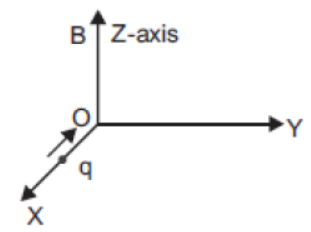
**(ii) Kinetic Energy:** No, the charge does not gain any kinetic energy. The magnetic force \( \vec{F} = q(\vec{v} \times \vec{B}) \) is always perpendicular to the velocity of the particle at every point on its path. As a result, the work done on the charge is zero (\( W = 0 \)), which means its speed and kinetic energy remain constant.
In simple words: (i) Since the magnetic force pulls the charge downward, it travels in a circle curving into the bottom-right quadrant of the flat page. (ii) It gains zero energy because the magnetic force only changes its direction, not its speed.
Exam Tip: Identify that the trajectory is a circle in the x-y plane, and always emphasize that magnetic forces do zero work.
Question 23. Explain how Biot - Savart law enables one to express the Ampere’s circuital law in the integral form, viz., \( \oint \vec{B} \cdot d\vec{l} = \mu_0 I \) where I is the total current passing through the surface.
Answer: The Biot-Savart Law defines the magnetic field \( d\vec{B} \) of a small current element as \( d\vec{B} = \frac{\mu_0}{4\pi} \frac{I (d\vec{l} \times \hat{r})}{r^2} \).
For an infinitely long straight wire carrying a current \( I \), integrating the Biot-Savart Law over the entire length of the wire gives the magnetic field \( B \) at a perpendicular distance \( r \):
\( B = \frac{\mu_0 I}{2\pi r} \) --- (1)
This magnetic field is directed along circular paths concentric with the wire.
Now, let us evaluate the closed line integral of this magnetic field \( \vec{B} \) along a circular Amperian loop of radius \( r \) around the wire:
\( \oint \vec{B} \cdot d\vec{l} = \oint B \cdot dl \cos 0^\circ \)
Since \( B \) is constant at a distance \( r \):
\( \oint \vec{B} \cdot d\vec{l} = B \oint dl = B (2\pi r) \) --- (2)
Substituting the value of \( B \) from (1) into (2):
\( \oint \vec{B} \cdot d\vec{l} = \left( \frac{\mu_0 I}{2\pi r} \right) (2\pi r) = \mu_0 I \).
This demonstrates that integrating the field derived from the Biot-Savart Law directly results in the integral form of Ampere's Circuital Law.
In simple words: Biot-Savart Law calculates the magnetic field of a straight wire as \( \frac{\mu_0 I}{2\pi r} \). Multiplying this field by the circumference of a circle of radius \( r \) around the wire cancels out \( 2\pi r \), leaving exactly \( \mu_0 I \), which is Ampere's Law.
Exam Tip: This is a classic theoretical derivation showing the consistency between the two fundamental laws of electromagnetism. Keep the integration steps clear.
Section B: Numerical Problems
Question 1. Two small identical circular coils marked 1 and 2 carryequal currents and are placed with their geometric axesperpendicular to each other as shown in the figure. Derive an expression for the resultant magnetic field at O
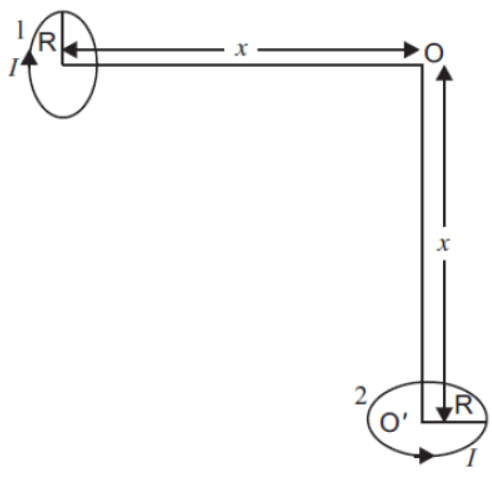
Answer: Let \( R \) be the radius of each coil and \( x \) be the distance from the center of each coil to the point \( O \). The magnetic field \( B \) along the axis of a circular coil carrying current \( I \) is:
\( B_1 = B_2 = \frac{\mu_0 I R^2}{2 (R^2 + x^2)^{3/2}} \)
Since the axes of the two coils are perpendicular to each other, the magnetic field vectors \( \vec{B}_1 \) and \( \vec{B}_2 \) at point \( O \) are also perpendicular to each other.
The magnitude of the resultant magnetic field \( B_{\text{net}} \) is:
\( B_{\text{net}} = \sqrt{B_1^2 + B_2^2} = \sqrt{2 B_1^2} = \sqrt{2} B_1 \)
\( \implies B_{\text{net}} = \sqrt{2} \frac{\mu_0 I R^2}{2 (R^2 + x^2)^{3/2}} \).
The direction of the resultant field is at an angle of \( 45^\circ \) to the axis of either coil.
In simple words: Because the two identical coils are perpendicular, their magnetic fields meet at a 90-degree angle. We find the total field using the Pythagorean theorem, which multiplies the field of one coil by the square root of 2.
Exam Tip: Always remember to state that the angle of the resultant vector is \( 45^\circ \) because the two component field vectors are equal in magnitude.
Question 2. A moving coil galvanometer has a resistance of 10Ω , and produces full scale deflection for a current of 25mA. How can the instrument be adopted to measure i) voltages upto120V ii)currents upto 20A?
Answer: Given:
- Galvanometer resistance, \( G = 10\text{ }\Omega \)
- Full-scale deflection current, \( I_g = 25\text{ mA} = 0.025\text{ A} \)
**(i) To measure voltages up to \( V = 120\text{ V} \):**
We connect a high resistance \( R \) in series with the galvanometer:
\( R = \frac{V}{I_g} - G = \frac{120}{0.025} - 10 = 4800 - 10 = 4790\text{ }\Omega \).
Thus, a resistance of **\( 4790\text{ }\Omega \)** must be connected in series.
**(ii) To measure currents up to \( I = 20\text{ A} \):**
We connect a low shunt resistance \( S \) in parallel with the galvanometer:
\( S = \frac{I_g G}{I - I_g} = \frac{0.025 \times 10}{20 - 0.025} = \frac{0.25}{19.975} \approx 0.0125\text{ }\Omega \).
Thus, a shunt resistance of **\( 0.0125\text{ }\Omega \)** must be connected in parallel.
In simple words: To measure 120V, block the excess current with a 4790-ohm resistor in series. To measure 20A, divert the excess current using a tiny 0.0125-ohm bypass resistor in parallel.
Exam Tip: Double-check your divisions: dividing by 0.025 is mathematically equivalent to multiplying by 40.
Question 3. A voltmeter can measure upto 25V and its resistance is 1000Ω. What has to be done to make it measure upto 250 V?
Answer: Let \( V_1 = 25\text{ V} \) be the initial range, and \( R_1 = 1000\text{ }\Omega \) be the voltmeter resistance. The full-scale current is:
\( I_g = \frac{V_1}{R_1} = \frac{25}{1000} = 0.025\text{ A} \)
To increase the range to \( V_2 = 250\text{ V} \), we must connect an additional resistance \( R \) in series:
\( V_2 = I_g (R_1 + R) \)
\( \implies 250 = 0.025 (1000 + R) \)
\( \implies 1000 + R = \frac{250}{0.025} = 10000 \)
\( \implies R = 9000\text{ }\Omega \).
Therefore, a resistance of **\( 9000\text{ }\Omega \)** must be connected in series.
In simple words: To increase the voltmeter's range by 10 times, we must increase the total resistance by 10 times. This means adding a 9000-ohm resistor in series with the existing 1000-ohm coil.
Exam Tip: A quick shortcut is \( R = (n-1)R_g \), where \( n = \frac{250}{25} = 10 \). Thus \( R = 9 \times 1000 = 9000\text{ }\Omega \).
Question 4. A solenoid is 2m long and 3cm in diameter.It has 5 layers of windings of 1000 turns each and carries a current of 5A.What is the magnetic field at its centre? How will the magnetic induction change when a core of i) antimony ii) soft iron is introduced inside the solenoid?
Answer: Given:
- Length, \( L = 2\text{ m} \)
- Total turns, \( N = 5 \times 1000 = 5000\text{ turns} \)
- Current, \( I = 5\text{ A} \)
The number of turns per unit length is:
\( n = \frac{N}{L} = \frac{5000}{2} = 2500\text{ turns/m} \)
The magnetic field \( B \) at the center of the solenoid is:
\( B = \mu_0 n I = (4\pi \times 10^{-7}) \times 2500 \times 5 = 5\pi \times 10^{-3}\text{ T} \approx 1.57 \times 10^{-2}\text{ T} \).
**Effects of cores:**
(i) **Antimony (Diamagnetic):** The magnetic field will **decrease slightly** because the relative permeability is less than 1 (\( \mu_r < 1 \)).
(ii) **Soft Iron (Ferromagnetic):** The magnetic field will **increase enormously** because of its very high relative permeability (\( \mu_r \gg 1 \)).
In simple words: The base magnetic field at the center is 0.0157 Tesla. Adding an antimony core weakens this field slightly, whereas adding a soft iron core boosts its strength by thousands of times.
Exam Tip: Be sure to multiply the layers of windings to get the total number of turns (\( N = 5000 \)) before starting.
Question 5. A 0.5 m long solenoid has 500turns and has a magnetic field of 2.52 x 10⁻³ T at its centre. Find the i) current in the solenoid ii) magnetic field at one end of the solenoid.
Answer: Given:
- Length, \( L = 0.5\text{ m} \)
- Turns, \( N = 500 \)
- Magnetic field at center, \( B_{\text{center}} = 2.52 \times 10^{-3}\text{ T} \)
The turns per unit length is \( n = \frac{N}{L} = \frac{500}{0.5} = 1000\text{ turns/m} \).
**(i) Current in the solenoid (\( I \)):**
\( B_{\text{center}} = \mu_0 n I \)
\( \implies 2.52 \times 10^{-3} = (4\pi \times 10^{-7}) \times 1000 \times I \)
\( \implies I = \frac{2.52 \times 10^{-3}}{4\pi \times 10^{-4}} = \frac{2.52}{0.4\pi} \approx 2\text{ A} \).
**(ii) Magnetic field at one end of the solenoid:**
The magnetic field at the end of a long solenoid is exactly half of the field at its center:
\( B_{\text{end}} = \frac{1}{2} B_{\text{center}} = \frac{2.52 \times 10^{-3}}{2} = 1.26 \times 10^{-3}\text{ T} \).
In simple words: To produce this field, a current of 2 amperes must flow through the coil. At either open end of the solenoid, the magnetic strength drops to exactly half of its central value, which is 0.00126 Tesla.
Exam Tip: Always remember that the magnetic field at the ends of a solenoid is \( \frac{\mu_0 n I}{2} \), which is half of the central value.
Question 6. A straight wire carries a current of 3A in the upward direction. Calculate the magnitude of magnetic field at a point 15cm away from the wire. Draw a diagram to show the direction of magnetic field and current.
Answer: Given:
- Current, \( I = 3\text{ A} \)
- Perpendicular distance, \( r = 15\text{ cm} = 0.15\text{ m} \)
The magnitude of the magnetic field \( B \) is:
\( B = \frac{\mu_0 I}{2\pi r} = \frac{(4\pi \times 10^{-7}) \times 3}{2\pi \times 0.15} = \frac{2 \times 10^{-7} \times 3}{0.15} = 4 \times 10^{-6}\text{ T} \).
**Direction:** According to the Right-Hand Grip Rule, if the thumb points upward (direction of current), the fingers curl in an anticlockwise direction as viewed from above.
In simple words: At a distance of 15 cm, the magnetic field strength is 4 microtesla. The field wraps around the upward-pointing wire in circular, counter-clockwise loops.
Exam Tip: Always convert the distance to meters first. State the Right-Hand Grip Rule to justify your direction drawing.
Question 7. In a chamber a uniform magnetic field of 6.5G (1G =10-4T) is maintained .An electron is shot into the field with a speed of 4.8x 10⁶m/s ,normal to the field. State whether the path of the electron would be circle or helix ? What would be the radius of the path?
Answer: Since the electron is shot perpendicular (normal) to the magnetic field (\( \theta = 90^\circ \)), the magnetic force acts as a perfect centripetal force. Therefore, the path of the electron will be a **circle**.
Given:
- Magnetic field, \( B = 6.5\text{ G} = 6.5 \times 10^{-4}\text{ T} \)
- Speed, \( v = 4.8 \times 10^6\text{ m/s} \)
- Electron mass, \( m = 9.1 \times 10^{-31}\text{ kg} \)
- Electron charge, \( q = 1.6 \times 10^{-19}\text{ C} \)
The radius \( r \) of the circular path is:
\( r = \frac{m v}{q B} = \frac{(9.1 \times 10^{-31}) \times (4.8 \times 10^6)}{(1.6 \times 10^{-19}) \times (6.5 \times 10^{-4})} \)
\( r = \frac{43.68 \times 10^{-25}}{1.04 \times 10^{-22}} = 4.2 \times 10^{-2}\text{ m} = 4.2\text{ cm} \).
Thus, the radius of the path is **\( 4.2\text{ cm} \)**.
In simple words: Because the electron enters at a right angle, it spins in a perfect circle. Solving for its radius using its mass and speed gives exactly 4.2 centimeters.
Exam Tip: Don't forget to convert Gauss (G) to Tesla (T) by multiplying by \( 10^{-4} \). This is a very common source of calculation errors.
Question 8. What is the magnitude of force per unit length on a wire carrying a current of 8A and making an angle of 30◦ with the direction of a uniform magnetic field of 0.15T ?
Answer: The magnetic force acting on a current-carrying wire is \( F = I l B \sin\theta \).
The force per unit length is:
\( \frac{F}{l} = I B \sin\theta \)
Given:
- Current, \( I = 8\text{ A} \)
- Magnetic field, \( B = 0.15\text{ T} \)
- Angle, \( \theta = 30^\circ \)
Substituting these values:
\( \frac{F}{l} = 8 \times 0.15 \times \sin 30^\circ = 1.2 \times 0.5 = 0.6\text{ N/m} \).
Therefore, the magnitude of the force per unit length is **\( 0.6\text{ N/m} \)**.
In simple words: Multiplying the current by the magnetic field and the sine of the angle shows that the magnetic field exerts a push of 0.6 Newtons on every meter of the wire.
Exam Tip: This is a direct, straightforward calculation. Make sure to state the unit as Newtons per meter (\( \text{N/m} \)) for force per unit length.
Question 9. A charge q moving in a straight line is accelerated by a pd of V. It enters a uniform magnetic field normal to it .Deduce the expression for the radius of circular path in terms of V
Answer: When a charge \( q \) is accelerated through a potential difference \( V \), its gained kinetic energy \( K \) is:
\( K = q V \)
Since \( K = \frac{p^2}{2m} \), the momentum \( p \) of the charge is:
\( p = \sqrt{2 m K} = \sqrt{2 m q V} \)
When this charge enters a perpendicular magnetic field, it moves in a circular path of radius \( r \):
\( r = \frac{m v}{q B} = \frac{p}{q B} \)
Substituting the value of momentum \( p \):
\( r = \frac{\sqrt{2 m q V}}{q B} = \frac{1}{B} \sqrt{\frac{2 m V}{q}} \).
This is the required expression for the radius in terms of \( V \).
In simple words: The voltage gives the charge kinetic energy and speed. By substituting this speed into the circular motion radius formula, we find the radius is \( \frac{1}{B} \sqrt{\frac{2 m V}{q}} \).
Exam Tip: This derivation is highly popular. Always show the step connecting potential energy (\( qV \)) to momentum (\( p = \sqrt{2mqV} \)) clearly.
Question 10. Calculate the force per unit length of a long straight wire carrying a current of 4A due to a parallel wire carrying a current of 6A in same direction, if the distance between the wires is 3cm find the nature of force also.
Answer: The force per unit length between two parallel current-carrying wires is:
\( \frac{F}{l} = \frac{\mu_0 I_1 I_2}{2\pi d} \)
Given:
- \( I_1 = 4\text{ A} \), \( I_2 = 6\text{ A} \)
- Distance, \( d = 3\text{ cm} = 0.03\text{ m} \)
Substituting these values:
\( \frac{F}{l} = \frac{(4\pi \times 10^{-7}) \times 4 \times 6}{2\pi \times 0.03} = \frac{2 \times 10^{-7} \times 24}{0.03} = 1.6 \times 10^{-4}\text{ N/m} \).
**Nature of Force:** Since the currents flow in the same direction, the force is **attractive** in nature.
In simple words: The two parallel wires exert a mutual magnetic pull of \( 1.6 \times 10^{-4} \) Newtons on every meter of their length. Because the currents are moving in the same direction, they attract each other.
Exam Tip: Always explicitly state the nature of the force (attractive or repulsive) as part of your final answer to get full credit.
Question 11. An electron in an atom revolves around the nucleus in an orbit of radius 0.53angstrom.Calculate the equivalent magnetic moment if the frequency of revolution of electron is 6.8 x 10⁹ MHz
Answer: Given:
- Radius, \( r = 0.53\text{ \AA} = 0.53 \times 10^{-10}\text{ m} \)
- Frequency, \( \nu = 6.8 \times 10^9\text{ MHz} = 6.8 \times 10^{15}\text{ Hz} \)
The current \( I \) due to the revolving electron is:
\( I = \frac{e}{T} = e \nu = (1.6 \times 10^{-19}\text{ C}) \times (6.8 \times 10^{15}\text{ Hz}) = 1.088 \times 10^{-3}\text{ A} \).
The area \( A \) of the orbit is:
\( A = \pi r^2 = \pi \times (0.53 \times 10^{-10})^2 \approx 8.82 \times 10^{-21}\text{ m}^2 \).
The equivalent magnetic dipole moment \( M \) is:
\( M = I A = (1.088 \times 10^{-3}\text{ A}) \times (8.82 \times 10^{-21}\text{ m}^2) \approx 9.6 \times 10^{-24}\text{ A m}^2 \) (or \( \text{J/T} \)).
In simple words: The spinning electron acts like a microscopic loop of electrical current. Calculating this current and multiplying it by the circle's area gives a tiny magnetic moment of \( 9.6 \times 10^{-24} \text{ A m}^2 \).
Exam Tip: Convert the frequency from MHz to Hz by multiplying by \( 10^6 \). A very common mistake is missing this conversion factor.
Question 12. A magnetic field of 2 x10³ A/m produces a magnetic induction of 4π Wb/m2 in a bar of iron. Calculate the relative permeability and susceptibility of iron.
Answer: Given:
- Magnetic intensity, \( H = 2 \times 10^3\text{ A/m} \)
- Magnetic induction, \( B = 4\pi\text{ T} \) (or \( \text{Wb/m}^2 \))
**1. Relative Permeability (\( \mu_r \)):**
We know \( B = \mu H = \mu_r \mu_0 H \).
\( \implies \mu_r = \frac{B}{\mu_0 H} = \frac{4\pi}{((4\pi \times 10^{-7}) \times (2 \times 10^3))} = \frac{1}{2 \times 10^{-4}} = 5000 \).
**2. Magnetic Susceptibility (\( \chi_m \)):**
\( \chi_m = \mu_r - 1 = 5000 - 1 = 4999 \).
In simple words: The iron core concentrates the magnetic lines, making the field 5000 times stronger than it would be in a vacuum. Its relative permeability is 5000, and its susceptibility is 4999.
Exam Tip: Susceptibility and relative permeability are dimensionless ratios, so do not write any units for them.
Question 13. Two magnetic poles , one of which is twice stronger than the other, repel one another with a force of 2 x10⁻⁵ N, when kept at a separation of 20cm in air. Calculate the pole strengths of the two poles.
Answer: According to Coulomb's Law for magnetic poles, the force of repulsion is:
\( F = \frac{\mu_0}{4\pi} \frac{m_1 m_2}{d^2} \)
Let the pole strengths be \( m_1 = x \) and \( m_2 = 2x \).
Given:
- \( F = 2 \times 10^{-5}\text{ N} \)
- \( d = 20\text{ cm} = 0.2\text{ m} \)
Substituting these values:
\( 2 \times 10^{-5} = 10^{-7} \times \frac{x \cdot (2x)}{0.2^2} \)
\( \implies 2 \times 10^{-5} = 10^{-7} \times \frac{2x^2}{0.04} \)
\( \implies 2 \times 10^{-5} = 5 \times 10^{-6} x^2 \)
\( \implies x^2 = \frac{2 \times 10^{-5}}{5 \times 10^{-6}} = 4 \implies x = 2\text{ A m} \).
Therefore:
- Strength of the first pole, \( m_1 = 2\text{ A m} \)
- Strength of the second pole, \( m_2 = 4\text{ A m} \).
In simple words: By setting up Coulomb's magnetic law, we calculate that the two magnetic poles have strengths of 2 A m and 4 A m.
Exam Tip: Always write the unit of pole strength as Ampere-meter (\( \text{A m} \)) to maintain standard marking schemes.
Question 14. Calculate the intensity of magnetization of earth ,assume the earth to be a giant bar magnet of magnetic moment 8.0 x 10²² Am2 , take the earth’s radius to be 6400km
Answer: The intensity of magnetization \( I \) is defined as the magnetic moment \( M \) per unit volume \( V \):
\( I = \frac{M}{V} \)
The Earth is assumed to be a sphere of radius \( R = 6400\text{ km} = 6.4 \times 10^6\text{ m} \). Its volume is:
\( V = \frac{4}{3} \pi R^3 = \frac{4}{3} \pi (6.4 \times 10^6)^3 \approx 1.1 \times 10^{21}\text{ m}^3 \).
Given the magnetic moment \( M = 8.0 \times 10^{22}\text{ A m}^2 \):
\( I = \frac{8.0 \times 10^{22}}{1.1 \times 10^{21}} \approx 72.7\text; \text{ A/m} \).
Therefore, the intensity of magnetization of the Earth is approximately **\( 72.7\text{ A/m} \)**.
In simple words: If the entire Earth were a single magnet, its magnetization density (intensity of magnetization) would be about 72.7 amperes per meter.
Exam Tip: Keep track of your power-of-ten math when cubing the Earth's radius, as this is a frequent calculation bottleneck.
Question 15. A bar magnet made of steel has a magnetic moment of 2.5Am2 and a mass of 6.0 x10⁻³ kg. If the density of steel is 7.9 x 10³kg/m3 , find the intensity of magnetization of the magnet
Answer: Given:
- Magnetic moment, \( M = 2.5\text{ A m}^2 \)
- Mass, \( m = 6.0 \times 10^{-3}\text{ kg} \)
- Density, \( d = 7.9 \times 10^3\text{ kg/m}^3 \)
First, we calculate the volume \( V \) of the steel bar magnet:
\( V = \frac{\text{Mass}}{\text{Density}} = \frac{6.0 \times 10^{-3}}{7.9 \times 10^3} \approx 7.59 \times 10^{-7}\text{ m}^3 \).
The intensity of magnetization \( I \) is:
\( I = \frac{M}{V} = \frac{2.5}{7.59 \times 10^{-7}} \approx 3.29 \times 10^6\text{ A/m} \).
Therefore, the intensity of magnetization of the magnet is **\( 3.29 \times 10^6\text{ A/m} \)**.
In simple words: Using mass and density to find the volume, we divide the magnet's strength by this volume, finding its magnetization intensity is \( 3.29 \times 10^6\text{ A/m} \).
Exam Tip: State the formulas for both volume and intensity of magnetization clearly before beginning the numerical divisions.
Question 16. A circular coil of 100 turns and radius 10cm carries a current of 5A. It is suspended vertically in a uniform horizontal magnetic field of 0.5T, the field lines making an angle of 60◦ with the plane of the coil .Calculate the magnitude of the torque that must be applied on it to prevent it from turning.
Answer: Given:
- Turns, \( N = 100 \)
- Radius, \( r = 10\text{ cm} = 0.1\text{ m} \)
- Current, \( I = 5\text{ A} \)
- Magnetic field, \( B = 0.5\text{ T} \)
- Angle with the plane of the coil, \( \alpha = 60^\circ \).
The angle \( \theta \) between the normal to the plane (area vector) and the magnetic field is:
\( \theta = 90^\circ - \alpha = 90^\circ - 60^\circ = 30^\circ \).
The area of the coil is:
\( A = \pi r^2 = \pi \times (0.1)^2 = 0.01\pi\text{ m}^2 \approx 0.0314\text{ m}^2 \).
The torque \( \tau \) acting on the coil is:
\( \tau = N I A B \sin\theta \)
\( \implies \tau = 100 \times 5 \times (0.01\pi) \times 0.5 \times \sin 30^\circ \)
\( \implies \tau = 2.5\pi \times 0.5 = 1.25\pi \approx 3.93\text{ N m} \).
Therefore, the required balancing torque is **\( 3.93\text{ N m} \)**.
In simple words: The magnetic field twists the coil. To keep it from spinning, we must apply an equal and opposite torque of 3.93 Newton-meters.
Exam Tip: Be very careful: the formula uses the angle \( \theta \) with the normal. If the angle with the plane is given as \( \alpha \), use \( \theta = 90^\circ - \alpha \).
Question 17. Two concentric circular coils X and Y of radii 16cm and 10cm respectively, lie in the same vertical plane containing north to south direction. Coil X has 20 turns and coil Y 25 turns ; they carry currents of 16A and 18A respectively. In coil X ,the current direction is anti clock wise and in coil Y ,the current direction is clock wise ,with respect to an observer looking at the coils facing west. Find the magnitude and direction of the net magnetic field with respect to the observer.
Answer: For an observer facing west:
1. **Coil X (Radii \( r_1 = 0.16\text{ m} \), \( N_1 = 20 \), \( I_1 = 16\text{ A} \)):**
The current is anticlockwise, so the magnetic field \( \vec{B}_X \) points **East** (towards the observer). Its magnitude is:
\( B_X = \frac{\mu_0 N_1 I_1}{2 r_1} = \frac{(4\pi \times 10^{-7}) \times 20 \times 16}{2 \times 0.16} = 4\pi \times 10^{-4}\text{ T} \).
2. **Coil Y (Radii \( r_2 = 0.10\text{ m} \), \( N_2 = 25 \), \( I_2 = 18\text{ A} \)):**
The current is clockwise, so the magnetic field \( \vec{B}_Y \) points **West** (away from the observer). Its magnitude is:
\( B_Y = \frac{\mu_0 N_2 I_2}{2 r_2} = \frac{(4\pi \times 10^{-7}) \times 25 \times 18}{2 \times 0.10} = 9\pi \times 10^{-4}\text{ T} \).
Since \( B_Y > B_X \), the net magnetic field is directed towards the **West**:
\( B_{\text{net}} = B_Y - B_X = 9\pi \times 10^{-4} - 4\pi \times 10^{-4} = 5\pi \times 10^{-4}\text{ T} \approx 1.57 \times 10^{-3}\text{ T} \).
Thus, the net magnetic field has a magnitude of **\( 1.57 \times 10^{-3}\text{ T} \)** and is directed **West**.
In simple words: The two concentric coils fight each other. Coil Y creates a stronger field pointing West, while Coil X creates a weaker field pointing East. Subtracting them shows the net field is 1.57 millitesla directed West.
Exam Tip: Clearly specify the directions using compass points (East/West) to make your solution easy for the examiner to read.
Question 18. A short bar magnet of magnetic moment 0.5 J/T is placed with its axis is 30° to a uniform magnetic of 0.1 T. Calculate (i) the magnitude of the torque experienced and (ii) the direction onwhich it acts.
Answer: Given:
- Magnetic moment, \( M = 0.5\text{ J/T} \)
- Magnetic field, \( B = 0.1\text{ T} \)
- Angle, \( \theta = 30^\circ \)
**(i) Magnitude of torque (\( \tau \)):**
\( \tau = M B \sin\theta = 0.5 \times 0.1 \times \sin 30^\circ = 0.05 \times 0.5 = 0.025\text{ N m} \).
**(ii) Direction:**
The torque vector \( \vec{\tau} = \vec{M} \times \vec{B} \) acts in a direction **perpendicular to the plane containing both the magnetic moment and the magnetic field vectors**, tending to align the magnet's axis parallel to the magnetic field.
In simple words: (i) The torque twisting the bar magnet has a magnitude of 0.025 Newton-meters. (ii) Its direction is perpendicular to the plane of the field, acting to align the magnet with the external lines.
Exam Tip: Remember that torque is a vector cross-product, so its direction is always perpendicular to the plane formed by \( \vec{M} \) and \( \vec{B} \).
Question 19. A magnetised needle of magnetic moment 4.8 × 10⁻² J T–1 is placed at 30° with the direction of uniform magnetic field of magnitude 3 × 10⁻² T. Calculate the torque acting on the needle.
Answer: Given:
- Magnetic moment, \( M = 4.8 \times 10^{-2}\text{ J/T} \)
- Magnetic field, \( B = 3 \times 10^{-2}\text{ T} \)
- Angle, \( \theta = 30^\circ \)
The torque \( \tau \) acting on the needle is:
\( \tau = M B \sin\theta \)
\( \implies \tau = (4.8 \times 10^{-2}) \times (3 \times 10^{-2}) \times \sin 30^\circ \)
\( \implies \tau = 14.4 \times 10^{-4} \times 0.5 = 7.2 \times 10^{-4}\text{ N m} \).
Therefore, the torque acting on the needle is **\( 7.2 \times 10^{-4}\text{ N m} \)**.
In simple words: By multiplying the needle's magnetic moment, the field strength, and the sine of 30 degrees, we find the twisting torque is \( 7.2 \times 10^{-4} \) Newton-meters.
Exam Tip: Keep track of the negative exponents in the powers of ten during your multiplication steps.
Question 20. A beam of proton passes undeflected with a horizontal velocity v, through a region of electric andmagnetic fields, mutually perpendicular to each other and perpendicular to the direction of thebeam. If the magnitudes of the electric and magnetic fields are 100 kV/m, 50 mT respectively,calculate
(i) velocity of the beam v.
(ii) force exerted by the beam on a target on the screen, if the proton beam carries a current of 0.80 mA.
Answer: Given:
- Electric field, \( E = 100\text{ kV/m} = 10^5\text{ V/m} \)
- Magnetic field, \( B = 50\text{ mT} = 50 \times 10^{-3}\text{ T} = 0.05\text{ T} \)
- Current, \( I = 0.80\text{ mA} = 8 \times 10^{-4}\text{ A} \)
**(i) Velocity of the beam (\( v \)):**
Since the beam passes undeflected through the crossed fields, the electric force balances the magnetic force:
\( q E = q v B \implies v = \frac{E}{B} \)
\( \implies v = \frac{10^5}{0.05} = 2 \times 10^6\text{ m/s} \).
The velocity of the beam is **\( 2 \times 10^6\text{ m/s} \)**.
**(ii) Force exerted by the beam on the target:**
Let \( n' \) be the number of protons hitting the target per second. The current is:
\( I = n' \cdot e \implies n' = \frac{I}{e} \)
When a proton of mass \( m_p \) hits the target, it stops, so its change in momentum is \( \Delta p = m_p v \).
The force \( F \) exerted by the beam is the rate of change of momentum:
\( F = n' \cdot m_p v = \left( \frac{I}{e} \right) m_p v \)
Substituting the values (\( m_p = 1.67 \times 10^{-27}\text{ kg} \), \( e = 1.6 \times 10^{-19}\text{ C} \)):
\( F = \left( \frac{8 \times 10^{-4}}{1.6 \times 10^{-19}} \right) \times (1.67 \times 10^{-27}) \times (2 \times 10^6) \)
\( F = (5 \times 10^{15}) \times (3.34 \times 10^{-21}) = 1.67 \times 10^{-5}\text{ N} \).
Therefore, the force exerted on the target is **\( 1.67 \times 10^{-5}\text{ N} \)**.
In simple words: (i) Since the forces cancel, the proton speed is \( E/B \), which equals 2 million meters per second. (ii) By calculating how many protons hit the target per second and multiplying by their individual momentum, we find the total force is \( 1.67 \times 10^{-5} \) Newtons.
Exam Tip: This is an advanced composite numerical. State the velocity selector formula \( v = E/B \) and the momentum force equation \( F = n' m v \) clearly.
Free study material for Physics
CBSE Class 12 Physics Worksheets for Chapter 04 Moving Charges and Magnetism
Mastering Chapter 04 Moving Charges and Magnetism with Printable Worksheets
Review targeted practice exercises for Class 12 Physics Chapter 04 Moving Charges and Magnetism. Curated to match official CBSE guidelines, these printable problem sets support daily revision and improve overall test readiness.
Verified Solutions and NCERT Alignment
Each worksheet draws directly from authorized standard textbooks to maintain academic accuracy. Evaluating your finished exercises against expert-verified solutions helps master the formal presentation standards expected in school evaluations.
Additional Study Resources for Class 12 Physics
Consistent engagement with these exercises builds familiarity with recurring exam themes. If specific areas within Chapter 04 Moving Charges and Magnetism cause trouble, utilize our dedicated NCERT solutions for Class 12 Physics to clear up doubts immediately.
FAQs
You can download the latest chapter-wise printable worksheets for Class 12 Physics Chapter 04 Moving Charges and Magnetism for free from StudiesToday.com. These have been made as per the latest CBSE curriculum for this academic year.
Yes, Class 12 Physics worksheets for Chapter 04 Moving Charges and Magnetism focus on activity-based learning and also competency-style questions. This helps students to apply theoretical knowledge to practical scenarios.
Yes, we have provided solved worksheets for Class 12 Physics Chapter 04 Moving Charges and Magnetism to help students verify their answers instantly.
Yes, our Class 12 Physics test sheets are mobile-friendly PDFs and can be printed by teachers for classroom.
For Chapter 04 Moving Charges and Magnetism, regular practice with our worksheets will improve question-handling speed and help students understand all technical terms and diagrams.