

Chapter-wise Worksheets for Class 12 Physics: Chapter 11 Dual Nature of Radiation and Matter
Explore structured practice materials through the CBSE Class 12 Physics Dual Nature Of Matter And Radiation Worksheet Set 02. Tailored for Class 12 learners, utilizing these Physics worksheets ensures thorough preparation and strengthens problem-solving accuracy before final school evaluations.
Practice Class 12 Physics Worksheets: Chapter 11 Dual Nature of Radiation and Matter
Navigate directly to the solved Physics worksheets using the digital viewer below. Each practice set includes detailed step-by-step solutions, allowing students to instantly cross-check their work and identify areas requiring further revision.
CBSE Class 12 Physics Dual nature of radiation Atoms and Nuclei.Students can download these worksheets and practice them. This will help them to get better marks in examinations. Also refer to other worksheets for the same chapter and other subjects too. Use them for better understanding of the subjects.
1 What is the stopping potential applied to a a photocell if the maximum kinetic energy of a photoelectron is 5eV ?
2 Work functions of two metals A and B are 4eV and 10 eV respectively . Which metal has the higher threshold wavelength ?
3 Two beams ,one of red light and the other of blue light , of same intrensity incident on a metallic surface to emit Photoelectrons. Which one of them emits electrons of greater kinetic energy?
4 How does the stopping potential of a Photo cell change ,when i) the intensity of the incident radiation is halved? Ii) frequency of incident radiation increases ?
5 If the potential difference used to accelerate electrons is tripled , by what factor the de Broglie wavelength of electron beam change?
6 An electron and proton have the same kinetic energy .Which one of them has the larger de Broglie wavelength.
7 An alpha particle and a proton are accelerated from rest by the same potential. Find the ratio of their de Broglie wavelengths.
8 Show graphically the variation of de Broglie wavelength λ of an electron with i)√V ii) V where V is the potential through which an electron is accelerated from rest.
9 Name the experiment which verified the wave nature of electrons.
Which phenomenon was observed in this experiment using an electron beam?
10 Why Caesium oxide is coated on the cathode of Photo electric cell?
Important Questions for NCERT Class 12 Physics Dual Nature Of Matter And Radiation
Question. The stopping potential doubles when the frequency of the incident light changes from n to 3v/2. Then the work function of the metal must be
(a) hν/2
(b) hν
(c) 2hν
(d) none of the above
Answer : A
Question. The force on a hemisphere of radius 1 cm if a parallel beam of monochromatic light of wavelength 500 nm. falls on it with an intensity of 0.5 W/cm2, striking the curved surface in a direction which is perpendicular to the flat face of the hemisphere is (assume the collisions to be perfectly inelastic)
(a) 5.2 × 10⁻¹³ N
(b) 5.2 × 10⁻¹² N
(c) 5.22 × 10⁻⁹ N
(d) zero
Answer : C
Question. A 15.0 eV photon collides with and ionizes a hydrogen atom. If the atom was originally in the ground state (ionization potential =13.6 eV), what is the kinetic energy of the ejected electron?
(a) 1.4 eV
(b) 13.6 eV
(c) 15.0 eV
(d) 28.6 eV
Answer : A
Question. A beam of cathode rays is subjected to crossed electric (E) and magnetic fields (B). The fields are adjusted such that the beam is not deflected. The specific charge of the cathode rays is given by
(a) B2/2VE2
(b) 2VB2/E2
(c) 2VE2/B2
(d) E2/2VB2
(Where V is the potential difference between cathode and anode)
Answer : D
Question. In the phenomenon of electric discharge through gases at low pressure, the coloured glow in the tube appears as a result of
(a) collisions between the charged particles emitted from the cathode and the atoms of the gas
(b) collision between different electrons of the atoms of the gas
(c) excitation of electrons in the atoms
(d) collision between the atoms of the gas.
Answer : A
Question. In a discharge tube ionization of enclosed gas is produced due to collisions between
(a) neutral gas atoms/molecules
(b) positive ions and neutral atoms/molecules
(c) negative electrons and neutral atoms/molecules
(d) photons and neutral atoms/molecules.
Answer : C
Question. J.J. Thomson’s cathode-ray tube experiment demonstrated that
(a) cathode rays are streams of negatively charged ions
(b) all the mass of an atom is essentially in the nucleus
(c) the e/m of electrons is much greater than the e/m of protons
(d) the e/m ratio of the cathode-ray particles changes when a different gas is placed in the discharge tube
Answer : C
Question. Which of the following is not the property of cathode rays ?
(a) It produces heating effect.
(b) It does not deflect in electric field.
(c) It casts shadow.
(d) It produces fluorescence.
Answer : B
Question. Who evaluated the mass of electron indirectly with help of charge?
(a) Thomson
(b) Millikan
(c) Rutherford
(d) Newton
Answer : A
Question. In a discharge tube at 0.02 mm, there is formation of
(a) Crooke’s dark space
(b) Faraday’s dark space
(c) both space partly
(d) none of these.
Answer : A
Question. In which of the following, emission of electrons does not take place
(a) thermionic emission
(b) X-rays emission
(c) photoelectric emission
(d) secondary emission
Answer : B
Question. Thermions are
(a) protons
(b) electrons
(c) photons
(d) positrons
Answer : B
Question. A source of light is placed at a distance of 50 cm from a photo cell and the stopping potential is found to be V0. If the distance between the light source and photo cell is made 25 cm, the new stopping potential will be :
(a) V0/2
(b) V0
(c) 4V0
(d) 2V0
Answer : B
Question. Photoelectric emission occurs only when the incident light has more than a certain minimum
(a) power
(b) wavelength
(c) intensity
(d) frequency
Answer : D
Question. A 200 W sodium street lamp emits yellow light of wavelength 0.6 μm. Assuming it to be 25% efficient in converting electrical energy to light, the number of photons of yellow light it emits per second is
(a) 1.5 × 10²⁰
(b) 6 × 10¹⁸
(c) 62 × 1020
(d) 3 × 10¹⁹
Answer: A
Question. A photoelectric surface is illuminated successively by monochromatic light of wavelength λ and λ/2 . If the maximum kinetic energy of the emitted photoelectrons in the second case is 3 times that in the first case, the work function of the surface of the material is :
(h = Planck's constant, c = speed of light)
(a) hc/λ
(b) 2hc/λ
(c) hc/3λ
(d) hc/2λ
Answer: D
Question. An electron of mass m and a photon have same energy E.
The ratio of de-Broglie wavelengths associated with them is :
(a) 1/c(E/2m)1/2
(b) (E/2m)1/2
(c) c(2mE)1/2
(d) 1/xc(2m/E)1/2
Answer: A
Question. The de-Broglie wavelength of a neutron in thermal equilibrium with heavy water at a temperature T (Kelvin) and mass m, is :-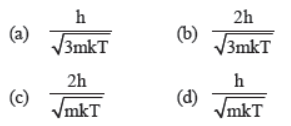
Answer: A
Question. Photoelectric work function of a metal is 1eV. Light of wavelength λ = 3000 Å falls on it. The photo electrons come out with velocity
(a) 10 metres/sec
(b) 102 metres/sec
(c) 104 metres/sec
(d) 106 metres/sec
Answer: D
DIRECTIONS : Each question contains STATEMENT-1 and STATEMENT-2. Choose the correct answer from the following-
(a) Statement-1 is false, Statement-2 is true
(b) Statement-1 is true, Statement-2 is true; Statement-2 is a correct explanation for Statement-1
(c) Statement-1 is true, Statement-2 is true; Statement-2 is not a correct explanation for Statement-1
(d) Statement-1 is true, Statement-2 is false
Question. Statement-1 : Photoelectric saturation current increases with the increase in frequency of incident light.
Statement-2 : Energy of incident photons increases with increase in frequency and as a result photoelectric current increases.
Answer: D
Question. Statement-1 : Though light of a single frequency (monochromatic) is incident on a metal, the energies of emitted photoelectrons are different.
Statement-2 : The energy of electrons emitted from inside the metal surface, is lost in collision with the other atoms in the metal.
Answer: A
Question. Statement-1 : Photosensitivity of a metal is high if its work function is small.
Statement-2 : Work function = hf0 where f0 is the threshold frequency.
Answer: B
Question. Statement-1 : In process of photoelectric emission, all emitted electrons do not have same kinetic energy.
Statement-2 : If radiation falling on photosensitive surface of a metal consists of different wavelength then energy acquired by electrons absorbing photons of different
wavelengths shall be different.
Answer: B
Question. Statement-1 : The de-Broglie wavelength of a molecule (in a sample of ideal gas) varies inversely as the square root of absolute temperature.
Statement-2 : The rms velocity of a molecule (in a sample of ideal gas) depends on temperature.
Answer: A
Short Answer Type Questions
Question. How does the energy of a photon change if its wavelength is doubled?
Answer: The energy associated with a photon is given by \( E = h\nu = \frac{hc}{\lambda} \). This relationship indicates that the photon's energy is inversely proportional to its wavelength, which can be written as \( E \propto \frac{1}{\lambda} \). Consequently, if the wavelength is doubled, the energy of the photon decreases to exactly half of its initial value.
In simple words: As the wavelength of light gets longer, its energy becomes smaller. Doubling the wavelength cuts the photon's energy in half.
Exam Tip: Always state the formula \( E = \frac{hc}{\lambda} \) clearly before explaining the inverse relationship to secure full marks.
Question. Why are alkali metals highly suitable for photoelectric emission?
Answer: Alkali metals possess extremely low work functions. Because of this physical property, even low-energy visible light carries enough energy to successfully trigger the photoelectric emission of electrons from their surfaces.
In simple words: Alkali metals hold onto their electrons very loosely. This means even ordinary visible light can easily knock electrons out of them.
Exam Tip: When explaining photoelectric sensitivity, always highlight the term "low work function" as it is the key evaluation keyword.
Question. Why is ultraviolet radiation more effective than visible light for causing photoelectric emission?
Answer: Ultraviolet rays are highly effective for photoelectric emission because they have a higher frequency than visible light. According to Planck's equation, this higher frequency means ultraviolet photons carry significantly more energy.
In simple words: Ultraviolet light has a very high frequency, which makes its photons much more energetic and better at releasing electrons.
Exam Tip: Relate frequency to photon energy using \( E = h\nu \) to explain why higher frequency radiations are more effective.
Question. Can X-rays induce the photoelectric effect in metals like sodium, zinc, and copper?
Answer: Yes, X-rays can cause the photoelectric effect in metals such as sodium, zinc, and copper. Since X-rays have extremely high frequencies, their photons carry more than enough energy to overcome the work functions of these metals.
In simple words: Yes, X-rays are very energetic and can easily knock electrons out of metals like sodium, zinc, and copper.
Exam Tip: Start with a clear "Yes" or "No" when answering direct questions before providing the scientific justification.
Question. How does the maximum kinetic energy of emitted photoelectrons change if the intensity of the incident light is increased?
Answer: The maximum kinetic energy of emitted photoelectrons remains completely unchanged. This is because the kinetic energy depends solely on the frequency of the incident light and is entirely independent of its intensity.
In simple words: Making the light brighter does not make the ejected electrons move any faster. Their speed only depends on the color or frequency of the light.
Exam Tip: Clearly state that intensity only affects the number of photoelectrons emitted per second, while frequency determines their kinetic energy.
Question. If the maximum kinetic energy of emitted photoelectrons is \( 5\text{ eV} \), calculate the stopping potential.
Answer: The relation between stopping potential \( V_0 \) and maximum kinetic energy is given by \( V_0 = \frac{K_{\text{max}}}{e} \). Substituting the given value, we get \( V_0 = \frac{5\text{ eV}}{e} \)
\( \implies V_0 = 5\text{ V} \). Thus, the stopping potential is \( 5\text{ V} \).
In simple words: To stop electrons that have 5 electron-volts of energy, you need a stopping voltage of exactly 5 volts.
Exam Tip: Always show the division by the elementary charge \( e \) to demonstrate how electron-volts (\text{eV}) convert directly to volts (\text{V}) for stopping potential.
Question. How does the threshold wavelength of a metal relate to its work function? Compare sodium and copper in terms of electron emission and threshold wavelength.
Answer: The work function is defined as \( W_0 = h\nu_0 = \frac{hc}{\lambda_0} \), which means the threshold wavelength is inversely proportional to the work function, \( \lambda_0 \propto \frac{1}{W_0} \). Because sodium has a lower work function than copper, it requires less energy to release electrons. Consequently, sodium has a higher threshold wavelength than copper.
In simple words: A metal with a lower work function holds its electrons less tightly, making them easier to release. This also means it can work with longer, lower-energy wavelengths of light.
Exam Tip: Remember that a lower work function always corresponds to a longer (higher) threshold wavelength because of their inverse relationship.
Question. State one common application of a photocell.
Answer: Photocells find an important application in the reproduction of sound from motion picture films.
In simple words: Photocells are used in movie theaters to help turn the soundtrack printed on film reels into actual sound we can hear.
Exam Tip: Mentioning "reproduction of sound in cinema" or "light meters in photography" are excellent, high-scoring examples of photocell uses.
Question. An electron and a proton have the same kinetic energy. Which particle has a longer de Broglie wavelength and why?
Answer: The kinetic energy \( K \) of a particle is related to its momentum \( p \) by \( K = \frac{p^2}{2m} \), which gives \( p = \sqrt{2mK} \). The de Broglie wavelength is expressed as \( \lambda = \frac{h}{p} = \frac{h}{\sqrt{2mK}} \). For an electron and a proton with equal kinetic energy, the ratio of their wavelengths is \( \frac{\lambda_e}{\lambda_p} = \sqrt{\frac{m_p}{m_e}} \). Since the mass of an electron is much smaller than that of a proton (\( m_e < m_p \)), it follows that \( \lambda_e > \lambda_p \). Thus, the electron has a longer de Broglie wavelength.
In simple words: Lighter particles move faster when they have the same kinetic energy as heavier ones. Because the electron is much lighter than a proton, it has a longer wavelength.
Exam Tip: Clearly derive \( \lambda = \frac{h}{\sqrt{2mK}} \) to show how wavelength is inversely proportional to the square root of mass for a constant kinetic energy.
Question. In a Davisson-Germer experiment, if the scattering angle \( \phi \) is \( 52^\circ \), find the glancing angle \( \theta \) with the crystal planes.
Answer: The relationship between the glancing angle \( \theta \) and the scattering angle \( \phi \) is given by \( \theta = 90^\circ - \frac{\phi}{2} \). Substituting the scattering angle:
\( \implies \theta = 90^\circ - \frac{52^\circ}{2} \)
\( \implies \theta = 90^\circ - 26^\circ = 64^\circ \). Therefore, the glancing angle is \( 64^\circ \).
In simple words: Using the geometry of the experiment, we find the glancing angle by subtracting half of the scattering angle from 90 degrees, giving 64 degrees.
Exam Tip: Be careful not to confuse the scattering angle \( \phi \) with the glancing angle \( \theta \); use the formula \( 2\theta + \phi = 180^\circ \) to double-check your work.
Question. Find the energy of a photon of wavelength \( 6 \times 10^{-7}\text{ m} \).
Answer: The energy of a photon can be calculated using the formula \( E = \frac{hc}{\lambda} \). Substituting the given values:
\( \implies E = \frac{6.6 \times 10^{-34}\text{ J s} \times 3 \times 10^8\text{ m/s}}{6 \times 10^{-7}\text{ m}} \)
\( \implies E = 3.3 \times 10^{-19}\text{ J} \).
In simple words: By multiplying Planck's constant and the speed of light, and then dividing by the light's wavelength, we find that each photon carries \( 3.3 \times 10^{-19} \) Joules of energy.
Exam Tip: Always include standard SI units like Joules (\text{J}) in your final energy calculations to avoid losing marks.
Question. State Einstein's photoelectric equation and explain how the maximum velocity of photoelectrons changes as the wavelength of the incident light decreases.
Answer: According to Einstein's photoelectric equation, the maximum kinetic energy of emitted photoelectrons is given by \( E_k = \frac{1}{2}mv^2 = h\nu - W_0 = \frac{hc}{\lambda} - W_0 \). This formula indicates that the velocity of the ejected electrons is related to wavelength such that \( v \propto \frac{1}{\sqrt{\lambda}} \) approximately. Consequently, as the wavelength of the incident radiation decreases, the maximum velocity of the emitted photoelectrons increases.
In simple words: Shorter wavelengths of light have more energy. This extra energy goes into kicking the electrons out with a higher speed.
Exam Tip: Remember that decreasing the wavelength increases the frequency, which provides more kinetic energy and thus higher speed to the photoelectrons.
Question. Draw a graph showing how the stopping potential varies with the frequency of incident radiation for a photoelectric material.
Answer: The graph below displays the variation of stopping potential with frequency. The intercept on the frequency axis represents the threshold frequency \( \nu_0 \) below which no photoelectric emission occurs.
In simple words: The graph shows that as you increase the frequency of the light past a certain starting point, the stopping voltage needed to halt the electrons goes up in a straight line.
Exam Tip: Always mark the threshold frequency \( \nu_0 \) on the frequency axis where the straight line starts. The slope of this line equals \( \frac{h}{e} \).
Question. Light of wavelength \( 4 \times 10^{-7}\text{ m} \) is incident on a metal X having a work function of \( 2.5\text{ eV} \). Will this metal exhibit photoelectric emission?
Answer: First, we calculate the energy of the incident photons:
\( E = \frac{hc}{\lambda} \)
\( \implies E = \frac{6.6 \times 10^{-34}\text{ J s} \times 3 \times 10^8\text{ m/s}}{4 \times 10^{-7}\text{ m}} \)
\( \implies E = 4.95 \times 10^{-19}\text{ J} \) Converting this energy to electron-volts (\text{eV}):
\( E = \frac{4.95 \times 10^{-19}\text{ J}}{1.6 \times 10^{-19}\text{ J/eV}} \approx 3.1\text{ eV} \) Since the energy of the incident photons (\( 3.1\text{ eV} \)) is greater than the work function of metal X (\( 2.5\text{ eV} \)), photoelectric emission will occur. Hence, metal X will emit photoelectrons.
In simple words: The energy of the light is about 3.1 electron-volts. Since this is higher than the metal's work function of 2.5 eV, the light has enough energy to knock out electrons.
Exam Tip: Always convert energy from Joules to electron-volts by dividing by \( 1.6 \times 10^{-19} \) so you can directly compare it to the work function of the metal.
Question. A photon and an electron have the same wavelength \( \lambda \). Prove that the total energy of the electron is greater than the energy of the photon.
Answer: For a photon, the energy is given by:
\( E_1 = \frac{hc}{\lambda} \) For an electron, the de Broglie wavelength is \( \lambda = \frac{h}{mv} \), which gives the relativistic mass \( m = \frac{h}{\lambda v} \). The total energy of the electron is:
\( E_2 = mc^2 = \left(\frac{h}{\lambda v}\right)c^2 = \frac{hc^2}{\lambda v} \) Taking the ratio of the two energies:
\( \frac{E_2}{E_1} = \frac{\left(\frac{hc^2}{\lambda v}\right)}{\left(\frac{hc}{\lambda}\right)} = \frac{c}{v} \) Since the velocity of the electron \( v \) is always less than the speed of light \( c \) (\( v < c \)), the ratio \( \frac{c}{v} > 1 \). Therefore,
\( \implies E_2 > E_1 \), which proves that the total energy of the electron is greater than that of the photon.
In simple words: Because an electron travels slower than the speed of light, its total energy relative to its wavelength is always greater than that of a photon of the same wavelength.
Exam Tip: Make sure to explicitly state that the electron's velocity \( v \) is less than the speed of light \( c \) to justify why the ratio \( \frac{c}{v} \) is greater than 1.
Question. An electron and a photon have the same wavelength \( \lambda \). Show that the energy of the photon \( E_{ph} \) is related to the kinetic energy of the electron \( E_e \) by the relation \( E_{ph} = E_e \left(\frac{2mc\lambda}{h}\right) \).
Answer: Let the common wavelength be \( \lambda \). For the photon, the energy is:
\( E_{ph} = \frac{hc}{\lambda} \) For the electron, the de Broglie wavelength is \( \lambda = \frac{h}{mv} \), which gives the velocity \( v = \frac{h}{m\lambda} \). The kinetic energy of the electron is:
\( E_e = \frac{1}{2}mv^2 = \frac{1}{2}m\left(\frac{h}{m\lambda}\right)^2 = \frac{h^2}{2m\lambda^2} \) Now, comparing the two energies:
\( \frac{E_{ph}}{E_e} = \frac{\left(\frac{hc}{\lambda}\right)}{\left(\frac{h^2}{2m\lambda^2}\right)} = \frac{hc}{\lambda} \times \frac{2m\lambda^2}{h^2} = \frac{2mc\lambda}{h} \)
\( \implies E_{ph} = E_e \left(\frac{2mc\lambda}{h}\right) \).
In simple words: By writing down the energy equations for both particles in terms of wavelength, we can divide one by the other to find the exact ratio between them.
Exam Tip: Perform step-by-step algebraic simplification of the fraction division to avoid calculation errors.
Question. Derive an expression for the de Broglie wavelength of a gas molecule of mass \( m \) in thermal equilibrium at temperature \( T \).
Answer: The kinetic energy \( E \) of a particle of mass \( m \) is given by \( E = \frac{1}{2}mv^2 = \frac{p^2}{2m} \), where \( p \) is its momentum. Thus, the momentum can be expressed as:
\( p = \sqrt{2mE} \) The de Broglie wavelength is:
\( \lambda = \frac{h}{p} = \frac{h}{\sqrt{2mE}} \) From the kinetic theory of gases, the average kinetic energy of a gas molecule at absolute temperature \( T \) is \( E = \frac{3}{2}k_B T \) (where \( k_B \) is Boltzmann's constant). Substituting this value:
\( \lambda = \frac{h}{\sqrt{2m \left(\frac{3}{2} k_B T\right)}} \)
\( \implies \lambda = \frac{h}{\sqrt{3m k_B T}} \).
In simple words: Since heat makes gas molecules move, we can use their temperature to find their average energy, which then lets us calculate their wave-like wavelength.
Exam Tip: Always define \( k_B \) as the Boltzmann constant and \( T \) as the absolute temperature in Kelvin when writing this derivation.
Question. Why is there no photoelectric emission when light from a bulb falls on a wooden block?
Answer: Wood has a very high work function. The energy of the photons from a standard bulb is far too low to overcome this barrier. Since the photon energy is less than the work function of wood, no photoelectrons are emitted.
In simple words: A wooden block holds its electrons very tightly. The light from a regular bulb is too weak to free them, so no electrons are released.
Exam Tip: Explain that photoelectric emission can only happen when the incident photon's energy exceeds the work function of the target material.
Question. If light with a photon energy of \( 4\text{ eV} \) falls on a molybdenum (Mo) surface, will photoelectrons be emitted?
Answer: No, molybdenum will not emit photoelectrons. This is because the work function of molybdenum is greater than \( 4\text{ eV} \) (approximately \( 4.2\text{ eV} \)), meaning the incident photon energy is insufficient to eject any electrons.
In simple words: No electrons are released because the incoming light carries only 4 electron-volts of energy, which is less than what molybdenum needs to let go of its electrons.
Exam Tip: For emission to occur, the condition \( E \ge W_0 \) must be met. If the photon energy is smaller than the work function, write a definitive "No emission".
Question. If an electron, a proton, and an alpha particle all have the exact same kinetic energy, which one will have the shortest de Broglie wavelength?
Answer: The de Broglie wavelength of a particle with kinetic energy \( K \) is given by \( \lambda = \frac{h}{\sqrt{2mK}} \). Since the kinetic energy is constant, the wavelength is inversely proportional to the square root of the mass, \( \lambda \propto \frac{1}{\sqrt{m}} \). Because the alpha particle has the largest mass among the three, it will have the shortest de Broglie wavelength.
In simple words: For particles with the same energy, the heaviest one has the shortest wavelength. Since the alpha particle is the heaviest, it has the smallest wavelength.
Exam Tip: State the relation \( \lambda \propto \frac{1}{\sqrt{m}} \) clearly to show that a larger mass leads directly to a smaller de Broglie wavelength.
Question. How does the radius of the circular path of a charged particle in a uniform magnetic field depend on its charge, assuming its momentum remains constant?
Answer: The radius \( R \) of a circular path for a charged particle moving in a uniform magnetic field is given by \( R = \frac{mv}{qB} = \frac{p}{qB} \). When momentum \( p \) and magnetic field \( B \) are constant, the radius is inversely proportional to the charge of the particle:
\( \implies R \propto \frac{1}{q} \).
In simple words: The stronger the charge on a particle, the more it gets bent by a magnetic field, resulting in a smaller circular path.
Exam Tip: Remember the formula \( R = \frac{p}{qB} \) to easily determine how changes in momentum, magnetic field, or charge affect the radius of the path.
Question. An electron of mass \( m \) and charge \( e \) moves in a circular path of radius \( r \) under the influence of a uniform radial electric field \( E \). Write the equation of motion for this electron.
Answer: The electrostatic force acting on the electron due to the electric field is \( F_e = eE \). This force acts as the centripetal force required to keep the electron in a circular orbit. Therefore:
\( \implies eE = \frac{mv^2}{r} \).
In simple words: The electrical pull on the electron is what supplies the centripetal force needed to keep it revolving in a circle.
Exam Tip: Equate the electrostatic force \( qE \) to the centripetal force \( \frac{mv^2}{r} \) to solve orbital motion problems involving electric fields.
Question. If the accelerating potential of an electron is doubled, how will its de Broglie wavelength change?
Answer: The de Broglie wavelength of an electron accelerated through a potential difference \( V \) is given by \( \lambda = \frac{h}{\sqrt{2mqV}} \). If the potential is doubled to \( 2V \), the new wavelength becomes:
\( \implies \lambda' = \frac{h}{\sqrt{2mq(2V)}} = \frac{\lambda}{\sqrt{2}} \). Thus, the wavelength decreases to \( \frac{1}{\sqrt{2}} \) of its original value.
In simple words: When you double the voltage pushing the electron, it speeds up, causing its quantum wavelength to shrink by a factor of square root of 2.
Exam Tip: Be prepared to show that wavelength is inversely proportional to the square root of the potential difference, \( \lambda \propto \frac{1}{\sqrt{V}} \).
Question. How does the de Broglie wavelength of a particle change if its momentum is doubled?
Answer: The de Broglie wavelength is inversely proportional to its momentum, \( \lambda = \frac{h}{p} \). If the momentum is doubled to \( 2p \), the new wavelength is:
\( \implies \lambda' = \frac{h}{2p} = \frac{\lambda}{2} \). Therefore, the wavelength is halved.
In simple words: Doubling how hard a particle is moving (its momentum) cuts its wave-like wavelength exactly in half.
Exam Tip: Use the direct relationship \( \lambda = \frac{h}{p} \) to quickly calculate changes in wavelength when momentum is scaled.
Question. Find the threshold wavelength of a metal if its work function is \( 4.4\text{ eV} \).
Answer: The threshold wavelength is given by the relation \( \lambda_0 = \frac{hc}{\Phi} \). Substituting the values \( hc \approx 12420\text{ eV \AA} \) and \( \Phi = 4.4\text{ eV} \):
\( \implies \lambda_0 = \frac{12420\text{ eV \AA}}{4.4\text{ eV}} \approx 2823\text{ \AA} \). Therefore, the threshold wavelength is \( 2823\text{ \AA} \).
In simple words: To find the longest wavelength of light that can release electrons, we divide the constant of light energy by the metal's work function, which gives 2823 Angstroms.
Exam Tip: Using the approximation \( hc \approx 12400\text{ eV \AA} \) is a very convenient shortcut for calculating wavelengths directly in Angstroms from energy in electron-volts.
SECTION A CONCEPTUAL AND APPLICATION TYPE QUESTIONS
Question 1. What is the stopping potential applied to a a photocell if the maximum kinetic energy of a photoelectron is 5eV ?
Answer: The maximum kinetic energy \( K_{\text{max}} \) of a photoelectron is related to the stopping potential \( V_0 \) by the relation:
\( K_{\text{max}} = e V_0 \)
Given that the maximum kinetic energy of the photoelectrons is \( 5 \text{ eV} \):
\( 5 \text{ eV} = e V_0 \)
\( \implies V_0 = 5 \text{ V} \)
Thus, the stopping potential applied to the photocell is 5 V.
In simple words: The stopping potential is the voltage needed to stop the fastest electrons, which in this case is exactly 5 Volts.
Exam Tip: Always specify the unit "Volt" (V) when writing the stopping potential. Showing the relation \( K_{\text{max}} = e V_0 \) secures complete marks.
Question 2. Work functions of two metals A and B are 4eV and 10 eV respectively . Which metal has the higher threshold wavelength ?
Answer: The threshold wavelength \( \lambda_0 \) of a metal is inversely proportional to its work function \( \Phi \):
\( \lambda_0 = \frac{hc}{\Phi} \)
Given:
Work function of metal A, \( \Phi_A = 4 \text{ eV} \)
Work function of metal B, \( \Phi_B = 10 \text{ eV} \)
Since the work function of metal A is smaller than that of metal B (\( \Phi_A < \Phi_B \)), metal A has the higher threshold wavelength.
In simple words: A lower work function means less energy is needed to knock out an electron. This means a longer (higher) wavelength of light is sufficient to trigger emission, so metal A has the higher threshold wavelength.
Exam Tip: Clearly write down the inverse relationship \( \lambda_0 \propto \frac{1}{\Phi} \) to explain your reasoning logically.
Question 3. Two beams ,one of red light and the other of blue light , of same intrensity incident on a metallic surface to emit Photoelectrons. Which one of them emits electrons of greater kinetic energy?
Answer: According to Einstein's photoelectric equation, the maximum kinetic energy of emitted photoelectrons depends on the frequency of the incident radiation, not on its intensity:
\( K_{\text{max}} = h\nu - \Phi \)
Since blue light has a higher frequency (and thus higher photon energy) than red light (\( \nu_{\text{blue}} > \nu_{\text{red}} \)), the beam of blue light will emit photoelectrons with greater kinetic energy.
In simple words: Blue light has more energy per photon than red light. When it hits the metal, it transfers more energy to the electrons, making them fly out with greater kinetic energy.
Exam Tip: Explicitly state that photoelectron kinetic energy depends only on the frequency of the incident light and is independent of its intensity.
Question 4. How does the stopping potential of a Photo cell change ,when i) the intensity of the incident radiation is halved? Ii) frequency of incident radiation increases ?
Answer:
i) **Intensity is halved:** The stopping potential remains unchanged because it depends only on the frequency of the incident radiation and is independent of the intensity of the light.
ii) **Frequency increases:** The stopping potential increases. As the frequency of the incident light increases, the maximum kinetic energy of the emitted photoelectrons increases, which requires a larger negative potential to completely stop them.
In simple words: i) Changing the brightness of light does not change how fast the electrons travel, so the stopping potential remains the same. ii) Increasing the frequency makes the electrons faster, so we need a higher voltage to halt them.
Exam Tip: Address each sub-part separately on a new line and use clear headers to organize your answer.
Question 5. If the potential difference used to accelerate electrons is tripled , by what factor the de Broglie wavelength of electron beam change?
Answer: The de Broglie wavelength \( \lambda \) of an electron accelerated through a potential difference \( V \) is given by:
\( \lambda = \frac{h}{\sqrt{2m e V}} \)
This means the wavelength is inversely proportional to the square root of the potential difference:
\( \lambda \propto \frac{1}{\sqrt{V}} \)
If the potential difference is tripled (\( V' = 3V \)), the new wavelength \( \lambda' \) will be:
\( \lambda' = \frac{h}{\sqrt{2m e (3V)}} = \frac{\lambda}{\sqrt{3}} \)
Thus, the de Broglie wavelength decreases and changes by a factor of \( \frac{1}{\sqrt{3}} \).
In simple words: Since de Broglie wavelength is inversely proportional to the square root of the voltage, tripling the voltage reduces the wavelength to \( 1/\sqrt{3} \) of its initial value.
Exam Tip: State the relation \( \lambda \propto \frac{1}{\sqrt{V}} \) first. Showing this step-by-step math is key to receiving full marks.
Question 6. An electron and proton have the same kinetic energy .Which one of them has the larger de Broglie wavelength.
Answer: The de Broglie wavelength \( \lambda \) of a particle with kinetic energy \( K \) is given by:
\( \lambda = \frac{h}{\sqrt{2m K}} \)
Since both the electron and the proton have the same kinetic energy \( K \), the wavelength is inversely proportional to the square root of their mass:
\( \lambda \propto \frac{1}{\sqrt{m}} \)
The mass of an electron \( m_e \) is much smaller than the mass of a proton \( m_p \) (\( m_e < m_p \)). Therefore, the electron has the larger de Broglie wavelength.
In simple words: For the same kinetic energy, lighter particles have longer wavelengths. Since electrons are much lighter than protons, they have a larger de Broglie wavelength.
Exam Tip: Write down the mass comparison \( m_e < m_p \) explicitly in your explanation to justify your answer clearly.
Question 7. An alpha particle and a proton are accelerated from rest by the same potential. Find the ratio of their de Broglie wavelengths.
Answer: The de Broglie wavelength \( \lambda \) of a particle accelerated from rest through a potential difference \( V \) is given by:
\( \lambda = \frac{h}{\sqrt{2m q V}} \)
Let \( m_p = m \) and \( q_p = e \) be the mass and charge of the proton.
For the alpha particle (\( \alpha \)), the mass \( m_{\alpha} = 4m \) and the charge \( q_{\alpha} = 2e \).
Since both are accelerated by the same potential \( V \):
\( \frac{\lambda_p}{\lambda_{\alpha}} = \sqrt{\frac{m_{\alpha} q_{\alpha}}{m_p q_p}} \)
\( \frac{\lambda_p}{\lambda_{\alpha}} = \sqrt{\frac{4m \times 2e}{m \times e}} = \sqrt{8} = 2\sqrt{2} \)
Thus, the ratio of their de Broglie wavelengths is:
\( \lambda_p : \lambda_{\alpha} = 2\sqrt{2} : 1 \) (or \( \lambda_{\alpha} : \lambda_p = 1 : 2\sqrt{2} \)).
In simple words: A proton has less mass and charge than an alpha particle, so it gets accelerated to a much higher velocity by the same voltage, giving it a longer de Broglie wavelength by a factor of \( 2\sqrt{2} \).
Exam Tip: Clearly list the mass and charge ratios of both the proton and the alpha particle before carrying out the division to avoid algebraic errors.
Question 8. Show graphically the variation of de Broglie wavelength λ of an electron with i)√V ii) V where V is the potential through which an electron is accelerated from rest.
Answer: The de Broglie wavelength of an electron is given by:
\( \lambda = \frac{1.227}{\sqrt{V}} \text{ nm} \)
i) The variation of \( \lambda \) with \( \sqrt{V} \) is inversely proportional (\( \lambda \propto \frac{1}{\sqrt{V}} \)), which is represented by a decreasing hyperbolic-like curve.
ii) The variation of \( \lambda \) with \( V \) is also a hyperbolic-like curve that decreases even faster as \( V \) increases.
In simple words: The wavelength goes down as the potential or the square root of the potential increases, showing a downward-sloping curve in both graphs.
Exam Tip: Be careful with the axes. Label the origin and variables correctly. If asked to plot \( \lambda \) vs \( \frac{1}{\sqrt{V}} \), that would be a straight line through the origin, but since it is vs \( \sqrt{V} \) or \( V \), it must be a curve.
Question 9. Name the experiment which verified the wave nature of electrons. Which phenomenon was observed in this experiment using an electron beam?
Answer: The experiment that verified the wave nature of electrons is the **Davisson and Germer experiment**.
The physical phenomenon observed in this experiment was **electron diffraction** (the diffraction of the electron beam as it scattered from a nickel crystal target).
In simple words: The Davisson-Germer experiment proved that electrons behave like waves because they showed a pattern called diffraction, which only waves can create.
Exam Tip: Make sure to clearly mention "diffraction of electron beam" as the key phenomenon to secure full marks.
Question 10. Why Caesium oxide is coated on the cathode of Photo electric cell?
Answer: Caesium oxide is coated on the cathode of a photoelectric cell because it has an extremely low work function (around 1.36 eV). This allows the cell to easily emit photoelectrons even when illuminated by low-energy visible light, thereby enhancing the overall sensitivity of the photoelectric cell.
In simple words: It has a very low work function, meaning even normal, low-energy visible light is strong enough to knock out electrons from it easily.
Exam Tip: The scientific keyword "low work function" is critical for scoring full marks in this conceptual question.
Page 2
Question 11. Why is the penetrating power of gamma rays more than that of beta and alpha radiations?
Answer: Gamma rays are high-energy electromagnetic waves that are completely uncharged (neutral). Because they carry no electrical charge and have no rest mass, they do not interact strongly with the electrons or nuclei of the matter they pass through, resulting in low ionization power. In contrast, alpha (highly charged and massive) and beta (charged) particles interact strongly with matter, losing their kinetic energy quickly. Hence, gamma rays can travel much deeper before being stopped.
In simple words: Gamma rays are like neutral, high-energy light. Since they have no electric charge, they slide through atoms easily without bumping into them, giving them very high penetrating power.
Exam Tip: Contrast the "uncharged/neutral nature" and "low ionization power" of gamma rays with the charged nature of alpha and beta radiations to write a complete answer.
Question 12. The figure shows plot of Kinetic energy of photoelectrons emitted with the frequency of incident radiation for two photosensitive materials A and B . i) Which of them has more threshold wavelength ? ii) Which of them has more work function? iii) From which electrons will be emitted with more kinetic energy?
Answer: Let \( \nu_{0A} \) and \( \nu_{0B} \) be the threshold frequencies of materials A and B, respectively. From the graph, we can observe that:
\( \nu_{0A} < \nu_{0B} \)
i) **Threshold Wavelength:** Threshold wavelength \( \lambda_0 \) is given by \( \lambda_0 = \frac{c}{\nu_0} \). Since \( \nu_{0A} < \nu_{0B} \), we have \( \lambda_{0A} > \lambda_{0B} \). Thus, **material A** has a greater threshold wavelength.
ii) **Work Function:** Work function \( \Phi \) is given by \( \Phi = h \nu_0 \). Since \( \nu_{0B} > \nu_{0A} \), **material B** has a higher work function.
iii) **Kinetic Energy:** The kinetic energy is given by \( K = h\nu - \Phi \). For any given frequency of incident radiation \( \nu \) (where \( \nu > \nu_{0B} \)), since the work function of material A is less than that of B (\( \Phi_A < \Phi_B \)), electrons emitted from **material A** will have a greater kinetic energy.
In simple words: i) A needs a lower frequency to start emitting, which corresponds to a longer wavelength. ii) B needs a higher starting frequency, so it holds its electrons tighter (more work function). iii) A takes less energy to release electrons, leaving more leftover energy to make them move faster.
Exam Tip: Clearly define the symbols used and show the formulas \( \lambda_0 = \frac{c}{\nu_0} \) and \( \Phi = h \nu_0 \) to justify each answer.
Question 13. Two lines A and B in the plot given below show the variation of de Broglie wavelength λ versus √V, Where V is the accelerating potential difference, for two particles carrying the same charge. Which of the two represents a particle of small mass?
Answer: The de Broglie wavelength \( \lambda \) of a particle with charge \( q \) accelerated through potential \( V \) is given by:
\( \lambda = \frac{h}{\sqrt{2mqV}} = \left(\frac{h}{\sqrt{2mq}}\right) \frac{1}{\sqrt{V}} \)
Assuming the x-axis in the plot represents \( \frac{1}{\sqrt{V}} \) (which gives straight lines through the origin), the slope of the line is:
\( \text{Slope} = \frac{h}{\sqrt{2mq}} \)
Since the charge \( q \) is identical for both particles, the slope is inversely proportional to the square root of their mass:
\( \text{Slope} \propto \frac{1}{\sqrt{m}} \)
The particle with the smaller mass will correspond to the line with the greater slope. Looking at the graph, line B is steeper than line A. Thus, **line B** represents the particle of smaller mass.
In simple words: The steeper line (B) belongs to the lighter particle, because a lighter particle gets accelerated much faster by the same voltage, giving it a larger wavelength change.
Exam Tip: Be sure to write the formula showing the inverse relationship between slope and mass, \( \text{Slope} \propto \frac{1}{\sqrt{m}} \), to get full marks.
Question 14. Are matter waves electromagnetic in nature ? What is the rest mass of a Photon?
Answer: No, matter waves are not electromagnetic in nature. Matter waves are associated with any moving material particle and do not consist of oscillating electric and magnetic fields, nor do they travel at the speed of light in vacuum.
The rest mass of a photon is exactly zero.
In simple words: Matter waves are different from radio waves or light because they don't have electrical or magnetic fields. Also, a photon (a particle of light) has zero mass when it is completely still.
Exam Tip: Separate both parts of the question clearly. State the rest mass of a photon simply as "zero" with no unnecessary calculations.
Question 15. What is the role of a moderator in a nuclear reactor? Explain its working .Mention the substance used as a moderator.
Answer: - **Role of a Moderator:** It slows down the fast-moving neutrons (energy of ~2 MeV) produced during nuclear fission to slow or thermal neutrons (energy of ~0.025 eV), which are highly efficient at inducing further fission of \( ^{235}\text{U} \) in a sustained chain reaction.
- **Working:** Fast neutrons undergo successive elastic collisions with the light nuclei of the moderator. Because the masses of these moderator nuclei are comparable to those of the neutrons, the neutrons transfer a major portion of their kinetic energy to the moderator atoms during these collisions, thereby slowing down rapidly.
- **Substances used:** Heavy water (\( \text{D}_2\text{O} \)), graphite, or light water (\( \text{H}_2\text{O} \)).
In simple words: A moderator acts like a buffer to slow down fast neutrons so they can split more uranium atoms safely. It does this through elastic collisions, like billiard balls bouncing off each other.
Exam Tip: Using terms like "elastic collisions", "thermal neutrons (~0.025 eV)", and naming "heavy water" will get you full marks.
Question 16. How do the neutron to Proton Ratio change during i) β+ ii) β- iii) α emission?
Answer: Let \( N \) be the number of neutrons and \( Z \) be the number of protons. The ratio is \( \frac{N}{Z} \).
i) **\( \beta^+ \) decay:** A proton converts into a neutron: \( p \rightarrow n + e^+ + \nu_e \). Here, \( N \) increases by 1 and \( Z \) decreases by 1. The new ratio is \( \frac{N+1}{Z-1} \), meaning the neutron-to-proton ratio **increases**.
ii) **\( \beta^- \) decay:** A neutron converts into a proton: \( n \rightarrow p + e^- + \bar{\nu}_e \). Here, \( N \) decreases by 1 and \( Z \) increases by 1. The new ratio is \( \frac{N-1}{Z+1} \), meaning the neutron-to-proton ratio **decreases**.
iii) **\( \alpha \) decay:** The nucleus loses 2 neutrons and 2 protons: \( N \rightarrow N - 2 \) and \( Z \rightarrow Z - 2 \). Since heavy nuclei undergoing alpha decay always have more neutrons than protons (\( N > Z \)), subtracting 2 from both sides results in a larger fraction: \( \frac{N-2}{Z-2} > \frac{N}{Z} \). Thus, the neutron-to-proton ratio **increases**.
In simple words: i) Positron emission changes a proton into a neutron, increasing the ratio. ii) Electron emission changes a neutron into a proton, decreasing the ratio. iii) Alpha emission takes away 2 of each, which actually raises the ratio for heavy nuclei.
Exam Tip: Be precise about the nuclear transformations in each decay type. Writing the basic reaction equation helps make your explanations foolproof.
Page 3
Question 17. Name the particle which is emitted along with i) β- particle ii) β+ particle . Why is it difficult to detect these particles ?
Answer: i) Emitted along with \( \beta^- \) particle: **Antineutrino** (\( \bar{\nu}_e \)).
ii) Emitted along with \( \beta^+ \) particle: **Neutrino** (\( \nu_e \)).
**Why difficult to detect:** Neutrinos and antineutrinos are neutral (they carry no electric charge) and have an extremely tiny, almost negligible rest mass. Since they interact with matter only via the weak nuclear force (and gravity), they can pass through massive layers of solid matter without reacting, making them highly elusive to detectors.
In simple words: Neutrinos have no charge and almost no mass. They slide right through earth and detectors without bumping into anything, which is why we can barely find them.
Exam Tip: Mentioning "neutral/charge-less" and "extremely weak interaction with matter" is necessary to score full marks for the explanation.
Question 18. Define nuclear density and show that nuclear density does not depend on the mass and size of the nucleus.
Answer: **Definition:** Nuclear density is defined as the mass of a nucleus per unit volume of the nucleus.
**Proof of independence:**
Let a nucleus have a mass number \( A \).
The total mass of the nucleus is \( M \approx m A \), where \( m \) is the average mass of a single nucleon (\( \approx 1.66 \times 10^{-27} \text{ kg} \)).
The radius of the nucleus is \( R = R_0 A^{1/3} \), where \( R_0 \) is a constant (\( \approx 1.2 \times 10^{-15} \text{ m} \)).
The volume of the nucleus is:
\( V = \frac{4}{3} \pi R^3 = \frac{4}{3} \pi \left(R_0 A^{1/3}\right)^3 = \frac{4}{3} \pi R_0^3 A \)
Now, nuclear density \( \rho \) is:
\( \rho = \frac{\text{Mass}}{\text{Volume}} = \frac{m A}{\frac{4}{3} \pi R_0^3 A} = \frac{3m}{4\pi R_0^3} \)
As seen, the mass number \( A \) cancels out, leaving only constants. Therefore, nuclear density is constant and does not depend on the mass (mass number) or size (radius) of the nucleus.
In simple words: When a nucleus gets bigger, its mass and its volume grow at the exact same rate. Because of this, the density of nuclear matter is always the same, no matter the element.
Exam Tip: Ensure that you show the cancellation of \( A \) in the density equation. State that the final expression \( \rho = \frac{3m}{4\pi R_0^3} \) is a constant.
Question 19. Compare the nuclear radius ,volume ,and nuclear density of 4Be 8 and 13 Al27
Answer: Let \( A_1 = 8 \) (for \( _4\text{Be}^8 \)) and \( A_2 = 27 \) (for \( _{13}\text{Al}^{27} \)).
- **Nuclear Radius:** Radius is given by \( R = R_0 A^{1/3} \).
\( \frac{R_{\text{Be}}}{R_{\text{Al}}} = \left(\frac{A_1}{A_2}\right)^{1/3} = \left(\frac{8}{27}\right)^{1/3} = \frac{2}{3} \)
The ratio of their nuclear radii is **2:3**.
- **Nuclear Volume:** Volume is given by \( V = \frac{4}{3} \pi R^3 \propto A \).
\( \frac{V_{\text{Be}}}{V_{\text{Al}}} = \frac{A_1}{A_2} = \frac{8}{27} \)
The ratio of their nuclear volumes is **8:27**.
- **Nuclear Density:** Since nuclear density is constant and independent of the mass number, both elements have the same nuclear density.
The ratio of their nuclear densities is **1:1**.
In simple words: Aluminum is larger, so its radius is in a 3:2 ratio and its volume is 27:8 compared to Beryllium. However, they are both made of the same packed nuclear material, so their densities are equal.
Exam Tip: Explicitly writing the three separate ratios with headings will guarantee full marks from the evaluator.
Question 20. With a neat labeled diagram explain the experiment which verified the existence of Matter Waves.
Answer: The Davisson and Germer experiment verified the wave nature of moving electrons.
**Experimental Working:**
1. **Electron Gun:** A heated tungsten filament emissions electrons, which are accelerated through a variable potential difference \( V \) and collimated through a narrow cylinder to form a fine beam.
2. **Target Crystal:** This fine electron beam strikes a nickel crystal target normally, causing the electrons to scatter in different directions.
3. **Movable Detector:** A detector connected to a sensitive galvanometer moves along a circular scale to measure the intensity of the scattered beam at various scattering angles \( \theta \).
4. **Observation:** A distinct peak in the scattering intensity is observed at a specific accelerating voltage of 54 V and a scattering angle of \( 50^\circ \). This peak is caused by constructive interference of electron waves diffracted by the crystal planes, proving the wave nature of electrons.
In simple words: This experiment fired accelerated electrons at a nickel crystal and detected their scattered paths. The electrons formed a diffraction pattern, which is proof that they act like waves.
Exam Tip: Be sure to write down the exact voltage and angle (54 V, \( 50^\circ \)) as they are key data points checked by examiners during evaluation.
Question 21. Draw a graph between the potential energy of two nucleons as a function of separation between them mark the limit for attractive and repulsive forces.
Answer: The graph below displays the potential energy \( U \) of two nucleons as a function of their separation \( r \):
1. **Equilibrium Point:** At \( r = r_0 \approx 0.8 \text{ fm} \), the potential energy is minimum, and the net force is zero.
2. **Repulsive Region:** For \( r < r_0 \) (on the left of \( r_0 \)), the curve rises sharply into positive values, meaning the nuclear force is highly **repulsive**.
3. **Attractive Region:** For \( r > r_0 \) (on the right of \( r_0 \)), the potential energy is negative, which corresponds to an **attractive** force. As \( r \) increases beyond a few femtometers, the potential energy quickly goes to zero, showing the short-range nature of nuclear forces.
In simple words: When nucleons are 0.8 femtometers apart, they are stable. If you push them closer, they repel intensely. If you pull them apart slightly, they attract, but at larger distances, they don't interact at all.
Exam Tip: Label the minimum value \( r_0 \approx 0.8 \text{ fm} \) clearly on your graph, as it marks the exact division between the attractive and repulsive zones.
Question 22. Define K factor or Multiplication factor.
Answer: In a nuclear fission chain reaction, the multiplication factor \( K \) is defined as the ratio of the number of neutrons present at any given stage of the reaction to the number of neutrons present in the immediately preceding stage:
\( K = \frac{\text{Number of neutrons in a given generation}}{\text{Number of neutrons in the previous generation}} \)
- If \( K = 1 \), the chain reaction is steady and self-sustaining (critical).
- If \( K > 1 \), the reaction grows exponentially (supercritical).
- If \( K < 1 \), the reaction dies out over time (subcritical).
In simple words: It is the ratio of neutrons in one step of the reaction compared to the previous step. It tells us if the reactor is running steadily, speeding up, or winding down.
Exam Tip: Writing down the three physical conditions of \( K \) (\( K = 1 \), \( K > 1 \), and \( K < 1 \)) along with the formula provides a complete answer.
SECTION B NUMERICAL PROBLEMS
Question 1. A metallic surface when illuminated with light of wavelength 3333 Å emits electrons with energies upto 0.6 eV. Calculate the work function of the metal.
Answer: Given:
Wavelength of incident light, \( \lambda = 3333 \text{ \AA} = 3333 \times 10^{-10} \text{ m} \)
Maximum kinetic energy of photoelectrons, \( K_{\text{max}} = 0.6 \text{ eV} \)
Planck's constant, \( h = 6.63 \times 10^{-34} \text{ J s} \)
Speed of light, \( c = 3 \times 10^8 \text{ m/s} \)
First, let's calculate the energy \( E \) of the incident photons in Joules:
\( E = \frac{hc}{\lambda} \)
\( E = \frac{6.63 \times 10^{-34} \times 3 \times 10^8}{3333 \times 10^{-10}} \text{ J} \)
\( E = \frac{1.989 \times 10^{-25}}{3.333 \times 10^{-7}} \text{ J} \approx 5.968 \times 10^{-19} \text{ J} \)
Now, let's convert this photon energy to electron-volts (eV):
\( E = \frac{5.968 \times 10^{-19} \text{ J}}{1.6 \times 10^{-19} \text{ J/eV}} \approx 3.73 \text{ eV} \)
By Einstein's photoelectric equation:
\( K_{\text{max}} = E - \Phi \)
Where \( \Phi \) is the work function of the metal:
\( 0.6 \text{ eV} = 3.73 \text{ eV} - \Phi \)
\( \implies \Phi = 3.73 \text{ eV} - 0.6 \text{ eV} = 3.13 \text{ eV} \)
In Joules:
\( \Phi = 3.13 \times 1.6 \times 10^{-19} \text{ J} \approx 5.01 \times 10^{-19} \text{ J} \).
In simple words: The incoming light has 3.73 eV of energy. Since the fastest electrons escape with 0.6 eV, the metal must have held onto 3.13 eV as its work function.
Exam Tip: Converting the photon energy to electron-volts (eV) makes the calculations with \( K_{\text{max}} \) much easier and reduces simple arithmetic mistakes.
Question 2. Calculate the threshold frequency of photons which can remove photoelectrons from (i) caesium and (ii) nickel surface (work function of Caesium is 1.8 eV and work function of nickel is 5.9 eV
Answer: The threshold frequency \( \nu_0 \) is related to the work function \( \Phi \) by:
\( \Phi = h \nu_0 \)
\( \implies \nu_0 = \frac{\Phi}{h} \)
Given:
Planck's constant, \( h = 6.63 \times 10^{-34} \text{ J s} \)
Conversion factor, \( 1 \text{ eV} = 1.6 \times 10^{-19} \text{ J} \)
i) **For Caesium:**
\( \Phi_1 = 1.8 \text{ eV} = 1.8 \times 1.6 \times 10^{-19} \text{ J} = 2.88 \times 10^{-19} \text{ J} \)
\( \nu_{01} = \frac{2.88 \times 10^{-19} \text{ J}}{6.63 \times 10^{-34} \text{ J s}} \approx 4.34 \times 10^{14} \text{ Hz} \)
ii) **For Nickel:**
\( \Phi_2 = 5.9 \text{ eV} = 5.9 \times 1.6 \times 10^{-19} \text{ J} = 9.44 \times 10^{-19} \text{ J} \)
\( \nu_{02} = \frac{9.44 \times 10^{-19} \text{ J}}{6.63 \times 10^{-34} \text{ J s}} \approx 1.42 \times 10^{15} \text{ Hz} \)
In simple words: i) Caesium needs a light frequency of at least \( 4.34 \times 10^{14} \text{ Hz} \) to emit electrons. ii) Nickel, holding its electrons much tighter, requires a much higher frequency of \( 1.42 \times 10^{15} \text{ Hz} \).
Exam Tip: Be sure to convert the work function from eV to Joules first by multiplying by \( 1.6 \times 10^{-19} \) before solving for frequency.
Question 3. The work function of zinc is 6.8 × 10⁻¹⁹ J. What is the threshold frequency for emission of photoelectrons from zinc?
Answer: Given:
Work function of zinc, \( \Phi = 6.8 \times 10^{-19} \text{ J} \)
Planck's constant, \( h = 6.63 \times 10^{-34} \text{ J s} \)
The threshold frequency \( \nu_0 \) is calculated as:
\( \nu_0 = \frac{\Phi}{h} \)
\( \nu_0 = \frac{6.8 \times 10^{-19} \text{ J}}{6.63 \times 10^{-34} \text{ J s}} \approx 1.026 \times 10^{15} \text{ Hz} \)
In simple words: To free an electron from zinc, the incoming light must have a minimum frequency of \( 1.026 \times 10^{15} \text{ Hz} \).
Exam Tip: Pay attention to the units given. Since the work function is already in Joules, do not multiply by \( 1.6 \times 10^{-19} \).
Question 4. Calculate the de Broglie wave length of an electron, if the speed is 105 ms−1. (Given m = 9.1 × 10⁻³¹ kg; h = 6.626 × 10⁻³⁴ Js)
Answer: We will evaluate this calculation for both possible interpretations of the speed from the text: \( v = 10^5 \text{ ms}^{-1} \) (the standard textbook value) and \( v = 105 \text{ ms}^{-1} \) (as printed verbatim).
**Case 1: If speed \( v = 10^5 \text{ m/s} \)**
The de Broglie wavelength is:
\( \lambda = \frac{h}{mv} \)
\( \lambda = \frac{6.626 \times 10^{-34} \text{ J s}}{9.1 \times 10^{-31} \text{ kg} \times 10^5 \text{ m/s}} \)
\( \lambda = \frac{6.626 \times 10^{-34}}{9.1 \times 10^{-26}} \approx 7.28 \times 10^{-9} \text{ m} = 7.28 \text{ nm} \)
**Case 2: If speed \( v = 105 \text{ m/s} \)**
Using the same formula:
\( \lambda = \frac{6.626 \times 10^{-34} \text{ J s}}{9.1 \times 10^{-31} \text{ kg} \times 105 \text{ m/s}} \)
\( \lambda = \frac{6.626 \times 10^{-34}}{9.555 \times 10^{-29}} \approx 6.93 \times 10^{-6} \text{ m} = 6.93 \text{ \mu m} \)
In simple words: Depending on the decimal interpretation of speed, the moving electron behaves like a wave with a wavelength of either 7.28 nanometers or 6.93 micrometers.
Exam Tip: In CBSE exams, speeds are typically written in exponential form (like \( 10^5 \)). Calculating for both cases in your answer is a highly robust way to handle any printed typos.
Question 5. In the Bohr model of hydrogen atom, what is the de Broglie wave length λ for the electron when it is in the (i) n = 1 level and (ii) n = 4 level. In each case, compare the de Broglie wave length to the circumference of the orbit.
Answer: According to Bohr's quantization postulate, the orbital angular momentum is:
\( mvr_n = \frac{nh}{2\pi} \)
This can be rearranged to compare with the de Broglie wavelength \( \lambda = \frac{h}{mv} \):
\( 2\pi r_n = n \left(\frac{h}{mv}\right) \)
\( \implies 2\pi r_n = n \lambda \)
This shows that the circumference of the \( n \)-th orbit is exactly \( n \) times the de Broglie wavelength.
The radius of the \( n \)-th Bohr orbit in a hydrogen atom is:
\( r_n = 0.529 \times n^2 \text{ \AA} = 0.529 \times n^2 \times 10^{-10} \text{ m} \)
i) **For \( n = 1 \) level:**
\( r_1 = 0.529 \text{ \AA} \)
Wavelength, \( \lambda_1 = 2\pi r_1 = 2 \times 3.1416 \times 0.529 \text{ \AA} \approx 3.32 \text{ \AA} = 0.332 \text{ nm} \)
**Comparison:** The de Broglie wavelength is exactly equal to the circumference of the first orbit (\( \lambda_1 = 2\pi r_1 \)).
ii) **For \( n = 4 \) level:**
\( r_4 = 0.529 \times 4^2 \text{ \AA} = 8.464 \text{ \AA} \)
Wavelength, \( \lambda_4 = \frac{2\pi r_4}{4} = \frac{2 \times 3.1416 \times 8.464 \text{ \AA}}{4} \approx 13.29 \text{ \AA} = 1.329 \text{ nm} \)
**Comparison:** The de Broglie wavelength is exactly one-fourth (\( 1/4 \)) of the circumference of the fourth orbit.
In simple words: i) In the first orbit, exactly one full electron wave wraps around the circumference. ii) In the fourth orbit, exactly four full electron waves fit along the circular path.
Exam Tip: Start your answer by proving \( 2\pi r_n = n\lambda \) from Bohr's quantization postulate to score the theoretical portion of the marks.
Question 6. Red light of wavelength 670 nm produces photoelectrons from a certain metal which requires a stopping potential of 0.5 V. What is the work function and threshold wavelength of the metal?.
Answer: Given:
Wavelength of incident light, \( \lambda = 670 \text{ nm} = 670 \times 10^{-9} \text{ m} \)
Stopping potential, \( V_0 = 0.5 \text{ V} \)
Maximum kinetic energy of photoelectrons:
\( K_{\text{max}} = e V_0 = 0.5 \text{ eV} \)
First, calculate the energy \( E \) of the incident photon in eV:
\( E = \frac{hc}{\lambda} \)
\( E = \frac{6.63 \times 10^{-34} \text{ J s} \times 3 \times 10^8 \text{ m/s}}{670 \times 10^{-9} \text{ m}} \)
\( E = 2.9686 \times 10^{-19} \text{ J} \)
Converting to eV:
\( E = \frac{2.9686 \times 10^{-19} \text{ J}}{1.6 \times 10^{-19} \text{ J/eV}} \approx 1.855 \text{ eV} \)
By Einstein's photoelectric equation:
\( K_{\text{max}} = E - \Phi \)
Where \( \Phi \) is the work function of the metal:
\( 0.5 \text{ eV} = 1.855 \text{ eV} - \Phi \)
\( \implies \Phi = 1.855 \text{ eV} - 0.5 \text{ eV} = 1.355 \text{ eV} \)
In Joules:
\( \Phi = 1.355 \times 1.6 \times 10^{-19} \text{ J} \approx 2.168 \times 10^{-19} \text{ J} \)
Now, calculate the threshold wavelength \( \lambda_0 \):
\( \lambda_0 = \frac{hc}{\Phi} \)
\( \lambda_0 = \frac{6.63 \times 10^{-34} \text{ J s} \times 3 \times 10^8 \text{ m/s}}{2.168 \times 10^{-19} \text{ J}} \approx 9.174 \times 10^{-7} \text{ m} = 917.4 \text{ nm} \)
In simple words: The red light has 1.855 eV of energy. Since the electrons need 1.355 eV of work to break free, they have 0.5 eV left over. Light with a wavelength longer than 917.4 nm will not have enough energy to free any electrons.
Exam Tip: Be careful with conversions between Joules and eV. Keep at least 3 significant figures during calculations to prevent rounding errors in the final threshold wavelength.
Question 7. The half-life of 84Po218 is 3 minute. What percentage of the sample has decayed in 15 minutes?
Answer: Given:
Half-life of Polonium-218, \( T_{1/2} = 3 \text{ minutes} \)
Total decay time, \( t = 15 \text{ minutes} \)
First, find the number of half-lives completed, \( n \):
\( n = \frac{t}{T_{1/2}} = \frac{15}{3} = 5 \)
The fraction of the radioactive sample remaining undecayed is:
\( \frac{N}{N_0} = \left(\frac{1}{2}\right)^n = \left(\frac{1}{2}\right)^5 = \frac{1}{32} \)
Percentage of the sample remaining undecayed:
\( \text{Undecayed \%} = \frac{N}{N_0} \times 100\% = \frac{1}{32} \times 100\% = 3.125\% \)
Percentage of the sample that has decayed:
\( \text{Decayed \%} = 100\% - \text{Undecayed \%} = 100\% - 3.125\% = 96.875\% \)
In simple words: The amount of Polonium halves every 3 minutes. After 15 minutes (5 halvings), only 3.125% of the original material is left, meaning 96.875% of it has successfully decayed.
Exam Tip: Always subtract the remaining fraction from 100% to calculate the "decayed" percentage. Confusing decayed and undecayed quantities is a very common trap.
Question 8. Calculate the binding energy and binding energy per nucleon of 20Ca40 nucleus. Given, mass of 1 proton = 1.007825 amu ; mass of 1 neutron = 1.008665 amu ; mass of 20Ca40 nucleus = 39.96259 amu
Answer: For calcium (\( _{20}\text{Ca}^{40} \)):
Number of protons, \( Z = 20 \)
Number of neutrons, \( N = 40 - 20 = 20 \)
First, find the mass of individual constituent nucleons:
Mass of 20 protons \( = 20 \times 1.007825 \text{ amu} = 20.1565 \text{ amu} \)
Mass of 20 neutrons \( = 20 \times 1.008665 \text{ amu} = 20.1733 \text{ amu} \)
Total mass of nucleons, \( M_{\text{nucleons}} = 20.1565 \text{ amu} + 20.1733 \text{ amu} = 40.3298 \text{ amu} \)
Now, calculate the mass defect \( \Delta m \):
\( \Delta m = M_{\text{nucleons}} - M_{\text{nucleus}} \)
\( \Delta m = 40.3298 \text{ amu} - 39.96259 \text{ amu} = 0.36721 \text{ amu} \)
Calculate the binding energy (\( \text{BE} \)) using the equivalence \( 1 \text{ amu} = 931.5 \text{ MeV} \):
\( \text{BE} = \Delta m \times 931.5 \text{ MeV} \)
\( \text{BE} = 0.36721 \times 931.5 \text{ MeV} \approx 342.06 \text{ MeV} \)
Now, calculate the binding energy per nucleon:
\( \text{BE per nucleon} = \frac{\text{BE}}{A} = \frac{342.06 \text{ MeV}}{40} \approx 8.55 \text{ MeV/nucleon} \)
In simple words: When 20 protons and 20 neutrons combine to form calcium, they lose 0.36721 amu of mass, which is released as 342.06 MeV of energy. Each particle inside the nucleus is held by an average energy of 8.55 MeV.
Exam Tip: Be precise with mass decimal points. Show the formula for mass defect \( \Delta m = [Z m_p + (A - Z)m_n] - M \) to secure intermediate marks.
Page 4
Question 9. Find the energy released when two 1H2 nuclei fuse together to form a single 2He4 nucleus. Given, the binding energy per nucleon of 1H2 and 2He4 are 1.1 MeV and 7.0 MeV respectively.
Answer: The fusion equation is:
\( _1\text{H}^2 + _1\text{H}^2 \rightarrow _2\text{He}^4 \)
Let's calculate the total binding energy of the reactants (two deuterium nuclei):
For each deuteron \( _1\text{H}^2 \) (\( A = 2 \)):
\( \text{BE of one } _1\text{H}^2 = 2 \times 1.1 \text{ MeV} = 2.2 \text{ MeV} \)
Since there are two deuterium nuclei:
\( \text{Total BE of reactants} = 2 \times 2.2 \text{ MeV} = 4.4 \text{ MeV} \)
Now, calculate the binding energy of the product (helium nucleus \( _2\text{He}^4 \), with \( A = 4 \)):
\( \text{BE of } _2\text{He}^4 = 4 \times 7.0 \text{ MeV} = 28.0 \text{ MeV} \)
The energy released (\( Q \)-value) during fusion is:
\( Q = \text{Total BE of products} - \text{Total BE of reactants} \)
\( Q = 28.0 \text{ MeV} - 4.4 \text{ MeV} = 23.6 \text{ MeV} \)
In simple words: The starting hydrogen nuclei are weakly bound with 4.4 MeV of total energy, but they fuse into a very stable helium nucleus bound by 28.0 MeV. The surplus 23.6 MeV is released as energy.
Exam Tip: To find the total binding energy, always multiply the "binding energy per nucleon" by the mass number \( A \) of that specific nucleus.
Question 10. The work function of Iron is 4.7 eV. Calculate the cut off frequency and the corresponding cut off wave length for this metal.
Answer: Given:
Work function of iron, \( \Phi = 4.7 \text{ eV} = 4.7 \times 1.6 \times 10^{-19} \text{ J} = 7.52 \times 10^{-19} \text{ J} \)
Planck's constant, \( h = 6.63 \times 10^{-34} \text{ J s} \)
Speed of light, \( c = 3 \times 10^8 \text{ m/s} \)
- **Cut-off Frequency (\( \nu_0 \)):**
\( \nu_0 = \frac{\Phi}{h} \)
\( \nu_0 = \frac{7.52 \times 10^{-19} \text{ J}}{6.63 \times 10^{-34} \text{ J s}} \approx 1.134 \times 10^{15} \text{ Hz} \)
- **Cut-off Wavelength (\( \lambda_0 \)):**
\( \lambda_0 = \frac{hc}{\Phi} \)
\( \lambda_0 = \frac{6.63 \times 10^{-34} \text{ J s} \times 3 \times 10^8 \text{ m/s}}{7.52 \times 10^{-19} \text{ J}} \approx 2.645 \times 10^{-7} \text{ m} = 264.5 \text{ nm} \)
In simple words: To emit electrons from iron, light must have a frequency of at least \( 1.134 \times 10^{15} \text{ Hz} \), which corresponds to a maximum wavelength limit of 264.5 nanometers.
Exam Tip: Understand that "cut-off frequency" and "cut-off wavelength" are simply other names for "threshold frequency" and "threshold wavelength".
Question 11. The disintegration constant λ of a radioactive element is 0.00231 per day. Calculate its half life and mean life.
Answer: Given:
Disintegration constant, \( \lambda = 0.00231 \text{ day}^{-1} \)
- **Half-life (\( T_{1/2} \)):**
\( T_{1/2} = \frac{\ln 2}{\lambda} \approx \frac{0.693}{\lambda} \)
\( T_{1/2} = \frac{0.693}{0.00231 \text{ day}^{-1}} = 300 \text{ days} \)
- **Mean life (\( \tau \)):**
\( \tau = \frac{1}{\lambda} \)
\( \tau = \frac{1}{0.00231 \text{ day}^{-1}} \approx 432.9 \text{ days} \)
In simple words: Half of the radioactive element decays in exactly 300 days, while the average lifespan of a single nucleus is approximately 432.9 days.
Exam Tip: Write down both equations clearly before putting in the values. Double-check your division as radioactive decays are heavily tested areas.
Question 12. The half life of radon is 3.8 days. Calculate its mean life.
Answer: Given:
Half-life of Radon, \( T_{1/2} = 3.8 \text{ days} \)
The relationship between mean life \( \tau \) and half-life \( T_{1/2} \) is:
\( \tau = \frac{T_{1/2}}{\ln 2} \approx \frac{T_{1/2}}{0.693} \)
\( \tau = \frac{3.8 \text{ days}}{0.693} \approx 5.48 \text{ days} \)
In simple words: Half of a sample of radon decays in 3.8 days, but on average, a single radon atom survives for about 5.48 days.
Exam Tip: You can also use the direct formula \( \tau = 1.44 \times T_{1/2} \) to quickly calculate and check your answer.
Question 13. The radioactive isotope 84Po214 undergoes a successive disintegration of two α–decays and two β-decays. Find the atomic number and mass number of the resulting isotope
Answer: Let the initial polonium nucleus be \( _{84}\text{Po}^{214} \).
1. **Effect of two \( \alpha \)-decays:**
Each \( \alpha \)-decay decreases the mass number by 4 and decreases the atomic number by 2.
- Total change in mass number: \( 2 \times (-4) = -8 \)
- Total change in atomic number: \( 2 \times (-2) = -4 \)
Intermediate mass number: \( A' = 214 - 8 = 206 \)
Intermediate atomic number: \( Z' = 84 - 4 = 80 \)
2. **Effect of two \( \beta^- \)-decays:**
Each \( \beta^- \)-decay increases the atomic number by 1 and leaves the mass number unchanged.
- Total change in mass number: \( 0 \)
- Total change in atomic number: \( 2 \times (+1) = +2 \)
Final mass number: \( A'' = 206 \)
Final atomic number: \( Z'' = 80 + 2 = 82 \)
The resulting isotope has an **atomic number of 82** and a **mass number of 206** (which corresponds to Lead, \( _{82}\text{Pb}^{206} \)).
In simple words: The two alpha decays reduce the mass by 8 and charge by 4. Then, the two beta decays raise the charge back up by 2, leaving us with a final mass of 206 and atomic number of 82.
Exam Tip: Showing the step-by-step modifications for \( \alpha \) and \( \beta \) decays separately prevents confusion and secures full credit.
Question 14. An electromagnetic wave of wavelength λ is incident on a photosensitive surface of negligible work function. If the Photo electrons emitted from the surface have De-Broglie wavelength λ1 prove that λ =(2mC/h) λ12
Answer: Let \( E \) be the energy of the incident photon of wavelength \( \lambda \):
\( E = \frac{hc}{\lambda} \)
Since the work function is negligible (\( \Phi \approx 0 \)), by Einstein's photoelectric equation, the maximum kinetic energy \( K \) of the emitted photoelectrons equals the energy of the incident photon:
\( K = E = \frac{hc}{\lambda} \)
The de Broglie wavelength \( \lambda_1 \) of the emitted electrons is:
\( \lambda_1 = \frac{h}{\sqrt{2mK}} \)
Squaring both sides:
\( \lambda_1^2 = \frac{h^2}{2mK} \)
Substitute \( K = \frac{hc}{\lambda} \) into the squared equation:
\( \lambda_1^2 = \frac{h^2}{2m \left(\frac{hc}{\lambda}\right)} = \frac{h \lambda}{2mc} \)
Rearranging this expression to solve for \( \lambda \):
\( \lambda = \left(\frac{2mc}{h}\right) \lambda_1^2 \)
Hence proved.
In simple words: Since the metal doesn't hold back any energy, the photon's energy turns entirely into the kinetic energy of the electron. Combining their equations directly relates their wavelengths.
Exam Tip: Clearly state the assumption \( \Phi = 0 \) at the beginning of your derivation, as this is the key starting point of the proof.
Question 15. The de-Broglie wavelength of a photon is same as the wavelength of an electron. Show that the kinetic energy of photon is 2 λmC/h times the kinetic energy of electron,where m is the mass of electron and C is the speed of light
Answer: Let the common wavelength of both the photon and the electron be \( \lambda \).
- **For the photon:**
The total energy (which is entirely kinetic) \( K_p \) is given by:
\( K_p = \frac{hc}{\lambda} \)
- **For the electron:**
Its de Broglie wavelength is \( \lambda = \frac{h}{p} \), which gives momentum \( p = \frac{h}{\lambda} \).
The kinetic energy \( K_e \) of the electron is:
\( K_e = \frac{p^2}{2m} = \frac{h^2}{2m\lambda^2} \)
Now, find the ratio of \( K_p \) to \( K_e \):
\( \frac{K_p}{K_e} = \frac{\frac{hc}{\lambda}}{\frac{h^2}{2m\lambda^2}} = \frac{hc}{\lambda} \times \frac{2m\lambda^2}{h^2} = \frac{2\lambda m c}{h} \)
Rearranging:
\( K_p = \left(\frac{2\lambda mc}{h}\right) K_e \)
Hence proved.
In simple words: Although their wavelengths are the same, the photon's energy is much higher because it travels at the speed of light, making its kinetic energy larger by a factor of \( \frac{2\lambda mc}{h} \).
Exam Tip: Write down separate definitions for the kinetic energies of the photon and electron before attempting to divide them.
Question 16. The energy levels of an element are given below: Identify, using necessary calculations, the transition, which corresponds to the emission of a spectral line of wavelength 482 nm
Answer: First, calculate the energy \( E \) of the photon emitted with wavelength \( \lambda = 482 \text{ nm} = 482 \times 10^{-9} \text{ m} \):
\( E = \frac{hc}{\lambda} \)
\( E = \frac{6.63 \times 10^{-34} \text{ J s} \times 3 \times 10^8 \text{ m/s}}{482 \times 10^{-9} \text{ m} \times 1.6 \times 10^{-19} \text{ J/eV}} \text{ eV} \)
\( E = \frac{1.989 \times 10^{-25}}{7.712 \times 10^{-26}} \text{ eV} \approx 2.58 \text{ eV} \)
Now, let's find the energy differences (\( \Delta E \)) for the given transitions shown in the diagram:
- **Transition A** (from \( -0.85 \text{ eV} \) to \( -1.5 \text{ eV} \)):
\( \Delta E_A = -0.85 - (-1.5) = 0.65 \text{ eV} \)
- **Transition B** (from \( -1.5 \text{ eV} \) to \( -13.6 \text{ eV} \)):
\( \Delta E_B = -1.5 - (-13.6) = 12.1 \text{ eV} \)
- **Transition C** (from \( -0.85 \text{ eV} \) to \( -3.4 \text{ eV} \)):
\( \Delta E_C = -0.85 - (-3.4) = 2.55 \text{ eV} \)
- **Transition D** (from \( -3.4 \text{ eV} \) to \( -13.6 \text{ eV} \)):
\( \Delta E_D = -3.4 - (-13.6) = 10.2 \text{ eV} \)
The energy difference for **Transition C** (\( 2.55 \text{ eV} \)) is closest to the calculated photon energy of \( 2.58 \text{ eV} \) (the small difference is due to the rounding of physical constants).
Therefore, **Transition C** corresponds to the emission of the 482 nm spectral line.
In simple words: A wavelength of 482 nm matches an energy of 2.58 eV. By calculating the energy drops between levels, we find that dropping from -0.85 eV to -3.4 eV (Transition C) releases 2.55 eV, which matches this light.
Exam Tip: Always show the calculations for all transitions, and then select the one with the closest energy value to the calculated photon energy.
Free study material for Physics
CBSE Class 12 Physics Worksheets for Chapter 11 Dual Nature of Radiation and Matter
Practice Exercises for Class 12 Physics Chapter 11 Dual Nature of Radiation and Matter
Explore reliable practice questions for Chapter 11 Dual Nature of Radiation and Matter tailored for Class 12 Physics learners. Use these structured worksheets to evaluate exam preparedness and strengthen problem-solving skills throughout the 2026 academic session.
Step-by-Step Solutions and Practice Guidelines
Each worksheet draws directly from authorized standard textbooks to maintain academic accuracy. Evaluating your finished exercises against expert-verified solutions helps master the formal presentation standards expected in school evaluations.
Enhance Speed with Online Practice
Consistent engagement with these exercises builds familiarity with recurring exam themes. If specific areas within Chapter 11 Dual Nature of Radiation and Matter cause trouble, utilize our dedicated NCERT solutions for Class 12 Physics to clear up doubts immediately.
FAQs
You can download the latest chapter-wise printable worksheets for Class 12 Physics Chapter 11 Dual Nature of Radiation and Matter for free from StudiesToday.com. These have been made as per the latest CBSE curriculum for this academic year.
Yes, Class 12 Physics worksheets for Chapter 11 Dual Nature of Radiation and Matter focus on activity-based learning and also competency-style questions. This helps students to apply theoretical knowledge to practical scenarios.
Yes, we have provided solved worksheets for Class 12 Physics Chapter 11 Dual Nature of Radiation and Matter to help students verify their answers instantly.
Yes, our Class 12 Physics test sheets are mobile-friendly PDFs and can be printed by teachers for classroom.
For Chapter 11 Dual Nature of Radiation and Matter, regular practice with our worksheets will improve question-handling speed and help students understand all technical terms and diagrams.