

Chapter-wise Worksheets for Class 12 Physics: Chapter 03 Current Electricity
Explore structured practice materials through the CBSE Class 12 Physics Current Electricity Worksheet Set 01. Tailored for Class 12 learners, utilizing these Physics worksheets ensures thorough preparation and strengthens problem-solving accuracy before final school evaluations.
Practice Class 12 Physics Worksheets: Chapter 03 Current Electricity
Navigate directly to the solved Physics worksheets using the digital viewer below. Each practice set includes detailed step-by-step solutions, allowing students to instantly cross-check their work and identify areas requiring further revision.
Important Questions for NCERT Class 12 Physics Current Electricity
Question. You are given several identical resistances each of value R = 10 W and each capable of carrying a maximum current of one ampere. It is required to make a suitable combination of these resistances of 5 W which can carry a current of 4 ampere. The minimum number of resistances of the type R that will be required for this job is
(a) 4
(b) 10
(c) 8
(d) 20
Answer: C
Question. 40 electric bulbs are connected in series across a 220 V supply. After one bulb is fused the remaining 39 are connected again in series across the same supply. The illumination will be
(a) more with 40 bulbs than with 39
(b) more with 39 bulbs than with 40
(c) equal in both the cases
(d) in the ratio 402 : 392.
Answer: B
Question. The internal resistance of a 2.1 V cell which gives a current of 0.2 A through a resistance of 10 W is
(a) 0.8 W
(b) 1.0 W
(c) 0.2 W
(d) 0.5 W
Answer: D
Question. The internal resistance of a cell of e.m.f. 2 V is 0.1 W.
It is connected to a resistance of 3.9 W. The voltage across the cell will be
(a) 1.95 V
(b) 1.9 V
(c) 0.5 V
(d) 2 V
Answer: A
Question. A wire of radius r has resistance R. If it is stretched to a radius r/2 , its resistance will be :
(a) 16 R
(b) 2 R
(c) 4 R
(d) zero
Answer: A
Question. Electroplating is not provided to be used for "
(a) shinning appearance
(b) protection of metal against corrosion
(c) fine finishing to the surface
(d) hardening the metals
Answer: D
Question. Two filaments of same length are connected first in series then in parallel. For the same amount of main current flowing, the ratio of the heat produced is:
(a) 1 : 2
(b) 4 : 1
(c) 1 : 4
(d) 2 : 1
Answer: D
Question. The cell has an emf of 2V and the internal resistance of this cell is 0.1W, it is connected to a resistance of 3.9W. The voltage across the cell will be :
(a) 1.95 V
(b) 1.5 V
(c) 2 V
(d) 1.8 V
Answer: A
Question. The internal resistance of a cell is the resistance of :
(a) electrolyte used in the cell
(b) electrodes of the cell
(c) vessel of the cell
(d) none of these
Answer: A
Question. An electric bulb marked 40 W and 200V, is used in a circuit of supply voltage 100V. Now its power is
(a) 10 W
(b) 20 W
(c) 40 W
(d) 100 W
Answer: A
Question. The voltage of clouds is 4 × 10⁶ volt with respect to round. In a lighteing strike lasting 100 m sec, a charge of 4 coulombs is delivered to the ground.
The power of lightening strike is :
(a) 160 MW
(b) 80 MW
(c) 20 MW
(d) 500 KW
Answer: A
Question. Four wires of the same diameter are connected in turn between two points, maintained at a constant potential difference. Their resistivities are; r and L (wire 1)., 1.2r and 1.2 L (wire 2), 0.9 r and 0.9L (wire 3) and r and 1.5 L (wire 4). Rank the wires according to the rates at which energy is dissipated as heat, greatest first
(a) 4 > 3 > 1 > 2
(b) 4 > 2 > 1 > 3
(c) 1 > 2 > 3 > 4
(d) 3 > 1 > 2 > 4
Answer: D
Question. The resistance of a galvanometer is 50 W and current required to give full scale deflection is 100 μA in order to convert it into an ammeter for reading upto 10 A. It is necessary to put an resistance of
(a) 3.5 × 10⁻⁴ W
(b) 10 × 10–4 W
(c) 2.5 × 10⁻⁴ W
(d) 5 × 10⁻⁴ W
Answer: D
Question. Electroplating is not provided to be used for
(a) shinning appearance [1998]
(b) protection of metal against corrosion
(c) fine finishing to the surface
(d) hardening the metals
Question. If specific resistance of a potentiometer wire is 10–7 W m and current flow through it is 0.1 amp.,
cross-sectional area of wire is 10–6 m2 then potential gradient will be
(a) 10–2 volt/m
(b) 10–4 volt/m
(c) 10–6 volt/m
(d) 10–8 volt/m.
Question. The potentiometer is best for measuring voltage, as
(a) it has a sensitive galvanometer and gives null deflection
(b) it has wire of high resistance
(c) it measures p.d. like in closed circuit
(d) it measures p.d. like in open circuit.
Question. A potentiometer consists of a wire of length 4 m and resistance 10 W. It is connected to a cell of e.m.f. 2 V. The potential difference per unit length of the wire will be
(a) 5 V/m
(b) 2 V/m
(c) 0.5 V/m
(d) 10 V/m
Question. In the given circuit, as the sliding contact C is moved from A to B
(a) the readings of both the ammeter and the voltmeter remain constant
(b) the reading of both the ammeter and the voltmeter increase
(c) the reading of the ammeter remains constant but that of the voltmeter increases
(d) the reading of the ammeter remains constant but that of the voltmeter decreases
Answer: C
Question. The internal resistance of a 2.1 V cell which gives a current of 0.2 A through a resistance of 10 Ω is
(a) 0.5 Ω
(b) 0.8 Ω
(c) 1.0 Ω
(d) 0.2 Ω
Answer: A
Question. A capacitor of 10m F has a pot. difference of 40 volts across it. If it is discharged in 0.2 second, the average current during discharge is
(a) 2 m A
(b) 4 m A
(c) 1 m A
(d) 0.5 m A
Answer: A
Question. A wire X is half the diameter and half the length of a wire Y of similar material. The ratio of resistance of X to that of Y is
(a) 8 : 1
(b) 4 : 1
(c) 2 : 1
(d) 1 : 1
Answer: C
Question. Potentiometer measures potential more accurately because
(a) it measures potential in open circuit
(b) it uses sensitive galvanometer for null deflection
(c) it uses high resistance potentiometer wire
(d) it measures potential in closed circuit
Answer: A
Question. Two identical fuses are rated at 10 A. If they are joined
(A) in parallel, the combination acts as a fuse of rating 20 A
(B) in parallel, the combination acts as a fuse of rating 5 A
(C) in series, the combination acts as a fuse of rating 10 A
(D) in series, the combination acts as a fuse of rating 20 A
Select the correct options.
(a) A, B
(b) A, C
(c) B, D
(d) B, C, D
Answer: B
Question. A current source drives a current in a coil of resistance R1 for a time t. The same source drives current in another coil of resistance R2 for same time. If heat generated is same, find internal resistance of source.
(a) R1R2/R1 + R2
(b) R1 + R2
(c) zero
(d) √R1R2
Answer: D
Question. In which of the following the power dissipation is proportional to the square of the current ?
(a) Peltier effect
(b) Joule's effect
(c) Thomson effect
(d) None of the above
Answer: B
Question. When current is passed through a junction of two dissimilar metals, heat is evolved or absorbed at the junction. This process is called
(a) Seebeck effect
(b) Joule effect
(c) Petlier effect
(d) Thomson effect
Answer: C
Question. You are given a resistance coil and a battery. In which of the following cases is largest amount of heat generated ?
(a) When the coil is connected to the battery directly
(b) When the coil is divided into two equal parts and both the parts are connected to the battery in parallel
(c) When the coil is divided into four equal parts and all the four parts are connected to the battery in parallel
(d) When only half the coil is connected to the battery
Answer: C
Question. The electric resistance of a certain wire of iron is R. If its length and radius are both doubled, then
(a) the resistance and the specific resistance, will both remain unchanged
(b) the resistance will be doubled and the specific resistance will be halved
(c) the resistance will be halved and the specific resistance will remain unchanged
(d) the resistance will be halved and the specific resistance will be doubled
Answer: C
Question. A given resistor has the following colour scheme of the various strips on it : Brown, black, green and silver. Its value in ohm is
(a) 1.0´104 ±10%
(b) 1.0´105 ±10%
(c) 1.0´106 ±10%
(d) 1.0´107 ±10%
Answer: C
Question. A 12 cm wire is given a shape of a right angled triangle ABC having sides 3 cm, 4 cm and 5 cm as shown in the figure.
The resistance between two ends (AB, BC, CA) of the respective sides are measured one by one by a multi-meter. The resistances will be in the ratio of
(a) 3 : 4 : 5
(b) 9 : 16 : 25
(c) 27 : 32 : 35
(d) 21 : 24 : 25
Answer: C
Question. An electric lamp is marked 60 W, 220 V. The cost of kilo watt hour of electricity is Rs. 1.25. The cost of using this lamp on 220 V for 8 hours is
(a) Re 0.25
(b) Re 0.60
(c) Re 1.20
(d) Re 4.00
Answer: B
Question. A potentiometer consists of a wire of length 4m and resistance 10Ω. It is connected to a cell of e.m.f. 3V. The potential gradient of wire is
(a) 5V/m
(b) 2V/m
(c) 5V/m
(d) 10V/m
Answer: A
Question. If R1 and R2 are respectively the filament resistances of a 200 watt bulb and a 100 watt bulb designed to operate on the same voltage
(a) R1 is two times R2
(b) R2 is two times R1
(c) R2 is four times R1
(d) R1 is four times R2
Answer: B
Question. Two wires A and B of the same material, having radii in the ratio 1 : 2 and carry currents in the ratio 4 : 1. The ratio of drift speed of electrons in A and B is
(a) 16 : 1
(b) 1 : 16
(c) 1 : 4
(d) 4 : 1
Answer: A
Question. Two wires of same metal have the same length but their cross-sections are in the ratio 3 : 1. They are joined in series.
The resistance of the thicker wire is 10 W. The total resistance of the combination is
(a) 5/2 Ω
(b) 40/3 Ω
(c) 40 Ω
(d) 100 Ω
Answer: C
Question. Two electric bulbs whose resistance are in the ratio 1 : 2 are arranged in parallel to a constant voltage source. The powers dissipated in them have the ratio
(a) 1 : 2
(b) 1 : 1
(c) 2 : 1
(d) 1 : 4
Answer: C
Question. A flow of 107 electrons per second in a conducting wire constitutes a current of
(a) 1.6 x 10⁻²⁶A
(b) 1.6 x 1026A
(c) 1.6 x 10⁻¹²A
(d) 1.6 x 10¹²A
Answer: C
Q.1 The sequence of bands marked on a carbon resistor is red, red. Red silver. What is the value of resistance?
Ans:‐ 22×102±10%
Q.2 . A wire is cut into half. What is the effect on its specific resistance?
Ans :‐ No effect.
Q.3 :‐ Why do we prefer a potentiometer with a longer bridge wire?
Ans:‐ When the bridge wire is longer the potential gradient is smaller. Smaller the potential gradient more is the sensitivity of potentiometer wire.
Q.4 What are the factors affecting internal resistance of a cell
Ans-Nature of electrolyte Separation between the electrode
Important Questions for NCERT Class 12 Physics Current Electricity
Question. Consider the following two statements.
(A) Kirchhoff’s junction law follows from the conservation of charge.
(B) Kirchhoff’s loop law follows from the conservation of energy.
Which of the following is correct?
(a) Both (A) and (B) are wrong.
(b) (A) is correct and (B) is wrong.
(c) (A) is wrong and (B) is correct.
(d) Both (A) and (B) are correct.
Answer: D
Question. Kirchhoff’s first and second laws of electrical circuits are consequences of
(a) conservation of energy and electric charge respectively
(b) conservation of energy
(c) conservation of electric charge and energy respectively
(d) conservation of electric charge.
Answer: C
Question. Two wires of same metal have the same length but their cross sections are in the ratio 3 : 1.
They are joined in series. The resistance of the thicker wire is 10 W. The total resistance of the combination is
(a) 5/2 W
(b) 40/3 W
(c) 40 W
(d) 100 W
Answer: C
Question. The potentiometer is best for measuring voltage, as
(a) it has a sensitive galvanometer and gives null deflection
(b) it has wire of high resistance
(c) it measures p.d. like in closed circuit
(d) it measures p.d. like in open circuit.
Answer: D
Question. A potentiometer consists of a wire of length 4 m and resistance 10 W. It is connected to a cell of e.m.f. 2 V. The potential difference per unit length of the wire will be
(a) 5 V/m
(b) 2 V/m
(c) 0.5 V/m
(d) 10 V/m
Answer: C
Question. A current of 2 A flows through a 2 W resistor when connected across a battery. The same battery supplies a current of 0.5 A when connected across a 9 W resistor. The internal resistance of the battery is
(a) 0.5 W
(b) 1/3 W
(c) 1/4 W
(d) 1 W
Answer: B
Question. A potentiometer is an accurate and versatile device to make electrical measurements of EMF because the method involves
(a) potential gradients
(b) a condition of no current flow through the galvanometer
(c) a combination of cells, galvanometer and resistances
(d) cells.
Answer: B
Question. A student measures the terminal potential difference (V ) of a cell (of emf e and internal resistance r) as a function of the current (I) flowing through it. The slope, and intercept, of the graph between V and I, then, respectively, equal
(a) –r and e
(b) r and –e
(c) –e and r
(d) e and –r
Answer: A
Question. The resistances of the four arms P, Q, R and S in a Wheatstone’s bridge are 10 ohm, 30 ohm, 30 ohm and 90 ohm, respectively. The e.m.f. and internal resistance of the cell are 7 volt and 5 ohm respectively.
If the galvanometer resistance is 50 ohm, the current drawn from the cell will be
(a) 0.1 A
(b) 2.0 A
(c) 1.0 A
(d) 0.2 A
Answer: D
Question. Three resistances P, Q, R each of 2 W and an unknown resistance S form the four arms of a Wheatstone bridge circuit. When a resistance of 6 W is connected in parallel to S the bridge gets balanced. What is the value of S ?
(a) 3 Ω
(b) 6 Ω
(c) 1 Ω
(d) 2 Ω
Answer: A
Question. A potentiometer wire, 10 m long, has a resistance of 40W. It is connected in series with a resistance box and a 2 V storage cell. If the potential gradient along the wire is 0.1 m V/cm, the resistance unplugged in the box is
(a) 260 W
(b) 760 W
(c) 960 W
(d) 1060 W
Answer: B
Question. Coils in the resistance boxes are made from doubled up insulated wires
(a) to cancel the effect of self induction
(b) to nullify the heating effect
(c) to nullify the Peltier effect
(d) to reduce effective length of the wire
Answer: A
Question. Given a current carrying wire of non-uniform cross-section. Which one of the following is constant throughout the length of wire ?
(a) current only
(b) current and drift speed
(c) drift speed only
(d) current, electric field and drift speed
Answer: B
Question. If specific resistance of a potentiometer wire is 10–7 W m and current flow through it is 0.1 amp., cross-sectional area of wire is 10–6 m2 then potential gradient will be
(a) 10–2 volt/m
(b) 10–4 volt/m
(c) 10–6 volt/m
(d) 10–8 volt/m.
Answer: A
Question. A potentiometer wire has length 4 m and resistance 8 W. The resistance that must be connected in series with the wire and an accumulator of e.m.f. 2 V, so as to get a potential gradient 1 mV per cm on the wire is
(a) 44 W
(b) 48 W
(c) 32 W
(d) 40 W
Question. A potentiometer circuit has been set up for finding the internal resistance of a given cell. The main battery, used across the potentiometer wire, has an emf of 2.0 V and a negligible internal resistance.
The potentiometer wire itself is 4 m long. When the resistance R, connected across the given cell, has values of
(i) infinity
(ii) 9.5 W
the balancing lengths on the potentiometer wire are found to be 3 m and 2.85 m, respectively. The value of internal resistance of the cell is
(a) 0.25 W
(b) 0.95 W
(c) 0.5 W
(d) 0.75 W
Question. A cell can be balanced against 110 cm and 100 cm of potentiometer wire, respectively with and without being short circuited through a resistance of 10 W.
Its internal resistance is
(a) 2.0 ohm
(b) zero
(c) 1.0 ohm
(d) 0.5 ohm
Question. A torch bulb rated as 4.5 W, 1.5 V is connected as shown in fig. The e.m.f. of the cell, needed to make the bulb glow at full intensity is 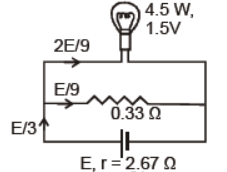
(a) 4.5 V
(b) 1.5 V
(c) 2.67 V
(d) 13.5 V
Answer: D
Question. A 100-W bulb and a 25-W bulb are designed for the same voltage. They have filaments of the same length and material. The ratio of the diameter of the 100-W bulb to that of the 25-W bulb is
(a) 4 : 1
(b) 2 : 1
(c) √2 :1
(d) 1 : 2
Answer: B
Question. In a metre bridge, the balancing length from the left end (standard resistance of one ohm is in the right gap) is found to be 20 cm. The value of the unknown resistance is
(a) 0.8 Ω
(b) 0.5 Ω
(c) 0.4 Ω
(d) 0.25 Ω
Answer: D
Question. An electric fan and a heater are marked as 100 W, 220 V and 1000 W, 220 V respectively. The resistance of heater is
(a) equal to that of fan
(b) lesser than that of fan
(c) greater than that of fan
(d) zero
Answer: B
Question. In an electroplating experiment, m g of silver is deposited when 4 A of current flows for 2 minutes. The amount in g of silver deposited by 6 A of current for 40 seconds will be
(a) 4 m
(b) 2 m
(c) m/2
(d) m/4
Answer: C
Question. In the circuit shown below, if the resistance of voltmeter is 4 kW, then the error in the reading of voltmeter will be 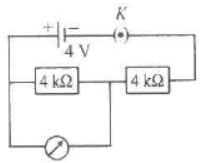
(a) 50%
(b) 68%
(c) 17%
(d) 33.3%
Answer: D
Question. A steady current of 5 A is maintained for 45 minutes. During this time it deposits 4.572 g of zinc at the cathode of voltameter.
E.C.E. of zinc is
(a) 3.387 × 10⁻⁴ g/C
(b) 3.387 × 10⁻⁴ kg/C
(c) 3.384 × 10⁻⁴ kg/C
(d) 3.384 × 10⁻³ kg/C
Answer: A
Question. In a neon gas discharge tube Ne+ ions moving through a cross-section of the tube each second to the right is 2.9 × 10¹⁸, while 1.2 × 10¹⁸ electrons move towards left in the same time; the electronic charge being 1.6 × 10⁻¹⁹ C, the net electric current is
(a) 0.27 A to the right
(b) 0.66 A to the right
(c) 0.66 A to the left
(d) zero
Answer: B
Question. Three copper wires of lengths and cross sectional areas are (l, A), (2 l, A/2) and (l/2, 2A). Resistance is minimum in
(a) wire of cross-sectional area A/2
(b) wire of cross-sectional area A
(c) wire of cross-sectional area 2A
(d) same in all the three cases
Answer: C
Question. A 4 ohm resistance wire is bent through 180º at its mid point and the two halves are twisted together. Then the resistance is
(a) 1 Ω
(b) 2 Ω
(c) 5 Ω
(d) 8 Ω
Answer: A
Question. When a current I is set up in a wire of radius r, the drift velocity is vd. If the same current is set up through a wire of radius 2 r, the drift velocity will be
(a) 4 vd
(b) 2 vd
(c) vd/2
(d) vd/4
Answer: D
Question. If nealy 105 coulomb are liberated by 1gm equivalent of aluminium, then amount of aluminium (equivalent weight 9) deposited through electrolysis in 20 minutes by a current of 50 ampere will be :
(a) 0.6 gm.
(b) 0.09 gm
(c) 5.4 gm
(d) 10.8 gm
Answer: C
Question. The amount of charge Q passed in time t through a crosssection of a wire is Q = 5 t2 + 3 t + 1.
The value of current at time t = 5 s is
(a) 9 A
(b) 49 A
(c) 53 A
(d) None of these
Answer: C
Question. Two identical cells connected in series send 1.0A current through a 5 Ω resistor. When they are connected in parallel, they send 0.8 A current through the same resistor. What is the internal resistance of the cell?
(a) 0.5 Ω
(b) 1.0 Ω
(c) 1.5 Ω
(d) 2.5 Ω
Answer: D
Question. If the resistance of a conductor is 5Ω at 50º C & 7Ω at 100º C, then mean temperature coefficient of resistance (of material) is
(a) 0.013/ ºC
(b) 0.004/ ºC
(c) 0.006/ ºC
(d) 0.008/ ºC
Answer: A
Question. If negligibly small current is passed though a wire of length 15 m & resistance of 5Ω, having uniform cross section of 6 × 10⁻⁷ m2, then coefficient of resistivity of material is
(a) 1×10⁻⁷Ω–m
(b) 2×10⁻⁷Ω–m
(c) 3×10⁻⁷Ω–m
(d) 4×10⁻⁷Ω–m
Answer: B
Question. The resistance of a wire at room temperature 30°C is found to be 10 W. Now to increase the resistance by 10%, the temperature of the wire must be [ The temperature coefficient of resistance of the material of the wire is 0.002 per °C]
(a) 36°C
(b) 83°C
(c) 63°C
(d) 33°C
Answer: B
Question. The resistance of the four arms P, Q, R and S in a Wheatstone’s bridge are 10 ohm, 30 ohm, 30 ohm and 90 ohm, respectively. The e.m.f. and internal resistance of the cell are 7 volt and 5 ohm respectively. If the galvanometer resistance is 50 ohm, the current drawn from the cell will be
(a) 0.2 A
(b) 0.1 A
(c) 2. 0 A
(d) 1. 0 A
Answer: A
Question. The four wires from a larger circuit intersect at junction A as shown. What is the magnitude and direction of the current between points A and B ?
(a) 2 A from A to B
(b) 2A from B to A
(c) 3A from A to B
(d) 2A from B to A
Answer: C
Question. The resistance of the coil of an ammeter is R. The shunt required to increase its range n-fold should have a resistance
(a) R/n
(b) R/n-1
(c) R/n+1
(d) nR
Answer: B
Question. A cell of internal resistance r is connected across an external resistance nr. Then the ratio of the terminal voltage to the emf of the cell is
(a) 1/n
(b) 1/n+1
(c) n/n+1
(d) n-1/n
Answer: C
Question. A battery of e.m.f. 10 V and internal resistance 0.5 W is connected across a variable resistance R. The value of R for which the power delivered in it is maximum is given by
(a) 0.5 Ω
(b) 1.0 Ω
(c) 2.0 Ω
(d) 0.25 Ω
Answer: A
Question. The deflection in a galvanometer decreases from 25 divisions to 5 divisions when a resistor of 20Ω is connected in series.
Find resistance of galvanometer.
(a) 4 Ω
(b) 5 Ω
(c) 6 Ω
(d) 7 Ω
Answer: B
Question. A galvanometer of 50 ohm resistance has 25 divisions. A current of 4 × 10⁻⁴ ampere gives a deflection of one division. To convert this galvanometer into a voltmeter having a range of 25 volts, it should be connected with a resistance of
(a) 2450 Ω in series.
(b) 2500 Ω in series.
(c) 245 Ω in series.
(d) 2550 Ω in series.
Answer: A
Question. In the equation AB = C, A is the current density, C is the electric field, Then B is
(a) resistivity
(b) conductivity
(c) potential difference
(d) resistance
Answer: A
1 The resistance of the platinum wire of a platinum resistance thermometer at the ice point is 5Ωand at steam point is 5.23Ωwhen the thermometer is inserted in a hot bath, the resistance of the platinum wire is 5.795Ω. Calculate the temperature of the bath.
2 Find the effective resistance when resistances are connected in series
3 Find the effective resistance when resistances are connected in parallel.
4 Explain why a transformer is required to lower the voltage to a value suitable for use at a station?
5 Derive the expression to find the power dissipated when current I is allowed to flow through a conductor?
6 What is an emf of a cell? Derive an expression to find the current flowing in a circuit in which a resistor R is connected across a cell of emf ε.
7 Derive an expression to find the effective emf of cells in series
8 Derive an expression to find the effective emf of cells in parallel
9 State Kirchhoff’s rules.
10 What is a Wheatstone Bridge? What is the advantage of it?
11 What is a Meter Bridge? Explain with a neat circuit diagram how a meter bridge can be Used to determine the unknown resistance of the given wire.
12 In a meter bridge, the null point is found at a distance of 33.7 cm from one end of the meter bridge. If now a resistance of 12Ωis connected in parallel with S, the null point occurs at 51.9 cm. Determine the values of R and S.
13 Give the principle of working of a potentiometer. Explain with a neat circuit diagram how potentiometer can be used to compare the emf of two primary cells.
14 Explain with a neat circuit diagram how potentiometer can be used to find the internal resistance of a cell.
Question Q.1 . The sequence of bands marked on a carbon resistor is red, red. Red silver. What is the value of resistance?
Answer: According to the carbon resistor color code, each color corresponds to a specific number:
- Red represents 2 (first digit).
- Red represents 2 (second digit).
- Red represents 2 (multiplier, i.e., \( 10^2 \)).
- Silver represents a tolerance of \( \pm 10\% \).
Thus, the total resistance value is:
\( R = 22 \times 10^2\,\Omega \pm 10\% \) (or \( 2200\,\Omega \pm 10\% \)).
In simple words: The color rings on a resistor tell us its value. For red-red-red-silver, the value is 2200 ohms with a margin of error of 10 percent.
Exam Tip: Remember the mnemonic "BB ROY of Great Britain had a Very Good Wife" to recall the color codes sequentially from 0 to 9.
Question Q.2 Does the drift velocity vary with the magnitude of the current through the conductor? Explain.
Answer: Yes, the drift velocity varies directly with the magnitude of the current flowing through a conductor. The relationship is given by the expression:
\( I = n e A v_d \implies v_d = \frac{I}{n e A} \)
Since the free electron density \( n \), charge of an electron \( e \), and cross-sectional area \( A \) of the conductor are constant parameters for a given wire, we can write:
\( v_d \propto I \)
Therefore, the drift velocity is directly proportional to the electric current.
In simple words: Yes, drift velocity depends on the current. When the current flowing through a wire increases, the electrons drift through the metal at a faster average speed.
Exam Tip: State the fundamental formula \( I = n e A v_d \) first, rearrange it to isolate \( v_d \), and establish the direct proportionality \( v_d \propto I \) to secure full marks.
Question Q.3 . A wire is cut into half. What is the effect on its specific resistance?
Answer: There is no effect on the specific resistance (resistivity) of the wire. Specific resistance is an intrinsic material property that depends strictly on the nature of the material and its temperature; it is entirely independent of the wire's length or cross-sectional area.
In simple words: Cutting the wire in half has no effect on its specific resistance because resistivity is a feature of the material itself, not how long or short the wire is.
Exam Tip: Specific resistance (resistivity) is a material-specific constant, unlike resistance which changes with dimensions (\( R = \rho \frac{l}{A} \)).
Question Q.4 :- Why do we prefer a potentiometer with a longer bridge wire?
Answer: A longer bridge wire is preferred in a potentiometer because increasing the length of the wire decreases the potential gradient (\( k = \frac{V}{L} \)) across it. A smaller potential gradient increases the sensitivity of the potentiometer, enabling it to measure even smaller potential differences more accurately.
In simple words: A longer wire makes the voltage drop more slowly and smoothly over its length. This makes the potentiometer much more sensitive and accurate for measuring small voltages.
Exam Tip: The key relationship to mention is \( k = \frac{V}{L} \). Show that as length \( L \) increases, potential gradient \( k \) decreases, which directly increases the sensitivity of the device.
Question Q.5 What are the factors affecting internal resistance of a cell
Answer: The internal resistance of a chemical cell is determined by several factors, including:
- The intrinsic nature of the electrolyte and the electrodes.
- The distance or separation between the electrodes (internal resistance is directly proportional to this separation).
- The effective surface area of the electrodes immersed in the electrolyte (inversely proportional).
- The concentration of the electrolyte.
- The temperature of the electrolyte (internal resistance decreases as temperature increases).
In simple words: The internal resistance of a battery depends on the chemicals used, how far apart the plates are inside, the size of those plates, the concentration of the liquid, and its temperature.
Exam Tip: When asked this, list at least three to four distinct factors to ensure you secure full marks.
Question Q.6 Establish a relation between the current and drift velocity
Answer: Let us consider a conductor of length \( l \) and uniform cross-sectional area \( A \). Let the number of free electrons per unit volume (free electron density) in the conductor be \( n \).
The total volume of the conductor is:
\( V = A \times l \)
The total number of free electrons in the conductor is:
\( N = n \times V = n A l \)
If \( e \) is the charge of an electron, then the total charge \( q \) contained within the conductor is:
\( q = N e = n A l e \)
Let an electric field be applied across the conductor by connecting a battery. Due to this field, the free electrons drift towards the positive terminal with an average drift velocity \( v_d \). The time \( t \) taken by the electrons to cross the entire length of the conductor is:
\( t = \frac{l}{v_d} \)
By definition, the electric current \( I \) flowing through the conductor is the rate of charge flow:
\( I = \frac{q}{t} \)
Substituting the expressions for \( q \) and \( t \):
\( I = \frac{n A l e}{\left(\frac{l}{v_d}\right)} \)
\( \implies I = n e A v_d \)
This is the fundamental relationship between electric current and the drift velocity of free electrons.
In simple words: By multiplying the volume of the wire by the electron density, we find the total number of moving electrons. Dividing the total charge by the time it takes the electrons to travel the length of the wire gives the current formula: \( I = n e A v_d \).
Exam Tip: Draw a simple schematic of a wire connected to a potential difference showing electrons drifting with velocity \( v_d \), and clearly define each variable (\( n, e, A, v_d \)) at the beginning of the derivation.
Question Q.7 Describe with the help of circuit diagram how a potentiometer can be used to compare the e.m.f. of two cells.
Answer: **Potential Gradient:**
The potential gradient (\( k \)) is defined as the drop in electric potential per unit length of the potentiometer wire:
\( k = \frac{V}{L} \)
**Method to Compare the EMF of Two Cells:**
Let \( E_1 \) and \( E_2 \) be the emfs of the two cells to be compared. The circuit is connected as shown in the diagram.
1. First, insert the key in the gap between terminals **a** and **c** of the two-way key, connecting cell \( E_1 \) to the secondary circuit. Slide the jockey along the wire to find a point \( J_1 \) where the galvanometer shows zero deflection (balance point). Let the balancing length be \( l_1 \). According to the principle of a potentiometer:
\( E_1 = k l_1 \) [Equation 1]
2. Next, remove the key from gap **a-c** and insert it into gap **b-c**, connecting cell \( E_2 \) to the secondary circuit. Again, slide the jockey to find the new balance point \( J_2 \) with balancing length \( l_2 \). Then:
\( E_2 = k l_2 \) [Equation 2]
3. Dividing Equation 1 by Equation 2, we obtain the ratio of the emfs of the two cells:
\( \frac{E_1}{E_2} = \frac{l_1}{l_2} \)
**Causes for One-Sided Deflection of the Galvanometer:**
(i) The positive terminals of all the cells (the driving battery and the cells \( E_1, E_2 \)) are not connected to the same common terminal point (A).
(ii) The electromotive force (emf) of the main driving cell in the primary circuit is less than the emf of the cells being measured in the secondary circuit.
In simple words: The potential gradient is the voltage drop per meter of the wire. By switching between the two cells and finding where the galvanometer reads zero, we get two lengths, \( l_1 \) and \( l_2 \). The ratio of the battery voltages is simply the ratio of these two lengths: \( \frac{E_1}{E_2} = \frac{l_1}{l_2} \).
Exam Tip: Always make sure that the positive terminals of both primary and secondary cells are connected to the same starting point of the potentiometer wire, otherwise you will get a persistent one-sided deflection.
Question Q.8 Define resistivity and state its SI unit. State and explain how the resistivity of a conductor varies with temperature
Answer: **Resistivity:**
The resistivity (or specific resistance) of a material is defined as the electrical resistance offered by a conductor of that material having a unit length and a unit cross-sectional area.
**SI Unit:** The SI unit of resistivity is the **ohm-meter (\( \Omega\cdot\text{m} \))**.
**Temperature Variation of Resistivity in a Conductor:**
The resistivity \( \rho \) of a metallic conductor is given by the expression:
\[ \rho = \frac{m}{n e^2 \tau} \]
where:
- \( m = \) mass of an electron,
- \( e = \) charge of an electron,
- \( n = \) number density of free electrons,
- \( \tau = \) relaxation time of free electrons.
In a metallic conductor, the free electron density \( n \) remains nearly independent of temperature. However, as the temperature increases, the thermal speed of the electrons increases, and the lattice ions vibrate more vigorously. As a result, the electrons undergo collisions with these vibrating ions much more frequently. This frequent scattering reduces the average relaxation time \( \tau \) between collisions. Since resistivity \( \rho \) is inversely proportional to the relaxation time (\( \rho \propto \frac{1}{\tau} \)), a decrease in \( \tau \) causes the resistivity of the metallic conductor to increase.
In simple words: Resistivity is the resistance of a 1-meter block of material. As a metal gets hotter, its atoms vibrate faster, making it harder for electrons to flow through without colliding. This decrease in relaxation time causes the metal's resistivity to rise.
Exam Tip: Always write the equation \( \rho = \frac{m}{n e^2 \tau} \) to mathematically justify why a decrease in relaxation time \( \tau \) directly increases the resistivity \( \rho \) with rising temperature.
Question Q.9 (a) Three resistors 1 Ω, 2 Ω, and 3 Ω are combined in series. What is the total resistance of the combination? (b) If the combination is connected to a battery of emf 12 V and negligible internal resistance, obtain the potential drop across each resistor
Answer: (a) When resistors are combined in series, their equivalent resistance \( R_{total} \) is the algebraic sum of the individual resistances:
\( R_{total} = R_1 + R_2 + R_3 \)
\( R_{total} = 1\,\Omega + 2\,\Omega + 3\,\Omega = 6\,\Omega \)
Thus, the total resistance of the combination is **\( 6\,\Omega \)**.
(b) The current \( I \) flowing through the series combination connected to a battery of \( E = 12\text{ V} \) with negligible internal resistance is given by Ohm's Law:
\( I = \frac{E}{R_{total}} = \frac{12\text{ V}}{6\,\Omega} = 2\text{ A} \)
In a series circuit, the same current flows through each resistor. Using Ohm's Law (\( V = I R \ )), we can find the potential drop across each individual resistor:
- Potential drop across the \( 1\,\Omega \) resistor:
\( V_1 = I R_1 = 2\text{ A} \times 1\,\Omega = 2\text{ V} \)
- Potential drop across the \( 2\,\Omega \) resistor:
\( V_2 = I R_2 = 2\text{ A} \times 2\,\Omega = 4\text{ V} \)
- Potential drop across the \( 3\,\Omega \) resistor:
\( V_3 = I R_3 = 2\text{ A} \times 3\,\Omega = 6\text{ V} \)
Therefore, the potential drops across the \( 1\,\Omega \), \( 2\,\Omega \), and \( 3\,\Omega \) resistors are **2 V, 4 V, and 6 V** respectively.
In simple words: (a) Adding the three resistors together gives a total resistance of 6 ohms. (b) With a 12-volt battery, 2 amperes of current flows through the circuit. Multiplying this current by each resistance gives voltage drops of 2 volts, 4 volts, and 6 volts across the three resistors.
Exam Tip: Double-check your calculations by summing up the individual voltage drops: \( 2\text{ V} + 4\text{ V} + 6\text{ V} = 12\text{ V} \), which must equal the battery's total EMF.
Question Q.10 Derive the balance condition of Wheat Stone bridge .also draw the circuit diagram to find the specific rsistance by meter bridge.
Answer: **Derivation of Balance Condition of a Wheatstone Bridge:**
Let \( P, Q, R, \) and \( S \) be four resistors connected to form a closed bridge as shown in the diagram. A galvanometer \( G \) is connected between junctions B and D, and a battery is connected across junctions A and C.
Let current \( I \) from the battery split at junction A into \( I_1 \) (along AB) and \( I_2 \) (along AD).
At junction B, the current \( I_1 \) splits into \( I_g \) (current through the galvanometer) and \( (I_1 - I_g) \) (along BC).
At junction D, the currents \( I_2 \) and \( I_g \) combine to form \( (I_2 + I_g) \) (along DC).
Applying **Kirchhoff's Second Law** (Loop Rule) to the closed loop **ABDA**:
\( I_1 P + I_g G - I_2 R = 0 \) [Equation 1]
where \( G \) is the resistance of the galvanometer.
Applying the loop rule to the closed loop **BCDB**:
\( (I_1 - I_g) Q - (I_2 + I_g) S - I_g G = 0 \) [Equation 2]
Under the **balanced condition**, no current flows through the galvanometer, meaning \( I_g = 0 \).
Substituting \( I_g = 0 \) in Equation 1 and Equation 2:
From Equation 1:
\( I_1 P - I_2 R = 0 \implies I_1 P = I_2 R \) [Equation 3]
From Equation 2:
\( I_1 Q - I_2 S = 0 \implies I_1 Q = I_2 S \) [Equation 4]
Dividing Equation 3 by Equation 4:
\[ \frac{I_1 P}{I_1 Q} = \frac{I_2 R}{I_2 S} \]
\( \implies \frac{P}{Q} = \frac{R}{S} \)
This is the balanced condition for a Wheatstone bridge.
**Meter Bridge Circuit Diagram to find the Specific Resistance:**
The meter bridge works on the principle of the Wheatstone bridge. The circuit diagram to find the unknown resistance \( S \) and thereby determine the specific resistance is shown below:
In simple words: In a balanced Wheatstone bridge, no current flows through the middle galvanometer. By applying Kirchhoff's loop rules to both halves of the loop and setting the galvanometer current to zero, we prove that the ratio of the adjacent resistances is equal: \( \frac{P}{Q} = \frac{R}{S} \).
Exam Tip: Always define the balanced condition clearly (\( I_g = 0 \)) before simplifying the loop equations. Make sure to draw both the Wheatstone bridge and the meter bridge circuit diagrams clearly.
Question Q.11 What do you mean by relaxation time of free electrons in metals?
Answer: The relaxation time (\( \tau \)) of free electrons in a metal is defined as the average time interval that elapses between two consecutive collisions of a free electron with the positive lattice ions of the metal.
In simple words: Relaxation time is the average time an electron spends traveling freely before it bumps into a metal atom.
Exam Tip: Use the symbol \( \tau \) (tau) to denote relaxation time and mention that it decreases as the temperature of the conductor increases.
Question Q.12 Will the drift speed of free electrons in a metallic conductor increases or decreases with increase or decrease in temperature?
Answer: The drift speed of free electrons in a metallic conductor **decreases** when the temperature increases, and **increases** when the temperature decreases. This occurs because raising the temperature causes the lattice ions to vibrate more vigorously, leading to more frequent collisions. This reduces the relaxation time \( \tau \), which in turn lowers the drift velocity \( v_d \) (since \( v_d = \frac{e E \tau}{m} \)).
In simple words: When a metal gets hotter, its atoms vibrate wildly, blocking the electrons and making them collide more often. This slows down their average drift speed.
Exam Tip: State the formula \( v_d = \frac{e E \tau}{m} \) to show that drift speed is directly proportional to relaxation time \( \tau \), which decreases with rising temperature.
Question Q.13 V – I graphs for parallel and series combination of two metallic resistors are shown in figure. Which graph represents parallel combination? Justify your answer-.
Answer: In a potential difference \( V \) versus current \( I \) graph, the slope of the line represents the resistance of the combination:
\( \text{Slope} = \frac{V}{I} = R \)
We know that the equivalent resistance of two resistors in a parallel combination (\( R_p \)) is always smaller than their equivalent resistance in a series combination (\( R_s \)):
\( R_p < R_s \)
From the given graph, the slope of line B is less than the slope of line A, meaning:
\( R_B < R_A \)
Therefore, **line B represents the parallel combination**, while line A represents the series combination.
In simple words: The slope of the line on a V-I graph represents resistance. Since parallel resistors have a lower combined resistance than series resistors, the flatter line B (which has less resistance) represents the parallel combination.
Exam Tip: State clearly that the slope of a V-I graph equals resistance, and explicitly point out that parallel combinations always result in a lower total resistance than series combinations.
Question Q.14 Describe the formula for the equivalent EMF and internal resistance for the parallel combination of two cells with EMF E1 and E2 and internal resistances r1 and r2 respectively. What is the corresponding formula for the series combination?
Answer: **Parallel Combination of Two Cells:**
Let two cells of electromotive forces \( E_1 \) and \( E_2 \) with internal resistances \( r_1 \) and \( r_2 \) be connected in parallel. The equivalent EMF (\( E_{eq} \)) and the equivalent internal resistance (\( r_{eq} \)) of this combination are given by:
\( E_{eq} = \frac{E_1 r_2 + E_2 r_1}{r_1 + r_2} \)
\( r_{eq} = \frac{r_1 r_2}{r_1 + r_2} \)
**Series Combination of Two Cells:**
When the same two cells are connected in series aiding each other, the equivalent EMF and internal resistance are simply the sum of their individual values:
\( E_{eq} = E_1 + E_2 \)
\( r_{eq} = r_1 + r_2 \)
In simple words: For two batteries in parallel, their combined voltage is \( \frac{E_1 r_2 + E_2 r_1}{r_1 + r_2} \) and their combined internal resistance is \( \frac{r_1 r_2}{r_1 + r_2} \). If you put them in series instead, you simply add their voltages and resistances together.
Exam Tip: Remember that if the cells in series are connected in opposition (positive terminal to positive terminal), the equivalent EMF becomes \( |E_1 - E_2| \), though the internal resistances still add up: \( r_1 + r_2 \).
Question Q.15 Why the resistance of the conductor increases with rise in temperature?
Answer: The electrical resistance \( R \) of a metallic conductor is expressed as:
\[ R = \frac{m l}{n A e^2 \tau} \]
where:
- \( m = \) mass of an electron,
- \( l = \) length of the conductor,
- \( n = \) free electron density,
- \( A = \) cross-sectional area,
- \( e = \) charge of an electron,
- \( \tau = \) relaxation time.
When the temperature of the metallic conductor rises, the thermal energy of the free electrons and the vibrational energy of the positive lattice ions increase. This causes the free electrons to collide much more frequently with the vibrating atoms and ions. Consequently, the average relaxation time \( \tau \) between consecutive collisions decreases. Since resistance \( R \) is inversely proportional to the relaxation time (\( R \propto \frac{1}{\tau} \)), this decrease in \( \tau \) directly results in an increase in the resistance of the conductor.
In simple words: As a metal wire gets hotter, its internal atoms vibrate faster, blocking the path of flowing electrons. This causes more frequent collisions, which decreases the relaxation time and increases the overall electrical resistance of the wire.
Exam Tip: State the complete formula for resistance in terms of microscopic parameters and show that \( R \propto \frac{1}{\tau} \) to provide a rigorous, high-scoring explanation.
Question Q.16 A carbon resistor of 47×103 ±5% is to be marked with rings of different colours for its identification write the sequence of colours?
Answer: According to the standard carbon resistor color code:
- The digit 4 is represented by **Yellow**.
- The digit 7 is represented by **Violet**.
- The multiplier \( 10^3 \) is represented by **Orange**.
- The tolerance of \( \pm 5\% \) is represented by **Gold**.
Therefore, the sequence of color rings on the resistor from left to right is **Yellow, Violet, Orange, Gold**.
In simple words: For a resistance of 47,000 ohms with a 5% tolerance, the color rings on the resistor must be yellow (4), violet (7), orange (multiplier of 1000), and gold (5% error margin).
Exam Tip: Always write down each digit and multiplier with its matching color separately to show your steps clearly to the examiner.
Question Q.17 State the Kirchoff’s laws
Answer: **1. Kirchhoff's First Law (Junction Rule or Current Law):**
It states that the algebraic sum of all electric currents meeting at any junction in an electrical network is always zero:
\[ \sum I = 0 \]
In other words, the total current entering a junction must equal the total current leaving that junction. This law is based on the **conservation of electric charge**.
**2. Kirchhoff's Second Law (Loop Rule or Loop Voltage Law):**
It states that around any closed loop in an electrical circuit, the algebraic sum of the changes in potential (including emfs and potential drops across resistors) is equal to zero:
\[ \sum V = \sum I R = \sum E \]
In other words, the algebraic sum of the emfs in any loop is equal to the algebraic sum of the products of the currents and resistances in that loop. This law is based on the **conservation of energy**.
In simple words: Kirchhoff's first law says that all current entering a junction must equal the current leaving it (charge is conserved). The second law says that the total voltage drops around any closed loop must equal the total voltage supplied (energy is conserved).
Exam Tip: Always mention the physical conservation laws on which these rules are based (conservation of charge for the first law, conservation of energy for the second law) as these are highly valued by examiners.
Question Q.18 Two wires of equal length, one of copper and other of manganin have seen same resistance .Which is thicker?
Answer: The resistance of a wire is given by:
\( R = \rho \frac{l}{A} \)
where \( \rho \) is the resistivity, \( l \) is the length, and \( A \) is the cross-sectional area.
Given that both wires have the same resistance (\( R_c = R_m \)) and equal length (\( l_c = l_m \)):
\( \rho_c \frac{l}{A_c} = \rho_m \frac{l}{A_m} \implies \frac{\rho_c}{A_c} = \frac{\rho_m}{A_m} \)
Rearranging the terms, we get:
\( \frac{A_m}{A_c} = \frac{\rho_m}{\rho_c} \)
We know that the resistivity of manganin is significantly greater than the resistivity of copper (\( \rho_m > \rho_c \)):
\( \frac{\rho_m}{\rho_c} > 1 \implies \frac{A_m}{A_c} > 1 \implies A_m > A_c \)
Since the cross-sectional area of the manganin wire is greater than that of the copper wire, the **manganin wire is thicker** than the copper wire.
In simple words: Manganin naturally resists electricity much more than copper. If we want a manganin wire to have the exact same resistance as a copper wire of the same length, we have to make the manganin wire thicker to help the electricity flow more easily.
Exam Tip: Derive the ratio of the cross-sectional areas \( \frac{A_m}{A_c} = \frac{\rho_m}{\rho_c} \) clearly to mathematically prove why manganin must be thicker.
Question Q.19 If the current supplied to a variable resister, is constant. Draw a graph between Voltage and Resistance.
Answer: According to Ohm's Law, the potential difference \( V \) across a resistor is given by:
\( V = I \times R \)
Since the current \( I \) supplied to the variable resistor is kept constant:
\( V \propto R \)
Thus, the potential difference \( V \) is directly proportional to the resistance \( R \). The graph representing this relationship is a straight line passing through the origin, as shown below:
In simple words: If you keep the current constant, doubling the resistance will double the voltage. This direct relationship is represented by a straight diagonal line starting from the origin.
Exam Tip: State the mathematical proportionality \( V \propto R \) under the condition of constant current \( I \) to justify why the graph is linear.
Question Q.20 Name the material used formatting standard resistance. Give reason of choice.
Answer: The materials commonly used to make standard resistors are alloys such as **manganin**, **constantan**, or **nichrome**.
**Reasons for Choice:**
1. **High Resistivity:** They offer a high value of electrical resistance in a relatively compact size.
2. **Low Temperature Coefficient of Resistance:** Their resistance changes negligibly with variations in temperature, ensuring that the standard resistor remains stable and accurate during operation.
In simple words: Standard resistors are made of alloys like manganin or constantan because these metals have high resistance and their values do not change when they heat up.
Exam Tip: The term "low temperature coefficient of resistance" is a key technical phrase that examiners specifically look for when grading this question.
Free study material for Physics
Chapter 03 Current Electricity Printable Worksheets and Exercises for Class 12 Physics
Mastering Chapter 03 Current Electricity with Printable Worksheets
Explore reliable practice questions for Chapter 03 Current Electricity tailored for Class 12 Physics learners. Use these structured worksheets to evaluate exam preparedness and strengthen problem-solving skills throughout the 2026 academic session.
Verified Solutions and NCERT Alignment
Built using official NCERT guidelines for Class 12 Physics, these practice sheets provide reliable academic support. Cross-reference your completed work with our detailed solutions to learn standard answer-writing formats for CBSE exams.
Additional Study Resources for Class 12 Physics
Wrap up your chapter revision by testing your knowledge against standard objective question formats. Explore our full library of free, up-to-date printable assignments to maximize your academic results in upcoming CBSE evaluations.
FAQs
You can download the latest chapter-wise printable worksheets for Class 12 Physics Chapter 03 Current Electricity for free from StudiesToday.com. These have been made as per the latest CBSE curriculum for this academic year.
Yes, Class 12 Physics worksheets for Chapter 03 Current Electricity focus on activity-based learning and also competency-style questions. This helps students to apply theoretical knowledge to practical scenarios.
Yes, we have provided solved worksheets for Class 12 Physics Chapter 03 Current Electricity to help students verify their answers instantly.
Yes, our Class 12 Physics test sheets are mobile-friendly PDFs and can be printed by teachers for classroom.
For Chapter 03 Current Electricity, regular practice with our worksheets will improve question-handling speed and help students understand all technical terms and diagrams.