

Class 12 Physics Practice Sheet: CBSE Class 12 Physics Electromagnetic Induction And Alternating Current Worksheet Set 03
Review targeted academic worksheets with the CBSE Class 12 Physics Electromagnetic Induction And Alternating Current Worksheet Set 03. Built according to official educational standards for the 2026-27 term, these downloadable Class 12 Physics resources support effective daily practice and detailed self-evaluation for Chapter 06 Electromagnetic Induction.
Download Chapter 06 Electromagnetic Induction Worksheet PDF with Answers
Access the complete worksheet PDF for Class 12 Physics below. Regular practice with these targeted academic tasks builds familiarity with standard question patterns and helps secure higher marks in final school examinations.
Important Questions for NCERT Class 12 Physics Electromagnetic Induction
Question. In which of the following devices, the eddy current
effect is not used?
(a) electric heater
(b) induction furnace
(c) magnetic braking in train
(d) electromagnet
Answer: A
Question. Eddy currents are produced when
(a) a metal is kept in varying magnetic field
(b) a metal is kept in steady magnetic field
(c) a circular coil is placed in a magnetic field
(d) current is passed through a circular coil
Answer: A
Question. The magnetic potential energy stored in a certain inductor is 25 mJ, when the current in the inductor is 60 mA. This inductor is of inductance
(a) 0.138 H
(b) 138.88 H
(c) 1.389 H
(d) 13.89 H
Answer: D
Question. A current of 2.5 A flows through a coil of inductance 5 H. The magnetic flux linked with the coil is
(a) 0.5 Wb
(b) 12.5 Wb
(c) zero
(d) 2 Wb
Answer: B
Question. A long solenoid has 500 turns. When a current of 2 ampere is passed through it, the resulting magnetic flux linked with each turn of the solenoid is 4 × 10⁻³ Wb. The self-inductance of the solenoid is
(a) 1.0 henry
(b) 4.0 henry
(c) 2.5 henry
(d) 2.0 henry
Answer: A
Question. A rectangular, a square, a circular and an elliptical loop, all in the (x – y) plane, are moving out of a uniform magnetic field with a constant velocity, V = v ^i . The magnetic field is directed along the negative z axis direction. The induced emf, during the passage of these loops, out of the field region, will not remain constant for
(a) the circular and the elliptical loops
(b) only the elliptical loop
(c) any of the four loops
(d) the rectangular, circular and elliptical loops
Answer: A
Question. A conducting circular loop is placed in a uniform magnetic field 0.04 T with its plane perpendicular to the magnetic field. The radius of the loop starts shrinking at 2 mm/s. The induced emf in the loop when the radius is 2 cm is
(a) 4.8p mV
(b) 0.8p mV
(c) 1.6p mV
(d) 3.4p mV
Answer: D
Question. For a coil having L = 2 mH, current flow through it is I = t2e–t then, the time at which emf becomes zero
(a) 2 sec
(b) 1 sec
(c) 4 sec
(d) 3 sec.
Answer: A
Question. The total charge, induced in a conducting loop when
it is moved in magnetic field depends on
(a) the rate of change of magnetic flux
(b) initial magnetic flux only
(c) the total change in magnetic flux
(d) final magnetic flux only.
Answer: C
Important Questions for NCERT Class 12 Physics Alternating Induction
Question. A transformer is used to light a 100 W and 110 V lamp from a 220 V mains. If the main current is 0.5 amp, the efficiency of the transformer is approximately
(a) 50%
(b) 90%
(c) 10%
(d) 30%
Answer: B
Question. The core of a transformer is laminated because
(a) ratio of voltage in primary and secondary may be increased
(b) energy losses due to eddy currents may be minimised
(c) the weight of the transformer may be reduced
(d) rusting of the core may be prevented.
Answer: B
Question. A step-up transformer operates on a 230 V line and supplies a load of 2 ampere. The ratio of the primary and secondary windings is 1 : 25. The current in the primary is
(a) 15 A
(b) 50 A
(c) 25 A
(d) 12.5 A
Answer: B
Question. If we decrease the frequency of the applied A.C. with a purely capacitive load, do (1) the amplitude of Vc and (2) amplitude of Ic increase, decrease of remain the same.
(a) (1) increase (2) same
(b) (1) same (2) increase
(c) (1) same (2) decrease
(d) (1) decrease (2) same
Answer: C
Question. In the circuit given in figure, 1 and 2 are ammeters.
Just after key K is pressed to complete the circuit, the reading will be
(a) zero in 1, maximum in 2
(b) maximum in both 1 and 2
(c) zero in both 1 and 2
(d) maximum in 1, zero in 2.
Answer: D
Question. The time constant of C-R circuit is
(a) 1/CR
(b) C/R
(c) CR
(d) R/C
Answer : C
Question. In an ac circuit an alternating voltage 200 2 sin100 t volts is connected to a capacitor of capacity 1 mF. The r.m.s. value of the current in the circuit is
(a) 10 mA
(b) 100 mA
(c) 200 mA
(d) 20 mA
Answer: D
Question. A coil having an area A0 is placed in a magnetic field which changes from B0 to 4 B0 in time interval t. The e.m.f. induced in the coil will be
(a) 3A0 B0 / t
(b) 4A0 B0 / t
(c) 3B0 /A0t
(d) 4A0 / B0t
Answer: A
Question. If coefficient of self induction of a coil is 1 H, an e.m.f. of 1V is induced, if
(a) current flowing is 1A
(b) current variation rate is 1 As–1
(c) current of 1A flows for one sec.
(d) None of these
Answer: B
Question. An electron moves along the line PQ which lies in the same plane as a circular loop of conducting wire as shown in figure.
What will be the direction of the induced current in the loop ?
(a) Anticlockwise
(b) Clockwise
(c) Alternating
(d) No current will be induced
Answer: A
Question. A long solenoid having 200 turns per cm carries a current of 1.5 amp. At the centre of it is placed a coil of 100 turns of cross-sectional area 3.14 × 10⁻⁴ m2 having its axis parallel to the field produced by the solenoid. When the direction of current in the solenoid is reversed within 0.05 sec, the induced e.m.f. in the coil is
(a) 0.48 V
(b) 0.048 V
(c) 0.0048 V
(d) 48 V
Answer: B
Question. A long solenoid of diameter 0.1 m has 2 × 10⁴ turns per meter. At the centre of the solenoid, a coil of 100 turns and radius 0.01 m is placed with its axis coinciding with the solenoid axis. The current in the solenoid reduces at a constant rate to 0A from 4 A in 0.05 s. If the resistance of the coil is 10π2Ω. the total charge flowing through the coil during this time is :-
(a) 16 μC
(b) 32 μC
(c) 16 π μC
(d) 32 π μC
Answer: B
Question. In a circuit given in figure 1 and 2 are ammeters. Just after key K is pressed to complete the circuit, the reading is 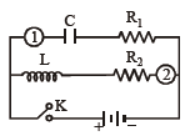
(a) zero in both 1 and 2
(b) maximum in both 1 and 2
(c) zero in 1 and maximum in 2
(d) maximum in 1 and zero in 2
Answer: C
Question. According to Faraday’s law of electromagnetic induction
(a) electric field is produced by time varying magnetic flux.
(b) magnetic field is produced by time varying electric flux.
(c) magnetic field is associated with a moving charge.
(d) None of these
Answer: A
Question. The mutual inductance of a pair of coils, each of N turns, is M henry. If a current of I ampere in one of the coils is brought to zero in t second, the emf induced per turn in the other coil, in volt, will be
(a) MI/t
(b) NMI/t
(c) MN/It
(d) MI/Nt
Answer: A
Question. A copper disc of radius 0.1 m rotated about its centre with 10 revolutions per second in a uniform magnetic field of 0.1 tesla with its plane perpendicular to the field. The e.m.f. induced across the radius of disc is
(a) π/10 volt
(b) 2π/10 volt
(c) π x 10-2 volt
(d) 2π x 10-2 volt
Answer: C
Question. Two solenoids of same cross-sectional area have their lengths and number of turns in ratio of 1 : 2. The ratio of self-inductance of two solenoids is
(a) 1 : 1
(b) 1 : 2
(c) 2 : 1
(d) 1 : 4
Answer: B
Question. Fig shown below represents an area A = 0.5 m2 situated in a uniform magnetic field B = 2.0 weber/m2 and making an angle of 60º with respect to magnetic field.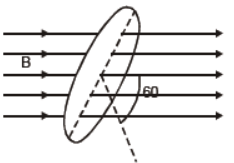
The value of the magnetic flux through the area would be equal to
(a) 2.0 weber
(b) √3 weber
(c) √3 / 2 weber
(d) 0.5 weber
Answer: D
Question. A metal rod moves at a constant velocity in a direction perpendicular to its length. A constant uniform magnetic field exists in space in a direction perpendicular to the rod as well its velocity. Select correct statements (s) from the following.
(a) The entire rod is at the same potential
(b) There is an electric field in the rod
(c) The electric potential is highest at the centre
(d) The electric potential is lowest at its centre and increases towards its ends
Answer: B
Question. A small square loop of wire of side l is placed inside a large square loop of side L (L >> l ). The loop are coplanar and their centres coincide. The mutual inductance of the system is proportional is
(a) l/L
(b) l2/L
(c) L/l
(d) L2/l
Answer: B
Question. As a result of change in the magnetic flux linked to the closed loop shown in the figure, an e.m.f. V volt is induced in the loop.
along the loop is
(a) QV
(b) 2QV
(c) QV/2
(d) zero
Answer: A
Question. A wire loop is rotated in a uniform magnetic field about an axis perpendicular to the field. The direction of the current induced in the loop reverses once each
(a) quarter revolution
(b) half revolution
(c) full revolution
(d) two revolutions
Answer: B
Question. If the number of turns per unit length of a coil of solenoid is doubled, the self-inductance of the solenoid will
(a) remain unchanged
(b) be halved
(c) be doubled
(d) become four times
Answer: D
Question. In an AC generator, a coil with N turns, all of the same area A and total resistance R, rotates with frequency ω in a magnetic field B. The maximum value of emf generated in the coil is
(a) N.A.B.R.w
(b) N.A.B.
(c) N.A.B.R.
(d) N.A.B.w
Answer: D
Question. Lenz’s law is consequence of the law of conservation of
(a) energy
(b) momentum
(c) charge
(d) mass
Answer: A
Question. Eddy currents are produced when
(a) a metal is kept in varying magnetic field
(b) a metal is kept in steady magnetic field
(c) a circular coil is placed in a magnetic field
(d) through a circular coil, current is passed
Answer: A
Question. An inductor may store energy in
(a) its electric field
(b) its coils
(c) its magnetic field
(d) both in electric and magnetic fields
Answer: C
Question. A 100 millihenry coil carries a current of 1 ampere. Energy stored in its magnetic field is
(a) 0.5 J
(b) 1 J
(c) 0.05 J
(d) 0.1 J
Answer: C
Important Questions for NCERT Class 12 Physics Electromagnetic Induction
Question. Two coils have a mutual inductance 0.005 H. The current changes in the first coil according to equation I = I0 sinwt, where I0 = 10 A and w = 100p rad/sec. The maximum value of e.m.f. in the second coil is
(a) p
(b) 5p
(c) 2p
(d) 4p
Answer : B
Question. If N is the number of turns in a coil, the value of self inductance varies as
(a) N 0
(b) N
(c) N 2
(d) N–2
Answer : C
Question. What is the self-inductance of a coil which produces 5 V when the current changes from 3 ampere to 2 ampere in one millisecond?
(a) 5000 henry
(b) 5 milli-henry
(c) 50 henry
(d) 5 henry
Answer : B
Question. A wire loop is rotated in a magnetic field. The frequency of change of direction of the induced e.m.f. is
(a) four times per revolution
(b) six times per revolution
(c) once per revolution
(d) twice per revolution
Answer : D
Question. In a region of magnetic induction B = 10–2 tesla, a circular coil of radius 30 cm and resistance p2 ohm is rotated about an axis which is perpendicular to the direction of B and which forms a diameter of the coil. If the coil rotates at 200 rpm the amplitude of the alternating current induced in the coil is
(a) 4p2 mA
(b) 30 mA
(c) 6 mA
(d) 200 mA
Answer : C
Question. If the number of turns per unit length of a coil of solenoid is doubled, the self-inductance of the solenoid will
(a) remain unchanged
(b) be halved
(c) be doubled
(d) become four times
Answer : D
Question. A 100 millihenry coil carries a current of 1A. Energy stored in its magnetic field is
(a) 0.5 J
(b) 1 J
(c) 0.05 J
(d) 0.1 J
Answer : C
Question. In a coil of resistance 10 W, the induced current developed by changing magnetic flux through it, is shown in figure as a function of time. The magnitude of change in flux through the coil in weber is
(a) 8
(b) 2
(c) 6
(d) 4
Answer : B
Important Questions for NCERT Class 12 Physics Alternating Induction
Question. The primary winding of a transformer has 500 turns whereas its secondary has 5000 turns. The primary is connected to an A.C. supply of 20 V, 50 Hz. The secondary will have an output of
(a) 2 V, 50 Hz
(b) 2 V, 5 Hz
(c) 200 V, 50 Hz
(d) 200 V, 500 Hz.
Answer: C
Question. A 50 Hz a.c. source of 20 volt is connected across R and C as shown in figure. The voltage across R is 12 volt. The voltage across C is :
(a) 8 V
(b) 16 V
(c) 10 V
(d) not possible to determine unless values of R and C are given
Answer: B
Question. Figure shows a circuit that contains three identical resistors with resistance R = 9.0 W each, two identical inductors with inductance L = 2.0 mH each, and an ideal battery with emf e = 18 V. The current i through the battery just after the switch closed is
(a) 0.2 A
(b) 2 A
(c) 0 ampere
(d) 2 mA
Answer: A
Question. In an A.C. circuit, the current flowing in inductance is I = 5 sin (100 t – p/2) amperes and the potential difference is V = 200 sin (100 t) volts. The power consumption is equal to
(a) 1000 watt
(b) 40 watt
(c) 20 watt
(d) zero
Answer: D
Question. A coil of 40 henry inductance is connected in series with a resistance of 8 ohm and the combination is joined to the terminals of a 2 volt battery. The time constant of the circuit is
(a) 5 seconds
(b) 1/5 seconds
(c) 40 seconds
(d) 20 seconds
Answer : A
Question. An A.C. circuit containing only capacitance, the current :
(a) lags the voltage by 90°
(b) leads the voltage by 90°
(c) remains in phase with voltage
(d) leads the voltage in 180°
Answer: B
Question. The two rails of a railway track, insulated from each other and the ground, are connected to millivoltmeter. What is the reading of the millivoltmeter when a train passes at a speed of 180 km/hr along the track, given that the vertical component of earth’s magnetic field is 0.2 × 10⁻⁴ wb/m2 and rails are separated by 1 metre
(a) 10–2 volt
(b) 10mV
(c) 1 volt
(d) 1 mV
Answer: D
Question. A current i = 2 sin (πt/3) amp is flowing in an inductor of 2 henry. The amount of work done in increasing the current from 1.0 amp to 2.0 amp is
(a) 1 J
(b) 2 J
(c) 3 J
(d) 4 J
Answer: C
Question. The self inductance of the motor of an electric fan is 10 H. In order to impart maximum power at 50 Hz, it should be connected to a capacitance of
(a) 8μF
(b) 4μF
(c) 2μF
(d) 1μF
Answer: D
Question. When the current in a coil changes from 2 amp. to 4 amp. in 0.05 sec., an e.m.f. of 8 volt is induced in the coil. The coefficient of self inductance of the coil is
(a) 0.1 henry
(b) 0.2 henry
(c) 0.4 henry
(d) 0.8 henry
Answer: B
Question. The total charge induced in a conducting loop when it is moved in a magnetic field depend on
(a) the rate of change of magnetic flux
(b) initial magnetic flux only
(c) the total change in magnetic flux
(d) final magnetic flux only
Answer: C
Question. Which of the following units denotes the dimension ML2/Q where Q denotes the electric charge?
(a) Wb/m2
(b) henry (H)
(c) H/m2
(d) weber (Wb)
Answer: B
Question. A rectangular coil of single turn, having area A, rotates in a uniform magnetic field B with an angular velocity w about an axis perpendicular to the field. If initially the plane of the coil is perpendicular to the field, then the average induced emf when it has rotated through 90° is
(a) ωBA/π
(b) ωBA/2π
(c) ωBA/4π
(d) 2ωBA/π
Answer: D
Question. Induced emf in the coil depends upon
(a) conductivity of coil
(b) amount of flux
(c) rate of change of linked flux
(d) resistance of coil
Answer: C
Question. Magnetic flux Φ in weber in a closed circuit of resistance 10Ω varies with time Φ (sec) as f = 6t2 – 5t + 1. The magnitude of induced current at t = 0.25s is
(a) 0.2 A
(b) 0.6 A
(c) 1.2 A
(d) 0.8 A
Answer: A
Question. A solenoid has 2000 turns wound over a length of 0.3 m. Its cross-sectional area is 1.2 × 10⁻³ m2. Around its central section a coil of 300 turns is wound. If an initial current of 2 A flowing in the solenoid is reversed in 0.25 s, the emf induced in the coil will be
(a) 2.4 × 10⁻⁴ V
(b) 2.4 × 10⁻² V
(c) 4.8 × 10⁻⁴ V
(d) 4.8 × 10⁻² V
Answer: B
Question. A coil having 500 square loops each of side 10 cm is placed normal to a magnetic field which increases at the rate of 1 Wb/m2. The induced e.m.f. is
(a) 0.1 V
(b) 5.0 V
(c) 0.5 V
(d) 1.0 V
Answer: B
Question. In a coil of area 10 cm2 and 10 turns with magnetic field directed perpendicular to the plane and is changing at the rate of 108 Gauss/second. The resistance of the coil is 20Ω. The current in the coil will be
(a) 0.5 A
(b) 5 A
(c) 50 A
(d) 5 × 10⁸ A
Answer: B
Question. If rotational velocity of a dynamo armature is doubled, then induced e.m.f. will become
(a) half
(b) two times
(c) four times
(d) unchanged
Answer: B
Question. A conducting square loop of side L and resistance R moves in its plane with a uniform velocity v perpendicular to one of its side. A magnetic induction B constant in time and space, pointing perpendicular and into the plane of the loop exists everywhere.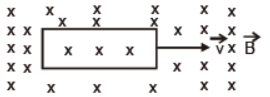
The current induced in the loop is
(a) B l v/R clockwise
(b) B l v/R anticlockwise
(c) 2B l v/R anticlockwise
(d) zero
Answer: D
Question. There are two coils A and B as shown in figure a current starts flowing in B as shown, when A is moved towards B and stops when A stops moving. The current in A is counter clockwise. B is kept stationary when A moves. We can infer that
(a) there is a constant current in the clockwise direction in A
(b) there is a varying current in A
(c) there is no current in A
(d) there is a constant current in the counter clockwise direction in A
Answer: D
Question. In the figure the flux through the loop perpendicular to the plane of the coil and directed into the paper is varying according to the relation Φ = 6t2 + 7t + 1 where Φ is in milliweber and t is in second. The magnitude of the emf induced in the loop at t = 2 s and the direction of induce current through R are 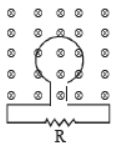
(a) 39 mV; right to left
(b) 39 mV; left to right
(c) 31 mV; right to left
(d) 31 mV; left to right
Answer: D
Question. A wire loop is rotated in a magnetic field. The frequency of change of direction of the induced e.m.f. is
(a) twice per revolution
(b) four times per revolution
(c) six times per revolution
(d) once per revolution
Answer: A
Question. A conducting circular loop is placed in a uniform magnetic field, B = 0.025 T with its plane perpendicular to the loop.
The radius of the loop is made to shrink at a constant rate of 1 mm s–1. The induced e.m.f. when the radius is 2 cm, is
(a) 2πμV
(b) πμV
(c) π/2 V
(d) 2μV
Answer: B
Question. If a current increases from zero to one ampere in 0.1 second in a coil of 5 mH, then the magnitude of the induced e.m.f. will be
(a) 0.005 volt
(b) 0.5 volt
(c) 0.05 volt
(d) 5 volt
Answer: C
Question. The armature of a dc motor has 20Ω resistance. It draws a current of 1.5 A when run by a 220 V dc supply. The value of the back emf induced in it is
(a) 150 V
(b) 170 V
(c) 180 V
(d) 190 V
Answer: D
Test Paper-I
Question 1. What is Electromagnetic Induction?
Answer: Electromagnetic induction is the phenomenon of generating an electric current or electromotive force (emf) in a closed circuit by changing the magnetic flux linked with that circuit.
In simple words: Electromagnetic induction is when we make electricity flow in a wire loop simply by moving a magnet nearby to change the magnetic field.
Exam Tip: Use the keyword 'changing magnetic flux' rather than just 'changing magnetic field' to earn full marks.
Question 2. What are the different methods of producing current in a coil?
Answer: An induced current can be produced in a coil by changing the magnetic flux linked with it. The different methods include:
(i) Moving a magnet relative to a stationary coil or moving a coil relative to a stationary magnet.
(ii) Changing the electric current flowing through a neighboring coil (mutual induction).
(iii) Rotating the coil inside a uniform magnetic field to change its orientation (as in an AC generator).
In simple words: We can make electricity flow in a coil by moving a magnet near it, by turning another electric coil on and off nearby, or by spinning the coil inside a magnetic field.
Exam Tip: State at least two clear methods. Focus on relative motion and changing current in a neighboring coil.
Question 3. Define Magnetic flux. Give the expression to find the same. What is its SI unit of measurement? Is it a scalar or vector quantity?
Answer: Magnetic flux is defined as the total number of magnetic field lines passing normally through a given surface area.
**Mathematical Expression:**
For a uniform magnetic field \( \mathbf{B} \) passing through a flat area \( \mathbf{A} \), the magnetic flux \( \Phi_B \) is given by the dot product:
\( \Phi_B = \mathbf{B} \cdot \mathbf{A} = B A \cos\theta \)
where \( \theta \) is the angle between the magnetic field vector and the normal to the area.
**SI Unit:** The SI unit of magnetic flux is the **weber (Wb)** (or tesla-square meter, \( \text{T}\cdot\text{m}^2 \)).
**Quantity Type:** It is a **scalar** quantity.
In simple words: Magnetic flux measures the total amount of magnetic field flowing through a loop. It is calculated as \( B A \cos\theta \), measured in webers, and is a scalar because it doesn't have a directional vector of its own.
Exam Tip: Make sure to clearly define \( \theta \) as the angle between the magnetic field and the area vector (normal to the surface), not the surface itself.
Question 4. State Faradays laws of electromagnetic Induction?
Answer: Faraday's laws of electromagnetic induction consist of two fundamental principles:
- **First Law (Qualitative):** Whenever the magnetic flux linked with a closed circuit changes over time, an electromotive force (emf) is induced in the circuit, which lasts as long as the change in flux continues.
- **Second Law (Quantitative):** The magnitude of the induced emf in a circuit is directly proportional to the time rate of change of magnetic flux linked with that circuit:
\( e = -\frac{d\Phi_B}{dt} \)
(where the negative sign arises from Lenz's law, showing that the induced emf opposes the change in flux).
In simple words: Faraday's laws say that changing the magnetic flux through a coil creates voltage, and the faster you change that flux, the more voltage you get.
Exam Tip: Write down the mathematical expression \( e = -\frac{d\Phi_B}{dt} \) and explicitly state the physical meaning of the negative sign to secure full marks.
Question 5. Give the expression to find the induced emf set up inside a coil. What are the different ways of producing induced emf
Answer: The magnitude of the induced emf \( e \) set up inside a coil of \( N \) turns is given by the expression:
\( e = -N \frac{d\Phi_B}{dt} \)
**Different Ways of Producing Induced EMF:**
Since magnetic flux is \( \Phi_B = B A \cos\theta \), an induced emf can be produced by changing any of the following parameters:
1. **By changing the magnetic field \( B \)** passing through the coil.
2. **By changing the area \( A \)** of the coil inside the magnetic field (e.g., stretching or shrinking the loop, or pulling it out of the field).
3. **By changing the orientation \( \theta \)** of the coil relative to the magnetic field (e.g., rotating the coil).
In simple words: The voltage in a coil is \( e = -N \frac{d\Phi}{dt} \). You can create this voltage by changing the strength of the magnetic field, changing the size of the coil, or spinning the coil to change its angle.
Exam Tip: Base your explanation on the variables of the flux equation \( \Phi_B = B A \cos\theta \) to show a systematic, logical approach.
Question 6. In the above experiments (a) what would you do to obtain a large deflection of the galvanometer? (b) How would you demonstrate the presence of an induced current in the absence of a galvanometer?
Answer: (a) To obtain a larger deflection of the galvanometer, we can:
1. Move the bar magnet (or the primary coil) in and out of the coil with a much higher speed to increase \( \frac{d\Phi_B}{dt} \).
2. Use a much stronger permanent magnet to increase the magnetic field \( B \).
3. Increase the number of turns \( N \) in the coil.
4. Insert a soft iron core inside the coil to increase magnetic permeability and concentrate the magnetic field lines.
(b) In the absence of a galvanometer, the presence of an induced current can be demonstrated by:
1. Connecting a small, low-power light-emitting diode (LED) or a small flashlight bulb in series with the coil. It will flash or glow momentarily when the magnet is moved rapidly.
2. Placing a small magnetic compass needle near one of the connecting wires of the closed loop. A sudden deflection of the compass needle during relative motion indicates the generation of an induced current.
In simple words: (a) To get a bigger jump on the meter, you can wave a stronger magnet much faster inside the coil, or add more wire loops to the coil. (b) Without a meter, you can prove current is flowing by hooking up a tiny LED light that flashes when the magnet moves, or by watching a compass needle twist nearby.
Exam Tip: State at least two specific actions for part (a) and focus on using an LED bulb or magnetic compass for part (b).
Question 7. A square loop of side 10 cm and resistance 0.5Ω is placed vertically in the east-west plane. A uniform magnetic field of 0.10 T is set up across the plane in the north-east direction. The magnetic field is decreased to zero in .070 s at a steady rate. Determine the magnitudes of induced emf and current during this time –interval.
Answer: **Given parameters:**
Side of the square loop, \( a = 10\text{ cm} = 0.1\text{ m} \)
Area of the loop, \( A = a^2 = (0.1\text{ m})^2 = 0.01\text{ m}^2 = 10^{-2}\text{ m}^2 \)
Resistance of the loop, \( R = 0.5\,\Omega \)
Initial magnetic field, \( B_1 = 0.10\text{ T} \)
Final magnetic field, \( B_2 = 0\text{ T} \)
Time interval, \( \Delta t = 0.070\text{ s} \)
The loop lies vertically in the East-West plane, meaning its normal (area vector) points along the North-South direction. The magnetic field is set up in the North-East direction, which makes an angle of \( \theta = 45^\circ \) with the normal (North).
**1. Calculation of Induced EMF:**
The initial magnetic flux linked with the loop is:
\( \Phi_1 = B_1 A \cos\theta = (0.10\text{ T}) \times (10^{-2}\text{ m}^2) \times \cos 45^\circ \)
\( \Phi_1 = 10^{-3} \times \frac{1}{\sqrt{2}}\text{ Wb} \approx 0.707 \times 10^{-3}\text{ Wb} \)
The final magnetic flux is:
\( \Phi_2 = 0\text{ Wb} \)
According to Faraday's law, the magnitude of the induced emf is:
\( |e| = \frac{|\Phi_2 - \Phi_1|}{\Delta t} = \frac{0.707 \times 10^{-3}\text{ Wb}}{0.070\text{ s}} \)
\( |e| = 1.01 \times 10^{-2}\text{ V} = 10.1\text{ mV} \)
**2. Calculation of Induced Current:**
Using Ohm's law, the magnitude of the induced current is:
\( I = \frac{|e|}{R} = \frac{1.01 \times 10^{-2}\text{ V}}{0.5\,\Omega} \)
\( I = 2.02 \times 10^{-2}\text{ A} = 20.2\text{ mA} \)
In simple words: The area of the square is 0.01 square meters. Because the field is at a 45-degree angle to the loop, the initial flux is about \( 0.707 \times 10^{-3} \) webers. When the field is switched off in 0.07 seconds, it creates a voltage of 10.1 millivolts and a current of 20.2 milliamperes.
Exam Tip: The angle \( \theta \) is the key. Since the normal of the East-West vertical plane points North, and the magnetic field is North-East, the angle between them is exactly \( 45^\circ \). Do not mistakenly use \( 90^\circ \) or \( 0^\circ \).
Question 8. A circular coil of radius 10cm, 500 turns and resistance 2Ω is placed with its plane perpendicular to the horizontal component of the earth’s magnetic field. It is rotated about its vertical diameter through 180⁰ in 0.25 s. Estimate the magnitudes of the emf and current induced in the coil. Horizontal component of the earth’s magnetic field at the place is 3.0 X 10⁻⁵T
Answer: **Given parameters:**
Radius of the circular coil, \( r = 10\text{ cm} = 0.1\text{ m} \)
Area of the coil, \( A = \pi r^2 = 3.14 \times (0.1\text{ m})^2 = 3.14 \times 10^{-2}\text{ m}^2 \)
Number of turns, \( N = 500 \)
Resistance of the coil, \( R = 2\,\Omega \)
Magnetic field, \( B = 3.0 \times 10^{-5}\text{ T} \)
Time interval, \( \Delta t = 0.25\text{ s} \)
Since the plane of the coil is perpendicular to the magnetic field, the angle between the area vector and the field is initially \( \theta_1 = 0^\circ \). After rotating the coil by \( 180^\circ \), the final angle becomes \( \theta_2 = 180^\circ \).
**1. Calculation of Induced EMF:**
The initial total flux is:
\( \Phi_{total1} = N B A \cos 0^\circ = N B A \)
The final total flux is:
\( \Phi_{total2} = N B A \cos 180^\circ = -N B A \)
The change in total flux is:
\( \Delta \Phi = \Phi_{total2} - \Phi_{total1} = -2 N B A \)
The magnitude of the induced emf is:
\( |e| = \frac{2 N B A}{\Delta t} = \frac{2 \times 500 \times (3.0 \times 10^{-5}\text{ T}) \times (3.14 \times 10^{-2}\text{ m}^2)}{0.25\text{ s}} \)
\( |e| = \frac{9.42 \times 10^{-4}}{0.25}\text{ V} = 3.77 \times 10^{-3}\text{ V} = 3.77\text{ mV} \)
**2. Calculation of Induced Current:**
The magnitude of the induced current is:
\( I = \frac{|e|}{R} = \frac{3.77 \times 10^{-3}\text{ V}}{2\,\Omega} \)
\( I = 1.89 \times 10^{-3}\text{ A} = 1.89\text{ mA} \)
In simple words: Rotating a 500-turn coil in Earth's tiny magnetic field flips the direction of the magnetic lines passing through it. This change in flux induces a small voltage of about 3.77 millivolts and, with 2 ohms of resistance, a current of 1.89 milliamperes flows.
Exam Tip: Remember that rotating a coil through \( 180^\circ \) doubles the magnetic flux change (\( \Delta\Phi = 2NBA \)), as the flux changes from positive to negative of the same magnitude.
Question 9. State Lenz’s law
Answer: Lenz's law states that the direction of the induced current or electromotive force (emf) in a circuit is always such that it opposes the change in magnetic flux that produces it.
In simple words: Lenz's law says that whenever you make electricity flow using a magnet, the electricity will create its own magnetic field to fight against whatever movement you made.
Exam Tip: The negative sign in Faraday's law \( e = -\frac{d\Phi}{dt} \) is the mathematical formulation of Lenz's law.
Question 10. Show that Lenz’s law is in accordance with the law of conservation of energy.
Answer: To show that Lenz's law is in accordance with the law of conservation of energy, consider pushing the North pole of a bar magnet toward a closed conducting loop.
According to Lenz's law, the induced current in the loop must create a North pole on the facing side to oppose the approach of the magnet. Thus, we must perform mechanical work to push the magnet closer against this repulsive magnetic force. This mechanical work done is converted into electrical energy, generating the induced current.
If Lenz's law were not true, the loop would develop a South pole instead, attracting the magnet and accelerating it without any external force. This would create electrical and kinetic energy out of nothing, violating the law of conservation of energy.
In simple words: When you push a magnet towards a coil, the coil fights back. You have to use physical effort to overcome this push, and your physical effort is what gets turned into the electrical energy. If the coil didn't fight back, we could get free electricity forever, which is impossible.
Exam Tip: Explain both the actual scenario (repulsion requiring mechanical work) and the hypothetical opposite scenario (unlimited energy generation) to write a complete answer.
Question 11. A closed loop moves normal to the constant electric field between the plates of a large capacitor. Is a current induced in the loop
a. When it is wholly inside the region between the capacitor plates
b. When it is partially outside the plates of the capacitor?
Electric field is normal to the plane of the loop.
Answer: No, there is no current induced in the loop in either case.
**Explanation:**
An electric current is only induced in a closed loop when there is a change in the **magnetic flux** (\( \Phi_B \)) linked with the loop over time. In this scenario, the loop is moving in an **electric field**, not a magnetic field. Since there is no magnetic field present, there is no magnetic flux to change. Therefore, no emf or current is induced in the loop, whether it is wholly inside or partially outside the capacitor plates.
In simple words: No current is induced at all. Electromagnetic induction only happens when a magnetic field changes, but here we only have an electric field inside a capacitor.
Exam Tip: Do not confuse electric fields with magnetic fields. Clearly state that electromagnetic induction is strictly a magnetic phenomenon.
Question 12. What is motional emf? Derive an expression for finding the same.
Answer: **Motional EMF:**
The electromotive force (emf) induced across the ends of a conductor when it moves through a stationary magnetic field is called motional emf.
**Derivation:**
Consider a straight conducting rod PQ of length \( l \) moving with a constant velocity \( v \) perpendicular to a uniform magnetic field \( B \), which is directed into the plane of the page. The rod slides along a U-shaped conducting frame to form a closed rectangular loop of variable area.
Let \( x \) be the length of the rectangular loop inside the magnetic field at any instant \( t \).
The magnetic flux \( \Phi_B \) linked with the closed rectangular loop is:
\( \Phi_B = B A = B (l x) \)
As the rod moves with velocity \( v = -\frac{dx}{dt} \) (the negative sign indicates \( x \) is decreasing), the magnetic flux changes over time. According to Faraday's law of induction, the induced emf \( e \) is:
\( e = -\frac{d\Phi_B}{dt} = -\frac{d}{dt}(B l x) \)
Since \( B \) and \( l \) are constant:
\( e = -B l \frac{dx}{dt} \)
Substituting \( \frac{dx}{dt} = -v \):
\( \implies e = B l v \)
In simple words: Motional emf is the voltage created when a metal rod cuts through magnetic field lines. By sliding a rod of length \( l \) at speed \( v \) through a magnetic field \( B \), the changing area of the loop alters the magnetic flux, generating a voltage equal to \( B l v \).
Exam Tip: Draw a simple rectangular sliding rod loop and clearly define the speed \( v = -\frac{dx}{dt} \) to get full marks for the derivation steps.
Question 13. a. A closed loop is held stationary in the magnetic field between the north and south poles of two permanent magnets held fixed. Can we hope to generate current in the loop by using very strong magnets?
b. A rectangular loop and a triangular loop are moving out of a uniform magnetic field region to a field-free region with a constant velocity v. In which loop do you expect the induced emf to be constant during the passage out of the field region? The field is normal to the loops.
Answer: **a.** No, we cannot generate any current in the loop, no matter how strong the magnets are. According to Faraday's law, a current is only induced when there is a **change** in the magnetic flux linked with the loop over time. Since both the loop and the magnets are held stationary, the magnetic flux remains constant (\( \frac{d\Phi_B}{dt} = 0 \)), so no current is induced.
**b.** We expect the induced emf to be constant in the **rectangular loop**.
*Reason:* The induced emf is given by \( e = B l v \), where \( l \) is the effective length of the conductor cutting the magnetic field lines perpendicular to the motion. For a rectangular loop, the vertical side cutting the field lines has a constant length \( l \), so as long as it moves out at a constant velocity \( v \), the emf remains constant. For a triangular loop, the effective length of the conductor cutting the field lines varies continuously as it leaves the field, which causes the induced emf to change continuously rather than remain constant.
In simple words: a. No, a stationary loop in a stationary field will never get any current, even with the strongest magnets in the world, because the magnetic field is not changing. b. The rectangular loop will have a constant voltage because its width stays the same as it exits, whereas the triangle's changing shape means its active width is constantly shrinking.
Exam Tip: State the formula \( e = B l v \) for part b to explain how a changing active length \( l \) prevents a constant emf in the triangular loop.
Question 14. Figure shows planar loops of different shapes moving out of or into a region of a magnetic field which is directed normal to the plane of the loop away from the reader. Determine the direction of induced current in loops (i) & (ii) using Lenz’s law.
Answer: Using Lenz's law, we determine the direction of the induced current by opposing the change in magnetic flux:
- **Loop (i) (Rectangular loop moving out of the magnetic field to the left):**
As the loop moves out of the field, the magnetic flux directed into the page decreases. To oppose this decrease, the induced current must create its own magnetic field pointing into the page. According to the right-hand rule, this requires a **clockwise** current. Therefore, the direction of the induced current is **along a-b-c-d-a**.
- **Loop (ii) (Triangular loop moving into the magnetic field to the left):**
As the triangular loop enters the field, the magnetic flux directed into the page increases. To oppose this increase, the induced current must produce its own magnetic field pointing out of the page. According to the right-hand rule, this requires an **anti-clockwise** current. Therefore, the direction of the induced current is **along a-c-b-a**.
In simple words: Lenz's law says loops always try to keep the magnetic field inside them constant. When loop (i) exits, it loses inward-pointing field lines, so it flows clockwise to create more. When loop (ii) enters, it gains inward-pointing lines, so it flows counter-clockwise to fight the gain.
Exam Tip: Clearly explain the physical cause (increase vs decrease in inward flux) before stating the resulting direction of current (clockwise vs anti-clockwise).
Free study material for Physics
Free CBSE Practice Worksheets: Class 12 Physics Chapter 06 Electromagnetic Induction
Practice Exercises for Class 12 Physics Chapter 06 Electromagnetic Induction
Review targeted practice exercises for Class 12 Physics Chapter 06 Electromagnetic Induction. Curated to match official CBSE guidelines, these printable problem sets support daily revision and improve overall test readiness.
Step-by-Step Solutions and Practice Guidelines
Each worksheet draws directly from authorized standard textbooks to maintain academic accuracy. Evaluating your finished exercises against expert-verified solutions helps master the formal presentation standards expected in school evaluations.
Enhance Speed with Online Practice
Consistent engagement with these exercises builds familiarity with recurring exam themes. If specific areas within Chapter 06 Electromagnetic Induction cause trouble, utilize our dedicated NCERT solutions for Class 12 Physics to clear up doubts immediately.
FAQs
You can download the latest chapter-wise printable worksheets for Class 12 Physics Chapter 06 Electromagnetic Induction for free from StudiesToday.com. These have been made as per the latest CBSE curriculum for this academic year.
Yes, Class 12 Physics worksheets for Chapter 06 Electromagnetic Induction focus on activity-based learning and also competency-style questions. This helps students to apply theoretical knowledge to practical scenarios.
Yes, we have provided solved worksheets for Class 12 Physics Chapter 06 Electromagnetic Induction to help students verify their answers instantly.
Yes, our Class 12 Physics test sheets are mobile-friendly PDFs and can be printed by teachers for classroom.
For Chapter 06 Electromagnetic Induction, regular practice with our worksheets will improve question-handling speed and help students understand all technical terms and diagrams.