

Official Class 12 Physics Worksheets: Chapter 04 Moving Charges and Magnetism
Explore structured practice materials through the CBSE Class 12 Physics Magnetism Worksheet Set 02. Tailored for Class 12 learners, utilizing these Physics worksheets ensures thorough preparation and strengthens problem-solving accuracy before final school evaluations.
Solved Practice Worksheets for Physics
Access the complete worksheet PDF for Class 12 Physics below. Regular practice with these targeted academic tasks builds familiarity with standard question patterns and helps secure higher marks in final school examinations.
Magnetism MCQ Questions with Answers Class 12 Physics
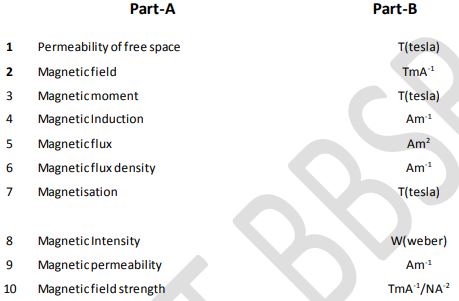
Important Questions for NCERT Class 12 Physics Magnetism And Matter
Question. There are four light-weight-rod samples A, B, C, D separately suspended by threads. A bar magnet is slowly brought near each sample and the following observations are noted
(i) A is feebly repelled
(ii) B is feebly attracted
(iii) C is strongly attracted
(iv) D remains unaffected
Which one of the following is true?
(a) B is of a paramagnetic material
(b) C is of a diamagnetic material
(c) D is of a ferromagnetic material
(d) A is of a non-magnetic material
Answer A
Question. Magnetic lines of force due to a bar magnet do not intersect because
(a) a point always has a single net magnetic field
(b) the lines have similar charges and so repel each other
(c) the lines always diverge from a single force
(d) the lines need magnetic lenses to be made to interest
Answer A
Question. A 250-turn rectangular coil of length 2.1 cm and width 1.25 cm carries a current of 85 mA and subjected to a magnetic field of strength 0.85 T.
Work done for rotating the coil by 180° against the torque is
(a) 4.55 mJ
(b) 2.3 mJ
(c) 1.15 mJ
(d) 9.1 mJ
Answer D
Question. If a diamagnetic substance is brought near the north or the south pole of a bar magnet, it is
(a) repelled by the north pole and attracted by the south pole
(b) attracted by the north pole and repelled by the south pole
(c) attracted by both the poles
(d) repelled by both the poles
Answer D
Question. The magnetic susceptibility of an ideal diamagnetic substance is
(a) –1
(b) 0
(c) +1
(d) ¥
Answer A
Question. If the magnetic dipole moment of an atom of diamagnetic material, paramagnetic material and ferromagnetic material are denoted by md, mp and mf respectively, then
(a) md = 0 and mp ≠ 0
(b) md ≠ 0 and mp = 0
(c) mp = 0 and mf ≠ 0
(d) md ≠ 0 and mf ≠ 0.
Answer A
Question. A bar magnet is hung by a thin cotton thread in a uniform horizontal magnetic field and is in equilibrium state. The energy required to rotate it by 60° is W. Now the torque required to keep the magnet in this new position is
(a) W√3
(b) 3W
(c) √3W /2
(d) 2W/3
Answer B
Question. A magnetic needle suspended parallel to a magnetic field requires 3 J of work to turn it through 60°.
The torque needed to maintain the needle in this position will be
(a) 2√3J
(b) 3 J
(c) √3 J
(d) 3/2 J
Answer B
Question. The magnetic moment of a diamagnetic atom is
(a) much greater than one
(b) 1
(c) between zero and one
(d) equal to zero
Answer D
Question. A short bar magnet of magnetic moment 0.4 J T–1 is placed in a uniform magnetic field of 0.16 T. The magnet is in stable equilibrium when the potential energy is
(a) 0.064 J
(b) –0.064 J
(c) zero
(d) –0.082 J
Answer B
Question. If q1 and q2 be the apparent angles of dip observed in two vertical planes at right angles to each other, then the true angle of dip q is given by
(a) tan2q = tan2q1 + tan2q2
(b) cot2q = cot2q1 – cot2q2
(c) tan2q = tan2q1 – tan2q2
(d) cot2q = cot2q1 + cot2q2
Answer D
Question. Two points A and B are situated at a distance x and 2x respectively from the nearer pole of a magnet 2 cm long. The ratio of magnetic field at A and B is
(a) 4 : 1 exactly
(b) 4 : 1 approximately
(c) 8 : 1 approximately
(d) 1 : 1 approximately
Answer C
Question. Imagine rolling a sheet of paper into a cylinder and placing a bar magnet near its end as shown in figure. What can you say about the sign of →B.→dA for every area →dA
on the surface?
(a) Positive
(b) Negative
(c) No sign
(d) Can be positive or negative
Answer B
Question. A vibration magnetometer placed in magnetic meridian has a small bar magnet. The magnet executes oscillations with a time period of 2 sec in earth’s horizontal magnetic field of 24 microtesla.
When a horizontal field of 18 microtesla is produced opposite to the earth’s field by placing a current carrying wire, the new time period of magnet will be
(a) 1 s
(b) 2 s
(c) 3 s
(d) 4 s
Answer D
Question. A bar magnet having a magnetic moment of 2 × 10⁴ J T–1 is free to rotate in a horizontal plane. A horizontal magnetic field B = 6 × 10⁻⁴ T exists in the space. The work done in taking the magnet slowly from a direction parallel to the field to a direction 60° from the field is
(a) 12 J
(b) 6 J
(c) 2 J
(d) 0.6 J
Answer B
Question. According to Curie’s law, the magnetic susceptibility of a substance at an absolute temperature T is proportional to
(a) 1/T
(b) T
(c) 1/T2
(d) T2
Answer A
Question. Domain formation is the necessary feature of :
(a) ferromagnetism
(b) diamagnetism
(c) paramagnetism
(d) all of these
Answer A
Question. What happens, when a magnetic substance is heated ?
(a) It loses its magnetism
(b) It becomes a strong magnet
(c) Does not effect the magnetism
(d) Either (b) and (c)
Answer A
Free study material for Physics
CBSE Class 12 Physics Worksheets for Chapter 04 Moving Charges and Magnetism
Mastering Chapter 04 Moving Charges and Magnetism with Printable Worksheets
Explore reliable practice questions for Chapter 04 Moving Charges and Magnetism tailored for Class 12 Physics learners. Use these structured worksheets to evaluate exam preparedness and strengthen problem-solving skills throughout the 2026 academic session.
Verified Solutions and NCERT Alignment
Built using official NCERT guidelines for Class 12 Physics, these practice sheets provide reliable academic support. Cross-reference your completed work with our detailed solutions to learn standard answer-writing formats for CBSE exams.
Additional Study Resources for Class 12 Physics
Follow up your worksheet practice by attempting the interactive online MCQ tests for Chapter 04 Moving Charges and Magnetism to evaluate your execution speed. All printable assignments and revision sheets on our platform are updated for the 2026 session and available free of charge.
FAQs
You can download the latest chapter-wise printable worksheets for Class 12 Physics Chapter 04 Moving Charges and Magnetism for free from StudiesToday.com. These have been made as per the latest CBSE curriculum for this academic year.
Yes, Class 12 Physics worksheets for Chapter 04 Moving Charges and Magnetism focus on activity-based learning and also competency-style questions. This helps students to apply theoretical knowledge to practical scenarios.
Yes, we have provided solved worksheets for Class 12 Physics Chapter 04 Moving Charges and Magnetism to help students verify their answers instantly.
Yes, our Class 12 Physics test sheets are mobile-friendly PDFs and can be printed by teachers for classroom.
For Chapter 04 Moving Charges and Magnetism, regular practice with our worksheets will improve question-handling speed and help students understand all technical terms and diagrams.