

Download Class 12 Physics Practice Worksheets
Access comprehensive chapter-wise worksheets for 1 Mark Question Bank using the CBSE Class 12 Physics 1 Mark Question Bank Worksheet. Designed to align with the 2026-27 academic syllabus for Class 12 Physics, these printable practice sets help students reinforce key concepts and improve their overall exam readiness.
Access 1 Mark Question Bank Practice Papers and Solutions
View or download the dedicated CBSE Class 12 Physics 1 Mark Question Bank Worksheet resource below. Engaging with these practice papers under focused study conditions ensures continuous academic progress and mastery of the 2026-27 curriculum for 1 Mark Question Bank.
CBSE Class 12 Physics 1 mark Question Bank. Students can download these worksheets and practice them. This will help them to get better marks in examinations. Also refer to other worksheets for the same chapter and other subjects too. Use them for better understanding of the subjects.
1 Marks Questions
Page 1
Question 1. In 1 which orientation a dipole placed in a uniform electric field is in a) Stable, b) Unstable Equilibrium?
Answer:
(a) **Stable Equilibrium:** The electric dipole is in a state of stable equilibrium when the electric dipole moment \( \vec{p} \) is aligned in the same direction as the uniform electric field \( \vec{E} \), which corresponds to an angle of \( \theta = 0^\circ \) between them.
(b) **Unstable Equilibrium:** The dipole is in unstable equilibrium when the dipole moment \( \vec{p} \) is aligned in the direction opposite to the electric field \( \vec{E} \), corresponding to an angle of \( \theta = 180^\circ \) between them.
In simple words: A dipole is happy and stable when it points in the same direction as the electric field (0 degrees). It becomes highly unstable when flipped completely backwards to face the opposite direction (180 degrees).
Exam Tip: Be sure to write the formula for potential energy of a dipole, \( U = -pE \cos\theta \). It clearly shows that \( U \) is minimum (\( -pE \)) at \( \theta = 0^\circ \) and maximum (\( +pE \)) at \( \theta = 180^\circ \).
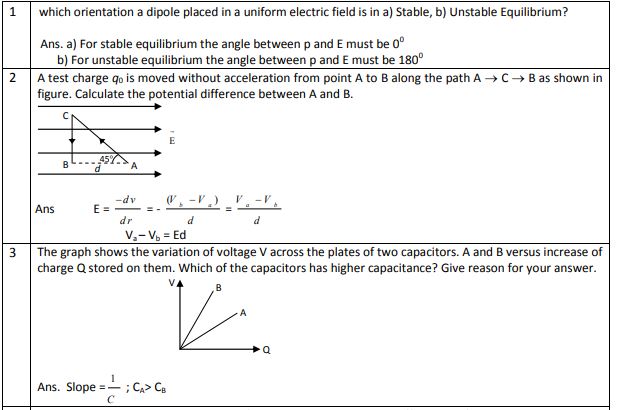
Question 2. A test charge q0 is moved without acceleration from point A to B along the path A C B as shown in figure. Calculate the potential difference between A and B.
Answer: The uniform electric field \( \vec{E} \) is directed horizontally to the right. Let's analyze the potential difference by breaking the path down:
1. **Along path \( C \to B \):** The movement from point C to B is perpendicular to the electric field lines. Since no work is done against the electric field along a path perpendicular to it, the potential remains constant along this vertical line: \[ V_C = V_B \] 2. **Along path \( A \to C \):** The horizontal distance between the starting point A and the vertical plane containing C and B is \( d \). The relation between electric field and potential difference along this direction is: \[ E = -\frac{dV}{dr} \] Rearranging this, the potential difference between A and C (and thus between A and B) is given by: \[ V_A - V_B = E \cdot d \]
In simple words: Moving a charge vertically (from C to B) doesn't change the potential because it is perpendicular to the electric field. The only change happens along the horizontal distance \( d \), meaning the potential difference between A and B is simply the field strength multiplied by the distance \( d \).
Exam Tip: State clearly that the work done along the perpendicular path \( C \to B \) is zero since the electric field is conservative and the displacement is perpendicular to the force.
Question 3. The graph shows the variation of voltage V across the plates of two capacitors. A and B versus increase of charge Q stored on them. Which of the capacitors has higher capacitance? Give reason for your answer.
Answer: The capacitance \( C \) of a capacitor is defined by the formula: \[ C = \frac{Q}{V} \] On a graph plotting voltage \( V \) on the vertical axis and charge \( Q \) on the horizontal axis, the slope of any line is: \[ \text{Slope} = \frac{V}{Q} = \frac{1}{C} \] This shows that the capacitance \( C \) is inversely proportional to the slope of the line: \[ C = \frac{1}{\text{Slope}} \] Looking at the graph, line B has a steeper slope than line A (\( \text{Slope}_B > \text{Slope}_A \)). Consequently, the capacitor represented by line A has a smaller slope and thus possesses a **higher capacitance** (\( C_A > C_B \)).
In simple words: Since the vertical axis is Voltage and the horizontal is Charge, the flatter line (A) means it takes less voltage to store the same amount of charge. This means capacitor A is better at storing charge and has a higher capacitance.
Exam Tip: Be careful with the axes. If the graph plots \( Q \) on the vertical axis and \( V \) on the horizontal axis, the slope would directly represent the capacitance \( C \), which is the opposite of this graph.
Question 4. The given graph shows the variation of charge q versus potential difference V for two capacitors C1 and C2. The two capacitors have same plate separation but the plate area of C2 is double than that of C1. Which of the lines in the graph correspond to C1 and C2 and why?
Answer: The capacitance \( C \) of a parallel plate capacitor is given by the formula: \[ C = \frac{\varepsilon_0 A}{d} \] Since both capacitors have the same plate separation \( d \), their capacitance is directly proportional to their plate area: \[ C \propto A \] Given that the plate area of \( C_2 \) is double that of \( C_1 \), we have: \[ C_2 > C_1 \] Now, let's analyze the graph of charge \( q \) versus potential difference \( V \). The slope of any line on this graph is: \[ \text{Slope} = \frac{q}{V} = C \] This means the line with the steeper slope represents the higher capacitance. In the graph, line A has a steeper slope than line B. Therefore: - **Line A corresponds to \( C_2 \)** (the capacitor with larger area and higher capacitance). - **Line B corresponds to \( C_1 \)** (the capacitor with smaller area and lower capacitance).
In simple words: Since capacitor 2 has twice the area of capacitor 1, it has more capacity. On a charge vs voltage graph, the steeper line (A) represents the larger capacitance, so line A belongs to \( C_2 \) and line B belongs to \( C_1 \).
Exam Tip: Write down both equations \( C \propto A \) and \( \text{Slope} = C \) to establish a clear logical link for your final conclusion.
Question 5. A force F is acting between two charges placed some distance apart in vacuum. If a brass rod is placed between these two charges, how does the force change?
Answer: The electrostatic force \( F_m \) between two charges in a medium of dielectric constant \( K \) is related to the force in vacuum \( F \) by: \[ F_m = \frac{F}{K} \] Since brass is a metal (conductor), its dielectric constant is infinitely large: \[ K_{\text{brass}} = \infty \] Substituting this value into the equation: \[ F_{\text{brass}} = \frac{F}{\infty} = 0 \] Therefore, the electrostatic force between the two charges becomes **zero** when a brass rod is introduced between them.
In simple words: Brass is a metal, and metals block electric fields completely because they have an infinite dielectric constant. Placing a brass rod between the charges reduces the electrostatic force between them to exactly zero.
Exam Tip: Explicitly state that the dielectric constant \( K \) of any metallic conductor is infinity to show why the electrostatic force drops to zero.
Question 6. Which physical quantity has its S.I unit (1) Cm (2) N/C
Answer:
(1) **Coulomb-meter (\( \text{C}\cdot\text{m} \)):** This is the SI unit of **electric dipole moment**.
(2) **Newton per Coulomb (\( \text{N/C} \)):** This is the SI unit of **electric field intensity**.
In simple words: (1) Coulomb-meter is used to measure how strong an electric dipole is. (2) Newton per Coulomb is used to measure the strength of an electric field.
Exam Tip: Be careful with capitalization; write "Coulomb-meter" clearly to avoid confusing it with centimeters (\( \text{cm} \)).
Question 7. V – I graph for a metallic wire at two different temperatures T1 and T2 is as shown in figure. Which of the two temperatures T1 and T2 is higher and why?
Answer: According to Ohm's law, the resistance \( R \) of a conductor is: \[ R = \frac{V}{I} \] On a graph with current \( I \) on the vertical axis and voltage \( V \) on the horizontal axis, the slope of any line is: \[ \text{Slope} = \frac{I}{V} = \frac{1}{R} \] This shows that the resistance \( R \) is inversely proportional to the slope of the line: \[ R = \frac{1}{\text{Slope}} \] In the graph, the line for \( T_2 \) has a flatter slope than the line for \( T_1 \) (\( \text{Slope}_1 > \text{Slope}_2 \)). Therefore, the resistance of the wire is higher at temperature \( T_2 \) (\( R_2 > R_1 \)). For metallic conductors, resistance increases as temperature increases. Since \( R_2 > R_1 \), the temperature **\( T_2 \) is higher than \( T_1 \)**.
In simple words: A flatter line on this current-voltage graph means there is more resistance to the current flow. Since metals resist electricity more when they are hot, the flatter line (T2) must represent the higher temperature.
Exam Tip: Verify which variable is plotted on which axis. If the axes were flipped (voltage on the vertical axis), a steeper slope would represent higher resistance, resulting in the opposite conclusion.
Page 2
Question 8. A 10 V battery of negligible internal resistance is connected across a 200 V battery and a resistance of 38 Ω. Find the value of the current in circuit.
Answer: The two batteries are connected in an opposing series configuration (positive terminals connected together, or opposing each other). The net electromotive force (emf) \( E_{\text{net}} \) in the circuit is: \[ E_{\text{net}} = 200 \text{ V} - 10 \text{ V} = 190 \text{ V} \] The total resistance \( R_{\text{total}} \) in the circuit is \( 38\ \Omega \) (since the internal resistance of the battery is negligible). According to Ohm's law, the electric current \( I \) flowing in the circuit is: \[ I = \frac{E_{\text{net}}}{R_{\text{total}}} = \frac{190 \text{ V}}{38\ \Omega} = 5 \text{ A} \]
In simple words: Since the 10V battery opposes the larger 200V battery, the net voltage pushing current through the circuit is 190V. Dividing this net voltage by the 38 Ohm resistance gives a current of exactly 5 Amperes.
Exam Tip: Check the polarity orientation in the circuit diagram. If the batteries were assisting each other, the voltages would be added (\( 200 + 10 = 210 \text{ V} \)) instead of subtracted.
Question 9. The plot of the variation of potential difference across a combination of three identical cells in series, versus current is as shown below. What is the emf of each cell?
Answer: Let \( E \) be the electromotive force (emf) of each individual cell, and \( r \) be the internal resistance of each cell. For three identical cells connected in series: - The total equivalent emf is \( E_{\text{total}} = 3E \). - The total internal resistance is \( r_{\text{total}} = 3r \). The equation for the terminal potential difference \( V \) across this combination is: \[ V = E_{\text{total}} - I \cdot r_{\text{total}} \] \[ V = 3E - I \cdot (3r) \] From the given graph, we can find the y-intercept (the terminal potential difference when current is zero, \( I = 0 \)): \[ V = 6 \text{ V} \] Substituting these values: \[ 6 = 3E - 0 \cdot (3r) \] \[ 3E = 6 \text{ V} \]
\( \implies E = 2 \text{ V} \) Thus, the emf of each cell is **2 V**.
In simple words: The graph shows that when no current is flowing, the total voltage of the three series cells combined is 6V. Since the cells are identical, dividing this total voltage by 3 gives an EMF of 2V for each cell.
Exam Tip: Remember that the vertical intercept on a terminal potential difference vs current graph always represents the total electromotive force of the combination.
Question 10. A conductor of length L is connected to a dc source of emf V. If this conductor is replaced by another conductor of same material and same area of cross-section but of length 3L, how will the drift velocity change?
Answer: The drift velocity \( v_d \) of free electrons in a conductor of length \( L \) connected to an external voltage source \( V \) is given by: \[ v_d = \frac{e E \tau}{m} = \frac{e V \tau}{m L} \] where \( e \) is the electron charge, \( \tau \) is the relaxation time, and \( m \) is the electron mass. Since the material is the same, the relaxation time \( \tau \) remains constant. The potential difference \( V \) also remains unchanged. This shows that the drift velocity is inversely proportional to the length of the conductor: \[ v_d \propto \frac{1}{L} \] When the length is increased to \( 3L \), the new drift velocity \( v_d' \) is: \[ v_d' \propto \frac{1}{3L} = \frac{v_d}{3} \] Thus, the drift velocity of the electrons is reduced to **one-third** of its original value.
In simple words: Making the wire three times longer weakens the internal electric field pushing the electrons. Since the push is three times weaker, the electrons drift at only one-third of their original speed.
Exam Tip: Always state the proportional relationship \( v_d \propto \frac{1}{L} \) before calculating the final factor to show clear steps.
Question 11. Uniform electric and magnetic fields are produced pointing to the same direction. An electron is projected in the direction of the fields. What will be the effect on the kinetic energy of the electron due to the two fields?
Answer: Let's analyze the effects of both fields individually:
1. **Effect of the Magnetic Field (\( \vec{B} \)):** The magnetic force on a moving charge is \( \vec{F}_m = q (\vec{v} \times \vec{B}) \). Since the electron is projected parallel to the magnetic field direction, the angle \( \theta \) between \( \vec{v} \) and \( \vec{B} \) is \( 0^\circ \). \[ F_m = q v B \sin 0^\circ = 0 \] Since the magnetic force is zero, the magnetic field has no effect on the electron's motion or its kinetic energy.
2. **Effect of the Electric Field (\( \vec{E} \)):** Since the electron is negatively charged, the electric force acting on it is \( \vec{F}_e = -e\vec{E} \), which is directed opposite to the electric field lines. Because the electron is moving in the direction of the electric field, this opposing force acts as a retarding force. This causes the electron to decelerate, meaning its speed decreases and its **kinetic energy decreases**.
In simple words: The magnetic field does not exert any force because the electron travels parallel to it. However, the electric field pulls the negatively charged electron backwards, slowing it down and decreasing its kinetic energy.
Exam Tip: Specify that magnetic forces can never change the kinetic energy of any charged particle because they always act perpendicular to the direction of motion.
Question 12. If a magnet is broken into pieces, which one of the following remains unchanged in each part – mass, moment of inertia, magnetization?
Answer: When a magnet is broken into smaller pieces, its mass and volume decrease, which changes its mass distribution and reduces its moment of inertia. However, the **magnetization** (which is the magnetic dipole moment per unit volume, \( M = \frac{m}{V} \)) is an intrinsic property of the material and remains **unchanged** in each individual piece.
In simple words: Breaking a magnet obviously changes its weight and physical shape (which affects its moment of inertia), but the magnetic alignment inside the material (magnetization) stays exactly the same in every piece.
Exam Tip: Keep your answer brief and directly name "magnetization" as the intrinsic property that remains constant.
Question 13. A cyclotron is not suitable to accelerate electron. Why?
Answer: A cyclotron cannot be used to accelerate electrons because the mass of an electron is extremely small. Due to this small mass, even a tiny amount of energy acceleration causes the electron to reach relativistic speeds very quickly. As its speed approaches the speed of light, its mass increases significantly, causing it to fall out of step (phase resonance) with the high-frequency accelerating potential, making it slip out of the dees immediately.
In simple words: Electrons are incredibly light. In a cyclotron, they gain speed so fast that they lose their timing with the electric pulses and slip out of the machine almost instantly.
Exam Tip: Mention the synchronization mismatch between the electron's orbital frequency and the accelerating voltage frequency due to relativistic mass increase.
Question 14. How will the magnetic field intensity at the centre of a circular our carrying current change, if the current though the will is doubled and radius of the coil is halved?
Answer: The magnetic field intensity \( B \) at the center of a circular coil of radius \( r \) carrying a current \( I \) is given by: \[ B = \frac{\mu_0 I}{2r} \propto \frac{I}{r} \] If the current is doubled (\( I' = 2I \)) and the radius is halved (\( r' = \frac{r}{2} \)), the new magnetic field \( B' \) becomes: \[ B' = \frac{\mu_0 (2I)}{2\left(\frac{r}{2}\right)} = 4 \left( \frac{\mu_0 I}{2r} \right) = 4B \] Therefore, the magnetic field intensity at the center of the circular coil becomes **four times** its original value.
In simple words: Doubling the current doubles the magnetic field, and halving the radius doubles it again. Together, these changes cause the magnetic field at the center of the loop to increase to four times its initial strength.
Exam Tip: State the formula \( B = \frac{\mu_0 I}{2r} \) clearly before carrying out the step-by-step substitutions to ensure full marks.
Page 3
Question 15. Which physical quantity has the unit wb/m2? Is it a scalar or a vector quantity?
Answer: Weber per square meter (\( \text{Wb/m}^2 \)), which is equivalent to Tesla (\( \text{T} \)), is the SI unit of **magnetic field induction** (or magnetic flux density). It is a **vector** physical quantity.
In simple words: Weber per square meter measures the strength of a magnetic field. It is a vector quantity because it has both a specific strength and a direction.
Exam Tip: State clearly that \( 1 \text{ Wb/m}^2 = 1 \text{ Tesla} \) to show the equivalence of units.
Question 16. What type of magnetic material is used in making permanent magnets?
Answer: Ferromagnetic materials with **high retentivity** (to retain strong magnetization) and **high coercivity** (to resist demagnetization from stray fields or temperature changes) are used to make permanent magnets. Examples of such materials include Alnico and steel.
In simple words: We use materials with high retentivity and coercivity, like steel or Alnico, so the magnet stays strongly magnetized and cannot be easily demagnetized.
Exam Tip: Naming the twin properties of "high retentivity" and "high coercivity" is highly looked for by examiners.
Question 17. Why the oscillations of a copper disc in a magnetic field are lightly damped?
Answer: When a copper disc oscillates in a magnetic field, the changing magnetic flux passing through it induces circulating **eddy currents** within the disc. According to Lenz's law, these induced currents flow in a direction that opposes the motion of the disc. This electromagnetic damping force opposes the physical oscillation, causing the motion to be damped.
In simple words: Moving the copper disc through a magnetic field creates swirling electrical currents (eddy currents) inside it. These currents produce a magnetic pushback that acts like friction, slowing down and damping the disc's swing.
Exam Tip: Use the term "eddy currents" and cite "Lenz's law" to explain the origin of the opposing force.
Question 18. Two identical loops, one of copper and another of aluminum are rotated with the same speed in the same magnetic field. In which case, the induced
(a) emf. (b) current will be more and why?
Answer: Let's evaluate both quantities:
(a) **Induced EMF:** The induced electromotive force is given by Faraday's law of electromagnetic induction: \[ e = -\frac{d\Phi}{dt} \] Since both loops are identical in size and shape, and are rotated with the same speed in the same magnetic field, the rate of change of magnetic flux is identical for both. Therefore, the **induced emf remains the same** in both loops.
(b) **Induced Current:** According to Ohm's law, the induced current is: \[ I = \frac{e}{R} \] Since copper has a much lower electrical resistivity than aluminum, the electrical resistance \( R \) of the copper loop is smaller than that of the aluminum loop (\( R_{\text{copper}} < R_{\text{aluminum}} \)). Consequently, the **induced current will be larger in the copper loop**.
In simple words: (a) The voltage generated is identical in both loops because they cut through the magnetic field at the exact same rate. (b) However, since copper conducts electricity better (lower resistance) than aluminum, more current flows through the copper loop.
Exam Tip: Structure your answer clearly with separate sub-headings for (a) and (b) to ensure your explanation is easy to read.
Question 19. Power factor of an a.c. circuit is 0.5. What will be the phase difference between voltage and current in the circuit?
Answer: The power factor of an alternating current (AC) circuit is defined as: \[ \cos \phi = 0.5 \] where \( \phi \) is the phase difference between the voltage and the current. Taking the inverse cosine: \[ \phi = \cos^{-1}(0.5) \] \[ \phi = 60^\circ \quad \left(\text{or } \frac{\pi}{3} \text{ radians}\right) \] Thus, the phase difference between the voltage and the current is **\( 60^\circ \)**.
In simple words: The power factor is the cosine of the phase angle. Since the cosine of 60 degrees is 0.5, the phase difference between the voltage and the current is exactly 60 degrees.
Exam Tip: Specify the angle in both degrees (\( 60^\circ \)) and radians (\( \frac{\pi}{3} \)) to show complete working.
Question 20. A magnet is moved in the direction indicated by an arrow between two coil AB and CD as shown in the figure. Suggest the direction of current in each coil.
Answer: According to Lenz's law, the induced current in any coil always flows in a direction that opposes the magnetic change producing it.
1. **For Coil AB:** The North pole (N-pole) of the bar magnet is moving away from the coil (towards the right). To oppose this withdrawal, the end B of the coil must develop a **South pole** (S-pole) to attract the retreating magnet. Looking from end A, this magnetic configuration corresponds to an **anti-clockwise** current flow.
2. **For Coil CD:** The South pole (S-pole) of the bar magnet is moving towards the coil (towards the right). To oppose this approach, the end C of the coil must develop a **South pole** (S-pole) to repel the approaching magnet. Looking from end D, this magnetic configuration corresponds to an **anti-clockwise** current flow.
In simple words: Lenz's law states that coils fight against any magnet movement. (1) As the North pole leaves coil AB, the coil develops a South pole on its right side to pull it back, making the current flow anti-clockwise when viewed from the left end (A). (2) As the South pole approaches coil CD, the coil develops a South pole on its left side to push it away, making the current flow anti-clockwise when viewed from the right end (D).
Exam Tip: Explicitly state the magnetic polarity developed at each near end of the coils (B and C) to explain the direction of the induced currents step-by-step.
Question 21. What is the power dissipated in an a.c. circuit in which voltage and current are given by V=230 sin (ɷt+π/3) and I = 10 sin ɷt?
Answer: The equations for alternating voltage and current are: \[ V = V_0 \sin(\omega t + \phi) \quad \text{where } V_0 = 230 \text{ V} \] \[ I = I_0 \sin(\omega t) \quad \text{where } I_0 = 10 \text{ A} \] The phase difference between the voltage and the current is: \[ \phi = \frac{\pi}{3} = 60^\circ \] The average power dissipated \( \langle P \rangle \) in the circuit is given by: \[ \langle P \rangle = V_{\text{rms}} \cdot I_{\text{rms}} \cdot \cos \phi \] \[ \langle P \rangle = \left(\frac{V_0}{\sqrt{2}}\right) \cdot \left(\frac{I_0}{\sqrt{2}}\right) \cdot \cos 60^\circ \] \[ \langle P \rangle = \frac{V_0 \cdot I_0}{2} \cdot \cos 60^\circ \] Substituting the given values: \[ \langle P \rangle = \frac{230 \cdot 10}{2} \cdot 0.5 = 1150 \cdot 0.5 = 575 \text{ W} \] Thus, the power dissipated in the circuit is **575 W**.
In simple words: Using the average power formula with the peak values and the phase difference of 60 degrees, we find the dissipated power is \( \frac{230 \times 10}{2} \times \cos 60^\circ = 575 \text{ Watts} \).
Exam Tip: Be sure to write the formula \( \langle P \rangle = V_{\text{rms}} I_{\text{rms}} \cos \phi \) clearly before performing the calculation to show a structured solution.
Question 22. A closed loop PQRS of wire is moved into a uniform magnetic field at right angles to the plane of the paper as shown in the figure. Predict the direction of induced current in the loop.
Answer: As the closed loop PQRS enters the uniform magnetic field (directed inwards perpendicular to the plane of the paper, indicated by cross marks), the magnetic flux passing through the loop increases. According to Lenz's law, the induced current must flow in a direction that opposes this increase in magnetic flux. To counteract the increasing inward magnetic field, the loop develops its own magnetic field pointing **outwards** (perpendicular to the plane of the paper). By the right-hand thumb rule, an outward magnetic field requires the induced current to flow in an **anti-clockwise** direction.
In simple words: Moving the loop into the inward magnetic field increases the flux inside it. To fight this change, the loop creates its own outward-facing magnetic field. According to the right-hand rule, this opposing magnetic field forces the current to flow in an anti-clockwise direction.
Exam Tip: Specify that the increasing inward flux is opposed by the outward induced magnetic field, which is generated by the anti-clockwise flow of current.
Page 4
Question 23. Electromagnetic waves with wavelength
(i) 1 are used to treat muscular strain.
(ii) 2 are used by a FM radio station for broadcasting
(iii) 3 are used to detect fracture in bones
(iv) 4 are absorbed by the ozone layer of the atmosphere.
Identify and name the part of electromagnetic spectrum to which these radiations belong. Arrange these wavelengths in decreasing order of magnitude.
Answer: Let's identify each radiation band from the electromagnetic spectrum:
(i) **\( \lambda_1 \):** Used to treat muscular strain - **Infrared radiation**.
(ii) **\( \lambda_2 \):** Used for FM radio broadcasting - **Radio waves**.
(iii) **\( \lambda_3 \):** Used to detect bone fractures - **X-rays**.
(iv) **\( \lambda_4 \):** Absorbed by the ozone layer - **Ultraviolet (UV) rays**.
**Arrangement in decreasing order of wavelength magnitude:**
Radio waves have the longest wavelength, followed by infrared, ultraviolet, and X-rays. \[ \lambda_2 > \lambda_1 > \lambda_4 > \lambda_3 \] (Radio waves \( > \) Infrared \( > \) Ultraviolet \( > \) X-rays).
In simple words: (i) Infrared is used for muscle strain, (ii) Radio waves are used for FM broadcasting, (iii) X-rays are used for bone fractures, and (iv) UV rays are absorbed by the ozone. Arranging them from longest to shortest wavelength gives: Radio waves, Infrared, Ultraviolet, and X-rays.
Exam Tip: Always double-check the ordering requirement (whether it asks for "decreasing" or "increasing" order of magnitude) to avoid mistakes.
Question 24. The amplitude of oscillating electric field in an electromagnetic wave is 50 vm-1. What is the amplitude of the oscillating magnetic field?
Answer: The amplitude of the electric field \( E_0 \) and the magnetic field \( B_0 \) in an electromagnetic wave are related by: \[ c = \frac{E_0}{B_0} \] where \( c = 3 \times 10^8 \text{ m/s} \) is the speed of light in vacuum. Given \( E_0 = 50 \text{ V/m} \), we can solve for \( B_0 \): \[ B_0 = \frac{E_0}{c} = \frac{50 \text{ V/m}}{3 \times 10^8 \text{ m/s}} \approx 1.67 \times 10^{-7} \text{ T} \] Thus, the amplitude of the oscillating magnetic field is **\( 1.67 \times 10^{-7} \text{ T} \)**.
In simple words: Dividing the electric field amplitude (50) by the speed of light (\( 3 \times 10^8 \)) gives the magnetic field amplitude, which is approximately \( 1.67 \times 10^{-7} \text{ Tesla} \).
Exam Tip: Be sure to write the unit of the magnetic field as "Tesla" (\( \text{T} \)) in your final calculated answer.
Question 25. How does a charge q oscillating at certain frequency produce electromagnetic waves? Sketch a schematic diagram depicting electric and magnetic fields for electromagnetic wave propagation along the z-direction.
Answer: An oscillating electric charge is accelerated. According to classical electromagnetic theory, an accelerated charge creates an oscillating electric field in its surrounding space. This changing electric field in turn generates an oscillating magnetic field. This continuous mutual generation of changing electric and magnetic fields propagates through space as an electromagnetic wave. The diagram below shows the oscillating electric field (along the x-axis) and the magnetic field (along the y-axis) for a wave propagating along the z-axis:
In simple words: An oscillating charge is constantly accelerating, which produces a changing electric field. This changing electric field generates a changing magnetic field, and the two fields regenerate each other continuously to travel through space as an electromagnetic wave.
Exam Tip: Clearly show the three mutually perpendicular axes (electric field, magnetic field, and wave propagation direction) in your diagram to receive full marks.
Question 26. Name them waves which are used in telecommunication.
Answer: **Microwaves** (as well as radio waves) are widely used in telecommunication systems due to their ability to propagate through the atmosphere without significant absorption.
In simple words: Microwaves are the primary type of electromagnetic waves used for telecommunication, including mobile phones and satellite signals.
Exam Tip: Naming "microwaves" directly is sufficient for this standard one-mark question.
Question 27. An air bubble in a jar of water shines brightly. Why?
Answer: When light travels through the optically denser medium (water, refractive index \( \approx 1.33 \)) and strikes the boundary of the rarer medium (air inside the bubble, refractive index \( 1 \)) at an angle of incidence greater than the critical angle, it undergoes **total internal reflection**. The reflected light reflects back to the observer, making the bubble appear highly reflective and shiny.
In simple words: Light traveling through water hits the air bubble boundary at a flat angle and undergoes total internal reflection. This bounces the light back like a mirror, making the air bubble shine brightly.
Exam Tip: The key technical phrase required in your explanation is "total internal reflection" (TIR).
Question 28. How does the focal length of a convex lens change if monochromatic red light is used instead of violet light?
Answer: According to the Lens Maker's Formula: \[ \frac{1}{f} \propto (\mu - 1) \] This shows that the focal length is inversely proportional to the refractive index of the lens material: \[ f \propto \frac{1}{\mu - 1} \] According to Cauchy's relation, the refractive index decreases as the wavelength increases. Since red light has a longer wavelength than violet light, the refractive index for red light is smaller than that for violet light: \[ \mu_{\text{red}} < \mu_{\text{violet}} \] Since the refractive index for red light is smaller, the focal length \( f \) is larger. Therefore, the focal length of the convex lens **increases** when red light is used instead of violet light.
In simple words: Red light has a longer wavelength and bends less than violet light when passing through glass. Because it bends less, it focuses further away, which increases the focal length of the lens.
Exam Tip: State the relation \( \mu_{\text{red}} < \mu_{\text{violet}} \implies f_{\text{red}} > f_{\text{violet}} \) clearly to show a complete, logical progression in your answer.
Question 29. A chicken wakes up early in the morning and goes to sleep by sunset. Why?
OR Why is a chicken not able to see in the dim light?
Answer: In a chicken’s retina, there is a large concentration of cone cells (which are sensitive only to bright light and colors) but extremely few rod cells (which are responsible for detecting dim light). Because of this lack of rod cells, a chicken cannot resolve images in low-light conditions. Consequently, it is unable to see in the dim light of dusk or dawn, meaning it wakes up only in bright morning light and goes to sleep at sunset.
In simple words: A chicken's eyes have plenty of cone cells for bright daylight but very few rod cells for night vision. Because they lack night-vision cells, they are virtually blind in dim light, so they only function during the day.
Exam Tip: Highlight the distinction between "cone cells" (active in bright light) and "rod cells" (active in dim light) as the biological reason.
Question 30. Explain with reason, how the resolving power of a compound microscope will change when
(i) frequency of the incident light on the objective lens is increased.
Answer: The resolving power (R.P.) of a compound microscope is given by: \[ \text{R.P.} = \frac{2\mu \sin \theta}{\lambda} \] where \( \lambda \) is the wavelength of the incident light. The relationship between frequency \( \nu \), speed \( c \), and wavelength is \( \lambda = \frac{c}{\nu} \). Substituting this into the resolving power equation: \[ \text{R.P.} = \frac{2\mu \sin \theta \cdot \nu}{c} \propto \nu \] This shows that the resolving power is directly proportional to the frequency \( \nu \) of the incident light. Therefore, if the frequency of the incident light is increased, the resolving power of the compound microscope **increases**.
In simple words: Higher frequency light has a shorter wavelength, which reduces the wave diffraction limits. This allows the microscope to resolve smaller details, thereby increasing its resolving power.
Exam Tip: Be sure to write the formula showing the inverse relationship with \( \lambda \), and then relate \( \lambda \) to frequency \( \nu \) to validate your answer.
Question 31. In a single-slit diffraction experiment, the width of the slit is made double the original width. How does this affect the size and intensity of the central diffraction band?
Answer: Let \( d \) be the original width of the slit. 1. **Size of the Central Band:** The width of the central diffraction maximum is given by \( \beta = \frac{2D\lambda}{d} \propto \frac{1}{d} \). When the slit width \( d \) is doubled, the width of the central maximum is **halved**, making the central band narrower.
2. **Intensity of the Central Band:** The amplitude of the wave at the central maximum is directly proportional to the slit width \( d \), meaning the intensity \( I \) is proportional to the square of the slit width (\( I \propto d^2 \)). When the slit width is doubled, the intensity of the central band increases to \( 2^2 = 4 \), which is **four times** its original value.
In simple words: Doubling the slit width narrows the central bright stripe to half its original physical size, but focuses the light much more, making the center stripe four times brighter.
Exam Tip: Separate your answer into two distinct points for "size" and "intensity" to ensure you address both parts of the question clearly.
Page 5
Question 32. What is the shape of the wavefront when light is diverging from a point source?
Answer: When light diverges from a point source, the wavefronts propagate outward equally in all directions, forming concentric **spherical** shapes.
In simple words: Light from a tiny point source spreads out evenly like an expanding balloon, forming spherical wavefronts.
Exam Tip: A simple, direct answer naming "Spherical wavefront" is sufficient for this one-mark question.
Question 33. A light wave enters from air to glass. How will the following be affected: [1]
(i) Energy of the wave
(ii) Frequency of the wave:
Answer:
(i) **Energy of the wave:** When light hits the glass surface, a portion of the light wave is reflected back into the air, and some energy is absorbed by the glass medium. Therefore, the energy of the light wave entering the glass **decreases**.
(ii) **Frequency of the wave:** The frequency of a wave is determined solely by its source and is independent of the medium. Thus, the frequency of the light wave remains **unchanged**.
In simple words: (i) Since some light bounces off the glass surface, less energy actually enters the glass. (ii) The frequency (color) of the light stays exactly the same because it only depends on the source, not the medium.
Exam Tip: Emphasize that frequency is a fundamental characteristic of the source and never changes when a wave transitions between different media.
Question 34. The stopping potential in an experiment on photoelectric effect is 2 V. What is the maximum kinetic energy of the photoelectrons emitted?
Answer: The maximum kinetic energy \( K_{\text{max}} \) of the emitted photoelectrons is related to the stopping potential \( V_0 \) by: \[ K_{\text{max}} = e \cdot V_0 \] Given \( V_0 = 2 \text{ V} \): \[ K_{\text{max}} = e \cdot (2 \text{ V}) = 2 \text{ eV} \] Converting this energy to Joules: \[ K_{\text{max}} = 2 \times 1.6 \times 10^{-19} \text{ J} = 3.2 \times 10^{-19} \text{ J} \] Thus, the maximum kinetic energy is **\( 2 \text{ eV} \)** (or **\( 3.2 \times 10^{-19} \text{ J} \)**).
In simple words: The energy is simply the electron charge multiplied by the stopping voltage (2 Volts), which gives exactly 2 electron-volts (eV).
Exam Tip: You can write the final answer in either electron-volts (\( 2 \text{ eV} \)) or Joules (\( 3.2 \times 10^{-19} \text{ J} \)). Providing both shows complete understanding.
Question 35. The de-Broglie wavelength associated with an electron accelerated through a potential difference V is λ. What will be its wavelength when the accelerating potential is increased to 4 V?
Answer: The de-Broglie wavelength \( \lambda \) of an electron accelerated through a potential difference \( V \) is given by: \[ \lambda = \frac{h}{\sqrt{2m e V}} \propto \frac{1}{\sqrt{V}} \] When the accelerating potential is increased to \( 4V \), the new wavelength \( \lambda' \) becomes: \[ \lambda' \propto \frac{1}{\sqrt{4V}} = \frac{1}{2\sqrt{V}} = \frac{\lambda}{2} \] Thus, the de-Broglie wavelength becomes **half** of its original value (\( \frac{\lambda}{2} \)).
In simple words: Since the wavelength is inversely proportional to the square root of the voltage, increasing the voltage by 4 times reduces the wavelength to exactly half its original size.
Exam Tip: State the proportionality \( \lambda \propto \frac{1}{\sqrt{V}} \) clearly to show the math steps behind your final answer.
Question 36. Calculate the threshold frequency of photon for photoelectric emission from a metal of work function 0.1eV?
Answer: The work function \( \phi_0 \) is related to the threshold frequency \( \nu_0 \) by: \[ \phi_0 = h \cdot \nu_0 \implies \nu_0 = \frac{\phi_0}{h} \] Given: - \( \phi_0 = 0.1 \text{ eV} = 0.1 \times 1.6 \times 10^{-19} \text{ J} = 1.6 \times 10^{-20} \text{ J} \) - \( h = 6.63 \times 10^{-34} \text{ J}\cdot\text{s} \) Substituting these values: \[ \nu_0 = \frac{1.6 \times 10^{-20} \text{ J}}{6.63 \times 10^{-34} \text{ J}\cdot\text{s}} \approx 2.41 \times 10^{13} \text{ Hz} \] Thus, the threshold frequency is **\( 2.41 \times 10^{13} \text{ Hz} \)**.
In simple words: Converting the work function of 0.1 eV into Joules and dividing by Planck's constant gives a threshold frequency of approximately \( 2.41 \times 10^{13} \text{ Hertz} \).
Exam Tip: Always convert the work function from eV to Joules by multiplying by \( 1.6 \times 10^{-19} \) before using Planck's constant in SI units.
Question 37. Electron and proton are moving with same speed, which will have more wavelength?
Answer: The de-Broglie wavelength \( \lambda \) of a moving particle is given by: \[ \lambda = \frac{h}{p} = \frac{h}{m v} \] Since both the electron and the proton are moving with the same speed \( v \), their wavelength is inversely proportional to their mass: \[ \lambda \propto \frac{1}{m} \] Since the mass of an electron \( m_e \) is much smaller than the mass of a proton \( m_p \) (\( m_e < m_p \)), the **electron will have a longer wavelength**.
In simple words: For particles moving at the same speed, lighter ones have longer wavelengths. Since an electron is much lighter than a proton, the electron has a significantly longer wavelength.
Exam Tip: Cite the relation \( \lambda \propto \frac{1}{m} \) to justify your conclusion clearly.
Question 38. Write any two characteristics properties of nuclear force.
Answer:
1. **Short-range force:** The nuclear force is extremely short-ranged, acting effectively only over distances of a few femtometers (\( \approx 10^{-15} \text{ m} \)) and dropping to zero rapidly beyond that.
2. **Strongest force in nature:** It is the strongest known fundamental force, being about 100 times stronger than the electrostatic force and \( 10^{38} \) times stronger than gravity at nuclear distances.
In simple words: (1) The nuclear force is incredibly strong, easily holding the nucleus together. (2) However, it only works over extremely tiny distances (short-range) and disappears completely if the particles are pulled slightly apart.
Exam Tip: Other valid properties include "charge independence" and "non-central nature." List any two points clearly.
Question 39. Two nuclei have mass numbers in the ratio 8:125.What is the ratio of their nuclear radii?
Answer: The radius \( R \) of a nucleus is related to its mass number \( A \) by: \[ R = R_0 \cdot A^{1/3} \] where \( R_0 \) is a constant. Let the mass numbers of the two nuclei be \( A_1 \) and \( A_2 \) such that \( \frac{A_1}{A_2} = \frac{8}{125} \). The ratio of their nuclear radii is: \[ \frac{R_1}{R_2} = \left( \frac{A_1}{A_2} \right)^{1/3} = \left( \frac{8}{125} \right)^{1/3} = \frac{2}{5} \] Thus, the ratio of their nuclear radii is **\( 2:5 \)**.
In simple words: Since the radius depends on the cube root of the mass number, taking the cube root of 8 and 125 gives a radius ratio of 2 to 5.
Exam Tip: Write down the cube root relation \( R \propto A^{1/3} \) clearly to show how you simplify the fraction.
Question 40. State Bohr’s postulate of quantization of angular momentum of the orbiting electron in hydrogen atom.
Answer: According to Bohr's quantization postulate, an electron can only revolve in those specific stable, non-radiating circular orbits where its orbital angular momentum \( L \) is an integral multiple of \( \frac{h}{2\pi} \): \[ L = m v r = \frac{n h}{2\pi} \] where \( m \) is the electron mass, \( v \) is the velocity, \( r \) is the orbit radius, \( h \) is Planck's constant, and \( n = 1, 2, 3, \dots \) is the principal quantum number.
In simple words: Bohr's rule states that electrons can only orbit the nucleus in specific tracks where their angular momentum is a whole-number multiple of \( \frac{h}{2\pi} \).
Exam Tip: Write the equation \( m v r = \frac{n h}{2\pi} \) and define all the variables, especially \( n \) as an integer, to get full marks.
Page 6
Question 41. Write the empirical relation for paschen series lines of hydrogen atom?
Answer: The empirical relation (Rydberg formula) for the Paschen series spectral lines of a hydrogen atom is: \[ \frac{1}{\lambda} = R \left( \frac{1}{3^2} - \frac{1}{n^2} \right) \] where \( R \approx 1.097 \times 10^7 \text{ m}^{-1} \) is the Rydberg constant, and the integer \( n \) can take values \( n = 4, 5, 6, 7, \dots \).
In simple words: The Paschen series represents transitions where electrons fall down to the third orbit (\( n = 3 \)) from higher levels (\( n \ge 4 \)), producing infrared light.
Exam Tip: Clearly state that the integer \( n \) must be greater than 3 (\( n = 4, 5, 6, \dots \)) for the Paschen series.
Question 42. What type of impurity is added to obtain n-type semiconductor?
Answer: To obtain an n-type semiconductor, an intrinsic semiconductor (like Silicon or Germanium) is doped with a **pentavalent** impurity (atoms with 5 valence electrons), such as Phosphorus (\( \text{P} \)) or Arsenic (\( \text{As} \)).
In simple words: We add pentavalent impurities (atoms with 5 valence electrons, like Arsenic) to provide extra free electrons and create an n-type semiconductor.
Exam Tip: Mentioning the keyword "pentavalent impurity" along with an example like "Arsenic" or "Phosphorus" is required.
Question 43. How does the energy gap of an intrinsic semiconductor vary, when doped with a trivalent impurity?
Answer: When an intrinsic semiconductor is doped with a trivalent impurity (atoms with 3 valence electrons), a new **acceptor energy level** is created within the forbidden energy gap. This acceptor level lies extremely close to (just above) the top of the valence band. This significantly reduces the effective energy gap required for electrons to transition, as valence electrons can easily jump into this nearby acceptor level at room temperature, leaving behind holes in the valence band.
In simple words: Doping with a trivalent impurity creates a new "helper step" (acceptor level) just above the valence band, allowing electrons to jump up easily and conduct electricity.
Exam Tip: Use the term "acceptor energy level" and describe its location (just above the valence band) to explain the change clearly.
Question 44. How does width of depletion layer of p.n junction diode change with decrease in reverse bias?
Answer: The width of the depletion layer in a p-n junction diode is directly proportional to the applied reverse bias voltage. Therefore, if the reverse bias voltage is decreased, the width of the depletion layer **decreases**.
In simple words: Reverse bias pulls charge carriers away from the junction, widening the barrier. If you decrease this reverse bias, the pulling force weakens, causing the depletion layer to become narrower.
Exam Tip: State the direct relationship between reverse bias voltage and depletion layer width to justify your answer.
Question 45. Define current amplification factor in a common – emitter mode of transistor?
Answer: In the common-emitter configuration of a transistor, the AC current amplification factor \( \beta_{\text{ac}} \) is defined as the ratio of the change in collector current \( \Delta I_C \) to the corresponding change in base current \( \Delta I_B \) at a constant collector-emitter voltage \( V_{CE} \): \[ \beta_{\text{ac}} = \left( \frac{\Delta I_C}{\Delta I_B} \right)_{V_{CE} = \text{constant}} \]
In simple words: It is the ratio showing how much a small change in the input base current gets multiplied to produce a larger change in the output collector current.
Exam Tip: Do not forget to state that the collector-emitter voltage \( V_{CE} \) must be kept constant during this measurement.
Question 46. What is the purpose of modulating a signal in transmission?
Answer: Low-frequency audio signals cannot be transmitted directly over long distances because they require impractically large antennas and suffer heavy attenuation. Modulation overlays the low-frequency information onto a high-frequency carrier wave, which allows for practical antenna sizes, reduces signal distortion, and increases the transmission range.
In simple words: Low-frequency signals cannot travel far and require giant antennas. Modulation hitches the audio signal onto a fast, high-frequency carrier wave, allowing it to travel long distances using small, practical antennas.
Exam Tip: The two primary reasons for modulation are "reducing antenna size" and "preventing signal mixing." Naming either is highly effective.
Question 47. Why ground wave propagation is not suitable for high frequencies?
Answer: As the frequency of a electromagnetic wave increases, the energy loss due to absorption by the earth's surface increases rapidly. For frequencies above \( 1500 \text{ kHz} \), the ground wave is almost entirely absorbed by the earth within a very short distance, making ground wave propagation completely unsuitable for high-frequency signals.
In simple words: High-frequency signals get absorbed very quickly by the ground. Because the earth acts like a sponge for these frequencies, they cannot travel far as ground waves.
Exam Tip: Mention the frequency limit (typically above 1.5 MHz) where ground absorption becomes dominant.
Question 48. What does the term LOS communication mean ?
Answer: **Line-of-Sight (LOS) communication** refers to a space wave propagation mode where the transmitting and receiving antennas must be in a direct, unobstructed line-of-sight path with each other. This mode is used for high-frequency transmissions (such as TV signals in the 100-200 MHz range and microwave links) because these waves do not bend around the earth's curvature.
In simple words: Line-of-Sight communication means the transmitting and receiving antennas must be able to "see" each other in a straight line without any obstacles, because these high-frequency waves travel in straight lines and cannot curve around the earth.
Exam Tip: Provide an example like "satellite links" or "FM/TV transmission" to show the practical application of LOS propagation.
Question 49. A carrier wave of peak voltage 20 volt is used to transmit a message signal. What should be the peak voltage of the modulating signal in order to have modulation index 80%?
Answer: The modulation index \( \mu \) is given by the relation: \[ \mu = \frac{A_m}{A_c} \] where: - \( A_m \) is the peak voltage of the modulating (message) signal. - \( A_c = 20 \text{ V} \) is the peak voltage of the carrier wave. - \( \mu = 80\% = 0.8 \) Rearranging the formula to solve for \( A_m \): \[ A_m = \mu \cdot A_c \] \[ A_m = 0.8 \cdot 20 \text{ V} = 16 \text{ V} \] Thus, the peak voltage of the modulating signal must be **16 V**.
In simple words: To get an 80% modulation index on a 20-volt carrier wave, the message signal's peak voltage must be 80% of 20, which is exactly 16 Volts.
Exam Tip: Always show the formula \( \mu = \frac{A_m}{A_c} \) first before carrying out the simple multiplication step.
Question 50. In half-wave rectification, what is the output frequency if the input frequency is 50 Hz ? What is the output frequency of a full- wave rectifier for the same input frequency ?
Answer:
- **For a Half-wave Rectifier:** A half-wave rectifier transmits only one half-cycle of the AC input per cycle. Therefore, the ripple frequency of the output remains equal to the input frequency: \[ f_{\text{out}} = f_{\text{in}} = 50 \text{ Hz} \] - **For a Full-wave Rectifier:** A full-wave rectifier converts both positive and negative half-cycles of the AC input into uni-directional output pulses. This doubles the frequency of the output ripples: \[ f_{\text{out}} = 2 \cdot f_{\text{in}} = 2 \cdot 50 \text{ Hz} = 100 \text{ Hz} \]
In simple words: A half-wave rectifier outputs one pulse per input cycle, so the frequency stays at 50 Hz. A full-wave rectifier outputs two pulses per cycle, which doubles the output frequency to 100 Hz.
Exam Tip: State both answers clearly under separate points, noting that the output frequency is doubled for full-wave rectification.
Free study material for Physics
Download Class 12 Physics 1 Mark Question Bank Practice Worksheets
Download Chapter Worksheets: Class 12 Physics
Access structured practice worksheets for 1 Mark Question Bank aligned with the 2026 CBSE curriculum. These downloadable exercises for Class 12 Physics help students build accuracy and reinforce core concepts for upcoming school tests.
Concept Clarification for 1 Mark Question Bank
Built using official NCERT guidelines for Class 12 Physics, these practice sheets provide reliable academic support. Cross-reference your completed work with our detailed solutions to learn standard answer-writing formats for CBSE exams.
Effective Revision Strategies for School Exams
Consistent engagement with these exercises builds familiarity with recurring exam themes. If specific areas within 1 Mark Question Bank cause trouble, utilize our dedicated NCERT solutions for Class 12 Physics to clear up doubts immediately.
FAQs
You can download the latest chapter-wise printable worksheets for Class 12 Physics 1 Mark Question Bank for free from StudiesToday.com. These have been made as per the latest CBSE curriculum for this academic year.
Yes, Class 12 Physics worksheets for 1 Mark Question Bank focus on activity-based learning and also competency-style questions. This helps students to apply theoretical knowledge to practical scenarios.
Yes, we have provided solved worksheets for Class 12 Physics 1 Mark Question Bank to help students verify their answers instantly.
Yes, our Class 12 Physics test sheets are mobile-friendly PDFs and can be printed by teachers for classroom.
For 1 Mark Question Bank, regular practice with our worksheets will improve question-handling speed and help students understand all technical terms and diagrams.