

Class 12 Physics Practice Sheet: CBSE Class 12 Physics Quick Revision Questions Worksheet Set 02
Access comprehensive chapter-wise worksheets for Quick Questions using the CBSE Class 12 Physics Quick Revision Questions Worksheet Set 02. Designed to align with the 2026-27 academic syllabus for Class 12 Physics, these printable practice sets help students reinforce key concepts and improve their overall exam readiness.
Download Quick Questions Worksheet PDF with Answers
View or download the dedicated CBSE Class 12 Physics Quick Revision Questions Worksheet Set 02 resource below. Engaging with these practice papers under focused study conditions ensures continuous academic progress and mastery of the 2026-27 curriculum for Quick Questions.
CBSE Class 12 Physics Quick Revision Questions (2). Students can download these worksheets and practice them. This will help them to get better marks in examinations. Also refer to other worksheets for the same chapter and other subjects too. Use them for better understanding of the subjects.
1. A square loop of side 10 cm and resistance 0.5 Ω is placed vertically in the east-west plane. A uniform magnetic field of 0.10 T is set up across the plane in the north-east direction. The magnetic field is decreased to zero in 0.70 s at a steady rate. Determine the magnitudes of induced emf and current during this time-interval.
The angle θ made by the area vector of the coil with the magnetic field is 45°.
initial magnetic flux is

Question 1. A square loop of side 10 cm and resistance 0.5 Ω is placed vertically in the east-west plane. A uniform magnetic field of 0.10 T is set up across the plane in the north-east direction. The magnetic field is decreased to zero in 0.70 s at a steady rate. Determine the magnitudes of induced emf and current during this time-interval.
Answer: Let the side of the square loop be \( a = 10\text{ cm} = 0.1\text{ m} \), so its area is \( A = a^2 = 10^{-2}\text{ m}^2 \).
The resistance of the loop is \( R = 0.5\text{ }\Omega \).
Since the loop is in the vertical east-west plane and the magnetic field is oriented north-east, the angle \( \theta \) between the area vector (directed north) and the magnetic field is \( 45^\circ \).
The initial magnetic flux is:
\( \Phi_{\text{initial}} = B A \cos\theta = 0.10 \times 10^{-2} \times \cos 45^\circ = \frac{10^{-3}}{\sqrt{2}}\text{ Wb} \)
The final magnetic flux is \( \Phi_{\text{final}} = 0 \) because the field is reduced to zero in \( \Delta t = 0.70\text{ s} \).
The magnitude of the induced electromotive force (emf) is:
\( e = \frac{|\Phi_{\text{final}} - \Phi_{\text{initial}}|}{\Delta t} = \frac{10^{-3} / \sqrt{2}}{0.70} \approx 1.0 \times 10^{-3}\text{ V} = 1.0\text{ mV} \)
The magnitude of the induced current is:
\( I = \frac{e}{R} = \frac{1.0 \times 10^{-3}\text{ V}}{0.5\text{ }\Omega} = 2.0 \times 10^{-3}\text{ A} = 2.0\text{ mA} \).
In simple words: As the magnetic field passing through the loop drops to zero, a voltage is induced. By calculating the change in magnetic flux over time and dividing by the loop's resistance, we find the induced voltage is 1.0 millivolt and the resulting current is 2.0 milliamperes.
Exam Tip: Always specify the angle \( \theta \) between the area vector and the magnetic field correctly. A common trap is using the angle with the plane instead of the normal vector.
Question 2. A circular coil of radius 10 cm, 500 turns and resistance 2 Ω is placed with its plane perpendicular to the horizontal component of the earth’s magnetic field. It is rotated about its vertical diameter through 180° in 0.25 s. Estimate the magnitudes of the emf and current induced in the coil. Horizontal component of the earth’s magnetic field at the place is 3.0 × 10⁻⁵ T.
Answer: The radius of the coil is \( R_{\text{radius}} = 10\text{ cm} = 0.1\text{ m} \), so its area is \( A = \pi R_{\text{radius}}^2 = \pi \times 10^{-2}\text{ m}^2 \). The coil has \( N = 500 \) turns and a resistance of \( R = 2\text{ }\Omega \).
Initially, the plane is perpendicular to the horizontal component of the earth's magnetic field \( B = 3.0 \times 10^{-5}\text{ T} \), so the initial angle is \( \theta_1 = 0^\circ \).
The initial flux per turn is:
\( \Phi_1 = B A \cos 0^\circ = 3.0 \times 10^{-5} \times \pi \times 10^{-2} = 3.0\pi \times 10^{-7}\text{ Wb} \)
After rotating by \( 180^\circ \), the final angle is \( \theta_2 = 180^\circ \), and the final flux per turn is:
\( \Phi_2 = B A \cos 180^\circ = -3.0\pi \times 10^{-7}\text{ Wb} \)
The total change in magnetic flux is:
\( \Delta \Phi = \Phi_2 - \Phi_1 = -6.0\pi \times 10^{-7}\text{ Wb} \)
The magnitude of the induced emf is:
\( e = N \frac{|\Delta \Phi|}{\Delta t} = 500 \times \frac{6.0\pi \times 10^{-7}}{0.25} = 3.8 \times 10^{-3}\text{ V} \)
The induced current is:
\( I = \frac{e}{R} = \frac{3.8 \times 10^{-3}\text{ V}}{2\text{ }\Omega} = 1.9 \times 10^{-3}\text{ A} \).
In simple words: When the coil is flipped upside down, the magnetic lines passing through it are reversed. This double change in flux over a short time creates an induced voltage of 3.8 millivolts and an induced current of 1.9 milliamperes.
Exam Tip: Remember that rotating a coil through \( 180^\circ \) doubles the change in flux because \( \Delta \Phi = B A - (-B A) = 2 B A \).
Question 3. Figure below shows planar loops of different shapes moving out of or into a region of a magnetic field which is directed normal to the plane of the loop away from the reader. Determine the direction of induced current in each loop using Lenz’s law.
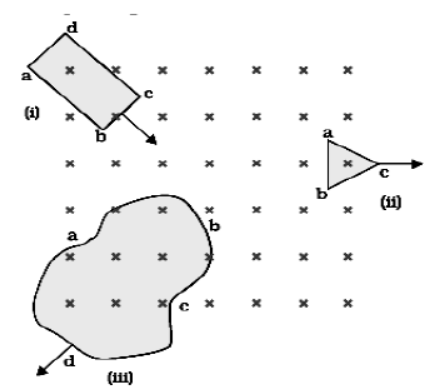
Answer: (i) **Rectangular loop (moving into the magnetic field):** As the loop enters the field region, the inward magnetic flux increases. According to Lenz's Law, the induced current must flow in a direction that opposes this increase. This is achieved by creating an outward magnetic field. Hence, the induced current flows in an anticlockwise direction along the path \( bcdab \).
(ii) **Triangular loop (moving out of the magnetic field):** As the loop leaves the field region, the inward magnetic flux decreases. To oppose this decrease, the induced current must create an inward magnetic field. Thus, the induced current flows in a clockwise direction along the path \( bacb \).
(iii) **Irregularly shaped loop (moving out of the magnetic field):** Similar to the triangular loop, the inward magnetic flux decreases as it leaves the field. To oppose this loss, the induced current must generate a reinforcing inward magnetic field. Therefore, the induced current flows in a clockwise direction along the path \( cdabc \).
In simple words: Lenz's Law states that a loop will always try to keep its magnetic environment constant. If magnetic field lines are added, the loop creates a current to block them. If field lines are lost, the loop creates a current to replace them.
Exam Tip: Always remember that 'moving in' increases flux (so the loop opposes it with an opposite field), while 'moving out' decreases flux (so the loop tries to maintain the field in the same direction).
Question 4. Kamala peddles a stationary bicycle the pedals of the bicycle are attached to a 100 turn coil of area 0.10 m2. The coil rotates at half a revolution per second and it is placed in a uniform magnetic field of 0.01 T perpendicular to the axis of rotation of the coil. What is the maximum voltage generated in the coil?
Answer: The coil has \( N = 100 \) turns, an area \( A = 0.10\text{ m}^2 \), and rotates with a frequency of \( \nu = 0.5\text{ rev/s} \). The uniform magnetic field is \( B = 0.01\text{ T} \).
The angular velocity \( \omega \) is:
\( \omega = 2\pi\nu = 2 \times \pi \times 0.5 = \pi\text{ rad/s} \)
The maximum electromotive force (voltage) \( e_0 \) induced in the rotating coil is:
\( e_0 = N B A \omega \)
\( \implies e_0 = 100 \times 0.01 \times 0.10 \times \pi = 0.314\text{ V} \).
In simple words: As the bicycle pedals rotate the coil in a magnetic field, an alternating voltage is produced. The peak voltage generated under these conditions is 0.314 volts.
Exam Tip: Ensure you use the standard formula for an AC generator, \( e_0 = N B A \omega \), where \( \omega = 2\pi\nu \). Keep all values in standard SI units.
Question 5. Current in a circuit falls from 5.0 A to 0.0 A in 0.1 s. If an average emf of 200 V induced, give an estimate of the self-inductance of the circuit.
Answer: The change in current is \( dI = 0.0\text{ A} - 5.0\text{ A} = -5.0\text{ A} \) over a time interval \( dt = 0.1\text{ s} \). The induced electromotive force is \( e = 200\text{ V} \).
The induced emf in an inductor is given by:
\( e = -L \frac{dI}{dt} \)
Substituting the given values:
\( 200 = -L \left( \frac{-5.0}{0.1} \right) \)
\( \implies 200 = 50 L \)
\( \implies L = \frac{200}{50} = 4\text{ H} \).
Therefore, the self-inductance of the circuit is \( 4\text{ Henrys} \).
In simple words: When a current is turned off rapidly, the magnetic field around the circuit collapses, inducing a counter-voltage. For a drop from 5 amps to zero in a tenth of a second to induce 200 volts, the self-inductance must be 4 Henrys.
Exam Tip: Pay attention to the negative sign in the formula \( e = -L \frac{dI}{dt} \). Since the current is decreasing, the rate of change is negative, making the induced emf positive.
Question 6. A pair of adjacent coils has a mutual inductance of 1.5 H. If the current in one coil changes from 0 to 20 A in 0.5 s, what is the emf induced and change of flux linkage with the other coil?
Answer: The mutual inductance between the two coils is \( M = 1.5\text{ H} \). The current in the first coil changes by \( dI_1 = 20\text{ A} - 0\text{ A} = 20\text{ A} \) in \( dt = 0.5\text{ s} \).
(i) The electromotive force (emf) induced in the second coil is:
\( e = -M \frac{dI_1}{dt} = -1.5 \times \frac{20}{0.5} = -60\text{ V} \)
The magnitude of the induced emf is \( 60\text{ V} \).
(ii) The change in the magnetic flux linkage \( d\Phi \) with the second coil is:
\( d\Phi = M \cdot dI_1 = 1.5 \times 20 = 30\text{ Wb} \).
In simple words: When current grows in one coil, its expanding magnetic field cuts across a neighboring coil, inducing a voltage of 60 volts and causing a total change in magnetic flux of 30 Webers.
Exam Tip: Remember that the change of flux linkage is directly given by \( d\Phi = M \cdot dI \), which does not depend on the time interval \( dt \).
Question 7. A jet plane is travelling towards west at a speed of 1800 km/h. What is the voltage difference developed between the ends of the wing having a span of 25 m, if the Earth’s magnetic field at the location has a magnitude of 5 × 10⁻⁴ T and the dip angle is 30°.
Answer: The speed of the plane is \( v = 1800\text{ km/h} = 500\text{ m/s} \) and the wingspan is \( l = 25\text{ m} \). The Earth's magnetic field is \( B = 5 \times 10^{-4}\text{ T} \) with a dip angle of \( \delta = 30^\circ \).
Since the plane moves horizontally, its wings cut only the vertical component of the Earth's magnetic field, which is:
\( B_v = B \sin\delta = 5 \times 10^{-4} \times \sin 30^\circ = 2.5 \times 10^{-4}\text{ T} \)
The induced motional potential difference (voltage) developed across the wings is:
\( e = B_v l v = (2.5 \times 10^{-4}\text{ T}) \times (25\text{ m}) \times (500\text{ m/s}) = 3.125\text{ V} \).
In simple words: As the plane flies, its metal wings sweep through the Earth's vertical magnetic field lines. This act of cutting the field lines acts like a generator, building up a voltage of 3.125 volts between the wing tips.
Exam Tip: Always identify which component of the Earth's magnetic field is perpendicular to the motion. For horizontal flight, it is always the vertical component \( B_v = B \sin\delta \).
Question 8. A light bulb is rated at 100W for a 220 V supply. Find (a) the resistance of the bulb; (b) the peak voltage of the source; and (c) the rms current through the bulb.
Answer: The bulb has a power rating \( P = 100\text{ W} \) and an rms voltage rating \( V_{\text{rms}} = 220\text{ V} \).
(a) The resistance \( R \) of the bulb filament is:
\( R = \frac{V_{\text{rms}}^2}{P} = \frac{220^2}{100} = 484\text{ }\Omega \)
(b) The peak voltage \( V_0 \) of the AC source is:
\( V_0 = \sqrt{2} V_{\text{rms}} = 1.414 \times 220 \approx 311\text{ V} \)
(c) The root-mean-square (rms) current \( I_{\text{rms}} \) passing through the bulb is:
\( I_{\text{rms}} = \frac{P}{V_{\text{rms}}} = \frac{100\text{ W}}{220\text{ V}} \approx 0.45\text{ A} \).
In simple words: For a standard 100-watt bulb on a 220-volt line, the filament resistance is 484 ohms, the voltage peaks at 311 volts during its AC cycle, and the average running current is 0.45 amperes.
Exam Tip: Always assume that standard household ratings are root-mean-square (rms) values unless peak values are explicitly specified.
Question 9. A 15.0 μF capacitor is connected to a 220 V, 50 Hz source. Find the capacitive reactance and the current (rms and peak) in the circuit. If the frequency is doubled, what happens to the capacitive reactance and the current?
Answer: The capacitance is \( C = 15.0\text{ }\mu\text{F} = 15 \times 10^{-6}\text{ F} \) connected to a \( V_{\text{rms}} = 220\text{ V} \), \( \nu = 50\text{ Hz} \) source.
(a) The capacitive reactance \( X_c \) is:
\( X_c = \frac{1}{2\pi\nu C} = \frac{1}{2\pi \times 50 \times 15 \times 10^{-6}} \approx 212\text{ }\Omega \)
(b) The rms current \( I_{\text{rms}} \) in the circuit is:
\( I_{\text{rms}} = \frac{V_{\text{rms}}}{X_c} = \frac{220}{212} \approx 1.04\text{ A} \)
(c) The peak current \( I_0 \) is:
\( I_0 = \sqrt{2} I_{\text{rms}} = 1.414 \times 1.04 \approx 1.47\text{ A} \)
The current is out of phase and leads the voltage by \( \pi/2 \).
If the source frequency is doubled, the capacitive reactance is halved because \( X_c \propto \frac{1}{\nu} \). Consequently, the current in the circuit is doubled.
In simple words: The capacitor resists AC flow with a reactance of 212 ohms, drawing an average current of 1.04 amps. If you double the frequency of the alternating current, the capacitor lets twice as much current pass through.
Exam Tip: Remember that a capacitor offers lower resistance (reactance) to higher frequencies, which is why current increases proportionally with frequency.
Question 10. What is the role of a Grid in Power Produced and its distribution ?
Answer: An electrical grid serves as an interconnected network that pools power generated from various regional power plants into a centralized hub. From this central grid, electricity is systematically distributed to all connected consumer locations. This setup guarantees a continuous and reliable power supply, ensuring that even if a local power plant suffers a shutdown, electricity can be diverted from other active stations in the network.
In simple words: A power grid links many different power stations together. If one station breaks down, the grid automatically routes electricity from other plants so that nobody loses power.
Exam Tip: Explain that a grid ensures load balancing and reliable redistribution of power across a large geographic area.
Question 11. Suppose that the lower half of the concave mirror’s reflecting surface is covered with an opaque (non-reflective) material. What effect will this have on the image of an object placed in front of the mirror?
Answer: Even if the bottom half of a concave mirror's reflecting surface is covered, the top half continues to reflect light rays from all parts of the object according to the laws of reflection. Therefore, a complete image of the entire object will still be formed. However, since the total area of the reflecting surface is reduced, fewer light rays contribute to forming the final image, which decreases its overall brightness (intensity) to approximately half of its original value.
In simple words: You will still see the whole image, not just half of it. However, because half of the mirror is covered and catches less light, the reflection will appear dimmer.
Exam Tip: Be clear that the size of the mirror does not restrict the completeness of the image, only the quantity of reflected light (brightness).
Question 12. A concave mirror and convex lens both are of same focal length f and made of Glass are immersed in water .Will there be change in their focal lengths? Explain.
Answer: For the concave mirror, there is no change in focal length when immersed in water. This is because reflection depends on the geometry of the mirror's surface, which remains unaffected by the surrounding medium.
For the convex lens, the focal length increases. The focal length of a lens is determined by the relative refractive index between the lens glass and the surrounding medium. Since water has a higher refractive index than air (\( n_{\text{water}} > n_{\text{air}} \)), the relative refractive index of the glass with respect to water decreases, reducing the bending power of the lens and thus increasing its focal length.
In simple words: The mirror's focal length stays the same because reflections do not care about the surrounding fluid. The lens's focal length increases because water reduces its ability to bend light, pushing the focus point further back.
Exam Tip: Use the Lens Maker's Formula \( \frac{1}{f} = (\mu_{\text{glass/medium}} - 1)(\frac{1}{R_1} - \frac{1}{R_2}) \) to show why focal length must increase as the refractive index of the surrounding medium increases.
Question 13. Light from a point source in air falls on a spherical glass surface (n = 1.5 and radius of curvature = 20 cm). The distance of the light source from the glass surface is 100 cm. At what position the image is formed?
Answer: For refraction at a spherical surface, the equation is:
\( \frac{n_2}{v} - \frac{n_1}{u} = \frac{n_2 - n_1}{R} \)
Given:
\( n_1 = 1 \) (air), \( n_2 = 1.5 \) (glass)
\( u = -100\text{ cm} \), \( R = +20\text{ cm} \)
Substituting these values:
\( \frac{1.5}{v} - \frac{1}{-100} = \frac{1.5 - 1}{20} \)
\( \implies \frac{1.5}{v} + \frac{1}{100} = \frac{0.5}{20} = \frac{1}{40} \)
\( \implies \frac{1.5}{v} = \frac{1}{40} - \frac{1}{100} = \frac{3}{200} \)
\( \implies v = +100\text{ cm} \).
Therefore, the real image is formed at a distance of \( 100\text{ cm} \) inside the glass medium, in the direction of the incident light.
In simple words: Using the formula for refraction through a curved surface, we calculate that the light rays converge to form a real image 100 centimeters inside the glass.
Exam Tip: Always strictly follow the Cartesian sign convention. Here, the object distance \( u \) is negative because it is measured against the direction of light, while \( R \) is positive.
Question 14. Find the position of the image formed by the lens combination given in the Fig.
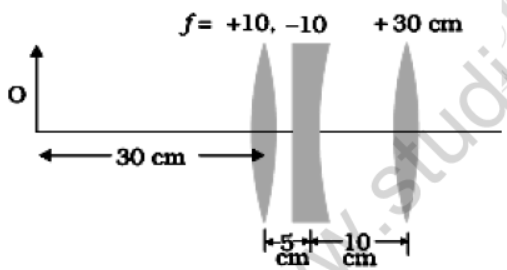
Answer: We find the final image position by analyzing the lenses sequentially:
1. **For the first convex lens (\( f_1 = +10\text{ cm} \)):**
\( u_1 = -30\text{ cm} \)
\( \frac{1}{v_1} - \frac{1}{u_1} = \frac{1}{f_1} \implies \frac{1}{v_1} - \frac{1}{-30} = \frac{1}{10} \implies v_1 = +15\text{ cm} \).
This image acts as a virtual object for the second lens.
2. **For the second concave lens (\( f_2 = -10\text{ cm} \)):**
The separation is \( 5\text{ cm} \), so the object distance is \( u_2 = 15\text{ cm} - 5\text{ cm} = +10\text{ cm} \).
\( \frac{1}{v_2} - \frac{1}{u_2} = \frac{1}{f_2} \implies \frac{1}{v_2} - \frac{1}{10} = -\frac{1}{10} \implies v_2 = \infty \).
The rays emerge parallel from the second lens.
3. **For the third convex lens (\( f_3 = +30\text{ cm} \)):**
Since the incoming rays are parallel, the object distance is \( u_3 = -\infty \).
Thus, the final image is formed at the principal focus of the third lens:
\( v_3 = +30\text{ cm} \).
The final image is located \( 30\text{ cm} \) to the right of the third lens.
In simple words: The first lens focuses the light at 15 cm. The second lens redirects these rays so they become completely parallel. The third lens then takes these parallel rays and focuses them to a final point exactly 30 cm to its right.
Exam Tip: In lens combinations, the image formed by a preceding lens always acts as the object for the next. Take special care when calculating the new object distance by subtracting the inter-lens separation.
Question 15. What is the value of polarising angle of a medium of refractive index √3 ?
Answer: According to Brewster's law, the refractive index of a medium is related to its polarizing angle \( i_p \) by the formula:
\( n = \tan i_p \)
Given \( n = \sqrt{3} \):
\( \tan i_p = \sqrt{3} \)
\( \implies i_p = 60^\circ \).
Therefore, the polarizing angle of the medium is \( 60^\circ \).
In simple words: Using Brewster's Law, we find that for a medium with a refractive index of square root of 3, the angle at which reflected light becomes completely polarized is 60 degrees.
Exam Tip: Always relate the polarizing angle directly to Brewster's Law equation \( n = \tan i_p \), which is a key concept in wave optics.
Question 16. Name the Phenomenon of light which could not be explained by wave theory?
Answer: The photoelectric effect is a phenomenon that could not be explained by the classical wave theory of light, necessitating the introduction of the photon (particle) theory of light instead.
In simple words: The photoelectric effect was the first major discovery that proved wave theory alone cannot explain how light behaves, leading scientists to realize light also travels in particle-like packets.
Exam Tip: In addition to the photoelectric effect, the Compton effect is another phenomenon that wave theory fails to explain.
Question 17. Which among the following radio waves, ultrasonic waves , Micro waves , ϒ rays cannot be polarised? Why?
Answer: Among the given options, ultrasonic waves cannot be polarized. This is because ultrasonic waves are longitudinal sound waves, and polarization is a property restricted solely to transverse waves (such as electromagnetic radio waves, microwaves, and gamma rays).
In simple words: Ultrasonic waves cannot be polarized. Polarization only works on waves that vibrate side-to-side, while sound-based ultrasonic waves vibrate forward-and-backward.
Exam Tip: Remember that only transverse waves can undergo polarization. This is a crucial concept for distinguishing transverse waves from longitudinal waves.
Question 18. Derive the relation between radius of curvature R and focal length of a spherical mirror.
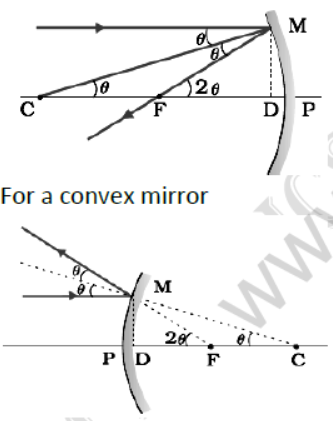
Answer: Consider a spherical mirror of small aperture with a pole \( P \), focus \( F \), and center of curvature \( C \). Let a ray parallel to the principal axis strike the mirror at point \( M \) and reflect through the focus \( F \).
From the geometry of the ray diagram, we observe that the angle of incidence is \( \theta \). Thus:
\( \angle MCP = \theta \quad \text{and} \quad \angle MFP = 2\theta \)
Let us drop a perpendicular \( MD \) from point \( M \) to the principal axis. For a mirror of small aperture, the angles \( \theta \) and \( 2\theta \) are very small:
\( \theta \approx \tan\theta = \frac{MD}{CD} \)
\( 2\theta \approx \tan 2\theta = \frac{MD}{FD} \)
Substituting the value of \( \theta \) into the second equation:
\( 2 \left( \frac{MD}{CD} \right) = \frac{MD}{FD} \implies FD = \frac{CD}{2} \)
Since the aperture of the mirror is small, point \( D \) lies extremely close to the pole \( P \), making \( FD \approx f \) (focal length) and \( CD \approx R \) (radius of curvature).
Therefore:
\( f = \frac{R}{2} \) or \( R = 2f \).
This proves that the focal length of a spherical mirror is exactly half of its radius of curvature.
In simple words: By tracing parallel rays reflecting off a curved mirror, we can use simple trigonometry for small angles to show that the focus point always sits exactly halfway between the mirror's surface and its center of curvature.
Exam Tip: Clearly state the assumption that the mirror has a small aperture, which allows the approximations \( \tan\theta \approx \theta \) and \( D \approx P \) to be valid.
Question 19. Derive mirror formula for a spherical mirror (Or) Derive mirror formula for a concave mirror forming a virtual image.
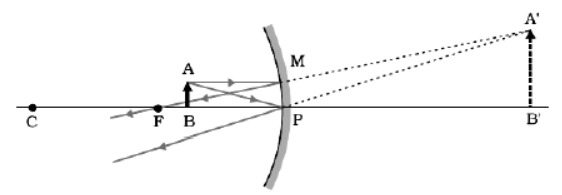
Answer: Consider an object \( AB \) placed in front of a concave mirror of small aperture, forming a virtual, erect, and magnified image \( A'B' \) behind the mirror.
Let \( u \) be the object distance (\( BP = -u \Custom_e \)), \( v \) be the image distance (\( B'P = +v \)), and \( f \) be the focal length (\( FP = -f \)).
From the ray diagram, the two right-angled triangles \( A'B'P \) and \( ABP \) are similar. Therefore:
\( \frac{A'B'}{AB} = \frac{B'P}{BP} \) --- (1)
Similarly, the triangles \( A'B'F \) and \( MPF \) (where \( MP \) is approximately a straight line perpendicular to the principal axis) are similar. Since \( MP = AB \):
\( \frac{A'B'}{AB} = \frac{B'F}{FP} \) --- (2)
Comparing equations (1) and (2):
\( \frac{B'P}{BP} = \frac{B'F}{FP} \)
Since \( B'F = B'P + PF = v - f \), we substitute the values with sign convention:
\( \frac{v}{-u} = \frac{v - (-f)}{-f} \implies \frac{v}{-u} = \frac{v + f}{-f} \)
\( \implies \frac{v}{u} = \frac{v + f}{f} \)
Dividing both sides by \( v \):
\( \frac{1}{u} = \frac{1}{f} + \frac{1}{v} \implies \frac{1}{v} + \frac{1}{u} = \frac{1}{f} \).
This is the required mirror formula.
In simple words: By comparing similar triangles formed by the light rays reflecting off the mirror, we set up ratios of their heights and lengths. Applying coordinate sign conventions yields the classic mirror formula.
Exam Tip: Always apply the Cartesian sign convention carefully: distances in the direction of incident light are positive, while those opposite are negative.
Question 20. Draw wave front from a) a point source at finite distance b) a point source at infinite distance c) a linear source .
Answer: We describe the shape of the wavefronts as follows:
(a) **Point source at a finite distance:** The wavefront is **spherical** in shape.
(b) **Point source at an infinite distance:** The wavefront is **planar** (flat) in shape.
(c) **Linear source (such as a slit):** The wavefront is **cylindrical** in shape.
In simple words: Light spreads outward differently based on its source: a tiny point bulb creates expanding spheres of light, a long tube bulb creates expanding cylinders, and light from a very distant star arrives in completely flat sheets.
Exam Tip: Be prepared to draw these three standard wavefront shapes in your exam sheets, as they are frequently asked as short conceptual drawings.
Question 21. Define band width or fringe width . Derive expression for fringe width in Young’s double slit experiment.
Answer: **Definition:** Fringe width (or bandwidth) \( \beta \) is defined as the separation between any two consecutive bright or dark interference fringes on the screen.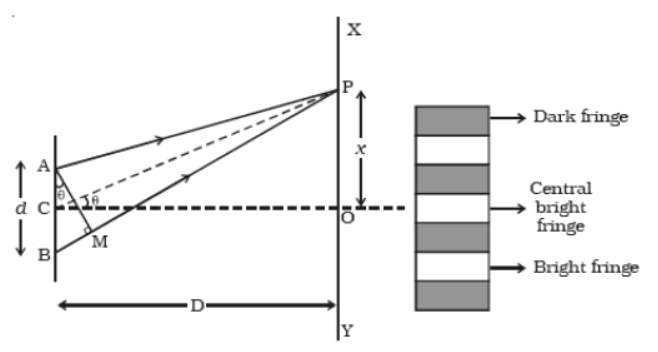
**Derivation:**
Let \( d \) be the separation between two coherent monochromatic light sources, \( A \) and \( B \), emitting light of wavelength \( \lambda \). A screen is positioned parallel to the plane of the sources at a distance \( D \).
Let \( O \) be the central point on the screen. Consider any arbitrary point \( P \) on the screen at a distance \( x \) from \( O \).
The path difference \( \delta \) between the two light waves arriving at \( P \) is:
\( \delta = BP - AP \)
By dropping a perpendicular \( AM \) from \( A \) onto \( BP \), we find that for small angles \( \theta \):
\( \delta = BM = d \sin\theta \approx d \tan\theta \)
From the geometry of the triangle, \( \tan\theta = \frac{x}{D} \). Thus, the path difference is:
\( \delta = \frac{x d}{D} \)
**For Bright Fringes (Constructive Interference):**
The path difference must be an integral multiple of wavelength:
\( \frac{x d}{D} = n \lambda \implies x_n = n \frac{D \lambda}{d} \)
The position of the \( (n+1)^{\text{th}} \) bright fringe is \( x_{n+1} = (n+1) \frac{D \lambda}{d} \).
The fringe width \( \beta \) is:
\( \beta = x_{n+1} - x_n = \frac{D \lambda}{d} \).
A similar calculation for dark fringes yields the identical width \( \beta = \frac{D \lambda}{d} \).
In simple words: Fringe width is the gap from one bright stripe to the next. By calculating the path difference between light waves from two slits and setting it to match bright spots, we prove the stripe width is always wavelength times screen distance, divided by slit spacing.
Exam Tip: Always write the final formula \( \beta = \frac{D\lambda}{d} \) clearly. State that the fringes are equally spaced on either side of the central maximum.
Question 22. State the condition to get clear and broad interference bands .
Answer: To obtain distinct, clear, and broad interference fringes, the following conditions must be fulfilled:
(i) The distance \( D \) between the coherent sources and the screen should be made as large as possible (\( \beta \propto D \)).
(ii) The wavelength \( \lambda \) of the light source used should be large (\( \beta \propto \lambda \)).
(iii) The distance \( d \) separating the two coherent sources must be kept as small as possible (\( \beta \propto \frac{1}{d} \)).
In simple words: To make the light stripes wide and easy to see, you should move the screen far away, use longer-wavelength light (like red), and place the two slits extremely close together.
Exam Tip: Relate these three qualitative conditions directly to the variables in the fringe width formula \( \beta = \frac{D\lambda}{d} \) to score maximum marks.
Question 23. i)Mention two advantages of reflecting telescopes. ii) Draw a neat labeled ray diagram of Cassegrain type reflecting telescope.
Answer: (i) **Advantages of reflecting telescopes over refracting telescopes:**
1. They are completely free from **chromatic aberration** because they use mirrors rather than lenses to focus light.
2. **Spherical aberration** is minimized or completely eliminated by utilizing a parabolic primary mirror.
3. Large mirrors are much easier to support mechanically from the back, providing superior structural stability compared to large, heavy lenses.
(ii) **Ray Diagram of Cassegrain Reflecting Telescope:**
In simple words: Reflecting telescopes are better because mirrors don't suffer from color-blurring (chromatic aberration) like lenses do, and they can be made much larger and more stable. The Cassegrain design bounces light off a large curved mirror at the back onto a small mirror at the front, which directs the light out through a hole in the back to the eyepiece.
Exam Tip: Always draw the primary mirror with a central hole and clearly label the convex secondary mirror in your Cassegrain ray diagram.
Question 24. i) Derive expression for refractive index of material of a prism . ii) A ray of light ,incident on an equilateral prism of n=√3 moves parallel to the base inside the prism. Find the angle of incidence of the ray.
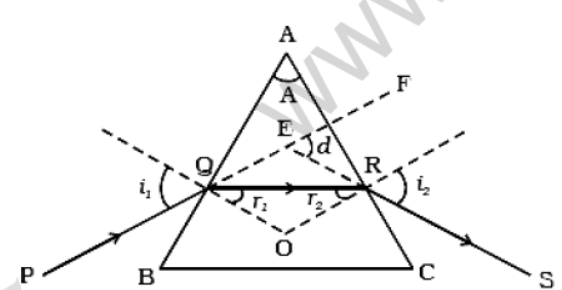
Answer: (i) **Prism Refractive Index Derivation:**
Consider a triangular glass prism \( ABC \) with a refracting angle \( A \). Let a light ray \( PQ \) be incident on face \( AB \) at an angle \( i_1 \), refract along \( QR \) at angle \( r_1 \), and emerge along \( RS \) from face \( AC \) at angle \( i_2 \) (refraction angle \( r_2 \)).
The angle between the extended incident ray and the emergent ray is the angle of deviation \( d \), given by:
\( d = (i_1 - r_1) + (i_2 - r_2) = (i_1 + i_2) - (r_1 + r_2) \) --- (1)
From the quadrilateral \( AQOR \), the opposite angles sum to \( 180^\circ \):
\( A + \angle QOR = 180^\circ \) --- (2)
From the triangle \( \triangle QOR \):
\( r_1 + r_2 + \angle QOR = 180^\circ \) --- (3)
Comparing equations (2) and (3), we get:
\( r_1 + r_2 = A \) --- (4)
Substituting (4) into (1):
\( d = i_1 + i_2 - A \implies i_1 + i_2 = A + d \) --- (5)
At the minimum deviation position (\( d = D_m \)), the refracted ray is symmetric and parallel to the base of the prism:
\( i_1 = i_2 = i \quad \text{and} \quad r_1 = r_2 = r \)
Thus, equation (4) becomes:
\( 2r = A \implies r = \frac{A}{2} \) --- (6)
And equation (5) becomes:
\( 2i = A + D_m \implies i = \frac{A + D_m}{2} \) --- (7)
According to Snell's Law, the refractive index of the prism material is:
\( n = \frac{\sin i}{\sin r} = \frac{\sin \left( \frac{A + D_m}{2} \right)}{\sin \left( \frac{A}{2} \right)} \).
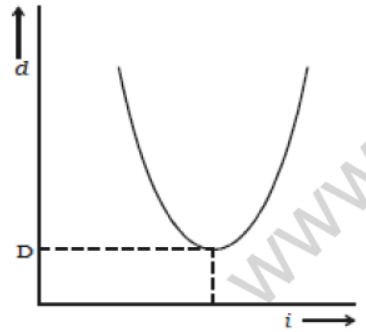
(ii) **Numerical Solution:**
Since the refracted ray travels parallel to the base of the equilateral prism (\( A = 60^\circ \)), the prism is in its minimum deviation position.
The angle of refraction is:
\( r = \frac{A}{2} = \frac{60^\circ}{2} = 30^\circ \)
Using Snell's Law:
\( n = \frac{\sin i}{\sin r} \implies \sqrt{3} = \frac{\sin i}{\sin 30^\circ} \)
\( \implies \sin i = \sqrt{3} \times \sin 30^\circ = \sqrt{3} \times 0.5 = \frac{\sqrt{3}}{2} \)
\( \implies i = 60^\circ \).
Therefore, the angle of incidence of the ray is \( 60^\circ \).
In simple words: Using geometric relationships of angles inside a prism, we find a direct formula linking refractive index to the prism's angle and minimum deviation. For an equilateral prism with refractive index root 3, if the beam travels parallel to the base, its entry angle must be exactly 60 degrees.
Exam Tip: Always specify that the refracted ray traveling parallel to the base is a clear indication that the prism is in the state of minimum deviation.
Question 25. Draw a neat ray diagram of an astronomical telescope in normal adjustment position. Mention one advantage of this position. Write the expression for magnification produced by it and the length of the telescope.
Answer: (i) **Ray Diagram of Astronomical Telescope in Normal Adjustment:**
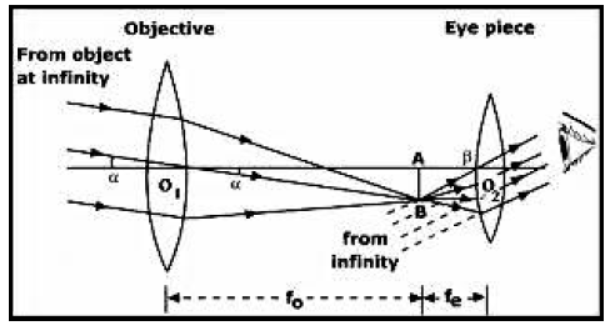
(iii) **Magnification Expression:** The angular magnification \( m \) is:
\( m = -\frac{f_o}{f_e} \)
where \( f_o \) is the focal length of the objective lens and \( f_e \) is the focal length of the eyepiece lens.
(iv) **Length of Telescope Tube:** The physical length \( L \) of the telescope tube is:
\( L = f_o + f_e \).
In simple words: In normal adjustment, a telescope forms its final image at infinity so your eyes don't have to strain to focus. The magnification equals the focal length of the front lens divided by that of the eyepiece, and the total tube length is simply the sum of these two focal lengths.
Exam Tip: Always remember that in normal adjustment, the principal focus of the objective lens coincides exactly with the principal focus of the eyepiece.
Question 26. Draw a neat ray diagram of COMPOUND MICROSCOPE forming image at near point . Mention one dis advantage of this position. Write the expression for magnification produced by it.
Answer: (i) **Ray Diagram of Compound Microscope (Image at Near Point):**
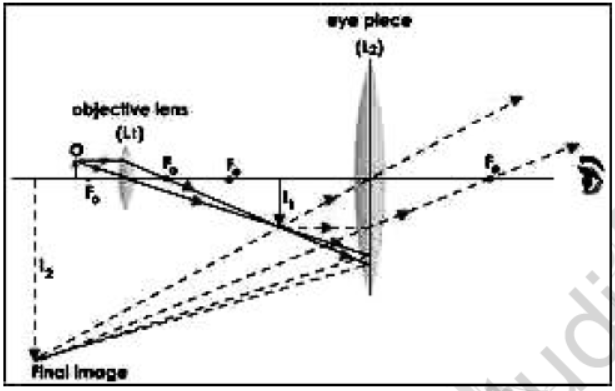
(ii) **Disadvantage:** Although this position yields maximum angular magnification, it causes significant strain to the observer's eye because the final image is formed at the least distance of distinct vision (\( D = 25\text{ cm} \)).
(iii) **Magnification Expression:** The total magnifying power \( m \) is:
\( m = m_o \times m_e = \frac{v_o}{-u_o} \left( 1 + \frac{f_e}{D} \right) \)
where \( v_o \) and \( u_o \) are the image and object distances for the objective lens, \( f_e \) is the eyepiece focal length, and \( D \) is the least distance of distinct vision.
In simple words: Focusing a microscope to form its image at the nearest comfortable reading distance (25 cm) gives the largest, most detailed view, but it forces your eye muscles to work hard, leading to quick eye fatigue.
Exam Tip: Identify clearly that for maximum magnification, the final image must be formed at the near point (\( D \)), which is mathematically expressed with the \( \left(1 + \frac{D}{f_e}\right) \) term.
Question 27. You are given three lenses ,whose parameters are given below.
[Table: L1 (3 D, 8 cm); L2 (6 D, 1 cm); L3 (10 D, 1 cm)]
Which two of the two lenses you will select as objective and eye piece of an Astronomical telescope? Justify.
Answer: To construct an astronomical telescope:
1. **Objective Lens:** We select lens **L1** (Power = 3 D, Aperture = 8 cm).
*Justification:* The objective lens of a telescope must have a large aperture to gather maximum light from faint, distant celestial bodies, and a large focal length (which corresponds to a lower power, \( f = \frac{1}{P} \)) to maximize magnifying power (\( m \approx -\frac{f_o}{f_e} \)).
2. **Eyepiece Lens:** We select lens **L3** (Power = 10 D, Aperture = 1 cm).
*Justification:* The eyepiece of a telescope must have a small focal length (high power) to ensure high magnification, and a small aperture to focus light into the observer's eye.
In simple words: For a telescope, we want a huge, low-power front lens (L1) to act as a giant bucket that gathers lots of starlight, and a small, high-power eyepiece lens (L3) to magnify that light as much as possible.
Exam Tip: Always explain that higher focal length corresponds to lower power. Select the lens with the lowest power and largest aperture for the telescope's objective.
Question 28. You are given three lenses ,whose parameters are given below.
[Table: L1 (3 D, 8 cm); L2 (6 D, 1 cm); L3 (10 D, 1 cm)]
Which two of the two lenses you will select as objective and eye piece of a compound microscope? Justify.
Answer: To build a compound microscope:
1. **Objective Lens:** We select lens **L3** (Power = 10 D, Aperture = 1 cm).
*Justification:* The objective of a compound microscope must have a very small focal length (high power) to produce a highly magnified real intermediate image of the tiny specimen placed close to it.
2. **Eyepiece Lens:** We select lens **L2** (Power = 6 D, Aperture = 1 cm).
*Justification:* The eyepiece must have a small focal length, but it must be slightly larger than the focal length of the objective lens (\( f_e > f_o \)), so we choose L2 (lower power than L3).
In simple words: For a microscope, both lenses need to be small and powerful. We select the absolute highest-power lens (L3) for the front to get close to the tiny specimen, and a slightly lower-power lens (L2) for the eyepiece.
Exam Tip: For a microscope, ensure that the focal length of the objective is smaller than that of the eyepiece (\( f_o < f_e \)), which means the objective must have a higher power rating.
Question 29. How does the following Parameters about a lens change with wavelength of light ?
i) focal length of light ii) Power iii) aperture?
Answer: (i) **Focal Length:** The focal length increases as the wavelength of light increases. According to the Lens Maker's Formula and Cauchy's equation, the refractive index decreases with increasing wavelength (\( n \propto \frac{1}{\lambda} \)), which causes the focal length to increase (\( f \propto \lambda \)).
(ii) **Power:** The power decreases as the wavelength increases because power is inversely proportional to focal length (\( P = \frac{1}{f} \)).
(iii) **Aperture:** The aperture remains unchanged because it is a physical parameter of the lens geometry and does not depend on the characteristics of the incident light.
In simple words: Red light has a longer wavelength than blue light. Passing red light through a lens pushes the focus point further away (longer focal length, lower power), while the physical width of the lens (aperture) stays exactly the same.
Exam Tip: Write out the relationship \( n \propto \frac{1}{\lambda} \) to show that red light bends less than violet light, leading directly to a larger focal length for longer wavelengths.
Question 30. What focal length should the reading spectacles have for a person for whom the least distance of distinct vision is 50 cm?
Answer: The standard least distance of distinct vision is \( 25\text{ cm} \). Therefore, a book should be placed at an object distance \( u = -25\text{ cm} \).
For this hypermetropic eye, the lens must form a virtual image of the book at the person's near point, which is \( v = -50\text{ cm} \).
Applying the lens formula:
\( \frac{1}{f} = \frac{1}{v} - \frac{1}{u} \)
\( \implies \frac{1}{f} = \frac{1}{-50} - \frac{1}{-25} = -\frac{1}{50} + \frac{1}{25} = \frac{1}{50} \)
\( \implies f = +50\text{ cm} \).
Thus, the spectacles must have a focal length of \( +50\text{ cm} \), using a convex lens.
In simple words: Since this person's eyes can't focus on anything closer than 50 cm, reading a book held at a normal distance of 25 cm requires a magnifying convex lens with a focal length of +50 cm to push the virtual image out to 50 cm.
Exam Tip: Always remember that hypermetropia (farsightedness) is corrected using a convex lens, which is mathematically represented by a positive focal length.
Question 31. Two slits are made one millimetre apart and the screen is placed one metre away. What is the fringe separation when blue green light of wavelength 500 nm is used?
Answer: Given:
Slit separation, \( d = 1\text{ mm} = 10^{-3}\text{ m} \)
Screen distance, \( D = 1\text{ m} \)
Wavelength of light, \( \lambda = 500\text{ nm} = 5 \times 10^{-7}\text{ m} \)
The fringe separation \( \beta \) is calculated as:
\( \beta = \frac{D \lambda}{d} \)
\( \implies \beta = \frac{1 \times 5 \times 10^{-7}}{10^{-3}} = 5 \times 10^{-4}\text{ m} = 0.5\text{ mm} \).
Therefore, the separation between adjacent fringes is \( 0.5\text{ mm} \).
In simple words: When blue-green light passes through two slits separated by 1 millimeter and hits a screen 1 meter away, it forms a pattern of stripes that are exactly 0.5 millimeters apart.
Exam Tip: Convert all parameters to standard SI units (meters) before performing any calculation to avoid simple decimal-point errors.
Question 32. For what distance is ray optics a good approximation ,when the aperture is 3 mm wide and the wavelength is 500 nm?
Answer: Given:
Aperture width, \( a = 3\text{ mm} = 3 \times 10^{-3}\text{ m} \)
Wavelength of light, \( \lambda = 500\text{ nm} = 5 \times 10^{-7}\text{ m} \)
The Fresnel distance \( z_F \), which marks the limit where ray optics remains a valid approximation, is:
\( z_F = \frac{a^2}{\lambda} \)
\( \implies z_F = \frac{(3 \times 10^{-3})^2}{5 \times 10^{-7}} = 18\text{ m} \).
This indicates that ray optics is a highly accurate approximation for propagation distances up to \( 18\text{ m} \).
In simple words: For a 3 mm opening using 500 nm light, the beam travels as a straight ray for about 18 meters before diffraction effects cause it to spread out significantly.
Exam Tip: The Fresnel distance \( z_F = \frac{a^2}{\lambda} \) defines the boundary where ray optics transitions into wave optics. Be sure to memorize this formula.
Question 33. What is the effect of doubling the intensity of incident radiation on i) Photo electric current ? ii) kinetic energy of photo electron?
Answer: (i) **Photoelectric Current:** Doubling the intensity of the incident radiation doubles the photoelectric current. This is because intensity represents the number of incident photons per second, and since one photon ejects one electron, the number of emitted photoelectrons increases proportionally.
(ii) **Kinetic Energy:** The maximum kinetic energy of the emitted photoelectrons remains completely unchanged. This is because kinetic energy depends solely on the frequency of the incident light and the work function of the metal, and is entirely independent of light intensity.
In simple words: (i) Making the light twice as bright doubles the number of electrons flowing out of the metal. (ii) However, brightness does not make any single electron fly off any faster; their individual speeds stay exactly the same.
Exam Tip: Always distinguish between intensity (which controls the number of electrons) and frequency (which controls the energy of the electrons).
Question 34. An electron and a proton are associated with same de Broglie wave length of 1nm. i) Find the ratio of their momenta ii) Which of them will have more kinetic energy?
Answer: Given that the de-Broglie wavelength of both the electron and the proton is identical (\( \lambda = 1\text{ nm} \)):
(i) **Ratio of Momenta:** The de-Broglie wavelength is given by \( \lambda = \frac{h}{p} \), which implies \( p = \frac{h}{\lambda} \). Since \( h \) is a constant and \( \lambda \) is the same for both particles, their linear momenta \( p \) must be equal. Therefore, the ratio of their momenta is \( 1 : 1 \).
(ii) **Kinetic Energy Comparison:** The relationship between kinetic energy \( K \) and momentum \( p \) is:
\( K = \frac{p^2}{2m} \)
Since both particles have the same momentum \( p \), their kinetic energy is inversely proportional to their mass (\( K \propto \frac{1}{m} \)). Because an electron has a much smaller mass than a proton (\( m_e \ll m_p \)), the electron will possess significantly higher kinetic energy.
In simple words: Since they have the exact same wavelength, they must have the exact same momentum. Because an electron is much lighter than a proton, carrying that same momentum requires it to have a much higher speed and kinetic energy.
Exam Tip: Recall the inverse relationship between kinetic energy and mass for particles of equal momentum: the lighter particle always carries more kinetic energy.
Question 35. State the laws of Photoelectric emission.
Answer: The fundamental laws governing photoelectric emission are:
(i) For a given photosensitive material, there exists a specific minimum frequency, known as the **threshold frequency** (\( \nu_0 \)), below which no photoelectric emission can occur, regardless of how intense the incident light is.
(ii) The magnitude of the photoelectric current is directly proportional to the intensity of the incident radiation, provided the frequency of the light is greater than the threshold frequency.
(iii) Photoelectric emission is an instantaneous process, meaning there is no measurable time lag between the incidence of light photons and the ejection of photoelectrons.
(iv) The maximum kinetic energy of the emitted photoelectrons is directly proportional to the frequency of the incident radiation, but is completely independent of its intensity.
In simple words: Photoelectric rules say: 1) Light must be above a certain color frequency to free any electrons at all. 2) Brighter light creates more electrons. 3) The process is instant. 4) Higher frequency light makes the electrons fly faster, but brighter light does not.
Exam Tip: Practice listing all four laws clearly, as this is a very common 3-mark or 5-mark theory question in modern physics.
Question 36. Mention the uses of Photo electric cells.
Answer: Photoelectric cells have several key technological applications:
(i) They are used in cinematography for the reproduction of sound from film tracks.
(ii) They are utilized in industrial systems for measuring and controlling the high temperatures of furnaces.
(iii) They are used to operate automatic switches for street lighting systems.
(iv) They are employed in astrophysics to analyze the temperatures and spectra of stars.
In simple words: Photo cells are used in movie theater sound systems, automatic streetlights, safety sensors, and as light detectors in space telescopes.
Exam Tip: Always remember to list at least three distinct practical applications to secure full marks on this recurring short-answer question.
Question 37. Derive expression for the de Broglie wavelength of an electron.
Answer: When an electron of mass \( m \) and charge \( e \) is accelerated from rest through an electric potential difference of \( V \) volts, the work done on the electron is stored as its kinetic energy \( K \):
\( K = e V \)
Since the kinetic energy is also given by \( K = \frac{1}{2} m v^2 \), the velocity \( v \) of the electron is:
\( v = \sqrt{\frac{2 e V}{m}} \) --- (1)
According to de-Broglie's hypothesis, the wavelength \( \lambda \) associated with this moving electron is:
\( \lambda = \frac{h}{m v} \) --- (2)
Substituting the expression for velocity from (1) into (2):
\( \lambda = \frac{h}{m \sqrt{\frac{2 e V}{m}}} = \frac{h}{\sqrt{2 m e V}} \).
Substituting the known values of the constants (\( h = 6.63 \times 10^{-34}\text{ J s} \), \( m = 9.1 \times 10^{-31}\text{ kg} \), and \( e = 1.6 \times 10^{-19}\text{ C} \)):
\( \lambda \approx \frac{12.27}{\sqrt{V}}\text{ \AA} \) or \( \frac{1.227}{\sqrt{V}}\text{ nm} \).
In simple words: When a voltage pulls an electron, it gains speed and momentum. Since a moving electron behaves like a wave, we can combine its kinetic energy formula with de-Broglie's wave rule to find its wavelength in terms of the voltage.
Exam Tip: Always remember to write the final simplified expression \( \lambda = \frac{12.27}{\sqrt{V}}\text{ \AA} \), as it is highly helpful for solving numerical questions quickly.
Question 38. a) i) Show graphically how the maximum kinetic energy of photo electrons emitted from a photosensitive material varies with the frequency of incident radiation.
b) How will you i ) calculate Planck’s constant and work function from the graph?
Answer: (i) **Graph of Max Kinetic Energy vs Frequency:**
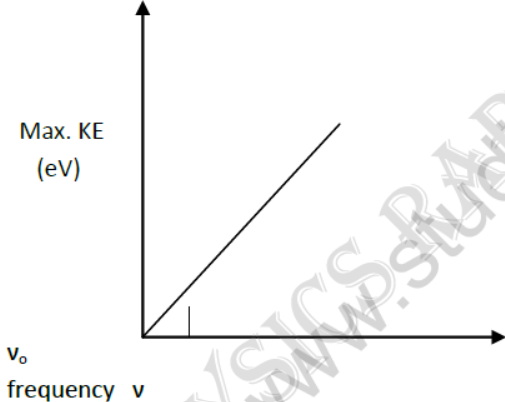
1. **Planck's Constant (\( h \)):** The slope of the straight-line graph is equal to Planck's constant \( h \) (\( \text{Slope} = \frac{\Delta K}{\Delta \nu} = h \)).
2. **Work Function (\( \phi \)):** The x-intercept of the graph gives the threshold frequency \( \nu_0 \). The work function is calculated by multiplying the slope (Planck's constant) by the x-intercept:
\( \phi = \text{Slope} \times \text{x-intercept} = h \nu_0 \).
In simple words: A plot of electron speed versus light frequency forms a straight line that starts at the threshold frequency. The slope of this line represents Planck's constant, and the starting point on the horizontal axis tells us the threshold frequency needed to calculate the metal's work function.
Exam Tip: Clearly state that the slope is a constant value for all metals, while the x-intercept (threshold frequency) varies depending on the type of photosensitive material.
Question 39. How will the Photo electric current change on decreasing the wave length of incident radiation?
Answer: The photoelectric current remains unchanged when the wavelength of the incident radiation is decreased. Photoelectric current depends solely on the intensity of the incident light (number of photons per second) and is independent of the wavelength or frequency of the radiation, provided the frequency is above the threshold frequency.
In simple words: Shortening the wavelength of light makes the ejected electrons fly faster, but it does not change the total number of electrons flowing. The current only increases if you make the light brighter.
Exam Tip: Always remember that current is determined by intensity, while kinetic energy is determined by wavelength (or frequency).
Question 40. de Broglie wavelength associated with an electron accelerated through a potential difference of V is λ. What will be its wavelength if the accelerating potential is increased to 4V?
Answer: The de-Broglie wavelength of an accelerated electron is inversely proportional to the square root of the potential difference \( V \):
\( \lambda \propto \frac{1}{\sqrt{V}} \)
If the accelerating potential is increased to \( V' = 4V \), the new wavelength \( \lambda' \) is:
\( \lambda' = \frac{\lambda}{\sqrt{4}} = \frac{\lambda}{2} \).
Therefore, the de-Broglie wavelength is halved.
In simple words: Since wavelength is inversely proportional to the square root of the voltage, increasing the voltage by 4 times increases the electron's speed and cuts its de-Broglie wavelength exactly in half.
Exam Tip: Remember that \( \lambda \propto \frac{1}{\sqrt{V}} \). Doubling the voltage does not halve the wavelength; it must be increased by four times to halve the wavelength.
Question 41. The maximum kinetic energy of a photoelectron is 3eV. What is its stopping potential?
Answer: The maximum kinetic energy \( K_{\text{max}} \) is related to the stopping potential \( V_0 \) by the relation:
\( K_{\text{max}} = e V_0 \)
Given \( K_{\text{max}} = 3\text{ eV} \):
\( 3\text{ eV} = e V_0 \implies V_0 = 3\text{ V} \).
Therefore, the stopping potential is \( 3\text{ V} \).
In simple words: If the most energetic electrons have 3 electron-volts of energy, you need to apply an opposing voltage of exactly 3 volts to stop them from reaching the collector.
Exam Tip: The numerical value of kinetic energy in eV is always equal to the magnitude of the stopping potential in volts. This makes calculations instant.
Question 42. The stopping Potential in an experiment on Photoelectric effect is 2V.What is the maximum kinetic energy of a photoelectron emitted.
Answer: The maximum kinetic energy \( K_{\text{max}} \) of emitted photoelectrons is related to the stopping potential \( V_0 \) by:
\( K_{\text{max}} = e V_0 \)
Given \( V_0 = 2\text{ V} \):
\( K_{\text{max}} = e \times 2\text{ V} = 2\text{ eV} \).
Thus, the maximum kinetic energy of the photoelectrons is \( 2\text{ eV} \) (or \( 3.2 \times 10^{-19}\text{ J} \)).
In simple words: An opposing voltage of 2 volts can halt all outgoing electrons, which means the most energetic electrons must carry exactly 2 electron-volts of kinetic energy.
Exam Tip: Always remember to state the units clearly. You can write the answer in both electron-volts (eV) and Joules (J) to show thoroughness.
Question 43. Name an experiment which shows wave nature of electrons. Which phenomenon was observed in this experiment using electron beam?
Answer: The experiment that confirmed the wave nature of electrons is the **Davisson and Germer experiment**. The physical phenomenon observed in this experiment was **electron diffraction** (similar to X-ray diffraction).
In simple words: The Davisson and Germer experiment proved that electrons can act like waves by showing they can undergo diffraction when bounced off a nickel crystal.
Exam Tip: Clearly specify 'electron diffraction' as the primary wave phenomenon observed in this experiment.
Question 44. Red light however bright it is , cannot produce the emission of electrons from a clean zinc surface. But even weak UV radiation can do so. Why?
Answer: Photoelectric emission is determined entirely by the frequency of the incident radiation, not by its intensity. Red light has a frequency lower than the threshold frequency of zinc, meaning its individual photons do not carry enough energy to free an electron, no matter how bright (intense) the light is. On the other hand, ultraviolet (UV) radiation has a frequency higher than the threshold frequency of zinc, so even a weak UV beam contains photons with enough energy to eject electrons instantly.
In simple words: A single photon of red light is too weak to knock an electron free, even if you shine billions of them at once. A UV photon is much more energetic, so even a tiny trickle of UV light can free electrons instantly.
Exam Tip: Explain this in terms of photon energy: \( E = h\nu \). If the photon energy is less than the work function (\( h\nu < \phi_0 \)), no emission can occur.
Question 45. Why metal surfaces are coated with photosensitive material?
Answer: Metal surfaces (cathodes) are coated with photosensitive materials to lower their work function. This reduction in work function makes it easier for low-energy light photons to trigger photoelectric emission.
In simple words: Coating the metal with photosensitive material lowers the energy barrier needed to free its electrons, allowing the solar cell or sensor to work under weaker light.
Exam Tip: Use the term 'work function' in your answer, as this is the key keyword examiners look for.
Question 46. A Nucleus 92U238 undergoes alpha-decay and transforms to thorium(Th). What is the mass number and atomic number of thorium?
Answer: During alpha decay, a nucleus emits an alpha particle (a helium nucleus, \( _2\text{He}^4 \)), which reduces its atomic number by 2 and its mass number by 4.
The decay reaction is:
\( _{92}\text{U}^{238} \rightarrow _{90}\text{Th}^{234} + _2\text{He}^4 \)
Therefore, for the transformed Thorium (Th) nucleus:
- Mass number \( A = 234 \)
- Atomic number \( Z = 90 \).
In simple words: When uranium shoots out an alpha particle, it loses 2 protons and 4 total nuclear particles. This turns it into thorium with an atomic number of 90 and a mass of 234.
Exam Tip: Always write out the complete balanced nuclear reaction to support your values of mass number and atomic number.
Question 47. What is the ratio of the orbits corresponding to first excited state and ground state in a hydrogen atom?
Answer: In a hydrogen atom, the radius \( r_n \) of the \( n^{\text{th}} \) orbit is proportional to the square of the principal quantum number \( n \):
\( r_n \propto n^2 \)
For the ground state: \( n = 1 \).
For the first excited state: \( n = 2 \).
Therefore, the ratio of the orbit radii is:
\( \frac{r_2}{r_1} = \frac{2^2}{1^2} = 4 : 1 \).
The ratio of the orbits is \( 4 : 1 \).
In simple words: According to Bohr's model, the second orbit is four times larger than the first orbit because orbit radius grows with the square of the orbit number.
Exam Tip: Be careful with terminology: 'first excited state' corresponds to \( n = 2 \), not \( n = 1 \) (which is the ground state).
Question 48. In a given sample , two radio isotopes A and B are initially present in the ratio 1: 4.The half lives of A and B are 100year and 50year respectively. Find the time after which the amounts of A and B are equal.
Answer: Let the initial number of nuclei of isotope A be \( N_0 \), and for isotope B be \( 4N_0 \). The half-lives are \( T_A = 100\text{ years} \) and \( T_B = 50\text{ years} \).
At any time \( t \), the remaining amounts are:
\( N_A(t) = N_0 \left( \frac{1}{2} \right)^{t/100} \)
\( N_B(t) = 4N_0 \left( \frac{1}{2} \right)^{t/50} \)
To find the time \( t \) when their amounts become equal (\( N_A(t) = N_B(t) \)):
\( N_0 \left( \frac{1}{2} \right)^{t/100} = 4N_0 \left( \frac{1}{2} \right)^{t/50} \)
\( \implies \left( \frac{1}{2} \right)^{t/100} = 2^2 \left( \frac{1}{2} \right)^{t/50} \)
\( \implies 2^{-t/100} = 2^2 \cdot 2^{-t/50} = 2^{2 - t/50} \)
Equating the powers of 2:
\( -\frac{t}{100} = 2 - \frac{t}{50} \)
\( \implies \frac{t}{50} - \frac{t}{100} = 2 \)
\( \implies \frac{t}{100} = 2 \implies t = 200\text{ years} \).
Therefore, the amounts of A and B will be equal after \( 200\text{ years} \).
In simple words: Isotope B starts with 4 times more material than A, but decays twice as fast. Because B shrinks much faster, after 200 years (which is 2 half-lives for A and 4 half-lives for B), the remaining quantities of both isotopes become exactly equal.
Exam Tip: You can verify this easily by tracking remaining fractions: after 200 years, A has halved twice (\( 1 \rightarrow 1/2 \rightarrow 1/4 \)), while B has halved four times (\( 4 \rightarrow 2 \rightarrow 1 \rightarrow 1/2 \rightarrow 1/4 \)). Both end up at \( 1/4 \) of their starting levels relative to \( N_0 \).
Question 49. A radioactive substance has a half life of T year. After how much time is its activity reduced to 6.25% of its original activity?
Answer: The activity \( R \) of a radioactive substance decays according to:
\( \frac{R}{R_0} = \left( \frac{1}{2} \right)^n \)
Given that the activity is reduced to \( 6.25\% \) of its original value:
\( \frac{R}{R_0} = \frac{6.25}{100} = \frac{1}{16} = \left( \frac{1}{2} \right)^4 \)
Comparing the equations, the number of half-lives that have elapsed is \( n = 4 \).
Since the half-life is \( T \) years, the total time required is:
\( t = n \cdot T = 4T\text{ years} \).
Therefore, the activity reduces to \( 6.25\% \) after \( 4T \) years.
In simple words: Since activity halves with every half-life, it drops to 50%, then 25%, then 12.5%, and finally reaches 6.25% after exactly four half-lives. This takes a total of 4T years.
Exam Tip: Recognize that standard percentages like 50%, 25%, 12.5%, 6.25%, and 3.125% correspond directly to integer powers of \( \frac{1}{2} \), simplifying half-life calculations.
Question 50. Define activity of radioactive substance and give its SI unit. Plot a graph showing variation of activity of a radioactive substance with time.
Answer: **Definition:** The activity \( R \) of a radioactive substance is defined as the rate of decay or disintegration of its nuclei per unit time:
\( R = -\frac{dN}{dt} = \lambda N \)
where \( \lambda \) is the decay constant and \( N \) is the number of remaining undecayed nuclei.
**SI Unit:** The SI unit of activity is the **Becquerel (Bq)**, where \( 1\text{ Bq} = 1\text{ disintegration per second} \).
**Graph of Activity vs Time:** Since \( R = \lambda N \), the graph of activity versus time follows the same exponential decay curve as \( N \) versus \( t \):In simple words: Activity is how many nuclear explosions (decays) happen inside a sample every second. It is measured in becquerels. Because there is less and less active material over time, the rate of decay drops off as a smooth downward-curving exponential graph.
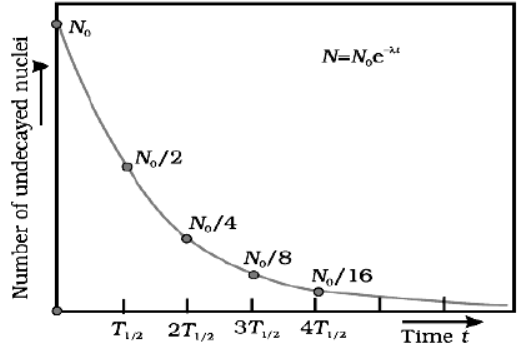
Exam Tip: Always mention both the definition of activity and its SI unit (Becquerel). Note that another common unit is the Curie (Ci), where \( 1\text{ Ci} = 3.7 \times 10^{10}\text{ Bq} \).
Question 51. Define Half life and mean life of a radioactive substance. Derive relation between them.
Answer: **Definitions:**
1. **Half-Life (\( T_{1/2} \)):** The half-life of a radioactive substance is defined as the time required for half of the initial number of active nuclei to decay.
2. **Mean Life (\( \tau \)):** The mean life (or average life) is the sum of the lifetimes of all the nuclei divided by the total number of nuclei. It is also defined as the time during which the number of active nuclei falls to \( \frac{1}{e} \) (approx. 37%) of its initial value.
**Derivation of Relationship:**
From the law of radioactive decay, the half-life is related to the decay constant \( \lambda \) by:
\( T_{1/2} = \frac{\ln 2}{\lambda} = \frac{0.693}{\lambda} \) --- (1)
The mean life \( \tau \) is defined as the reciprocal of the decay constant:
\( \tau = \frac{1}{\lambda} \) --- (2)
Substituting equation (2) into (1), we get:
\( T_{1/2} = 0.693 \tau \).
Therefore, the half-life is equal to \( 0.693 \) times the mean life.
In simple words: Half-life is the time it takes for half of the material to vanish. Mean life is the average lifespan of a single nucleus. Because some nuclei decay quickly and others last a long time, the half-life is slightly shorter, equaling about 69.3% of the average mean life.
Exam Tip: State clearly both definitions and write out the final relationship \( T_{1/2} = 0.693\tau \) to secure complete marks.
Question 52. Draw a plot of potential energy of a pair of nucleons as a function of their separations. Mark the regions where the nuclear force is attractive and repulsive. Write any two characteristic features of Nuclear forces.
Answer: (i) **Graph of Potential Energy of Nucleons vs Separation:**
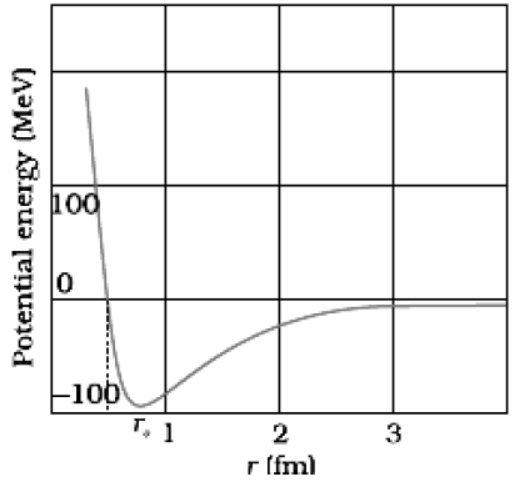
1. For separations \( r > r_0 \), the nuclear force is **attractive**.
2. For separations \( r < r_0 \) (less than approx. 0.8 fm), the nuclear force is **strongly repulsive**.
**Characteristic features of Nuclear forces:**
1. **Charge-Independent:** The nuclear force between proton-proton, neutron-neutron, and proton-neutron is approximately identical, as it does not depend on the electric charge of the particles.
2. **Short-Range Force:** These are extremely strong forces that operate only over tiny distances inside the nucleus and drop to zero outside of it.
In simple words: The nuclear force acts like a spring: if nucleons are pulled apart slightly, they attract; but if they are squeezed closer than 0.8 femtometers, they strongly repel. These forces are the strongest in nature and don't care whether a particle is a proton or a neutron.
Exam Tip: Clearly mark the minimum point on the graph at \( r_0 \approx 0.8\text{ fm} \), which corresponds to the point where potential energy is minimum and force is zero.
Question 53. Using Bohr’s second postulate of quantization of angular momentum show that the circumference of the electron’s nth orbit is n times its deBroglie wavelength.
Answer: According to Bohr's second postulate of angular momentum quantization, the angular momentum of an electron in the \( n^{\text{th}} \) stable orbit is an integral multiple of \( \frac{h}{2\pi} \):
\( m v r_n = \frac{n h}{2\pi} \) --- (1)
We can rearrange this expression as:
\( 2\pi r_n = \frac{n h}{m v} \) --- (2)
According to de-Broglie's equation, the wavelength \( \lambda \) associated with the moving electron is:
\( \lambda = \frac{h}{m v} \) --- (3)
Substituting equation (3) into equation (2), we obtain:
\( 2\pi r_n = n \lambda \).
Since \( 2\pi r_n \) is the circumference of the circular orbit, this proves that the circumference of the electron's \( n^{\text{th}} \) orbit is exactly \( n \) times its de-Broglie wavelength.
In simple words: Bohr's quantization rule says that an electron can only orbit at specific distances. Rearranging this formula shows that the perimeter of the orbit must fit a whole number of electron wavelengths, creating a stable standing wave.
Exam Tip: This derivation is highly popular. Always clearly state both Bohr's postulate and de-Broglie's equation to establish a direct, complete proof.
Question 54. The electron in hydrogen atom is initially in the third excited state .What is the maximum number of spectral lines which can be emitted when it finally moves to the ground state?
Answer: The third excited state of a hydrogen atom corresponds to the energy level \( n = 4 \), and the ground state corresponds to \( n = 1 \).
The maximum number of spectral lines emitted during transitions from a state \( n \) to the ground state is given by the formula:
\( N = \frac{n(n - 1)}{2} \)
Substituting \( n = 4 \):
\( N = \frac{4 \times (4 - 1)}{2} = \frac{12}{2} = 6 \).
The 6 possible transitions are:
- From \( n = 4 \) to \( n = 3, 2, 1 \) (3 transitions)
- From \( n = 3 \) to \( n = 2, 1 \) (2 transitions)
- From \( n = 2 \) to \( n = 1 \) (1 transition).
In simple words: The third excited state is level 4. As the electron cascades down to level 1, it can take different paths, releasing a maximum of 6 different light colors (spectral lines).
Exam Tip: Be careful not to mistake 'third excited state' as \( n = 3 \). Excited states start from \( n=2 \) (first excited state), so third is always \( n = 4 \).
Question 55. Define Half life period of a radioactive substance, and derive an expression for it .
Answer: **Definition:** The half-life period (\( T_{1/2} \)) of a radioactive substance is defined as the time taken for half of the initial active nuclei present in the sample to undergo disintegration.
**Derivation:**
According to the radioactive disintegration law:
\( N = N_0 e^{-\lambda t} \) --- (1)
where \( N_0 \) is the initial number of nuclei and \( \lambda \) is the decay constant.
At \( t = T_{1/2} \), the number of remaining active nuclei is \( N = \frac{N_0}{2} \). Substituting these values into (1):
\( \frac{N_0}{2} = N_0 e^{-\lambda T_{1/2}} \)
\( \implies \frac{1}{2} = e^{-\lambda T_{1/2}} \)
\( \implies e^{\lambda T_{1/2}} = 2 \)
Taking natural logarithms on both sides:
\( \lambda T_{1/2} = \ln 2 \)
\( \implies T_{1/2} = \frac{0.6931}{\lambda} \).
This is the required expression for half-life.
In simple words: Half-life is the time needed for a radioactive sample to lose half its active atoms. By setting the remaining atoms in the decay formula to half of the starting amount, we derive that the half-life is 0.693 divided by the decay rate.
Exam Tip: Show each step of taking the natural log (\( \ln 2 \approx 0.693 \)) to ensure you earn full credit for the derivation.
Question 56. Derive exponential law , N(t) = No e–λ t of radioactive decay.
Answer: **Statement of Law:** The rate of disintegration of a radioactive sample at any instant is directly proportional to the total number of active nuclei present in the sample at that instant.
\( \frac{dN}{dt} \propto -N \implies \frac{dN}{dt} = -\lambda N \)
where \( \lambda \) is the radioactive decay constant. The negative sign indicates that the number of active nuclei decreases as time progresses.
**Derivation:**
We can rearrange the differential equation as:
\( \frac{dN}{N} = -\lambda dt \) --- (1)
Integrating both sides of equation (1) under the limits from \( t = 0 \) (where \( N = N_0 \)) to time \( t \) (where \( N = N(t) \)):
\( \int_{N_0}^{N} \frac{1}{N} dN = -\lambda \int_0^t dt \)
\( \implies [\ln N]_{N_0}^N = -\lambda [t]_0^t \)
\( \implies \ln N - \ln N_0 = -\lambda t \)
\( \implies \ln \left( \frac{N}{N_0} \right) = -\lambda t \)
Taking exponentials on both sides:
\( \frac{N(t)}{N_0} = e^{-\lambda t} \)
\( \implies N(t) = N_0 e^{-\lambda t} \).
This is the exponential law of radioactive decay.
In simple words: The decay law says that having more radioactive atoms makes more decays happen. Integrating this rate over time mathematically proves that the number of active atoms drops off as a steady, curving exponential decay.
Exam Tip: Always explain the physical significance of the negative sign in the starting rate equation to show complete conceptual clarity.
Question 56. Calculate the binding energy and binding energy per nucleon of26Fe56 nucleus.
Answer: For the Iron nucleus \( _{26}\text{Fe}^{56} \):
- Number of protons, \( Z = 26 \)
- Number of neutrons, \( N = 56 - 26 = 30 \)
1. **Calculate the mass of individual constituent nucleons:**
- Mass of 26 protons: \( 26 \times 1.007825\text{ amu} = 26.20345\text{ amu} \)
- Mass of 30 neutrons: \( 30 \times 1.008665\text{ amu} = 30.25995\text{ amu} \)
- Combined mass of constituent nucleons: \( 26.20345 + 30.25995 = 56.46340\text{ amu} \)
2. **Calculate the mass defect (\( \Delta m \)):**
\( \Delta m = \text{Combined nucleon mass} - \text{Nuclear mass} \)
\( \implies \Delta m = 56.46340\text{ amu} - 55.93490\text{ amu} = 0.52850\text{ amu} \)
3. **Calculate the binding energy (B.E.):**
Using the energy equivalent \( 1\text{ amu} = 931\text{ MeV} \):
\( B.E. = 0.52850 \times 931\text{ MeV} \approx 492.03\text{ MeV} \)
4. **Calculate the binding energy per nucleon:**
\( \text{B.E. per nucleon} = \frac{\text{Total B.E.}}{\text{Mass number } A} = \frac{492.03\text{ MeV}}{56} \approx 8.79\text{ MeV} \).
Therefore, the binding energy is \( 492.03\text{ MeV} \) and the binding energy per nucleon is \( 8.79\text{ MeV} \).
In simple words: We calculate the total weight of 26 separate protons and 30 neutrons and subtract the actual weight of the iron nucleus. This missing weight (mass defect) is converted into binding energy, which holds the nucleus together with a strength of 8.79 MeV per nucleon.
Exam Tip: Use the conversion factor \( 1\text{ amu} = 931\text{ MeV} \) as provided in the exam data sheet to avoid rounding differences.
Question 57. Calculate the energy Q released in the nuclear fission reaction given below. 92U235 + 0n1 -> 56Ba141 + 36Kr92 + 30n1 + Q
Answer: We calculate the energy released \( Q \) using the mass difference between reactants and products:
1. **Total mass of the reactants:**
\( M_{\text{reactants}} = m(_{92}\text{U}^{235}) + m(_0\text{n}^1) = 235.045733\text{ amu} + 1.008665\text{ amu} = 236.054398\text{ amu} \)
2. **Total mass of the products:**
\( M_{\text{products}} = m(_{56}\text{Ba}^{141}) + m(_{36}\text{Kr}^{92}) + 3 \cdot m(_0\text{n}^1) \)
\( \implies M_{\text{products}} = 140.917700\text{ amu} + 91.885400\text{ amu} + 3 \cdot 1.008665\text{ amu} \)
\( \implies M_{\text{products}} = 232.803100\text{ amu} + 3.025995\text{ amu} = 235.829095\text{ amu} \)
3. **Mass defect (\( \Delta m \)):**
\( \Delta m = M_{\text{reactants}} - M_{\text{products}} = 236.054398\text{ amu} - 235.829095\text{ amu} = 0.225303\text{ amu} \)
4. **Energy released (\( Q \)):**
\( Q = \Delta m \times 931\text{ MeV} = 0.225303 \times 931\text{ MeV} \approx 200\text{ MeV} \).
Thus, the energy \( Q \) released in this fission reaction is approximately \( 200\text{ MeV} \).
In simple words: The products of uranium fission weigh slightly less than the starting atoms. This lost mass is converted directly into energy, releasing approximately 200 million electron-volts of power per split.
Exam Tip: Always be careful to include the mass of all neutrons on both sides of the reaction (1 on the reactant side and 3 on the product side).
Question 58. Why is a photodiode operated in reverse bias mode? Figure below shows reverse bias current under different illumination intensities I1, I2,I3,I4 for a given Photodiode. Arrange the intensities in increasing order.
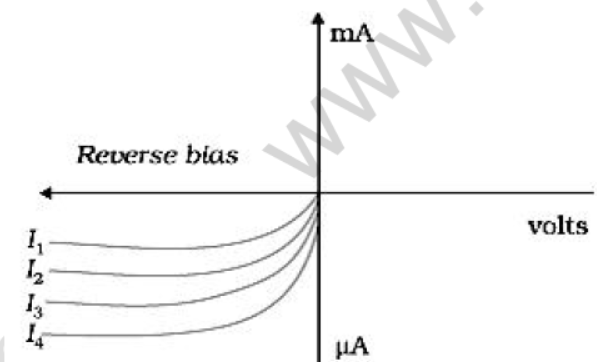
Answer: (i) **Operation in Reverse Bias:** A photodiode is operated in reverse bias because the fractional change in reverse saturation current caused by incident light is much easier to detect than the fractional change in forward current. Under reverse bias, the dark current is very small, allowing the signal-to-noise ratio of light detection to be highly optimized.
(ii) **Arrangement of Intensities:** The reverse saturation current is directly proportional to the intensity of the incident light. Looking at the characteristics graph, the current is lowest for \( I_1 \) and highest for \( I_4 \). Therefore, the correct increasing order of illumination intensities is:
\( I_1 < I_2 < I_3 < I_4 \).
In simple words: Photodiodes run in reverse because it's much easier to spot a tiny increase in a nearly-silent current when light strikes. Because more light intensity creates more current, the intensities are ranked in order of their lines on the graph.
Exam Tip: Remember that reverse current in a photodiode is strictly linear with respect to the light intensity, which is why \( I_1 < I_2 < I_3 < I_4 \).
Question 59. Write two characteristic features to distinguish between p-type and n- type semiconductors.
Answer: The primary distinguishing characteristics between p-type and n-type semiconductors are:
1. **Majority Charge Carriers:** In p-type semiconductors, holes are the majority charge carriers (concentration of holes is greater than electrons, \( n_h > n_e \)), whereas in n-type semiconductors, free electrons are the majority carriers (\( n_e > n_h \)).
2. **Mobility and Conductivity:** n-type semiconductors exhibit higher electrical conductivity and mobility compared to p-type semiconductors because the mobility of electrons is significantly higher than that of holes.
In simple words: P-type semiconductors have spaces (holes) as their main current carriers, while N-type semiconductors use free electrons. Because electrons travel faster than holes, N-type semiconductors conduct electricity more easily.
Exam Tip: State the relation \( n_h > n_e \) for p-type and \( n_e > n_h \) for n-type explicitly to make your answer complete and professional.
Question 60. Identify the logic gates X ,and Y in the figure and their combination. From the truth table for output Z for all possible inputs A and B.
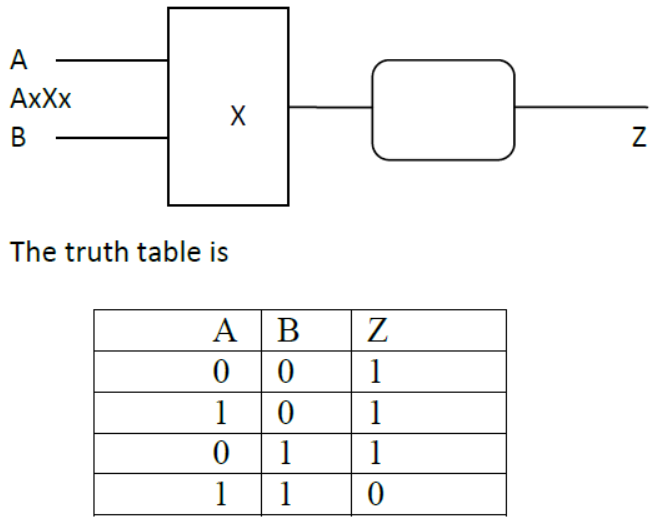
Answer: Based on the circuit and the provided truth table:
1. **Identification:** The first gate \( X \) is an **AND** gate, and the second gate \( Y \) is a **NOT** gate.
2. **Combination:** The combination of an AND gate followed by a NOT gate forms a **NAND** gate.
3. **Truth Table:**
| A | B | Z |
|---|---|---|
| 0 | 0 | 1 |
| 0 | 1 | 1 |
| 1 | 0 | 1 |
| 1 | 1 | 0 |
This behaves exactly as a NAND gate.
In simple words: The circuit combines an AND gate with a NOT gate to make a NAND gate. Its output is always on (1) unless both inputs are switched on (1) at the same time.
Exam Tip: Always specify the Boolean expression \( Z = \overline{A \cdot B} \) to demonstrate a complete understanding of the NAND gate logic.
Question 61. The current in the forward bias is known to be more (mA) than the current in the reverse bias (µA). What is the reason then to operate the photodiodes in reverse bias?
Answer: Even though the forward bias current is much larger, photodiodes are operated in reverse bias because the fractional or relative change in current when light is incident is significantly higher in reverse bias.
If \( n_e \) and \( n_h \) are the initial concentrations, and \( \Delta n_e \) and \( \Delta n_h \) are the generated carriers, then since \( n_h \gg n_e \) in a p-type region, the fractional change \( \frac{\Delta n_e}{n_e} \) is much larger than \( \frac{\Delta n_h}{n_h} \). Thus, measuring the change in minority carrier current (reverse saturation current) under illumination is much more sensitive and easier to detect.
In simple words: While forward bias has more current, a tiny flash of light would be lost like a whisper in a loud room. In reverse bias, the background current is almost zero, so the same flash of light stands out clearly.
Exam Tip: Explain this in terms of the fractional change in minority carrier concentration versus majority carrier concentration to demonstrate rigorous conceptual physics.
Question 62. What are LED’s? Mention their uses. Mention their advantages over conventional incandescent lamps .
Answer: **Definition:** Light Emitting Diodes (LEDs) are heavily doped p-n junction diodes that emit spontaneous light when operated under forward-bias conditions.
**Applications:**
1. Used in remote controls for television and home appliances.
2. Used in optical fiber communication networks.
3. Employed in digital display screens and indicator lights.
**Advantages of LEDs over conventional incandescent lamps:**
(i) Low operational voltage and extremely low power consumption.
(ii) Fast action with absolutely no warm-up time required.
(iii) High monochromaticity with a very narrow bandwidth (approx. 100 Å to 500 Å).
(iv) Exceptionally long life and high physical ruggedness.
In simple words: LEDs are electronic diodes that light up when current passes forward through them. They are used in remote controls and indicator lights, and they are much better than regular bulbs because they use almost no power, turn on instantly, and last for years.
Exam Tip: Be ready to list at least three distinct advantages and two applications of LEDs, as this is a popular short-answer question.
Question 63. Sketch the output Y from a NAND gate having inputs A and B given below:
Answer: For a NAND gate, the output is given by \( Y = \overline{A \cdot B} \). The output \( Y \) will be LOW (0) only during the time interval when both inputs \( A \) and \( B \) are simultaneously HIGH (1). For all other combinations of inputs, the output \( Y \) remains HIGH (1).
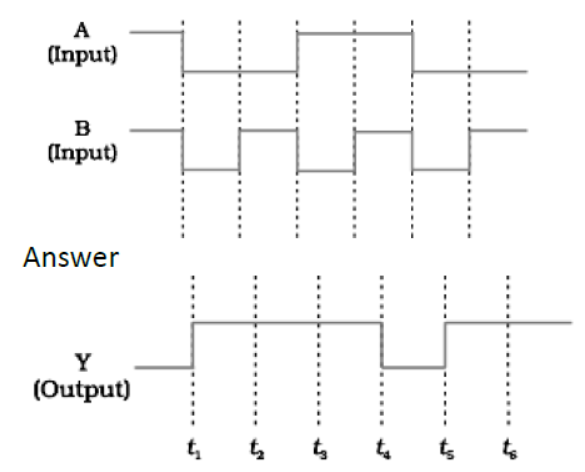
In simple words: A NAND gate only turns off (0) when both inputs A and B are switched on (1) at the same time. The output waveform is drawn showing it stays high almost the entire time except when both signals overlap at high values.
Exam Tip: Draw vertical dotted lines to mark the transition times \( t_1, t_2, t_3 \) to make your alignment of the input and output waveforms perfect.
Question 64. From the input A and B and output Y waveforms given below for a logic gate identify the logic gate . Give its logic symbol and truth table.
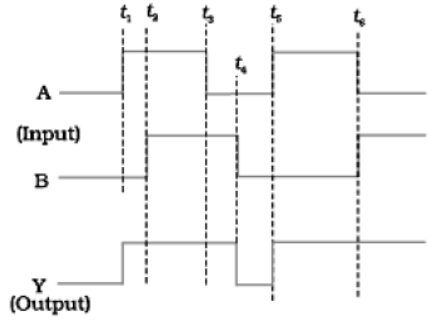
Answer: Analyzing the given waveforms:
- When \( A = 0, B = 0 \), the output \( Y = 0 \).
- When \( A = 1, B = 0 \), the output \( Y = 1 \).
- When \( A = 0, B = 1 \), the output \( Y = 1 \).
- When \( A = 1, B = 1 \), the output \( Y = 1 \).
This logic corresponds to an **OR gate**.
**Boolean Expression:** \( Y = A + B \)
**Truth Table:**
| A | B | Y |
|---|---|---|
| 0 | 0 | 0 |
| 0 | 1 | 1 |
| 1 | 0 | 1 |
| 1 | 1 | 1 |
In simple words: By comparing the input and output waveforms, we see that the output is on whenever at least one of the inputs is on. This matches the logic of an OR gate, which outputs a 1 for all combinations except when both inputs are 0.
Exam Tip: Be sure to practice identifying logic gates from waveforms, as it is a common 2-mark question in the semiconductors chapter.
Question 65. Name the important criteria required for the selection of a material for fabrication of solar cell.
Answer: The primary criteria for selecting materials to fabricate solar cells are:
(i) A suitable **band gap** (ideally between \( 1.0\text{ to } 1.8\text{ eV} \)).
(ii) High **optical absorption coefficient** (approx. \( 10^4\text{ cm}^{-1} \)).
(iii) Good electrical conductivity.
(iv) Abundant availability of the raw material in nature.
(v) Low fabrication cost.
In simple words: To make a good solar panel material, it must have the right energy gap to catch sunlight, absorb light strongly, conduct electricity well, be cheap to make, and be easy to find in nature.
Exam Tip: Always highlight the ideal band gap range (\( 1.0 - 1.8\text{ eV} \)) because this is the primary physical constraint for capturing the peak solar spectrum.
Question 66. Is it true that solar cell operate only in sunlight? Mention the uses of solar cells.
Answer: No, it is not true that solar cells can operate only in sunlight. Solar cells can work under any light source as long as the incident photons carry energy greater than the band gap of the semiconductor material.
**Uses of solar cells:**
1. To power electronic devices inside space vehicles and satellites.
2. As a power source for portable calculators, watches, and toys.
3. In remote solar-powered street lighting and water pumping systems.
In simple words: No. Solar panels don't need direct sun; they can work under any strong artificial light as long as the light has enough energy. They are used in space satellites, calculators, and rural streetlights.
Exam Tip: Explain that the operation is based on photon energy \( h\nu > E_g \), which is why any light source of sufficient frequency will work.
Question 67. Why the efficiency of a transformer can never be 100%?
Answer: The efficiency of a transformer can never reach 100% because some energy is always lost as heat during operation. The primary power losses in a transformer are:
(i) **Flux Loss:** Not all magnetic flux generated by the primary coil passes through the secondary coil.
(ii) **Copper (Joule) Loss:** Heating occurs in the copper windings due to their internal electrical resistance (\( I^2 R \) loss).
(iii) **Eddy Current Loss:** Swirling currents induced inside the soft iron core cause heating.
(iv) **Hysteresis Loss:** Energy is lost as heat during the continuous magnetization and demagnetization of the iron core.
In simple words: A transformer can never be 100% efficient because some electricity is always converted into wasted heat due to copper resistance, swirling currents in the iron core, and magnetic friction.
Exam Tip: List all four types of losses (flux, copper, eddy current, and hysteresis) to construct a complete and perfect answer.
Question 68. Draw a neat labeled diagram of Experimental setup of Davisson and Germer which verified the existence of Matter waves.
Answer: The Davisson and Germer experiment verified the wave nature of electrons by scattering a beam of electrons from a Nickel crystal.
**Experimental Setup Diagram:**
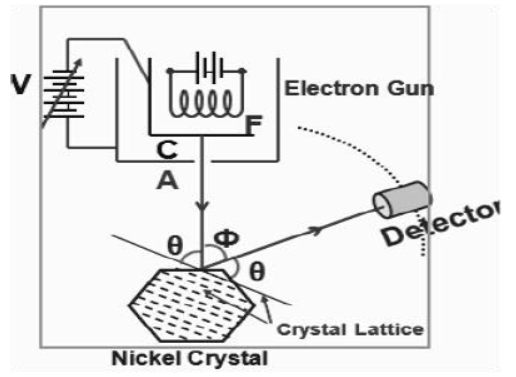
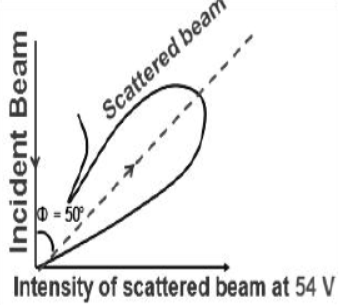
In simple words: The experiment uses an electron gun to shoot a stream of electrons at a nickel crystal. The scattered electrons are collected by a movable detector, showing a diffraction peak that proves electrons behave as waves.
Exam Tip: Always mention the key result of the experiment: a sharp maximum in intensity is observed at a scattering angle of \( 50^\circ \) with an accelerating potential of \( 54\text{ V} \).
Question 69. Assumethat light of wavelength 6000Å is coming from a star. What is the limit of resolution of a telescope whose objective has a diameter of 100 inch?
Answer: Given:
Wavelength of light, \( \lambda = 6000\text{ \AA} = 6 \times 10^{-7}\text{ m} \)
Diameter of objective lens, \( d = 100\text{ inches} = 2.54\text{ m} \)
The limit of resolution (angular separation \( d\theta \)) of the telescope is given by:
\( d\theta = \frac{1.22 \lambda}{d} \)
\( \implies d\theta = \frac{1.22 \times 6 \times 10^{-7}}{2.54} \approx 2.9 \times 10^{-7}\text{ radians} \).
Therefore, the limit of resolution of the telescope is \( 2.9 \times 10^{-7}\text{ radians} \).
In simple words: For a giant 100-inch telescope using 6000 Angstrom light, the smallest angle between two stars that it can still separate as distinct points is about 2.9 ten-millionths of a radian.
Exam Tip: Always convert the diameter of the objective lens from inches to meters (\( 1\text{ inch} = 2.54\text{ cm} \)) before applying the resolution formula.
Question 70. Draw a diagram to show double-slit interference pattern and an envelope showing the single slit diffraction.
Answer: The double-slit interference pattern is modulated by the single-slit diffraction envelope, showing that the intensity of the interference fringes is bounded by the diffraction pattern.
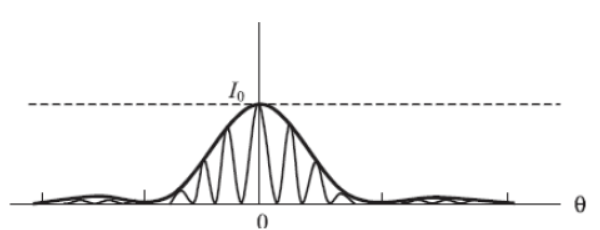
Exam Tip: Draw the single-slit diffraction envelope as a dashed line wrapping around the high-frequency interference peaks to show a neat, accurate diagram.
Question 71. For what distance is ray optics a good approximation when the aperture is 3 mm wide and the wavelength is 500 nm?
Answer: Given:
Aperture width, \( a = 3\text{ mm} = 3 \times 10^{-3}\text{ m} \)
Wavelength of light, \( \lambda = 500\text{ nm} = 5 \times 10^{-7}\text{ m} \)
The Fresnel distance \( z_F \) is calculated using:
\( z_F = \frac{a^2}{\lambda} = \frac{(3 \times 10^{-3})^2}{5 \times 10^{-7}} = 18\text{ m} \).
Thus, ray optics serves as a highly accurate approximation for distances up to \( 18\text{ m} \).
In simple words: Just like in Question 32, the Fresnel calculation confirms that light rays stay perfectly straight without noticeable diffraction spreading for up to 18 meters.
Exam Tip: Keep this formula handy, as it is a frequent quick calculation on modern optics exams.
Question 72. Monochromatic light of frequency = 6.0 x 10¹⁴ Hz isproduced by a laser. The power emitted is 2.0 x 10⁻³ W. (a) What is the energy of a photon in the light beam? (b) How many photons per second, on an average, are emitted by the source?.
Answer: Given:
Frequency of light, \( \nu = 6.0 \times 10^{14}\text{ Hz} \)
Power emitted, \( P = 2.0 \times 10^{-3}\text{ W} \)
(a) **Energy of a single photon (\( E \)):**
\( E = h \nu = (6.63 \times 10^{-34}\text{ J s}) \times (6.0 \times 10^{14}\text{ Hz}) = 3.98 \times 10^{-19}\text{ J} \)
(b) **Number of photons emitted per second (\( N \)):**
\( N = \frac{P}{E} = \frac{2.0 \times 10^{-3}\text{ W}}{3.98 \times 10^{-19}\text{ J}} \approx 5.0 \times 10^{15}\text{ photons per second} \).
In simple words: (a) Each individual photon carries a tiny energy packet of \( 3.98 \times 10^{-19} \) Joules. (b) To output 2 milliwatts of total laser power, the laser must shoot out 5 quadrillion photons every single second.
Exam Tip: Always remember to divide the total power (energy per second) by the energy of one photon to find the rate of photon emission.
Question 73. An electron, an α-particle, and a proton have the samekinetic energy. Which of these particles has the shortest de Broglie wavelength?
Answer: The de-Broglie wavelength of a particle in terms of its kinetic energy \( K \) is given by:
\( \lambda = \frac{h}{p} = \frac{h}{\sqrt{2 m K}} \)
Since all three particles have the same kinetic energy \( K \) and \( h \) is a constant, the wavelength is inversely proportional to the square root of the particle's mass (\( \lambda \propto \frac{1}{\sqrt{m}} \)).
Among the electron, proton, and alpha particle, the alpha particle is the heaviest (\( m_{\alpha} > m_p > m_e \bk \)). Therefore, the alpha particle will have the shortest de-Broglie wavelength.
In simple words: When different particles share the same kinetic energy, the heaviest one travels with the most momentum. Since a higher momentum means a shorter wavelength, the massive alpha particle has the shortest wavelength of them all.
Exam Tip: Be sure to state the relation \( \lambda \propto \frac{1}{\sqrt{m}} \) clearly to mathematically support your comparison.
Question 74. A particle is moving three times as fast as an electron.The ratio of the de Broglie wavelength of the particle to that of the electron is 1.813 × 10⁻⁴. Calculate the particle’s mass and identify the particle.
Answer: Let \( m_e \) and \( v_e \) be the mass and velocity of the electron, and \( m \) and \( v \) be the mass and velocity of the particle.
Given:
- Velocity ratio, \( \frac{v}{v_e} = 3 \)
- Wavelength ratio, \( \frac{\lambda}{\lambda_e} = 1.813 \times 10^{-4} \)
Using the de-Broglie wavelength formula:
\( \lambda = \frac{h}{m v} \quad \text{and} \quad \lambda_e = \frac{h}{m_e v_e} \)
\( \implies \frac{\lambda}{\lambda_e} = \left( \frac{m_e}{m} \right) \left( \frac{v_e}{v} \right) \)
Rearranging to find the mass of the particle \( m \):
\( m = m_e \left( \frac{\lambda_e}{\lambda} \right) \left( \frac{v_e}{v} \right) \)
Substituting the values:
\( m = (9.11 \times 10^{-31}\text{ kg}) \times \left( \frac{1}{1.813 \times 10^{-4}} \right) \times \left( \frac{1}{3} \right) \)
\( m \approx 1.675 \times 10^{-27}\text{ kg} \).
Since this calculated mass is approximately equal to the rest mass of a nucleon, the particle is identified as a **proton** (or a neutron).
In simple words: By comparing the particle's speed and wave properties to an electron, we calculate its mass to be \( 1.675 \times 10^{-27} \) kg. This matches the mass of a proton, identifying the mystery particle.
Exam Tip: Always carry out your calculations with high precision (at least three decimal places) because proton and neutron masses are very close to each other.
Question 75. A Straight wire of mass 200 g and length 1.5 m carries a current of 2 A. It is suspended in mid-air by a uniform horizontal magnetic field B .What is the magnitude of the magnetic field?
Answer: Given:
Mass of the wire, \( m = 200\text{ g} = 0.2\text{ kg} \)
Length of the wire, \( L = 1.5\text{ m} \)
Current, \( I = 2\text{ A} \)
For the wire to be suspended in mid-air, the upward magnetic force \( I L B \) must exactly balance the downward gravitational force (weight) \( m g \):
\( I L B = m g \)
\( \implies B = \frac{m g}{I L} \)
Substituting the values (taking \( g = 9.8\text{ m/s}^2 \)):
\( B = \frac{0.2 \times 9.8}{2 \times 1.5} = \frac{1.96}{3.0} \approx 0.65\text{ T} \).
Therefore, the magnitude of the required magnetic field is \( 0.65\text{ Tesla} \).
In simple words: To float a wire in mid-air, the upward magnetic lift must perfectly match the downward pull of gravity. Under these conditions, a magnetic field of 0.65 Tesla is required to achieve balance.
Exam Tip: Ensure the magnetic field is oriented perpendicular to both the wire and the vertical direction to maximize the magnetic force (\( \theta = 90^\circ \)).
Question 76. A message signal of frequency 10 kHz and peak voltageof 10 volts is used to modulate a carrier of frequency 1 MHz and peakvoltage of 20 volts. Determine (a) modulation index, (b) the side bandsproduced.
Answer: Given:
- Message signal frequency, \( f_m = 10\text{ kHz} \)
- Peak voltage of message signal, \( A_m = 10\text{ V} \)
- Carrier frequency, \( f_c = 1\text{ MHz} = 1000\text{ kHz} \)
- Peak voltage of carrier signal, \( A_c = 20\text{ V} \)
(a) **Modulation Index (\( \mu \)):**
\( \mu = \frac{A_m}{A_c} = \frac{10}{20} = 0.5 \)
(b) **Side Bands Produced:**
- Upper Side Band (USB) \( = f_c + f_m = 1000\text{ kHz} + 10\text{ kHz} = 1010\text{ kHz} \)
- Lower Side Band (LSB) \( = f_c - f_m = 1000\text{ kHz} - 10\text{ kHz} = 990\text{ kHz} \).
In simple words: The modulation index is 0.5, which means the carrier wave is modulated to half of its capacity. The process creates two side frequencies: an upper sideband at 1010 kHz and a lower sideband at 990 kHz.
Exam Tip: Always convert the carrier frequency from MHz to kHz so that you can directly add or subtract the message frequency without unit mismatches.
Question 77. A transmitting antenna at the top of a tower has a height32 m and the height of the receiving antenna is 50 m. What is themaximum distance between them for satisfactory communication inLOS mode? Given radius of earth 6.4 × 10⁶ m.
Answer: Given:
Height of transmitting antenna, \( h_t = 32\text{ m} \)
Height of receiving antenna, \( h_r = 50\text{ m} \)
Radius of the earth, \( R = 6.4 \times 10^6\text{ m} \)
The maximum line-of-sight distance \( d_m \) between the two antennas is:
\( d_m = \sqrt{2 R h_t} + \sqrt{2 R h_r} \)
Substituting the values:
\( d_m = \sqrt{2 \times 6.4 \times 10^6 \times 32} + \sqrt{2 \times 6.4 \times 10^6 \times 50} \)
\( d_m = \sqrt{4.096 \times 10^8} + \sqrt{6.4 \times 10^8} \)
\( d_m \approx 2.024 \times 10^4\text{ m} + 2.53 \times 10^4\text{ m} = 4.55 \times 10^4\text{ m} = 45.5\text{ km} \).
Therefore, the maximum distance for satisfactory line-of-sight communication is \( 45.5\text{ km} \).
In simple words: Because of the Earth's curve, both towers must be high enough to see over the horizon. Combining the horizon distances for both towers shows they can communicate over a maximum distance of 45.5 kilometers.
Exam Tip: Always remember to calculate the line-of-sight distances for the transmitter and receiver separately and then add them together: \( d_m = d_t + d_r \).
Question 78. Explain the polarization of sun light in the atmosphere by scattering .
Answer: When unpolarized sunlight passes through the Earth's atmosphere, it excites the electrons of air molecules. Under the influence of the electric field of the incident wave, these electrons acquire components of motion in directions perpendicular to the direction of wave propagation.
An observer looking at a direction perpendicular (\( 90^\circ \)) to the path of the sun will see scattered light. Since the accelerated charges do not radiate energy along their line of acceleration, the scattered light observed perpendicular to the incident ray has only transverse vibrations. Consequently, the scattered light is completely polarized perpendicular to the scattering plane.
In simple words: When sunlight hits air molecules, it shakes their electrons side-to-side. When you look at the sky at a 90-degree angle from the sun, you only receive waves vibrating in a single plane, meaning the scattered sky-light is polarized.
Exam Tip: Remember that scattering produces maximum polarization when the scattered light is observed at \( 90^\circ \) to the direction of the incident sunlight.
Question 79. In interference or diffraction some points on the screen appear bright and other points appear dark . Is this a violation of law of conservation of energy.
Answer: No, this is not a violation of the law of conservation of energy. In both interference and diffraction, light energy is simply redistributed across the screen. The energy that is missing from the dark fringe regions is completely transferred to the bright fringe regions, leaving the total energy of the wave system conserved. There is no net gain or loss of energy in the process.
In simple words: No, energy is not created or destroyed. The dark spots are simply areas where light waves cancel each other out, shifting their energy over to make the bright spots even brighter.
Exam Tip: Explicitly state that the process involves 'redistribution of light energy' to show complete conceptual mastery.
Question 82. An angular magnification (magnifying power) of 30X is desired using an objective of focal length 1.25cm and an eyepiece of focal length 5cm. How will you set up the compound microscope?
Answer: Given:
- Total magnification, \( M = 30 \)
- Objective focal length, \( f_o = 1.25\text{ cm} \)
- Eyepiece focal length, \( f_e = 5\text{ cm} \)
For near-point adjustment (least distance of distinct vision \( D = 25\text{ cm} \)), the magnification of the eyepiece is:
\( M_e = 1 + \frac{D}{f_e} = 1 + \frac{25}{5} = 6 \)
Since the total magnifying power of a compound microscope is \( M = m_o \times M_e \):
\( 30 = m_o \times 6 \implies m_o = -5 \)
For the objective lens:
\( m_o = -\frac{v_o}{u_o} = -5 \implies v_o = 5 u_o \) --- (1)
Applying the lens formula for the objective lens:
\( \frac{1}{f_o} = \frac{1}{v_o} - \frac{1}{u_o} \)
\( \implies \frac{1}{1.25} = \frac{1}{5 u_o} - \frac{1}{u_o} = -\frac{4}{5 u_o} \)
\( \implies 5 u_o = -4 \times 1.25 = -5 \implies u_o = -1.0\text{ cm} \)
Using this in (1):
\( v_o = 5 \times 1.0 = +5.0\text{ cm} \).
For the eyepiece lens, we find the object distance \( u_e \) when the image is formed at \( v_e = -25\text{ cm} \):
\( \frac{1}{f_e} = \frac{1}{v_e} - \frac{1}{u_e} \)
\( \implies \frac{1}{5} = \frac{1}{-25} - \frac{1}{u_e} \implies \frac{1}{u_e} = -\frac{6}{25} \implies u_e \approx -4.17\text{ cm} \).
The total distance (separation \( L \)) between the objective lens and the eyepiece is:
\( L = v_o + |u_e| = 5.0\text{ cm} + 4.17\text{ cm} = 9.17\text{ cm} \).
**Setup:** The object must be placed at a distance of \( 1.0\text{ cm} \) from the objective lens, and the separation between the objective and the eyepiece should be adjusted to exactly \( 9.17\text{ cm} \).
In simple words: To set up this microscope, place the slide exactly 1.0 cm away from the front objective lens, and adjust the total distance between the two lenses to be 9.17 cm.
Exam Tip: Double check your signs: for real images, \( m_o \) must be negative, and the total separation \( L \) is the sum of \( v_o \) and the absolute value of \( u_e \).
Question 80. When viewing through a compound microscope, our eyes should be positioned not on the eyepiece but a short distance away from it for best viewing. Why? How much should be that short distance between the eye and eyepiece?
Answer: When viewing through a compound microscope, the eye should be positioned at the **eye-ring** (or exit pupil), which is located at a short distance from the eyepiece.
The eye-ring is the image of the objective lens formed by the eyepiece, where all the light rays passing through the objective converge. Placing the pupil of the eye at this exact spot ensures that the eye collects all the light coming from the objective, providing the maximum possible field of view and brightness.
The precise location of this eye-ring naturally depends on the separation between the objective and the eyepiece.
In simple words: Instead of pressing your eye flat against the lens, you should hover it slightly back at a point called the eye-ring. This is where all the gathered light focus lines cross, giving you the brightest and widest possible view.
Exam Tip: Use the term 'eye-ring' or 'exit pupil' specifically, as this is the exact technical term tested in optics.
Question 81. The figure given shows an equiconvex lens (of refractive index n = 1.50) in contact with a liquid layer on top of a plane mirror. A small needle with its tip on the principal axis is moved along the axis until its inverted image is found at the position of the needle. The distance of the needle from the lens is measured to be 45.0cm. The liquid is removed and the experiment is repeated. The new distance is measured to be 30.0cm. What is the refractive index of the liquid?
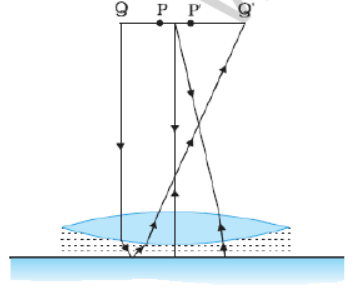
Answer: Let \( f_1 \) be the focal length of the equiconvex lens, \( f_2 \) be the focal length of the plano-concave liquid lens, and \( F \) be the combined focal length of the system.
1. **Without liquid:** the focal length is \( f_1 = 30.0\text{ cm} \).
Using the lens maker's formula for the equiconvex lens (\( n = 1.50 \)):
\( \frac{1}{f_1} = (n - 1) \left( \frac{1}{R} - \left(-\frac{1}{R}\right) \right) = (1.5 - 1) \frac{2}{R} = \frac{1}{R} \)
\( \implies R = f_1 = 30\text{ cm} \).
2. **With liquid:** the combined focal length is \( F = 45.0\text{ cm} \).
The combination formula is:
\( \frac{1}{F} = \frac{1}{f_1} + \frac{1}{f_2} \)
\( \implies \frac{1}{45} = \frac{1}{30} + \frac{1}{f_2} \)
\( \implies \frac{1}{f_2} = \frac{1}{45} - \frac{1}{30} = -\frac{1}{90} \implies f_2 = -90\text{ cm} \).
The liquid forms a plano-concave lens with radii \( R_1 = -30\text{ cm} \) and \( R_2 = \infty \). Applying the lens maker's formula:
\( \frac{1}{f_2} = (n_l - 1) \left( \frac{1}{-30} - \frac{1}{\infty} \right) = -\frac{n_l - 1}{30} \)
\( \implies -\frac{1}{90} = -\frac{n_l - 1}{30} \)
\( \implies n_l - 1 = \frac{30}{90} = 0.33 \)
\( \implies n_l = 1.33 \).
Therefore, the refractive index of the liquid is \( 1.33 \) (which corresponds to water).
In simple words: First, we find the curved mirror-like radius of the glass lens, which is 30 cm. Then we use the new focus point of 45 cm to calculate that the liquid layer acts as a concave lens with a focal length of -90 cm. Putting these into the refractive index formula reveals the liquid is water with an index of 1.33.
Exam Tip: Remember that the liquid layer in contact with the flat mirror always forms a plano-concave lens. Be careful to use \( R_2 = \infty \) for the flat mirror surface.
Question 82. A diverging lens of focal length F is divided into two identical parts , each forming a Plano concave lens . What is the focal length of each part ?
Answer: According to the lens maker's formula, the focal length \( F \) of a symmetrical diverging lens is given by:
\( \frac{1}{F} = (n_g - 1) \left( -\frac{1}{R} - \frac{1}{R} \right) = -\frac{2(n_g - 1)}{R} \implies F = -\frac{R}{2(n_g - 1)} \)
When the lens is cut vertically along its principal axis, it forms two identical plano-concave lenses, each with radii of curvature \( R_1 = -R \) and \( R_2 = \infty \).
The focal length \( f \) of each plano-concave lens is:
\( \frac{1}{f} = (n_g - 1) \left( -\frac{1}{R} - \frac{1}{\infty} \right) = -\frac{n_g - 1}{R} \implies f = -\frac{R}{n_g - 1} \).
Comparing the two expressions:
\( f = 2F \).
Therefore, each cut half has a focal length equal to twice the focal length of the original diverging lens.
In simple words: Cutting a double-concave lens in half makes each piece flatter on one side. This cuts its light-bending power in half, so its focal length doubles to 2F.
Exam Tip: Cutting a lens vertically doubles the focal length of each part, while cutting a lens horizontally does not change the focal length.
Question 83. At what angle of incidence should a light beam strike a glass slab of refractive index √3 such that the reflected and refracted light are perpendicular to each other?
Answer: When the reflected and refracted light rays are perpendicular to each other, the angle of incidence is equal to the polarizing angle (\( i_p \)).
According to Brewster's Law, the relation is:
\( n = \tan i_p \)
Given \( n = \sqrt{3} \):
\( \tan i_p = \sqrt{3} \implies i_p = 60^\circ \).
Therefore, the light beam should strike the glass slab at an angle of incidence of \( 60^\circ \).
In simple words: Just like in Brewster's Law (Question 15), if the reflected and refracted rays are at a perfect 90-degree angle, the incident angle must equal the polarizing angle, which is exactly 60 degrees.
Exam Tip: Always remember that the key indicator for Brewster's Law is that the reflected and refracted light rays are perpendicular to each other.
Question 84. Why zener diode is heavily doped?
Answer: A Zener diode is heavily doped on both the p-side and n-side of the junction. This extremely high doping concentration results in a very thin depletion region. Consequently, even a small reverse bias voltage produces an exceptionally high electric field across this thin junction, enabling controlled Zener breakdown to occur.
In simple words: Zener diodes are heavily doped to make their central barrier extremely thin. This thin barrier allows a strong electric field to form quickly, enabling the diode to safely regulate voltage during breakdown.
Exam Tip: The high electric field and thin depletion region are the key keywords examiners look for when grading this question.
Question 85. Why a photodiode is operated in reverse bias?
Answer: A photodiode is operated in reverse bias because the fractional or relative change in current when light falls on it is much higher in reverse bias than in forward bias. This allows the photodiode to act as a highly sensitive optical detector to observe even minor changes in light intensity.
In simple words: Running a photodiode in reverse keeps the background current quiet, making it incredibly easy to detect the tiny surge of current triggered when light hits the sensor.
Exam Tip: This is a direct, recurring question. Clearly contrast the high sensitivity of the fractional change in reverse bias to secure full marks.
Free study material for Physics
Download Class 12 Physics Quick Questions Practice Worksheets
Daily Practice Questions for Class 12 Physics
Review targeted practice exercises for Class 12 Physics Quick Questions. Curated to match official CBSE guidelines, these printable problem sets support daily revision and improve overall test readiness.
Detailed Answers for Class 12 Physics Quick Questions
Designed around the official curriculum for Class 12 Physics, these practice sheets guarantee standard compliance. Reviewing step-by-step solutions after completion sharpens your accuracy and clarifies complex sub-topics within Quick Questions.
Complete Your Chapter Revision
Consistent engagement with these exercises builds familiarity with recurring exam themes. If specific areas within Quick Questions cause trouble, utilize our dedicated NCERT solutions for Class 12 Physics to clear up doubts immediately.
FAQs
You can download the latest chapter-wise printable worksheets for Class 12 Physics Quick Questions for free from StudiesToday.com. These have been made as per the latest CBSE curriculum for this academic year.
Yes, Class 12 Physics worksheets for Quick Questions focus on activity-based learning and also competency-style questions. This helps students to apply theoretical knowledge to practical scenarios.
Yes, we have provided solved worksheets for Class 12 Physics Quick Questions to help students verify their answers instantly.
Yes, our Class 12 Physics test sheets are mobile-friendly PDFs and can be printed by teachers for classroom.
For Quick Questions, regular practice with our worksheets will improve question-handling speed and help students understand all technical terms and diagrams.