

Download Class 12 Biology Practice Worksheets
Access comprehensive chapter-wise worksheets for Chapter 08 Microbes In Human Welfare using the CBSE Class 12 Biology Microbes In Human Welfare Worksheet Set 02. Designed to align with the 2026-27 academic syllabus for Class 12 Biology, these printable practice sets help students reinforce key concepts and improve their overall exam readiness.
Access Chapter 08 Microbes In Human Welfare Practice Papers and Solutions
Access the complete worksheet PDF for Class 12 Biology below. Regular practice with these targeted academic tasks builds familiarity with standard question patterns and helps secure higher marks in final school examinations.
Question. Which of the following is not an advantage of mycorrhiza
(a) Phosphorus absorption
(b) Resistance to root borne pathogens
(c) Nitrogen fixation
(d) Tolerance to salinity and draught
Answer: C
Question. Which of the following chemicals, used as an immunosuppressive agent in organ transplantation
(a) Streptokinase
(b) Cyclosporin - A
(c) Statins
(d) Citric acid
Answer: B
Question. Match the following
A. Pectinases i. Blood cholesterol lowering agents
B. Streptokinases ii. Immunosuppressive agents
C. Cyclosporin - A iii.Clot-busters
D. Statin iv.Clearifying agents
A B C D
(a) iv iii ii i
(b) iv iii i ii
(c) iii iv ii i
(d) i ii iii iv
Answer: A
Question. Match the following
A. Citric acid i. Haemolytic streptococcus
B. Streptokinase ii. Aspergillus niger
C. Cyclosporin - A iii. Monascus purpureus
D. Statins iv. Trichoderma polysporum
A B C D
(a) i ii iii iv
(b) ii i iii iv
(c) ii i iv iii
(d) iv ii iii i
Answer: C
Question. Which of the following is one of the advantage of application of viruses as bioinsecticides
(a) They are less effective
(b) They are host specific
(c) They are costly
(d) They can not obtain easily
Answer: D
Question. In which of the following conditions use of baculoviruses is desirable
(a) When they are used as part of IPM
(b) When an ecologically sensitive area is being treated
(c) When beneficial insects are being conserved
(d) All of the above
Answer: D
Question. Which of the following is not a product of distillation
(a) Whisky
(b) Brandy
(c) Wine
(d) Rum
Answer: C
Question. Find out odd one with refrence to distillation
(a) Beer
(b) Wine
(c) Both 1 and 2
(d) Vodka
Answer: D
Question. Use of biofertilizer is the part of
(a) Inorganic farming
(b) Organic farming
(c) Energy cropping
(d) Energy plantation
Answer: B
Question. Cultivation of which of the following crop plant specially get benif itted by application of cyanobacteria
(a) Maize
(b) legumes
(c) Wheat
(d) Rice
Answer: D
Ques. Which bacteria is utilized in gobar gas plant?
(a) Methanogens
(b) Nitrifying bacteria
(c) Ammonifying bacteria
(d) Denitrifying bacteria
Answer: A
Ques. Gobar gas contains mainly
(a) CO2 + H2
(b) CO2 + H2O
(c) CH4 only
(d) CH4 + CO2.
Answer: D
Ques. Which of the following can be used as a biocontrol agent in the treatment of plant disease?
(a) Lactobacillus
(b) Trichoderma
(c) Chlorella
(d) Anabaena
Answer: B
Ques. Select the correct group of biocontrol agents.
(a) Nostoc, Azospirillium, Nucleopolyhedrovirus
(b) Bacillus thuringiensis, Tobacco mosaic virus, Aphids
(c) Trichoderma, Baculovirus, Bacillus thuringiensis
(d) Oscillatoria, Rhizobium, Trichoderma
Answer: C
Ques. A biocontrol agent to be a part of an integrated pest management should be
(a) species-specific and symbiotic
(b) free living and broad spectrum
(c) narrow spectrum and symbiotic
(d) species-specific and inactive on non-target organisms.
Answer: D
Ques. Microbe used for biocontrol of pest butterfly caterpillars is
(a) Saccharomyces cerevisiae
(b) Bacillus thuringiensis
(c) Streptococcus sp.
(d) Trichoderma sp.
Answer: B
Ques. Which one of the following is an example of carrying out biological control of pests/diseases using microbes?
(a) Trichoderma sp. against certain plant pathogens.
(b) Nucleopolyhedrovirus against white rust in Brassica.
(c) Bt-cotton to increase cotton yield.
(d) Lady bird beetle against aphids in mustard.
Answer: A
Ques. A common biocontrol agent for the control of plant diseases is
(a) baculovirus
(b) Bacillus thuringiensis
(c) Glomus
(d) Trichoderma.
Answer: D
Ques. Which of the following is not used as a biopesticide?
(a) Trichoderma harzianum
(b) Nucleopolyhedrovirus (NPV)
(c) Xanthomonas campestris
(d) Bacillus thuringiensis
Answer: C
Ques. Trichoderma harzianum has proved a useful microorganism for
(a) gene transfer in higher plants
(b) biological control of soil-borne plant pathogens
(c) bioremediation of contaminated soils
(d) reclamation of wastelands.
Answer: B
Ques. Which one of the following proved effective for biological control of nematodal diseases in plants?
(a) Gliocladium virens
(b) Paecilomyces lilacinus
(c) Pisolithus tinctorius
(d) Pseudomonas cepacia
Answer: B
Ques. A genetically engineered microorganism used successfully in bioremediation of oil spills is a species of
(a) Trichoderma
(b) Xanthomonas
(c) Bacillus
(d) Pseudomonas.
Answer: D
Ques. Biological control component is central to advanced agricultural production. Which of the following is used as a third eneration pesticide?
(a) Insect repellants
(b) Organophosphate and carbamates
(c) Pathogens
(d) Pheromones
Answer: D
Ques. Cochineal insects have proved very useful for
(a) cactus prevention
(b) Eichhornia prevention
(c) weeds control
(d) Parthenium control.
Answer: A
Ques. When a natural predator (living being) is applied on the other pathogen organism to control them, this process is called
(a) artificial control
(b) confusion technique
(c) biological control
(d) genetic engineering.
Answer: C
Ques. The rotenone is
(a) a natural herbicide
(b) a natural insecticide
(c) an insect hormone
(d) a bioherbicide.
Answer: B
Ques. One of the major difficulties in the biological control of insect pest is that
(a) the method is less effective as compared with the use of insecticides
(b) the practical difficulty of introducing the predator to specific areas
(c) the predator develops a preference to other diets and may itself become a pest
(d) the predator does not always survive when transferred to a new environment.
Answer: D
Ques. Biological control of agricultural pests, unlike chemical control, is
(a) self perpetuating
(b) polluting
(c) very expensive
(d) toxic.
Answer: A
Ques. Select the mismatch.
(a) Rhodospirillum – Mycorrhiza
(b) Anabaena – Nitrogen fixer
(c) Rhizobium – Alfalfa
(d) Frankia – Alnus
Answer: A
Ques. A nitrogen-fixing microbe associated with Azolla in rice fields is
(a) Spirulina
(b) Anabaena
(c) Frankia
(d) Tolypothrix.
Answer: B
Ques. Which one of the following microbes forms symbiotic association with plants and helps them in their nutrition?
(a) Azotobacter
(b) Aspergillus
(c) Glomus
(d) Trichoderma
Answer: C
Question. Mycorrhiza does not help the host plant in
(a) enhancing its phosphorus uptake capacity.
(b) increasing its tolerance to drought.
(c) enhancing its resistance to root pathogens.
(d) increasing its resistance to insects.
Answer : D
Question. What would happen if oxygen availability to activated sludge flocs is reduced?
(a) It will slow down the rate of degradation of organic matter.
(b) The centre of flocs will become anoxic, which would cause death of bacteria and eventually breakage of flocs.
(c) Flocs would increase in size as anaerobic bacteria would grow around flocs.
(d) Protozoa would grow in large numbers.
Answer : B
Question. Waste water treatment generates a large quantity of sludge, which can be treated by
(a) digesters
(b) activated sludge
(c) chemicals
(d) oxidation pond
Answer : A
Question. Which one of the following microbes forms symbiotic association with plants and help them in their nutrition ?
(a) Azotobacter
(b) Aspergillus
(c) Glomus
(d) Trichoderma
Answer : C
Question. Glomus form a symbiotic relationship with plant …………….
(a) leaves
(b) stem
(c) root
(d) stem and root
Answer : C
Question. Which one of the following is an example of carrying out biological control of pests/ diseases using microbes ?
(a) Trichoderma sp. against certain plant pathogens
(b) Nucleopolyhedrovirus against white rust in Brassica.
(c) Bt-cotton to increase cotton field.
(d) Lady bird beetle against aphids in mustard.
Answer : C
Question. The primary treatment of waste water involves the removal of
(a) dissolved impurities
(b) stable particles
(c) toxic substances
(d) harmful bacteria
Answer : B
Question. Match the items in Column ‘A’ and Column ‘B’ and choose correct answer.
Column A Column B
a Lady bird (i) Methanobacterium
b Mycorrhiza (ii) Trichoderma
c Biological control (iii) Aphids
d Biogas (iv) Glomus
The correct answer is :
(a) a – (ii), b – (iv), c – (iii), d – (i)
(b) a – (iii), b – (iv), c – (ii), d – (i)
(c) a – (iv), b – (i), c – (ii), d – (iii)
(d) a – (iii), b – (ii), c – (i), d – (iv)
Answer : B
Question. Which of the following is used as clot-buster for removing clots from blood vessels of patients who have undergone myocardial infarction?
(a) Cyclosporin
(b) Statins
(c) Streptokinase
(d) Lipase
Answer : C
Question. The free-living fungus Trichoderma can be used for
(a) killing insects
(b) biological control of plant diseases
(c) controlling butterfly caterpillars
(d) producing antibiotics
Answer : B
Very Short Answer Type Questions
Question. Write the significance of nucleopolyhedrovirus in pest management.
Answer : Nucleopolyhedroviruses are the effective biocontrol agent. They are species specific and have narrow spectrum insecticidal application having no negative impact on non target beneficial organisms.
They play significant role in pest management.
Question. Name any two free living nitrogen fixing bacteria.
Answer : Azotobacter and Azospirillum.
Question. Name any one symbiont which serves as a biofertilizer. Mention its specific role.
Answer : Rhizobium, a root nodule bacterium of legumes is a symbiont. It fixes nitrogen symbiotically and thus help the plants in obtaining their nitrogen nutrition and therefore serve as a biofertilizer.
Question. Name the types of association that the genus Glomus exhibits with higher plants.
Answer : Symbiosis / Mycorrhiza / Mutualism.
Short Answer Type Questions
Question. What is the pathogenic property of baculovirus, used as a biological agents ? Name the genus of these organisms.
Answer : Attacks insect and other arthropods.
Nucleopolyhedrovirus.
Detailed Answer :
Baculoviruses are pathogens that attack insects and other arthropods. The majority of baculoviruses used as biological control agents belongs to the genus nucleopolyhedrovirus.
Question. How do mycorrhizae help the plants to grow better?
OR
How do mycorrhiza act as biofertilizers ? Explain.
Name a genus of fungi that forms a mycorrhizal association with plants.
Answer : Mycorrhiza refers to symbiotic association between the fungus and the root of higher plants. These fungi in these associations absorb water, phosphorus, nitrogen, potassium, calcium from soil and pass it to the plant. The fungus brings about the solubilization of organic matter of soil humus, release of inorganic nutrients absorption and their transfer to roots. The genus Glomus forms a mycorrhizal association with plants.
Question. Explain the significant role of the genus Nucleopolyhedrovirus in an ecological sensitive area.
Answer : The genus Nucleopolyhedrovirus include baculoviruses which are insecticidal and therefore used as biocontrol agents. They have narrow spectrum, insecticidal application (IPM). They have no negative impact on plants / mammals / birds / fish / even non target insects. They are desirable in integrated pest management programme.
Question. Name a genus of baculovirus. Why are they considered good biocontrol agents ?
OR
Name the genus to which baculoviruses belong.
Describe their role in the integrated pest management programmes.
Answer : Nucleopolyhedrovirus
Species specific, narrow spectrum insecticidal application, no negative impact on non-target organisms.
Detailed Answer :
Nucleopolyhedrovirus is a genus of baculoviruses.
They are useful as they are good biocontrol agents.
They are species specific, narrow spectrum bioinsecticides. They control only species specific pest, do not affect non target organisms / beneficial insects are conserved / they aid in IPM problems / no negative impact on plants or other animals.
Therefore, they are considered as an important component of integrated pest management programme.
Question. Explain the role of Baculoviruses as biological control agents. Mention their importance in organic farming.
OR
Explain the significant role of the genus Nucleopolyhedrovirus in an ecological sensitive area.
Answer : The role of Baculoviruses :
Baculoviruses are pathogens that attack insects and other arthropods. The majority of baculoviruses used as biological control agents are in the genus Nucleopolyhedrovirus. These viruses are excellent species-specific, biocontrol agents have narrow spectrum insecticidal applications. They have been shown to have no negative impacts on plants, mammals, birds, fish or even on non-target insects.
Importance in organic farming :
(i) Baculoviruses are known to control pests like potato beetles, aphids and corn borers.
(ii) Entomopox virus is another baculovirus which adversely affects the rate of development of grasshopper and the amount of food it eats.
Question. An organic farmer relies on natural predation for controlling plant pests and diseases. Justify giving reasons why this is considered to be holistic approach.
Answer : Organic farming is holistic approach for controlling plant pest because it seeks to develop an understanding of the interactions amongst the organisms in the ecosystem.
Organic farmers do not try to completely eradicate the pest but keep them at manageable levels. A complete eradication of the pest is not beneficial and also not desirable because many beneficial predatory and parasitic insects can not survive without them.
Question. (i) Why do farmers prefer biofertilizers to chemical fertilizers these days ? Explain.
(ii) How do Anabaena and Mycorrhiza act as biofertilisers ?
Answer : (i) Farmers prefer biofertilisers to chemical fertilizers because :
(a) They help to get high yield of crops by making the soil rich with nutrients and useful microorganisms necessary for the growth of the plants.
(b) Chemical fertilizers make the environment polluted by releasing harmful chemicals and show biological magnification.
(c) Biofertilisers destroy only those harmful components from the soil that cause diseases in the plants.
(d) Biofertilisers are environment friendly and protect the environment against pollutants.
(ii) Fungi are known to form symbiotic association with plants called mycorrhiza. Many members of the genus Glomus forms mycorrhiza. The fungal symbiont in this association absorbs phosphorus from soil. Arbuscular mycorrhizal fungi play a vital role as a phosphatic biofertilizer.
Cyanobacteria are autotrophic microbes widely distributed in aquatic and terrestrial environments, many of which can fix atmospheric nitrogen e.g. Anabaena, Nostoc, Oscillatoria etc.
Question. Baculoviruses are good example of biocontrol agents. Justify giving three reasons.
Answer : i. Species specific / narrow spectrum insecticidal application.
ii. They have no negative impact on plants / mammals / birds / fish / non target insects.
iii. They are beneficial for IPM (Integrated Pest Management ) / Pest Management Programme.
Question. Given below is a list of six micro-organisms. State their usefulness to humans.
(i) Nucleopolyhedroviruses
(ii) Saccharomyces cerevisiae
(iii) Monascus purpureus
(iv) Trichoderma polysporum
(v) Penicillium notatum
(vi) Propionibacterium sharmanii
Answer : (i) Nucleopolyhedrovirus : It is a biological control agent and is a species-specific insecticide.
(ii) Saccharomyces cerevisiae : It is used to ferment bread dough and used in the preparation of ethanol.
(iii) Monascus purpureus : It is commercialised as blood cholesterol lowering agent.
(iv) Trichoderma polysporum : It produces cyclosporin A, which act as an immunosuppressive agent in organ transplant patients.
(v) Penicillium notatum : It is a source of penicillin, an antibiotic.
(vi) Propionibacterium shermanii : It is used in the preparation of cheese for texture, flavour and taste.
Long Answer Questions
Question. Describe how do ‘flocs’ and ‘activated sludge’ help in sewage treatment.
Answer.
Flocs are masses of aerobic bacteria associated with fungal filaments to form mesh like structures.
These aerobic microbes consume the major part of the organic matter in the effluent. This significantly reduces Biological oxygen demand (BOD) of the effluent.
A small part of the activated sludge is used as inoculum and pumped back to aeration tank. The remaining major part of the sludge is pumped into anaerobic sludge digesters where microbes or bacteria grow anaerobically to produce CH4 or H2S or CO2 or biogas.
Question. Complete the given table.
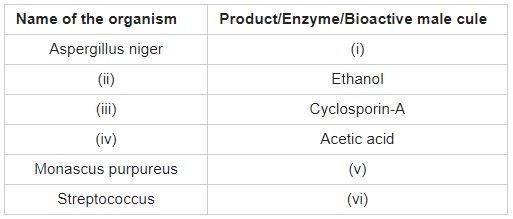
Answer. (i) Citric acid
(ii) Saccharomyces cerevisiae
(iii) Trichoderma polysporum
(iv) Acetobacter aceti
(v) Statin
(vi) Streptokinase
Question. Cow dung and water is mixed and this slurry is fed into the biogas plant for digestion by microbes. The person performing the process shares that there is no need to provide inoculum for it, why? What is the role of microbes at the source? Under which condition will they be most active and effective?
Answer. There is no need to provide inoculum for it because the bacteria, methanogens are present in cow dung. The role of these microbes is breakdown of cellulose. These are most active in an anaerobic condition.
Question. Explain the different steps involved in sewage treatment before it can be released into natural water bodies.
OR
Describe the process of waste-water treatment under the following heads:
(a) Primary treatment
(b) Secondary treatment
OR
Explain the process of sewage water treatment before it can be discharged into natural water bodies. Why is this treatment essential?
Answer. Primary treatment or physical treatment
• It is the physical removal of large and small particles from sewage.
• First, the floating debris is removed by sequential filtration by passing through wire mesh screens.
• Then, the grit (soil and small pebbles) are removed by sedimentation in settling tanks. The sediment is called primary sludge and the supernatant is the effluent.
• The effluent is taken for secondary treatment.
The sewage treatment is essential before being released into water bodies so as to check water borne diseases or pathogenic organisms due to water pollution.
Question. Why should biological control of pests and pathogens be preferred to the conventional use of chemical pesticides? Explain how the following microbes act as biocontrol agents:
(a) Bacillus thuringiensis
(b) Nucleopolyhedrovirus
Answer. Biological control of pests and pathogens is preferred because:
(i) The chemicals cause pollution of water bodies as well as ground water, besides getting stored in the plants.
(ii) The chemicals are toxic thus extremely harmful to human beings and other animals.
(a) Bacillus thuringiensis: Bacillus thuringiensis is available in sachets as dried spores, which are mixed with water and sprayed onto vulnerable plants. When they are eaten by the insect larvae, the toxin is released in the gut where it becomes active and kills the larvae.
B. thuringiensis toxin genes when introduced into plant, develop resistance to attack by insect pests. Specific Bt toxin genes obtained from B. thuringiensis are used in several crop plants which make them resistant to insect pest.
(b) Nucleopolyhedrovirus: These viruses are excellent candidates for species-specific, narrow spectrum insecticidal applications. This is especially desirable when beneficial insects are being conserved to aid in an overall integrated pest management (IPM) programme.
Question. Name the genus to which baculoviruses belong. Describe their role in the integrated pest management programmes.
Answer. Baculovirus belongs to the genus Nucleopolyhedrovirus. Baculoviruses are pathogens that attack insects and other arthopods. These viruses are very useful for species-specific, narrow spectrum insecticidal applications. Also, as they show no negative impacts on plants, mammals, birds, fish or even on non-target insects, they are beneficial in integrated pest management (IPM) programme in which beneficial insects are conserved.
Question. Explain the significant role of the genus Nucleopolyhedrovirus in an ecological sensitive area.
Answer. Baculoviruses are pathogens that attack insects and other arthropods. Baculoviruses of genus Nucleopolyhedrovirus are used as biological control agents. They are excellent candidates for species-specific, narrow spectrum insecticidal applications. They do not show negative impact on plants, mammals, birds, non-target insects. Therefore, they are used as biological control agents.
Importance in organic farming: It is desirable when beneficial insects are being conserved to aid in an overall Integrated Pest Management (IPM) programme. In organic farming, it is used to conserve beneficial insects and kills harmful ones.
Question. (i) How does Bacillus thuringiensis act as a biocontrol agent for protecting Brassica and fruit trees ? Explain.
(ii) (a) List the components of biogas.
(b) What makes methanogens a suitable source for biogas production ?
Answer : (i) Bacterium Bacillus thuringiensis (Bt) are available in sachets as dried spores, mixed with water and sprayed onto vulnerable plants, these are eaten up by the insect larvae, the toxins are released in the gut and larva gets killed.
(ii) Methane, H2S, CO2, H2
(iii) Methanogens grow anaerobically on cellulosic material, produce large amount of methane, alongwith CO2 & H2.
Question. (a) Organic farmers prefer biological control of diseases and pests to the use of chemicals for the same purpose Justify.
(b) Give an example of a bacterium, a fungus and an insect that are used as biocontrol agents.
Answer : (a) (i) Reduces dependence on toxic chemicals.
(ii) Protects our ecosystem or environment.
(iii) Protects and conserves non-target organisms / they are species – specific.
(iv) These chemicals being non-biodegradable may pollute the environment permanently.
(v) These chemicals being non-biodegradable may cause biomagnification.
(b) Bacteria : Bacillus thuringiensis.
Fungus : Trichoderma.
Insect : Ladybird / Dragonfly / Moth or any other correct example.
ONE MARK QUESTION
1 Name the group of organisms and the substrate they act on to produce biogas.
2 What is the role of bacterium in the production of Swiss cheese?
3 How can small amount of curd added to fresh milk convert it to curd?
4 write the scientific name of baker’s yeast.
TWO MARK QUESTIONS
5 What are baculoviruses? Write their significance in agriculture.
7 Mention the functions of LAB that are useful to man.
8 Name any four industrial products that employ microbes in their production.
9 Name any two alcoholic bewerages produced in each of the following ways:
a) With distillation
b) Without distillation
10 Mention any four diseases that can be treated by antibiotics.
3 MARK QUESTIONS
11 Name the three types of micro organisms acting as biofertilizers. How do they enrich the soil fertility?
12 Name any three organic acids and the microbes producing them.
13 Describe biogas plant.
14 Write the names of microbes from which Cyclosporin A, Statin and streptokinase obtained. Also write their importance.
5 MARK QUESTIONS
15 Dscribe the treatment of sewage before it is discharged into a water body like a river.
16 What are biofertilizers? Name the categories of organisms used as biofertilizers with an example for each.
Free study material for Biology
Download Class 12 Biology Chapter 08 Microbes In Human Welfare Practice Worksheets
Practice Exercises for Class 12 Biology Chapter 08 Microbes In Human Welfare
Explore reliable practice questions for Chapter 08 Microbes In Human Welfare tailored for Class 12 Biology learners. Use these structured worksheets to evaluate exam preparedness and strengthen problem-solving skills throughout the 2026 academic session.
Step-by-Step Solutions and Practice Guidelines
Designed around the official curriculum for Class 12 Biology, these practice sheets guarantee standard compliance. Reviewing step-by-step solutions after completion sharpens your accuracy and clarifies complex sub-topics within Chapter 08 Microbes In Human Welfare.
Enhance Speed with Online Practice
Consistent engagement with these exercises builds familiarity with recurring exam themes. If specific areas within Chapter 08 Microbes In Human Welfare cause trouble, utilize our dedicated NCERT solutions for Class 12 Biology to clear up doubts immediately.
FAQs
You can download the latest chapter-wise printable worksheets for Class 12 Biology Chapter 08 Microbes In Human Welfare for free from StudiesToday.com. These have been made as per the latest CBSE curriculum for this academic year.
Yes, Class 12 Biology worksheets for Chapter 08 Microbes In Human Welfare focus on activity-based learning and also competency-style questions. This helps students to apply theoretical knowledge to practical scenarios.
Yes, we have provided solved worksheets for Class 12 Biology Chapter 08 Microbes In Human Welfare to help students verify their answers instantly.
Yes, our Class 12 Biology test sheets are mobile-friendly PDFs and can be printed by teachers for classroom.
For Chapter 08 Microbes In Human Welfare, regular practice with our worksheets will improve question-handling speed and help students understand all technical terms and diagrams.