

Multiple Choice Questions (MCQs) for Class 12 Mathematics: Chapter 11 Three Dimensional Geometry
Access targeted multiple-choice questions for Chapter 11 Three Dimensional Geometry designed to align with the latest CBSE academic syllabus for Class 12 Mathematics. These objective practice sets help students evaluate their conceptual understanding and improve exam readiness.
Practice Chapter 11 Three Dimensional Geometry MCQs for Class 12 Mathematics
Navigate directly to the 50 objective questions for Chapter 11 Three Dimensional Geometry using the digital viewer below. Each practice set includes verified answer keys, allowing students to instantly cross-check their work and identify areas requiring further revision.
Question. The three planes x + y = 0, y + z = 0 and x + z = 0
(a) meet in a unique point
(b) meet in a line
(c) meet taken two at a time in parallel lines
(d) None of these
Answer : A
Question. The points (2, 3, 4), (−1, −2, 1) and (5, 8, 7) are
(a) formed an isosceles triangle
(b) formed an equilateral triangle
(c) collinear
(d) None of the above
Answer : C
Question. The direction cosines of the side AB of the ∆ ABC whose vertices are A( 3,5,-4), B (-1,1,2) ) and C (-5,-5,-2) are///3
(a) − 4/√17,-4/√17,6/√17
(b) −/√17,-2/√17,3/√17
(c) − 2/√17,2/√17,-3/√17
(d) None of these
Answer : B
Question. A line makes acute angles of α, β and γ with the coordinate axes such that cos α cos β = cos β=cos y=2/9 and cos y cos α =4/9, then cos α+ cos β+cos y is equal to
(a) 25/9
(b) 5/9
(c) 5/3
(d) 2/3
Answer : C
Question. Lines OA and OB are drawn from O with direction cosines proportional to (1,2, -1) and ( , ,3,-2,3), respectively. The direction ratios of the normal to the pane AOB are
(a) (4, 3, 2)
(b) (4,-3,-2)
(c) (-4,3,-2)
(d) (4,3,-2)
Answer : D
Question. If O is the origin and OP = 3 with direction ratios – 1, 2, – 2, then coordinates of P are
(a) (1, 2, 2)
(b) (– 1, 2, – 2)
(c) (– 3, 6, – 9)
(d) (-1/3, 2/3, 2/3)
Answer : B
Question. The equation of the plane passing through three noncollinear points with position vectors a̅, b̅, c̅ is
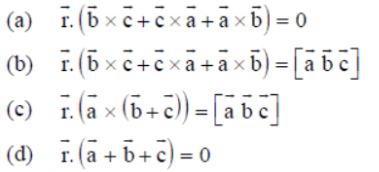
Answer : B
Question. The vector equation of the symmetrical form of equation of straight line x-5/3 = y+4/7 = z-6/2 is
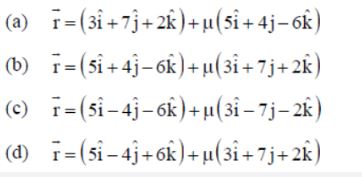
Answer : D
Question. The distance between the lines given by

(a) √59/14
(b) √59/7
(c) √118/7
(d) √59/7
Answer : B
Question. If O be the origin and the coordinates of P be (1, 2, –3), then the equation of the plane passing through P and perpendicular to OP is
(a) x + 2y + 3z = –5
(b) x + 2y + 3z = – 14
(c) x + 2y – 3z =14
(d) x + 2y – 3z =5
Answer : C
Question. The lines whose vector equations are

are perpendicular for all values of λ and μ if p =
(a) 1
(b) –1
(c) – 6
(d) 6
Answer : D
Question. A variable plane remains at constant distance p from the origin.If it meets coordinate axes at points A, B, C then the locus of the centroid of ΔABC is
(a) x-2 + y-2 + z-2 = 9p-2
(b) x-3 + y-3 + z-3 =9p-3
(c) x2 + y2 + z2 = 9p2
(d) x3 + y3 + z3 = 9p3
Answer : A
Question. Two lines r̅ = a̅1 + λb̅1 and r̅ = a̅2 + μb̅2 are said to be coplanar, if
(a) (a2 – a1) . (b1 × b2) = 0
(b) (x1, y1, z1)
(c) Both (a) and (b)
(d) None of the above
Answer : A
Question. The lines in a space which are neither intersecting nor parallel, are called
(a) concurrent lines
(b) intersecting lines
(c) skew lines
(d) parallel lines
Answer : C
Question. If a line makes angles α β γ , and with the positive directions of the coordinate axes, then the value of sin2α+sin2 β+ sin2 y is
(a) 0
(b) 1
(c) 2
(d) −1
Answer : C
Question. If a line makes angles α, β γ and with the axes, then cos2α+ cos2β+ cos2y is equal to
(a) −2
(b) −1
(c) 1
(d) 2
Answer : B
Question. O is the origin. OP makes an angle of 45° and 60° with the positive direction of x and y-axes respectively. OP = 12 units. Then, the coordinates of P are
(a) (6, 6, 6)
(b) (6, 6, −6)
(c) (6 √2, 6, ± 6)
(d) (6, ± 6, 6)
Answer : C
Question. The points (5,2,4), (6,-1,2) ) and ( 8,-7,k) are collinear, if k is equal to
(a) − 2
(b) 2
(c) 3
(d) − 1
Answer : A
Question. The vector equation of a plane which is at a distance of 7 units from the origin and normal to the vector
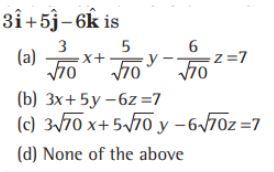
Answer : A
Question. The angle θ between two planes A1x + B1y + C1z + D1 =0 and A2x + B2y + C2z + D2 =0 is given by cos θ equal to
(a) A1A2 + B1B2 + C1C2
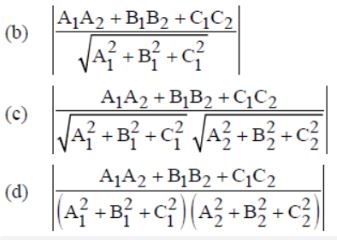
Answer : C
Question. If r = a1 + λb1 and r = a2 + μb2 are the equations of two lines, then cos θ =
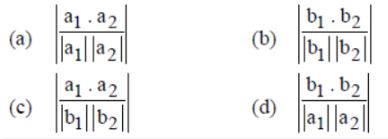
Answer : B
Question.
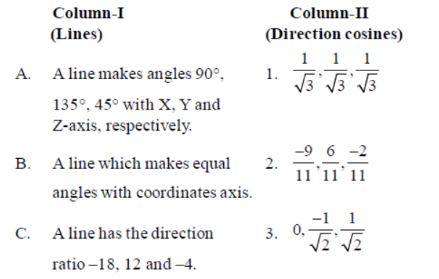
Codes
A B C
(a) 1 3 2
(b) 2 3 1
(c) 3 1 2
(d) 2 1 3
Answer : C
Question. The distance of the point (–5, –5, –10) from the point of intersection of the line r . = 2î – ĵ + 2k̂ + λ (3î + 4ĵ+ 2k̂ )and the plane r· (î – ĵ + k̂)= 5 is
(a) 13
(b) 12
(c) 4 √15
(d) 10 √2
Answer : A
Question. Which of the following is/are true?
I. The vector equation of the line passing through the point (1, 2, –4) and perpendicular to the two lines x-8/3 = y+19/-16 = z-10/7 and x-15/3 = y-29/8 = z-5/-5 is r = (î + 2ĵ – 4kˆ ) + λ (2î + 3ĵ + 6kˆ )
II. If a plane has intercepts a, b, c and is at a distance of p units from the origin, then p2 = a2 + b2 + c2.
(a) Only I is true
(b) Only II are true
(c) Both I and III are true
(d) Neither I nor II is true
Answer : A
Question. Let L be the line of intersection of the planes 2x + 3y + z = 1 and x + 3y + 2z = 2. If L makes an angle α with the positive x-axis, then cos α equals
(a) 1
(b) 1/√2
(c) 1/√3
(d) 1/2
Answer : C
Question. The vector equation of the plane which is at a distance of 6/√29 from the origin and its normal vector from the origin is 2î – 3ĵ + k̂, is

(c) Both a and b
(d) None of the above
Answer : B
Question. The distance of a point (2, 5, –3) from the plane r . (6î – 3ĵ + 2k̂) = 4 is
(a) 13
(b) 13/7
(c) 13/5
(d) 37/7
Answer : B
Question. What is the condition for the plane ax + by + cz + d = 0 to be perpendicular to xy-plane ?
(a) a = 0
(b) b = 0
(c) c = 0
(d) a + b +c = 0
Answer : C
Question. Distance between the parallel planes 2x – y + 3z + 4 = 0 and 6x – 3y + 9z – 3 = 0 is:
(a) 5/√3
(b) 4/√6
(c) 5/√14
(d) 3/2√3
Answer : C
Free study material for Mathematics
Chapter 11 Three Dimensional Geometry Objective Questions & Solutions for Class 12 Mathematics
About Chapter 11 Three Dimensional Geometry MCQs for Class 12 Mathematics
Explore reliable practice questions for Chapter 11 Three Dimensional Geometry tailored for Class 12 Mathematics learners. Use these multiple-choice formats to evaluate preparedness and strengthen problem-solving skills.
How to Verify Your MCQ Answers
Built using the official NCERT book for Class 12, these Mathematics objective sets provide reliable academic guidance. Pair your practice with our recommended NCERT solutions to master optimal problem-solving approaches.
Enhance Speed with Online MCQ Tests
Follow up your worksheet practice by attempting the interactive online Mathematics MCQ test for this chapter to evaluate your execution speed. All platform resources are free to access.
FAQs
You can get most exhaustive CBSE Class 12 Mathematics Three Dimensional Geometry MCQs Set 02 for free on StudiesToday.com. These MCQs for Class 12 Mathematics are updated for the 2026-27 academic session as per CBSE examination standards.
Yes, our CBSE Class 12 Mathematics Three Dimensional Geometry MCQs Set 02 include the latest type of questions, such as Assertion-Reasoning and Case-based MCQs. 50% of the CBSE paper is now competency-based.
By solving our CBSE Class 12 Mathematics Three Dimensional Geometry MCQs Set 02, Class 12 students can improve their accuracy and speed which is important as objective questions provide a chance to secure 100% marks in the Mathematics.
Yes, Mathematics MCQs for Class 12 have answer key and brief explanations to help students understand logic behind the correct option as its important for 2026 competency-focused CBSE exams.
Yes, you can also access online interactive tests for CBSE Class 12 Mathematics Three Dimensional Geometry MCQs Set 02 on StudiesToday.com as they provide instant answers and score to help you track your progress in Mathematics.