

Multiple Choice Questions (MCQs) for Class 12 Mathematics: Chapter 13 Probability
Review structured MCQ sets for Class 12 Mathematics Chapter 13 Probability. Built according to official CBSE guidelines, these downloadable questions support daily revision and core concept reinforcement.
Practice Chapter 13 Probability MCQs for Class 12 Mathematics
Access the complete set of multiple-choice questions for Chapter 13 Probability below. This focused format allows students to isolate specific topics for thorough review and uninterrupted practice alongside official CBSE textbooks.
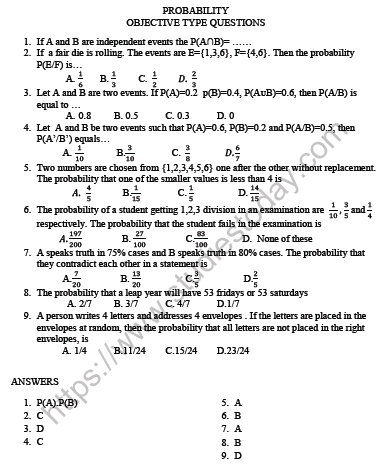
Question. If a fair die is rolling. The events are E={1,3,6}, F={4,6}. Then the probability P(E/F) is
a) 1/2
b) 2/3
c) 1/6
d) None of these
Answer : A
Question. Let A and B are two events. If P(A)=0.2 p(B)=0.4, P(AᴜB)=0.6, then P(A/B) is equal to
a) 0
b) 0.3
c) 0.5
d) 0.8
Answer : A
Question. Let A and B be two events such that P(A)=0.6, P(B)=0.2 and P(A/B)=0.5, then P(A’/B’) equals
a) 3/8
b) 3/10
c) 1/10
d) 6/7
Answer : A
Question. Two numbers are chosen from {1,2,3,4,5,6} one after the other without replacement. The probability that one of the smaller values is less than 4 is
a) 4/5
b) 1/15
c) 1/5
d) 14/15
Answer : A
Question. The probability of a student getting 1,2,3 division in an examination are 1/10, 3/5 and 1/4 respectively. The probability that the student fails in the examination is
a) 27/100
b) 83/100
c) None of these
d) 197/200
Answer : A
Question. A speaks truth in 75% cases and B speaks truth in 80% cases. The probability that they contradict each other in a statement is
a) 7/20
b) 13/20
c) 3/5
d) 2/5
Answer : A
Question. The probability that a leap year will have 53 fridays or 53 saturdays
a) 3/7
b) 4/7
c) 1/7
d) 2/7
Answer : A
Question. A die is thrown two times and the sum of the scores appearing on the die is observed to be a multiple of 4.
Then the conditional probability that the score 4 has appeared atleast once is :
(a) 1/4
(b) 1/3
(c) 1/8
(d) 1/9
Answer : D
Question. An unbiased coin is tossed eight times. The probability of obtaining at least one head and at least one tail is :
(a) 255/256
(b) 127/128
(c) 63/64
(d) 1/2
Answer : B
Question. A player X has a biased coin whose probability of showing heads is p and a player Y has a fair coin. They start playing a game with their own coins and play alternately. The player who throws a head first is a winner. If X starts the game, and the probability of winning the game by both the players is equal, then the value of ‘p’ is
(a) 1/3
(b) 1
(c) 1/4
(d) 2/5
Answer : A
Question. If A and B are any two events such that P(A) = 2/5 and P(A ∩ B) = 3/20 then the conditional probability, P(A | A' ù B')) , where A' denotes the complement of A, is equal to :
(a) 11/20
(b) 5/17
(c) 8/17
(d) 1/4/5
Answer : B
Question. If the probability of hitting a target by a shooter, in any shot, is 1/3 then the minimum number of independent shots at the target required by him so that the probability of hitting the target at least once is greater than 5/6 is:
(a) 3
(b) 6
(c) 5
(d) 4
Answer : C
Question. A bag contains 4 red and 6 black balls. A ball is drawn at random from the bag, its colour is observed and this ball along with two additional balls of the same colour are returned to the bag. If now a ball is drawn at random from the bag, then the probability that this drawn ball is red, is :
(a) 2/5
(b) 1/5
(c) 3/4
(d) 3/10
Answer : A
Question. Let A and E be any two events with positive probabilities:
Statement - 1: P(E/A) ≥ P(A/E) P(E)
Statement - 2: P(A/E) ≥ P(A∩E)
(a) Both the statements are true
(b) Both the statements are false
(c) Statement-1 is true, Statement-2 is false
(d) Statement-1 is false, Statement-2 is true
Answer : A
Question. Three numbers are chosen at random without replacement from {1,2,3,..8}. The probability that their minimum is 3, given that their maximum is 6, is :
(a) 3/8
(b) 1/5
(c) 1/4
(d) 2/5
Answer : B
Question. Let X be a set containing 10 elements and P(X) be its power set. If A and B are picked up at random from P(X), with replacement, then the probability that A and B have equal number elements, is :
(a) (210 -1)
(b) 20C10/210
(c) (210 - 1)/220
(d) 20C10/220
Answer : D
Question. Three persons P, Q and R independently try to hit a target. If the probabilities of their hitting the target are 3/4, 1/4 and 5/8 respectively, then the probability that the target is hit by P or Q but not by R is :
(a) 21/64
(b) 9/64
(c) 15/64
(d) 39/64
Answer : A
Question. Let A, B, C, be pairwise independent events with P (C) > 0 and P( A ∩ B ∩ C) = 0. Then P (Ac ∩ Bc / C)
(a) P (Bc) - P (B)
(b) P (Ac) + P (Bc)
(c) P (Ac) - P (Bc)
(d) P (Ac) - P (B)
Answer : D
Question. A, B, C try to hit a target simultaneously but independently.
Their respective probabilities of hitting the targets are
3/4, 1/2, 5/8. The probability that the target is hit by A or B but not by C is :
(a) 21/64
(b) 7/8
(c) 7/32
(d) 9/64
Answer : A
Question. Two aeroplanes I and II bomb a target in succession. The probabilities of I and II scoring a hit correctly are 0.3 and 0.2, respectively. The second plane will bomb only if the first misses the target. The probability that the target is hit by the second plane is
(a) 0.2
(b) 0.7
(c) 0.06
(d) 0.14.
Answer : D
Question. Let a random variable X have a binomial distribution with mean 8 and variance 4. If P(X d” 2) = k/162, then k is equal to:
(a) 17
(b) 121
(c) 1
(d) 137
Answer : D
Question. Let two fair six-faced dice A and B be thrown simultaneously. If E1 is the event that die A shows up four, E2 is the event that die B shows up two and E3 is the event that the sum of numbers on both dice is odd, then which of the following statements is NOT true ?
(a) E1 and E3 are independent.
(b) E1, E2 and E3 are independent.
(c) E1 and E2 are independent.
(d) E2 and E3 are independent.
Answer : B
Question. The probability of a man hitting a target is 2/5. He fires at the target k times (k, a given number). Then the minimum k, so that the probability of hitting the target at least once is more than 7/10, is :
(a) 3
(b) 5
(c) 2
(d) 4
Answer : A
Question. If C and D are two events such that C ⊂ D and P(D) ≠ 0, then the correct statement among the following is
(a) P(C | D) ≥ P(C)
(b) P(C | D) < P(C)
(c) P(C | D) = P(D)/P(C)
(d) P(C | D) = P(C)
Answer : A
Question. A person throws two fair dice. He wins Rs. 15 for throwing a doublet (same numbers on the two dice), wins Rs. 12 when the throw results in the sum of 9, and loses Rs. 6 for
any other outcome on the throw. Then the expected gain/loss (in Rs.) of the person is :
(a) (1/2) gain
(b) (1/4) loss
(c) (1/2) loss
(d) 2 gain
Answer : C
Question. Three houses are available in a locality. Three persons apply for the houses. Each applies for one house without consulting others. The probability that all the three apply for the same house is
(a) 9/2
(b) 9/1
(c) 9/8
(d) 9/7
Answer : B
Question. The probability that A speaks truth is , 5/4 while the probability for B is . 4/3
The probability that they contradict each other when asked to speak on a fact is
(a) 5/4
(b) 5/1
(c) 20/7
(d) 20/3
Answer : C
Question : A person writes 4 letters and addresses 4 envelopes . If the letters are placed in the envelopes at random, then the probability that all letters are not placed in the right envelopes, is
a) 23/24
b) 15/24
c) 11/24
d) 1/4
Answer : A
Attempt Mock Tests on this topic
Free study material for Mathematics
Chapter 13 Probability Objective Questions & Solutions for Class 12 Mathematics
Download Multiple Choice Questions: Chapter 13 Probability (Class 12 Mathematics)
Test your conceptual understanding of Chapter 13 Probability with these targeted multiple-choice questions. Designed in alignment with the latest CBSE curriculum for Class 12 Mathematics, these problem sets build accuracy and prepare students for objective exams.
Concept Clarification for Chapter 13 Probability
Cross-reference your completed choices with comprehensive NCERT solutions for Class 12 Mathematics to ensure absolute clarity across all sub-topics in this chapter.
Additional Study Resources for Class 12 Mathematics
Explore our broader library of printable assignments, chapter notes, and mock tests designed to support continuous revision and secure higher marks in CBSE assessments.
FAQs
You can get most exhaustive CBSE Class 12 Mathematics Probability MCQs Set 01 for free on StudiesToday.com. These MCQs for Class 12 Mathematics are updated for the 2026-27 academic session as per CBSE examination standards.
Yes, our CBSE Class 12 Mathematics Probability MCQs Set 01 include the latest type of questions, such as Assertion-Reasoning and Case-based MCQs. 50% of the CBSE paper is now competency-based.
By solving our CBSE Class 12 Mathematics Probability MCQs Set 01, Class 12 students can improve their accuracy and speed which is important as objective questions provide a chance to secure 100% marks in the Mathematics.
Yes, Mathematics MCQs for Class 12 have answer key and brief explanations to help students understand logic behind the correct option as its important for 2026 competency-focused CBSE exams.
Yes, you can also access online interactive tests for CBSE Class 12 Mathematics Probability MCQs Set 01 on StudiesToday.com as they provide instant answers and score to help you track your progress in Mathematics.