

Multiple Choice Questions (MCQs) for Class 12 Mathematics: Chapter 12 Linear Programming
Explore reliable objective questions for Chapter 12 Linear Programming tailored for Class 12 learners. Utilizing these Mathematics multiple-choice formats ensures thorough preparation and strengthens problem-solving speed for upcoming school assessments.
Practice Chapter 12 Linear Programming MCQs for Class 12 Mathematics
Access the complete set of multiple-choice questions for Chapter 12 Linear Programming below. This focused format allows students to isolate specific topics for thorough review and uninterrupted practice alongside official CBSE textbooks.
Question. The region represented by the inequalities x ≥ 6, y ≥ 2, 2x + y ≤ 0, x ≥ 0, y ≥ 0 is
(a) unbounded
(b) a polygon
(c) exterior of a triangle
(d) none of the options
Answer: d
Question. The minimum value of Z = 4x + 3y subjected to the constraints 3x + 2y ≥ 160, 5 + 2y ≥ 200, 2y ≥ 80; x, y ≥ 0 is
(a) 220
(b) 300
(c) 230
(d) none of the options
Answer: a
Question. The maximum value of f = 4x + 3y subject to constraints x ≥ 0, y ≥ 0, 2x + 3y ≤ 18; x + y ≥ 10 is
(a) 35
(b) 36
(c) 34
(d) none of the options
Answer: d
Question. Objective function of a L.P.P. is
(a) a constant
(b) a function to be optimised
(c) a relation between the variables
(d) none of the options
Answer: b
Question. Maximize Z = 11x + 8y, subject to x ≤ 4, y ≤ 6, x ≥ 0, y ≥ 0.
(a) 44 at (4, 2)
(b) 60 at (4, 2)
(c) 62 at (4, 0)
Answer: b
Question. The optimal value of the objective function is attained at the points
(a) on x-axis
(b) on y-axis
(c) which are corner points of the feasible region
(d) none of the options
Answer: c
Question. Z = 4x1 + 5x2, subject to 2x1 + x2 ≥ 7, 2x1 + 3x2 ≤ 15, x2 ≤ 3, x1, x2 ≥ 0. The minimum value of Z occurs at
(a) (3.5, 0)
(b) (3, 3)
(c) (7.5, 0)
(d) (2, 3)
Answer: a
Question. Minimize Z = 20x1 + 9x2, subject to x1 ≥ 0, x2 ≥ 0, 2x1 + 2x2 ≥ 36, 6x1 + x2 ≥ 60.
(a) 360 at (18, 0)
(b) 336 at (6, 4)
(c) 540 at (0, 60)
(d) 0 at (0, 0)
Answer: b
Question. Z = 8x + 10y, subject to 2x + y ≥ 1, 2x + 3y ≥ 15, y ≥ 2, x ≥ 0, y ≥ 0. The minimum value of Z occurs at
(a) (4.5, 2)
(b) (1.5, 4)
(c) (0, 7)
(d) (7, 0)
Answer: b
Question. In solving the LPP: “minimize f = 6x + 10y subect to constraints x ≥ 6, y ≥ 2, 2x + y ≥ 10, x ≥ 0, y ≥ 0” redundant constraints are
(a) x ≥ 6, y ≥ 2
(b) 2x + y ≥ 10, x ≥ 0, y ≥ 0
(c) x ≥ 6
(d) none of the options
Answer: b
Question. Region represented by x ≥ 0, y ≥ 0 is
(a) first quadrant
(b) second quadrant
(c) third quadrant
(d) fourth quadrant
Answer: a
Question. The maximum value of Z = 3x + 2y, subjected to x + 2y ≤ 2, x + 2y ≥ 8; x, y ≥ 0 is
(a) 32
(b) 24
(c) 40
(d) none of the options
Answer: d
Question. Maximize Z = 3x + 5y, subject to x + 4y ≤ 24, 3x + 4y ≤ 21, x + y ≤ 9, x ≥ 0, y ≥ 0.
(a) 20 at (1, 0)
(b) 30 at (0, 6)
(c) 37 at (4, 5)
(d) 33 at (6, 3)
Answer: c
Question. Maximize Z = 4x + 6y, subject to 3x + 2y ≤ 12, x + y ≥ 4, x, y ≥ 0.
(a) 16 at (4, 0)
(b) 24 at (0, 4)
(c) 24 at (6, 0)
(d) 36 at (0, 6)
Answer: d
Case Based Questions
1. Linear programming is a method for finding the optimal values (maximum or minimum) of quantities subject to the constraints when relationship is expressed as linear equations or inequations.
Based on the above information, answer the following questions:
Question. The optimal value of the objective function is attained at the points
(a) on X-axis
(b) on Y-axis
(c) which are corner points of the feasible region
(d) none of the options
Answer: c
Question. The graph of the inequality 3x + 4y < 12 is
(a) half plane that contains the origin
(b) half plane that neither contains the origin nor the points of the line 3x + 4y = 12.
(c) whole XOY-plane excluding the points on line 3x + 4y = 12
(d) none of the options
Answer: d
Question. The corner points of the feasible region determined by the system of linear constraints are (0, 10), (5, 5), (15, 15), (0, 20). Let Z = px + qy, where p, q > 0. Condition on p and q so that the maximum of Z occurs at both the points (15, 15) and (0, 20) is
(a) p = q
(b) p = 2q
(c) q = 2p
(d) q = 3p
Answer: d
2. Deepa rides her car at 25 km/hr. She has to spend ₹2 per km on diesel and if she rides it at a faster speed of 40 km/hr, the diesel cost increases to ₹5 per km. She has ₹100 to spend on diesel. Let she travels x kms with speed 25 km/hr and y kms with speed 40 km/hr. The feasible region for the LPP is shown below:
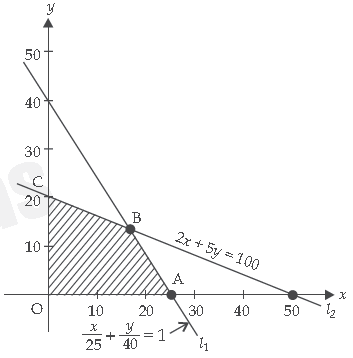
Based on the above information, answer the following questions:
Question. If Z = 6x – 9y be the objective function, then maximum value of Z is
(a) –20
(b) 150
(c) 180
(d) 20
Answer: b
Question. If Z = 6x + 3y be the objective function, then what is the minimum value of Z?
(a) 120
(b) 130
(c) 0
(d) 150
Answer: c
Corner points of the feasible region for an LPP are (0, 3), (5, 0), (6, 8), (0, 8). Let Z = 4x – 6y be the objective function.
Based on the above information, answer the following questions:
Question. The minimum value of Z occurs at
(a) (6, 8)
(b) (5, 0)
(c) (0, 3)
(d) (0, 8)
Answer: d
Question. Maximum value of Z occurs at
(a) (5, 0)
(b) (0, 8)
(c) (0, 3)
(d) (6, 8)
Answer: a
Question. Maximum of Z – Minimum of Z =
(a) 58
(b) 68
(c) 78
(d) 88
Answer: b
Question. The feasible solution of LPP belongs to
(a) first and second quadrant
(b) first and third quadrant
(c) only second quadrant
(d) only first quadrant
Answer: d
Suppose a dealer in rural area wishes to purpose a number of sewing machines. He has only ₹5,760 to invest and has space for at most 20 items for storage.

An electronic sewing machine costs him ₹360 and a manually operated sewing machine ₹240. He can sell an electronic sewing machine at a profit of ₹22 and a manually operated sewing machine at a profit of ₹18.
Based on the above information, answer the following questions:
Question. Let x and y denotes the number of electronic sewing machines and manually operated sewing machines purchased by the dealer. If it is assumed that the dealer purchased atleast one of the given machines, then
(a) x + y ≥ 0
(b) x + y < 0
(c) x + y > 0
(d) x + y ≤ 0
Answer: c
Question. Let the constraints in the given problem is represented by the following inequalities:
x + y ≤ 20
360x + 240y ≤ 5760
x, y ≥ 0
Then which of the following point lie in its feasible region.
(a) (0, 24)
(b) (8, 12)
(c) (20, 2)
(d) none of the options
Answer: b
Question. If the objective function of the given problem is maximise z = 22x + 18y, then its optimal value occur at
(a) (0, 0)
(b) (16, 0)
(c) (8, 12)
(d) (0, 20)
Answer: c
Question. If an LPP admits optimal solution at two consecutive vertices of a feasible region, then
(a) the required optimal solution is at the midpoint of the line joining two points.
(b) the optimal solution occurs at every point on the line joining these two points.
(c) the LPP under consideration is not solvable.
(d) the LPP under consideration must be reconstructed.
Answer: b
Let R be the feasible region (convex polygon) for a linear programming problem and let Z = ax + by be the objective function. When Z has an optimal value (maximum or minimum), where the variables x and y are subject to constraints described by linear inequalities, this optimal value must occur at a corner point (vertex) of the feasible region.
Based on the given information, answer the following questions:
Question. Objective function of a L.P.P. is
(a) a constant
(b) a function to be optimised
(c) a relation between the variables
(d) none of the options
Answer: b
Question. Which of the following statement is correct?
(a) Every LPP has at least one optimal solution
(b) Every LPP has a unique optimal solution.
(c) If an LPP has two optimal solutions, then it has infinitely many solutions.
(d) none of the options
Answer: c
Question. In solving the LPP : “minimize f = 6x + 10y subject to constraints x ≥ 6, y ≥ 2, 2x + y ≥ 10, x ≥ 0, y ≥ 0” redundant constraints are
(a) x ≥ 6, y ≥ 2
(b) 2x + y ≥ 10, x ≥ 0, y ≥ 0
(c) x ≥ 6
(d) none of the options
Answer: b
Question : In maximization problem, optimal solution occurring at corner point yields the
a) highest value of z
b) lowest value of z
c) mid values of z
d) mean values of z
Answer : A
Question : In a LPP, the objective function is always
a) Linear
b) Quadratic
c) Cubic
d) Biquadratic
Answer : A
Question : A feasible solution to a linear programming problem
a) Must satisfy all of the problem's constraints simultaneously
b) Need not satisfy all of the constraints, only the non-negativity constraints
c) Must be a corner point of the feasible region
d) Must give the maximum possible profit
Answer : A
Question : The corner points of the bounded feasible region of a LPP are A(0,50), B(20, 40), C(50, 100) and D(0, 200) and the objective function is Z = x + 2y. Then the maximum value is
a) 400
b) 250
c) 450
d) 100
Answer : A
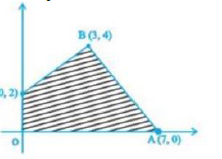
Question : The feasible region (shaded) for a L.P.P is shown in the figure. The maximum Z = 5x + 7y is
a) 43
b) 47
c) 45
d) 49
Answer : A
Attempt Mock Tests on this topic
Free study material for Mathematics
Multiple Choice Questions (MCQs) for Class 12 Mathematics Chapter 12 Linear Programming
Download Multiple Choice Questions: Chapter 12 Linear Programming (Class 12 Mathematics)
Test your conceptual understanding of Chapter 12 Linear Programming with these targeted multiple-choice questions. Designed in alignment with the latest CBSE curriculum for Class 12 Mathematics, these problem sets build accuracy and prepare students for objective exams.
Concept Clarification for Chapter 12 Linear Programming
Built using the official NCERT book for Class 12, these Mathematics objective sets provide reliable academic guidance. Pair your practice with our recommended NCERT solutions to master optimal problem-solving approaches.
Additional Study Resources for Class 12 Mathematics
Follow up your worksheet practice by attempting the interactive online Mathematics MCQ test for this chapter to evaluate your execution speed. All platform resources are free to access.
FAQs
You can get most exhaustive CBSE Class 12 Mathematics Linear Programming MCQs Set 01 for free on StudiesToday.com. These MCQs for Class 12 Mathematics are updated for the 2026-27 academic session as per CBSE examination standards.
Yes, our CBSE Class 12 Mathematics Linear Programming MCQs Set 01 include the latest type of questions, such as Assertion-Reasoning and Case-based MCQs. 50% of the CBSE paper is now competency-based.
By solving our CBSE Class 12 Mathematics Linear Programming MCQs Set 01, Class 12 students can improve their accuracy and speed which is important as objective questions provide a chance to secure 100% marks in the Mathematics.
Yes, Mathematics MCQs for Class 12 have answer key and brief explanations to help students understand logic behind the correct option as its important for 2026 competency-focused CBSE exams.
Yes, you can also access online interactive tests for CBSE Class 12 Mathematics Linear Programming MCQs Set 01 on StudiesToday.com as they provide instant answers and score to help you track your progress in Mathematics.