

School Assignments for Class 10 Science: Chapter 04 Carbon And Its Compound
Review targeted academic assignments with the CBSE Class 10 Science Carbon and its compounds Assignment Set 05. Built according to official CBSE standards for the 2026-27 term, these downloadable Class 10 Science worksheets support effective daily practice for Chapter 04 Carbon And Its Compound.
Practice Class 10 Science Assignments: Chapter 04 Carbon And Its Compound
View or download the dedicated CBSE Class 10 Science Carbon and its compounds Assignment Set 05 resource below. Engaging with these assignments under focused study conditions ensures continuous academic progress and mastery of the 2026-27 curriculum.
Very Short Answer Type Questions :
Question. What change will you observe if you test soap with litmus paper (red and blue)?
Answer: Soap is alkaline in nature, hence it will turn red litmus into blue, blue litmus will remain blue.
Question. Write the name and formula of the 2nd member of the series of carbon compounds whose general formula is CnH2n+1OH
Answer: Ethanol, C2H5OH or CH3CH2OH
Question. Why are carbon and its compounds used as fuels for most applications?
Answer: Carbon and its compounds undergo combustion to produce heat, the amount of heat released can be handled and used so they are used as fuels for most applications.
Question. Explain the formation of scum when hard water is treated with soap.
Answer: Hard water contains salts of calcium and magnesium. When soap molecule comes in contact with these salts it forms a curdy white precipitate (compound insoluble in water) called scum.
Soap + Hard water ⎯→ scum
Question. Write the name and formula of the 2nd member of the series of carbon compounds whose general formula is CnH2n.
Answer: C3H6, H2C=CH—CH3
Propene is second member of series whose general formula is CnH2n.
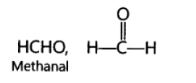
Question. Write the name and formula of the first member of the carbon compounds having functional group —CHO.
Answer:
Question. Give two uses of methane gas.
Answer: (i) It is used as a fuel (ii) It is the major component of biogas and CNG.
Question. Why do soaps form scum when added to hard water?
Answer: Hard water contains carbonate and sulphate salts of magnesium or sodium ions which react with the soap molecule to form a compound which is insoluble in water. Hence soaps form scum with hard water.
Question. What happens when ethanol burns in air?
Answer: Ethanol burns to form carbon dioxide and water.
Question. What is isomerism?
Answer: A property in which a compound can exist in different structural formula but its molecular formula remains the same.
Question. What is hydrophilic?
Answer: The substance showing attraction towards water is called hydrophilic.
Question. Name the second member of alkyne series.
Answer: Propyne
Question. Give the names of the functional group
(i) —CHO (ii) —C==O
Answer: (i) —CHO → Aldehyde (ii) (Img 28)
Question. The structural formula of an ester is
Name the alcohol and the acid from which it would have been formed.
Answer: Alcohol is C2H5OH ethanol
Acid is H3C—H2C—COOH propanoic acid.
Short Answer Type Questions :
Question. (a) Why are covalent compounds generally poor conductors of electricity?
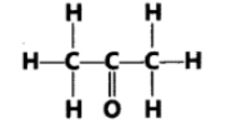
(b) Name the following compound:
(c) Name the gas evolved when ethanoic acid is added to sodium carbonate. How would you prove the presence of this gas?
Answer:
Question. Give reasons for the following observations:
(a) The element carbon forms a very large number of compounds.
(b) Air holes of a gas burner have to be adjusted when the heated vessels get blackened by the flame.
(c) Use of synthetic detergents causes pollution of water.
Answer: (a) Carbon forms large number of compounds since carbon is small in size and can form stable covalent bonds (catenation) and it shows tetravalency.
(b) Air holes of gas burner are made open (adjusted) so that air can pass through, which is needed for complete combustion, so that heated vessels do not get blackened.
(c) Some synthetic detergents are non-biodegradable, therefore, cause pollution of water.
Question. Name the compound formed when ethanol is warmed with ethanoic acid in the presence of a few drops of cone.H2S04
Answer:

Question. What happens when a small piece of sodium is dropped into ethanol?
Answer: Hydrogen gas will be evolved.

Question. Give the electron dot structure of CH3Cl and C2H2.

Answer:

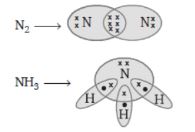
Question. Draw the electron dot structure of N2 and NH3.
Answer:
Question. State two characteristic features of carbon which when put together give rise to large number of carbon compounds.
Answer: (i) Catenation (ii) Tetravalency of carbon
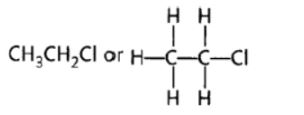
Question. Write the structural formula of chloroethane.
Answer:
Question. Give reason for the following observations:
(a) The element carbon forms a very large number of compounds.
(b) Air holes of a gas burner have to be adjusted when the heated vessels get blackened by the flame.
(c) Use of synthetic detergents causes pollution of water.
Answer: (a) Carbon forms large number of compounds due to its property of catenation, i.e. self linking. They form isomeric compounds i.e. compounds with same molecular formula but different structural formula.
(b) The vessels blacken due to deposits of black carbon particles on it which is caused due to incomplete combustion of fuel. Air holes are adjusted so that air enters through the holes and helps in complete combustion of the fuel.
(c) Synthetic detergent is non-biodegradable, it remains in the water thereby causing water pollution.
Question. What is meant by a functional group in an organic compound? Name the functional group present in
(i) CH3CH2OH
(ii) CH3COOH
(b) State one point of difference between soap and synthetic detergent.
Answer: (a) Functional group is an atom or group of atoms or reactive part of compound, which determines chemical properties of compounds.
(i) —OH (Alcohol)
(ii) —COOH (Carboxylic acid)
(b) Soaps do not work well with hard water, detergents work well with hard water.
Question. Give two uses of ethanol and one harmful effect of it.
Answer: Ethanol is a good solvent so it is used in making medicines such as tincture iodine, cough syrups and many tonics. Ethanol is also used in making alcoholic drinks.
Harmful effects: Intake of small amount of ethanol leads to drunkenness. Intake of even small amount of ethanol can be lethal. Long-term use or consumption can lead to severe health problems.
Question. (a) Name the compound CH3COOH and identify its functional group.
(b) Give a chemical test to identify this compound.
(c) Name the gas evolved when this compound acts on solid sodium carbonate. How would you identify this gas?
Answer: (a) Ethanoic acid, functional group is—COOH (Caboxylic/group)
(b) Take few drops of ethanoic acid in a test tube and add sodium hydrogen carbonate solution to it. Brisk effervescence of CO2 gas is formed.
(c) CO2 gas is evolved. To identify the gas, pass it through freshly prepared limewater, it turns milky due to the formation of milky white precipitate of CaCO3.
Ca(OH)2 + CO2 ⎯⎯→ CaCO3 + H2O
Question. (a) Give a chemical test to distinguish between saturated and unsaturated hydrocarbons.
(b) (i) Name the products formed when ethanol burns in air.
(ii) What two forms of energy are liberated on burning alcohol?
(c) Why is the reaction between methane and chlorine considered a substitution reaction?
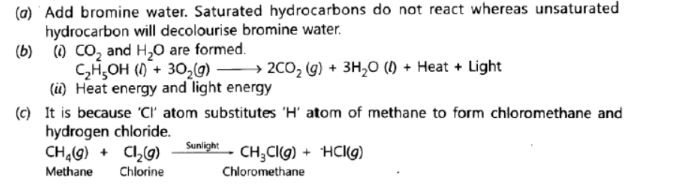
Answer: (a) On adding bromine water, the unsaturated hydrocarbon decolourises the bromine water but the saturated hydrocarbon will not decolourise bromine water.
(b) (i) Ethanol burns in air to produce carbon dioxide and water.
C2H5OH + 3O2 ⎯⎯→ 3CO2 + 3H2O + heat
(ii) Two forms of energy obtained are heat energy and light energy.
(c) When methane reacts with chlorine, the hydrogen atom of methane is replaced by chlorine atom step by step and hence it is termed as substitution reaction.
CH4 + Cl2 ⎯⎯→ CH3Cl + HCl
Question. (a) Give a chemical test to distinguish between saturated and unsaturated hydrocarbons.
(b) (i) Name the products formed when ethanol burns in air. ‘
(ii) What two forms of energy are liberated on burning alcohol?
(c) Why is the reaction between methane and chlorine considered a substitution reaction?
Answer:
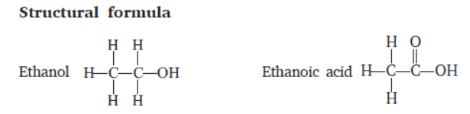
Question. An organic compound ‘X’ which is also called antifree mixture has the molecular formula C2H6O ‘X’ on oxidation gives a compound ‘Y’ which gives effervescence with a baking soda solution. What can X and Y be? Write their structural formula.
Answer: X is ethanol, (C2H5OH)
Y is ethanoic acid (CH3COOH)
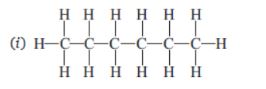
Question. Write the structures of isomers of hexane.
Answer:
Long Answer Type Questions :
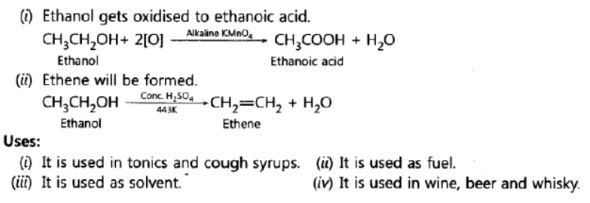
Question. With the help of balanced chemical equations explain what happens when ethanol is heated with (i) alkaline solution of potassium permanganate, (ii) excess concentrated sulphuric acid at 443 K. Mention any two uses of ethanol.
Answer:
Question. (a) What is homologous series? Give one example.
(b) What will happens if ethanoic acid reacts with ethanol in the presence of an acid as a catalyst? Name the reaction. Write the chemical reaction for this reaction.
(c) Why are soaps ineffective in hard water?
Answer: (a) Homologous series is series of compounds having same functional group and same chemical properties. When members of the series are arranged in ascending order, two successive members differ by –CH2 group and mass 14 u.
Example : Alcohol
CH3OH
CH2 mass 14. a.m.u
C2H5OH
C3H7OH
(b) Ethanol reacts with ethanoic acid to produce a fruity smelling compound called ester, the conc. sulphuric acid is used as dehydrating agent which removes water.
Such reaction is called esterification.
Example:

(c) Hard water contains salts of Ca and Mg. Soap molecule reacts with these salts to produce white precipitate called scum, which is insoluble in water and the cleansing action of soap becomes ineffective.
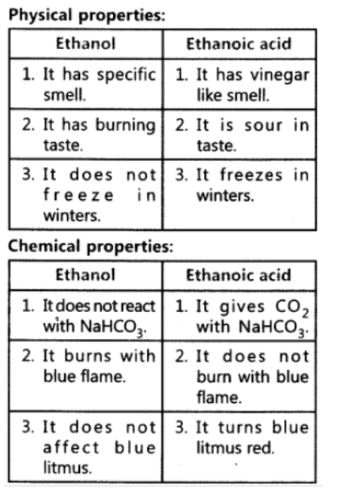
Question. List in tabular form three physical and two chemical properties on the basis of which ethanol and ethanoic acid can be differentiated
Answer:
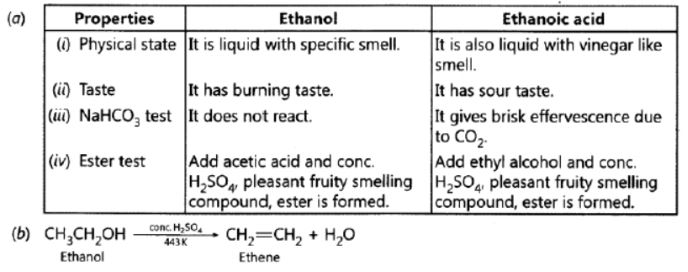
Question. (a) In tabular form, differentiate between ethanol and ethanoic acid under the following heads:
(i) Physical state (ii) Taste
(iii) NaHCO3 test (iV) Ester test
(b) Write a chemical reaction to show the dehydration of ethanol.
Answer:
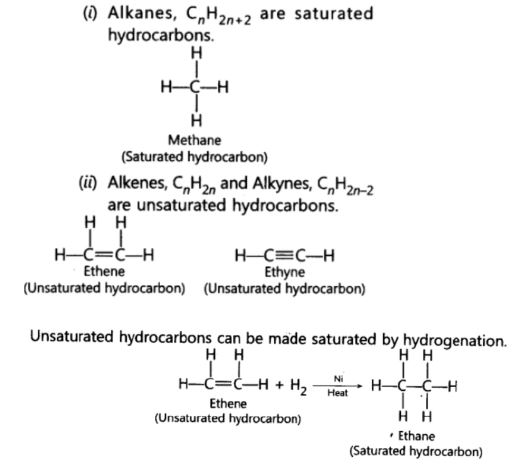
Question. What are the hydrocorbons write the name and general formula of (i) sturated hydrocarbons, (ii) unsaturated hydrocarbons, and draw the structure of one hydrocarbon of each type. How can an unsaturated hydrocarbon be made saturated?
Answer:
Free study material for Science
Chapter 04 Carbon And Its Compound Printable Assignments & Solutions for Class 10 Science
Class 10 Science Chapter 04 Carbon And Its Compound Printable Assignments
Explore reliable practice questions for Chapter 04 Carbon And Its Compound tailored for Class 10 learners. Use these structured worksheets to evaluate preparedness and strengthen core problem-solving skills.
Key Advantages of Solving Chapter 04 Carbon And Its Compound Assignments
- Exam Alignment: Questions strictly follow contemporary CBSE sample papers and grading schemes.
- Comprehensive Coverage: Features objective drills, case studies, and structured descriptive problems for Chapter 04 Carbon And Its Compound.
- Pacing & Precision: Regular problem-solving builds critical calculation speed and test-taking accuracy.
Effective Strategy for Class 10 Science Assignments
- Initial Reading: Begin by reading the NCERT book for Class 10 Science to build a baseline understanding.
- Independent Testing: Attempt assignment questions unassisted, then verify work using provided answer keys.
- Supplementary Aids: Leverage revision notes and worksheets whenever you encounter difficult topics.
FAQs
You can download free PDF assignments for Class 10 Science Chapter 04 Carbon And Its Compound from StudiesToday.com. These practice sheets have been updated for the 2026-27 session covering all concepts from latest NCERT textbook.
Yes, our teachers have given solutions for all questions in the Class 10 Science Chapter 04 Carbon And Its Compound assignments. This will help you to understand step-by-step methodology to get full marks in school tests and exams.
Yes. These assignments are designed as per the latest CBSE syllabus for 2026. We have included huge variety of question formats such as MCQs, Case-study based questions and important diagram-based problems found in Chapter 04 Carbon And Its Compound.
Practicing topicw wise assignments will help Class 10 students understand every sub-topic of Chapter 04 Carbon And Its Compound. Daily practice will improve speed, accuracy and answering competency-based questions.
Yes, all printable assignments for Class 10 Science Chapter 04 Carbon And Its Compound are available for free download in mobile-friendly PDF format.