

Official CBSE Assignments for Class 10 Science
Review targeted academic assignments with the CBSE Class 10 Science Acids Bases and Salts Assignment Set 02. Built according to official CBSE standards for the 2026-27 term, these downloadable Class 10 Science worksheets support effective daily practice for Chapter 02 Acids Bases Salts.
Solved Practice Assignments for Science
View or download the dedicated CBSE Class 10 Science Acids Bases and Salts Assignment Set 02 resource below. Engaging with these assignments under focused study conditions ensures continuous academic progress and mastery of the 2026-27 curriculum.
Question. Which one of the following can be used as an acid– base indicator by a visually impaired student?
(A) Litmus
(B) Turmeric
(C) Vanilla essence
(D) Petunia leaves
Answer : C
Question. What is formed when zinc reacts with sodium hydroxide?
(a) Zinc hydroxide and sodium
(b) Sodium zincate and hydrogen gas
(c) Sodium zinc-oxide and hydrogen gas
(d) Sodium zincate and water
Answer : B
Question. Which of the following statement is correct about an aqueous solution of an acid and of a base?
(i) Higher the pH, stronger the acid
(ii) Higher the pH weaker the acid
(iii ) Lower the pH ,stronger the base
(iv) Lower the pH, weaker the base
(a) i & iii
(b) ii & iii
(c ) I & iv
(d) ii & iv
Answer : D
Question. Tooth enamel is made up of
(a) calcium phosphate
(b) calcium carbonate
(c) calcium oxide
(d) potassium sulphate
Answer : A
Question. Sodium hydroxide turns phenolphthalein solution
(a) pink
(b) yellow
(c) colourless
(d) orange
Answer : A
Question. Which one of the given is true, if a substance has a pH value of 7?
(a) The substance is a base
(b) The substance is an acid
(c) The substance is a neutral substance
(d) Either (A) or (B)
Answer : C
Question. An aqueous solution turns red litmus solution blue. Excess addition of which of the following solution would reverse the change?
(a) Baking powder
(b) Lime
(c) Ammonium hydroxide solution
(d) Hydrochloric acid
Answer : D
Question. Rain is called acid rain when its:
(a) pH falls below 7
(b) pH falls below 6
(c) pH falls below 5.6
(d) pH is above 7
Answer : C
Question. When copper oxide and dilute hydrochloric acid react, colour changes to
(a) white
(b) bluish-green
(c) blue-black
(d) black
Answer : B
Question. Generally, when certain metals react with an acid they release gas.
(a) Nitrogen
(b) Oxygen
(c) Hydrogen
d) Argon
Answer : C
True or False :
Question. The more alkaline a solution, the more is the pH.
Answer: True
Question. Methyl orange indicator gives red colour in acidic solution and yellow colour in basic solution.
Answer: True
Question. All the organic acids are strong acids.
Answer: False
Question. The dilution of a concentrated acid should always be done by adding concentrated acid to water gradually with stirring.
Answer: True
Question. Glucose solution conduct electricity.
Answer: False
Question. The strength of an acid or base is measured on a scale of numbers called pH paper.
Answer: False
Fill in the blanks :
Question. Potassium nitrate has pH value equal to …………. .
Answer : 7 or seven
Question. Use of mild base like …………. on the bee-stung area gives relief.
Answer : baking soda
Question. …………. is one of the raw materials for the production of baking soda.
Answer : Sodium chloride
Question. Acids turn …………. litmus solution…………. .
Answer : blue, red
Question. The presence of …………. Ca in acids is responsible for their acidic properties.
Answer : H+
Question. One of the constituents of baking powder is sodium hydrogen carbonate, the other constituent is _____________ .
Answer : tartaric acid
Question. The salts of carbonic acids are called _____________ .
Answer : carbonates
Question. Mixing an acid or base with water results in decrease in the concentration of per unit volume. This process is called
Answer : OH– ions/H3O+ ions, dilution
Question. pH of basic solution is always …………. than 7.
Answer : more/greater
Question. The three most common indicators to test for acid and bases are litmus _____________ and _____________ .
Answer : methyl orange, phenolphthalein
MCQ Questions for NCERT Class 10 Science Acids Bases and Salts
Very Short Question :
Question. How will you test for the gas which is liberated when hydrochloric acid reacts with an active metal?
Answer: Bring a burning matchstick near the gas. It bums with ‘pop’ sound showing that it is hydrogen.
Question. Which gas is evolved when sodium hydroge-ncarbonate reacts with dilute hydrochloric acid?
Answer: Carbon dioxide gas is evolved.
Question. What is the colour of turmeric in soap solution?
Answer: Reddish-brown.
Question. What will happen to red litmus solution when it is added to bitter gourd extract? Is it acidic or basic?
Answer: It changes to blue. It is basic in nature.
Question. A few drops of sulphuric acid is added to water before electrolysis, why?
Answer: It makes water better conductor.
Question. What are phenolphthalein and methyl orange?
Answer: Synthetic indicators
Question. Which planet contains yellowish clouds of sulphuric acid?
Answer: Venus.
Question. What is the colour of litmus in a solution of ammonium hydroxide?
Answer: Red litmus will turn blue in ammonium hydroxide.
Question. What is litmus solution?
Answer: It is purple dye which is extracted from a plant ‘lichen’. It is used as acid-base indicator.
Question. Which gas is evolved when metal carbonates or metal hydrogen carbonate reacts with dilute acids?
Answer: CO2(g)
Question : i. A chemical compound X is used in glass and soap industry. Identify the compound and give its chemical formula.
ii. How many molecules of water of crystallisation are present in compound X?
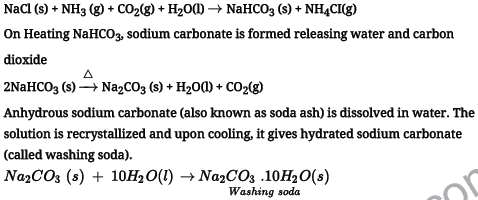
iii. How will you prepare the above compound starting from sodium chloride? Write all relevant equations involved in the process.
Answer : i. The compound (X) is washing soda. Its chemical formula is Na2CO3 .10H2O
ii. Ten molecules of water of crystallisation are present in this compound.
iii. Ammonia and carbon dioxide gas in passed through brine (or concentrated sodium chloride solution) then a mixture of NaHCO3 and NH4Cl is formed.
Question : a) Acids are sour in taste. Is it a way to find whether a substance is an acid or a base?
b) What is other physical test?
c) Any test with solid acid?
d) Can you check the evolution of CO2 chemically?
Question : a) What are acids?
b) Can presence of H+ ion in water be estimated? How?
c) How is pH related to strength of an acid?
d) Name one strong acid and one weak acid
Question : a) What are salts?
b) How many types of salts are formed?
c) What are neutral salts?
d) What do you mean by acidic salts?
e) Define basic salts.
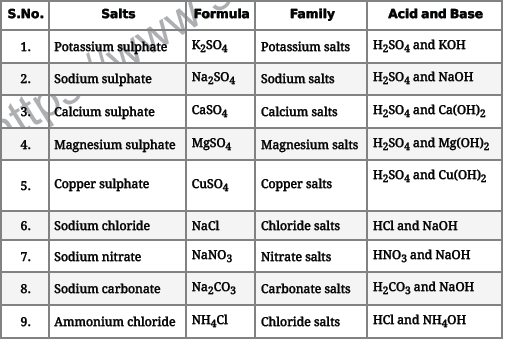
f) Give the corresponding acid and base from which sodium carbonate is formed
Question : a) What is common salt?
b) Why does common salt become moist in rainy season?
c) How is it used as a freezing mixture?
d) Name two important laboratory chemicals prepared from common salt on large scale.
Question : a) What is washing soda?
b) Name the process by which sodium carbonate is manufacture.
c) What are the raw materials used in the preparation of washing soda?
d) Sodium carbonate is obtained from another carbonate on heating. Name it.
Question : a) Name the substance used for bleaching cotton and wood pulp in textiles.
b) What is its chemical name?
c) How is it manufactured?
d) What is slaked lime?
e) Why does bleaching powder smell of chlorine?
Free study material for Science
Chapter 02 Acids Bases Salts Printable Assignments & Solutions for Class 10 Science
Download Assignment: Chapter 02 Acids Bases Salts (Class 10 Science)
Explore reliable practice questions for Chapter 02 Acids Bases Salts tailored for Class 10 learners. Use these structured worksheets to evaluate preparedness and strengthen core problem-solving skills.
Maximize Exam Scores with Chapter Practice Sets
- Syllabus Compliance: Sets reflect current CBSE evaluation criteria and official marking frameworks.
- Multi-Format Practice: Includes varied problem types designed to deepen comprehension across all sub-topics.
- Time Management: Routine practice optimizes pacing to finish school examinations comfortably within schedule.
Effective Strategy for Class 10 Science Assignments
- Concept Foundation: Review the NCERT book for Class 10 Science thoroughly before diving into assignment tasks.
- Self-Evaluation: Solve exercises independently before inspecting professional answer guides.
- Progress Monitoring: Note down complex formulas or concepts, clearing them up using available online practice aids.
FAQs
You can download free PDF assignments for Class 10 Science Chapter 02 Acids Bases Salts from StudiesToday.com. These practice sheets have been updated for the 2026-27 session covering all concepts from latest NCERT textbook.
Yes, our teachers have given solutions for all questions in the Class 10 Science Chapter 02 Acids Bases Salts assignments. This will help you to understand step-by-step methodology to get full marks in school tests and exams.
Yes. These assignments are designed as per the latest CBSE syllabus for 2026. We have included huge variety of question formats such as MCQs, Case-study based questions and important diagram-based problems found in Chapter 02 Acids Bases Salts.
Practicing topicw wise assignments will help Class 10 students understand every sub-topic of Chapter 02 Acids Bases Salts. Daily practice will improve speed, accuracy and answering competency-based questions.
Yes, all printable assignments for Class 10 Science Chapter 02 Acids Bases Salts are available for free download in mobile-friendly PDF format.