

Class 10 Science Practice Assignments: CBSE Class 10 Science Heredity Assignment Set 04
Explore structured practice materials through the CBSE Class 10 Science Heredity Assignment Set 04. Tailored for Class 10 learners, utilizing these Science assignments ensures thorough preparation and strengthens foundational knowledge before final CBSE evaluations.
Download Chapter 08 Heredity Assignment PDF with Solutions
Navigate directly to the solved Science assignments using the digital viewer below. Each practice set includes detailed step-by-step solutions, allowing students to instantly cross-check their work and identify areas requiring further revision.
Question. Gene is a short segment of
(a) protein
(b) Carbohydrate
(c) DNA
(d) Polypeptides
Answer: (c) DNA
Question. Which feature is considered as dominant by Mendel -
(a) Purple/ violet flower
(b) Long plant
(c) Yellow seed
(d) All of the options
Answer: (d) All of the options
Question. In human which on of the following is heterogametic –
(a) Male
(b) Female
(c) Baby Girl Child
(d) All of the options
Answer: (a) Male
Question. Which of the following is not associated with sex determination -
(a) Autosome
(b) Allosome
(c) Sex chromosome
(d) XX and XY
Answer: (b) Allosome
Question. Mendel’s dihybrid cross ratio is -
(a) 1:2:1
(b) 9:3:3:1
(c) 1:2:2:1
(d) 3:9:9:1
Answer: (b) 9:3:3:1
Question.Which of the following is not a direct conclusion that can be drawn from Mendel’s Experiment?
(a) Only one parental trait is expressed
(b) Two copies of each trait is inherited in sexually reproducing organism
(c) For recessive trait to be expressed, both copies should be identical
(d) Natural selection can alter frequency of an inherited trait
Answer: D
Question.What is the probability that the male progeny will be a boy?
(a) 50%
(b) 56%
(c) 47.43%
(d) It varies
Answer: A
Question. A Mendelian experiment consisted of breeding pea plants bearing violet flowers with pea plants bearing white flowers. What will be the result in F1 progeny?
(a) Heterozygous plant with violet flowers.
(b) Homozygous plant with violet flowers
(c) Heterozygous plant with white flowers
(d) Homozygous plant with white flowers
Answer: A
Question. In pea plant, round seed is dominant over the wrinkled. If a cross is carried out between these two plants, the genotype ratio of F2 progeny obtained from this cross is
(a) 1:1
(b) 3:1
(c) 1:2:1
(d) 9:3:3:1
Answer: C
Question. A cross between a tall plant (TT) and short pea plant (tt) resulted in progeny that were all tall plants because
(a) Tallness is the dominant trait
(b) shortness is the dominant trait
(c) Tallness is the recessive trait
(d) height of pea plant is not governed by gene ‘T’ or ‘t’
Answer: A
Question. A zygote which has an X-chromosome inherited from the father will develop into a
(a) Boy
(b) X-chromosome does not determine the sex of a child.
(c) Girl
(d) either boy or girl
Answer: C
Assertion and Reason Type Questions
Directions: In the following questions, a statement of assertion (A) is followed by a statement of reason (R). Mark the correct choice as:
(a)Both assertion (A) and reason (R) are true and reason (R) is the correct explanation of assertion (A)
(b)Both assertion (A) and reason (R) are true but reason (R) is not the correct explanation of assertion (A)
(c)Assertion (A) is true but reason (R) is false
(d)Assertion (A) is false but reason (R) is true
1.Assertion (A): Mendel chose a number of varieties of garden pea as plant material for his experiments.
Reason (R): Garden pea has well defined characters and was bisexual.
Answer: Correct option (a)
2.Assertion (A): In humans, males play an important role in determining the sex of the child.
Reason (R): Males have two X-chromosomes
Answer: Correct option (c)
Short Answer Type Questions
Question. When a cell reproduces, what happens to its DNA?
Answer: When a cell reproduces, its DNA is copied and passed on to the offspring.
Question. Why is variation important for a species?
Answer: Survival of species over time.
Question. Newly formed DNA copies may not be identical at times. Give one reason.
Ans. If there is error in DNA copying/inaccuracies in DNA copying.
Question.Tabulate two distinguishing features between acquired traits and inherited traits with one example of each.
Answer:

Question. "The sex of the children is determined by what they inherit from their father and not their mother." Justify
Answer: because Y sex chromosome is inherited only from the father
Question. Name the scientist who established the laws of inheritance.
Answer: Gregor Johann Mendel
Question. Where genes are located?
Answer: Genes are located over the chromosomes/DNA as linear segments
Question. Why did Mendel select Pea plant for his experiment?
Answer: availability of pure line plant, clearly visible observable characters, contrast characters of same features, easily pollinated (self and cross) etc.
Question. Describe genotype and phenotype with one example of each.
Answer: The genotype of an organism is its complete set of genetic material. Eg- TT, Tt, tt The phenotype is observable feature. E.g.- tall, dwarf
Question. What is the significance of variation?
Answer: Variation enables organisms to adjust and adapt better according to the changing conditions of the environment (Survival advantage).
Different kinds of variations in organisms lead to the development of new species.
Question. Mention the difference between the inherited and the acquired characters. Give one example of each of the characters that are inherited and the ones that are acquired in humans.
Answer: Inherited trait: obtain from parents (since the time of his birth and are passed on from one generation to another.
Acquired trait: gain after birth (person develops during his lifetime)
Inherited: attached ear lobe, baldness
Acquired: obesity, reading skill
Question. (a) Write foil form of DNA.
(b) Why are variations essential for the species?
Answer: (a) Deoxyribonucleic acid
(b) Genetic variation in a group of organisms enables some organisms to survive better than others in the environment in which they live.
Question. Describe law of dominance, the law of segregation and the law of segregation.
Answer: Low of dominance: - When parents having pure contrasting characters are crossed then only one character expresses itself in the F1 generation. This character is the dominant character and the character/factor which cannot express itself is called the recessive character.
Law of segregation: - The phenomenon of separation of the two alternating factors of one character, during gamete formation so that one gamete receives only one factor of a character is called as 'Law of Segregation.'
Law of independent assortment: the alleles of two (or more) different genes get sorted into gametes independently of one another
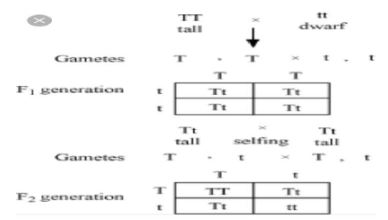
Question. In a monohybrid cross of tall Pea plants denoted by TT and short pea plants denoted by tt, Vaibhav obtained only tall plants (denoted by Tt) in F1 generation. However, in F2 generation she obtained both tall and short plants. Using the above information, explain the law of dominance.
Answer:
TT x tt Parents
T t
Tt................................................... F1
Tt x Tt self cross
T t T t .................................................. Gametes
F2
| T | T | |
| T | TT, Tall | Tt Tall |
| T | Tt, Tall | Tt, Dwarf |
Tall plant x Dwarf plant
Parental generation: TT × tt
Gametes: T, t
F1 Generation: Tt (Tall plant)
On selfing of F1 generation: Tt × Tt
Gametes: T, t and T, t
F2 Generation genotype: TT, Tt, Tt, tt
F2 Generation phenotype: Tall, Tall, Tall, Dwarf
Ratio: 3 : 1
Question. Mendel crossed tall pea plants with dwarf pea plants in his experiment. Write his observations giving reasons for the F1 and F2 generations.
Answer: In the F1 generation only tall plants are visible therefore tall (T) is dominant whereas dwarf (t) is recessive.
In F2 generation both tall and dwarf are visible. The dwarf is visible only in homozygous conditions.
Question. How do the following provide evidence in favour of evolution in organisms? Explain with an example for each.
(i) Homologous organs
(ii) Analogous organs
(iii) Fossils
Answer:
(i) Homologous organs are structures that are similar in form and function but originate from different evolutionary origins. This means that two different organisms may have the same organs, like a human arm and a bat’s wing, which have the same structure, but their origin is different. This is evidence in favour of evolution since it shows that two different organisms have adapted in different ways to the same environment.
(ii) Analogous organs are similar in function, but have different structures. For example, a bat’s wing and a bird’s wing have different structures, but both enable the organism to fly. This is also evidence in favour of evolution, as it shows that two different organisms have adapted differently to similar environments.
(iii) Fossils are the preserved remains of organisms that existed in the past. By studying fossils, it is possible to determine how organisms have changed over time. This provides evidence in favour of evolution, as it shows how organisms have adapted and changed to survive in the environment.
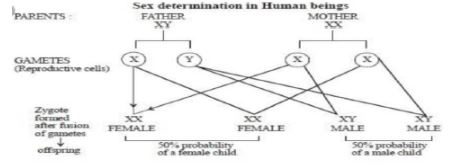
Question. How is the sex of child determined in human beings?
Answer: In human beings, sex of the child depends upon which kind of male gamete fertilizes the female gamete. If sperm carrying X chromosomes fertilizes the ovum carrying X chromosome, then the child born will be a girl. If a sperm carrying Y chromosome fertilizes the ovum which carries X chromosome, then the child born will be a boy.
Long Answer Type Questions
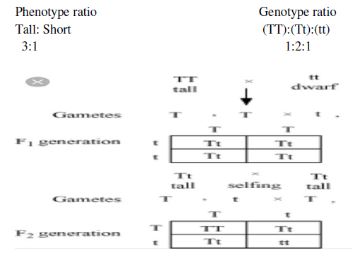
Question. Name the plant Mendel used for his experiment. What type of progeny was obtained by Mendel in F1 and F2 generation when he crossed the tall and short plants? Write the ratio he obtained in F2 generation plants.
Answer: Mendel used Pisum sativum (Pea plant) for his experiment.
Mendel took a tall pea (TT) plant and a short pea plant (tt) plant. When he crossed both, in F1 generation all plants were tall. When F1 progeny was self pollinated, all plants obtained in F2 generation were not tall. Instead 3 tall and I short pea plant was obtained.
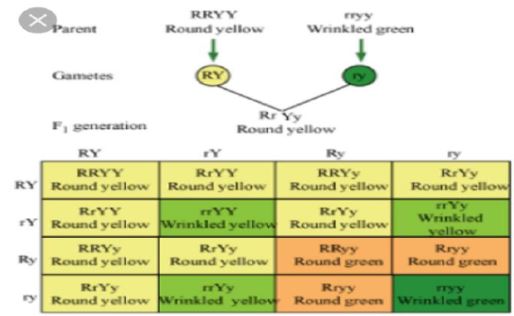
Question. How did Mendel’s experiments show that different traits are inherited independently? Explain
Answer: Mendel crossed pea plants having round green seeds (RRyy) with pea plants having wrinkled yellow seeds (rrYY).
Since the F1 plants are formed after crossing pea plants having green round seeds and pea plants having yellow wrinkled seeds, F1 generation will have both these characters in them.However, as we know that yellow seed colour and round seeds are dominant characters, therefore, the F1 plants will have yellow round seeds. Then this F1 progeny was self-pollinated and the F2 progeny was found to have yellow round seeds, green round seeds, yellow wrinkled seeds and green wrinkled seeds in the ratio of 9:3:3:1
Question. In a pea plant, the trait of flowers bearing purple colour(PP) is dominant over white colour(pp).Explain the inheritance pattern of F1 and F2 generation with the help of a cross following the rules of inheritance of traits. State the visible characters of F1 and F2 progenies?
Answer: Let purple trait be represented by:PP and White trait be:pp
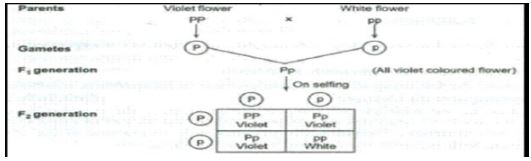
Visible characters of F1 progeny are all flowers are purple coloured and in F2 progenies 3 are purple coloured and 1 is white flower.
Question. (i) Define Genetics.
(ii) Who is regarded as the ‘Father of Genetics’? Name the plant on which he performed his experiment.
(iii) Why did he select that specific plant for his experiments?
Answer: (i) Genetics is the branch of biology that deals with the study of heredity and variations.
(ii) Gregor Johann Mendel is regarded as the Father of Genetics. He performed his experiment on garden pea.
(iii) He selects garden pea plant for his experiment for following reasons
* Garden pea plants were easily available
* They grow in one season
* Fertilization was easy
Question.How did Mendel explain that it is possible that a trait is inherited but not expressed in an Organism?
Answer: (i) In Mendel’s experiment, when pure tall pea plants were crossed with pure dwarf pea plants, only tall pea plants were obtained in F1 generation.
(ii) On self pollination the pea plants of F1 generation both tall and dwarf pea plants were obtained in F2 generation.
(iii) Reappearance of the dwarf pea plants in F2 generation proves that the dwarf trait was inherited but not expressed in F1 generation.
Free study material for Science
Download Practice Assignments: Class 10 Science Chapter 08 Heredity
Download Assignment: Chapter 08 Heredity (Class 10 Science)
Review targeted chapter assignments for Class 10 Science Chapter 08 Heredity. Built according to official CBSE guidelines, these downloadable problem sets help students build accuracy and prepare effectively for school tests.
Key Advantages of Solving Chapter 08 Heredity Assignments
- Exam Alignment: Questions strictly follow contemporary CBSE sample papers and grading schemes.
- Comprehensive Coverage: Features objective drills, case studies, and structured descriptive problems for Chapter 08 Heredity.
- Pacing & Precision: Regular problem-solving builds critical calculation speed and test-taking accuracy.
How to Approach Science Chapter 08 Heredity Assignments
- Textbook Review: Always study the core NCERT book for Class 10 Science prior to beginning the assignment.
- Independent Attempt: Solve Chapter 08 Heredity questions on your own initially before cross-checking with expert solutions.
- Error Tracking: Record challenging concepts in a dedicated notebook and practice online MCQ tests for revision.
FAQs
You can download free PDF assignments for Class 10 Science Chapter 08 Heredity from StudiesToday.com. These practice sheets have been updated for the 2026-27 session covering all concepts from latest NCERT textbook.
Yes, our teachers have given solutions for all questions in the Class 10 Science Chapter 08 Heredity assignments. This will help you to understand step-by-step methodology to get full marks in school tests and exams.
Yes. These assignments are designed as per the latest CBSE syllabus for 2026. We have included huge variety of question formats such as MCQs, Case-study based questions and important diagram-based problems found in Chapter 08 Heredity.
Practicing topicw wise assignments will help Class 10 students understand every sub-topic of Chapter 08 Heredity. Daily practice will improve speed, accuracy and answering competency-based questions.
Yes, all printable assignments for Class 10 Science Chapter 08 Heredity are available for free download in mobile-friendly PDF format.