

School Assignments for Class 10 Science: Chapter 12 Magnetic Effect Of Electric Current
Review targeted academic assignments with the CBSE Class 10 Science Magnetic Effects of Electric Current Assignment Set 04. Built according to official CBSE standards for the 2026-27 term, these downloadable Class 10 Science worksheets support effective daily practice for Chapter 12 Magnetic Effect Of Electric Current.
Practice Class 10 Science Assignments: Chapter 12 Magnetic Effect Of Electric Current
Navigate directly to the solved Science assignments using the digital viewer below. Each practice set includes detailed step-by-step solutions, allowing students to instantly cross-check their work and identify areas requiring further revision.
Assertion and Reason Type Questions
Direction – In each of the following questions, a statement of Assertion is given by the corresponding statement of Reason. Of the statements, mark the correct answer as
(a) If both Assertion and Reason are true and Reason is the correct explanation of Assertion.
(b) If both Assertion and Reason are true, but Reason is not the correct explanation of Assertion.
(c) If Assertion is true but Reason is false.
(d) If Assertion is false, but Reason is true.
(e) If Assertion and Reason both are false.
ASSERTION AND REASON
Question. Assertion: A current-carrying conductor experiences a force in a magnetic field.
Reason: The force acting on a current-carrying conductor in a magnetic field is due to interaction between magnetic field produced by the current-carrying conductor and external magnetic field in which the conductor is placed.
Answer: A
Question. Assertion: Electric Motor converts Electric Energy into mechanical Energy.
Reason: Electric motor is based on the principle of Flemings right-hand rule.
Answer: C
Question. Assertion: Magnetic field lines do not intersect each other.
Reason: There cannot to two direction of the magnetic field at a point.
Answer: A
Short Answer Type Questions
Question. Why and when does a current carrying conductor kept in a magnetic field experience force? List the factors on which direction of this force depends?
Answer: The drifting of free electrons of a conductor in a definite direction causes the current to flow through it. When such conductor is placed in a uniform magnetic field, each drifted electron of a conductor experience a magnetic force. This force is collectively experience by a conductor as a whole. Hence a current carrying conductor kept in a magnetic field experience a force. The direction of magnetic force depends on
(i) direction of current through the conductor, and
(ii) direction of magnetic field.
Question. What are magnetic field lines? Justify the following statements
(a) Two magnetic field lines never intersect each other.
(b) Magnetic field lines are closed curves.
Answer: Magnetic field lines: It is defined as the path along which the unit North pole (imaginary) tends to move in a magnetic field if free to do so.
(a) The magnetic lines of force do not intersect (or cross) one another. If they do so then at the point of intersection, two tangents can be drawn at that point which indicates that there will be two different directions of the same magnetic which field, i.e. the compass needle points in two different directions which is not possible.
(b) Magnetic field lines are closed continuous curves. They diverge from the north pole of a bar magnet and converge its south pole. Inside the magnet they move from south pole to north pole.
Question. What is meant by solenoid? How does a current carrying solenoid behave? Give its main use.
Answer: Solenoid: A coil of many circular turns of insulated copper wire wound on a cylindrical insulating body (i.e., cardboard etc.) such that its length is greater than its diameter is called solenoid.
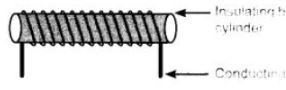
When current is flowing through the solenoid, the magnetic field line pattern resembles exactly with those of a bar magnet with the fixed polarity, i.e. North and South pole at its ends and it acquires the directive and attractive properties similar to bar magnet. Hence, the current carrying solenoid behave as a bar magnet.
Use of current carrying solenoid: It is used to form a temporary magnet called electromagnet as well as permanent magnet.
Long Answer Type Questions
Question. a)Describe an activity to demonstrate the pattern of magnetic field lines around a straight conductor carrying current.
(b) State the rule to find the direction of magnetic field associated with a current carrying conductor.
(c) What is the shape of a current carrying conductor whose magnetic field pattern resembles that of a bar-magnet ?
Answer: (a) Aim : To study the magnetic field due to a straight current carrying conductor.
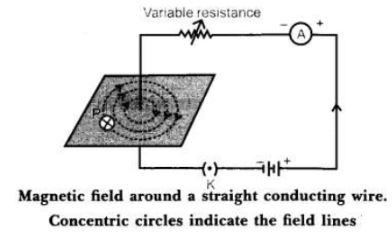
Apparatus Required : A thick conducting wire, battery, rheostat, magnetic needle, ammeter (0-5 A), key, a cardboard, a stand to hold the wire, iron filings and sprinkler of iron filings.
Procedure :
1. Attach the thick wire through a hole at the middle of the cardboard and clamp it in a stand.
2. Attach the ends of the wire through a key, variable resistor and an ammeter on either side of a battery and hold it vertically and perpendicularly to the board.
3. Spread the iron filings uniformly on the cardboard and place the magnetic needle on the board.
4. Close the key and tap the cardboard slightly and observe the orientation of iron filings.
Observation :
1. Just on closing the key, the iron filings are aligned in the pattern of concentric circles around the wire.
Conclusion :
1. Current carrying conductor is a source of magnetic field.
2. The magnetic field is in the form of concentric circles whose centre lies on the wire.
(b) Right-Hand Thumb Rule. This rule is used to find the direction of magnetic field due to a straight current carrying wire.
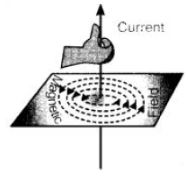
It states that if we hold the current carrying-conductor in the right hand in such a way that the thumb is stretched along the direction of current, then the curly finger around the conductor represent the direction of magnetic field produced by it. This is known as right-hand thumb rule.
Direction of Field Lines due to current carrying straight conductor is as shown in figure.
(c) Solenoid.
Free study material for Science
Chapter 12 Magnetic Effect Of Electric Current Printable Assignments & Solutions for Class 10 Science
Download Assignment: Chapter 12 Magnetic Effect Of Electric Current (Class 10 Science)
Access structured practice assignments for Chapter 12 Magnetic Effect Of Electric Current designed in alignment with the latest CBSE curriculum for Class 10 Science. These printable sets cover objective and descriptive problem types to support thorough revision.
Maximize Exam Scores with Chapter Practice Sets
- Curriculum Standards: Assignments match modern CBSE sample formats to ensure relevant preparation.
- Thorough Revision: Detailed problem sets reinforce core concepts and eliminate conceptual weak spots.
- Execution Speed: Timed practice with assignment sets sharpens overall response timing.
Effective Strategy for Class 10 Science Assignments
- Concept Foundation: Review the NCERT book for Class 10 Science thoroughly before diving into assignment tasks.
- Self-Evaluation: Solve exercises independently before inspecting professional answer guides.
- Progress Monitoring: Note down complex formulas or concepts, clearing them up using available online practice aids.
FAQs
You can download free PDF assignments for Class 10 Science Chapter 12 Magnetic Effect Of Electric Current from StudiesToday.com. These practice sheets have been updated for the 2026-27 session covering all concepts from latest NCERT textbook.
Yes, our teachers have given solutions for all questions in the Class 10 Science Chapter 12 Magnetic Effect Of Electric Current assignments. This will help you to understand step-by-step methodology to get full marks in school tests and exams.
Yes. These assignments are designed as per the latest CBSE syllabus for 2026. We have included huge variety of question formats such as MCQs, Case-study based questions and important diagram-based problems found in Chapter 12 Magnetic Effect Of Electric Current.
Practicing topicw wise assignments will help Class 10 students understand every sub-topic of Chapter 12 Magnetic Effect Of Electric Current. Daily practice will improve speed, accuracy and answering competency-based questions.
Yes, all printable assignments for Class 10 Science Chapter 12 Magnetic Effect Of Electric Current are available for free download in mobile-friendly PDF format.