

Read and download the CBSE Class 10 Science Biology Respiration Assignment Set A for the 2025-26 academic session. We have provided comprehensive Class 10 Biology school assignments that have important solved questions and answers for Chapter 5 Life Processes. These resources have been carefuly prepared by expert teachers as per the latest NCERT, CBSE, and KVS syllabus guidelines.
Solved Assignment for Class 10 Biology Chapter 5 Life Processes
Practicing these Class 10 Biology problems daily is must to improve your conceptual understanding and score better marks in school examinations. These printable assignments are a perfect assessment tool for Chapter 5 Life Processes, covering both basic and advanced level questions to help you get more marks in exams.
Chapter 5 Life Processes Class 10 Solved Questions and Answers
Question. Which of the following is the correct sequence of air passage during inhalation ?
(a) nostrils → larynx → pharynx → trachea → lungs
(b) nasal passage → trachea → pharynx → larynx → alveoli
(c) larynx → nostrils → pharynx → lungs
(d) nostrils → pharynx → larynx → trachea → alevoli
Answer : D
Question. Lack of oxygen in muscles often leads to cramps in the legs of sprinters. This is due to conversion of pyruvate to :
(a) ethanol
(b) carbon dioxide
(c) acetic acid
(d) lactic acid
Answer : D
Question. In cockroaches, air enters the body through :
(a) lungs
(b) gills
(c) spiracles
(d) skin
Answer : C
Question. Which of the following is most likely to have a much higher breathing rate ?
(a) man
(b) fish
(c) dog
(d) sparrow
Answer : B
Question. During the deficiency of oxygen in tissues of human beings, pyruvic acid is converted into lactic acid in :
(a) cytoplasm
(b) chloroplast
(c) mitochondria
(d) golgi body
Answer : A
Question. Which of the following statements are correct ?
(i) pyruvate can be converted into ethanol and carbon dioxide by yeast
(ii) fermentation takes place in the case of aerobic bacteria
(iii) fermentation takes place in mitochondria
(iv) fermentation is a form of anaerobic respiration
(a) (i) and (iii)
(b) (ii) and (iv)
(c) (i) and (iv)
(d) (ii) and (iii)
Answer : C
Question. Which of the following increases in muscle cells when they are lacking in oxygen ?
(a) carbon dioxide
(b) lactose
(c) lactic acid
(d) uric acid
Answer : C
Question. Internal respiration may be defined as :
(a) breathing in and releasing of oxygen in the tissue
(b) the oxidation of food substances to release energy
(c) the building up (synthesis) of complex substances
(d) getting rid of carbon dixode that would accumulate in the tissues.
Answer : B
Question. The photosynthesis in a plant is not taking place during the day time if the plant is releasing :
(a) water vapour
(b) oxygen
(c) carbon dioxide
(d) all the above
Answer : C
Question. The breathing and respiration in woody stem of a plant takes place through :
(a) root hair
(b) lenticels
(c) closed stomata
(d) open stomata
Answer : B
Question. One of the following organism does not depend on simple diffusion of gases for breathing and respiration.
This organism is :
(a) Amoeba
(b) Prawn
(c) Planaria
(d) Bryophyllum
Answer : B
Question. During marathon, we sometimes get painful contractions of leg muscles due to the accumulation of one of the following in leg muscles. This is :
(a) carbon dioxide
(b) alcohol
(c) lactose
(d) lactic acid
Answer : D
Questions Based on High Order Thinking Skills (HOTS)
Question. During the respiration of an organism A, 1 molecule of glucose produces 2 ATP molecules whereas in the respiration of another organism B, 1 molecule of glucose produces 38 ATP molecules.
(a) Which organism is undergoing aerobic respiration ?
Answer : B
(b) Which organism is undergoing anaerobic respiration ?
Answer : A
(c) Which type of organism, A or B, can convert glucose into alcohol ?
Answer : A
(d) Name one organism which behaves like A.
Answer : Yeast
(e) Name two organisms which behave like B.
Answer : Man, Dog
Question. A, B and C are three living organisms. The organism A is a unicellullar fungus which can live without air.
It is used in the commercial production of an organic compound P from molasses. The organism B is a unicellular animal which lives in water and feeds and moves by using pseudopodia. It breathes through an organelle Q. The organism C is a tiny animal which acts as a carrier of malarial parasite. It breathes and respires through a kind of tiny holes R and air-tubes S in its body.
(a) What are organisms (i) A (ii) B, and (iii) C ?
Answer : (i) Yeast (ii) Amoeba (iii) Mosquito
(b) Name (i) P (ii) Q (iii) R, and (iv) S.
Answer : (i) Ethanol (ii) Cell membrane (iii) Spiracles (iv) Tracheae
(c) Which organism/organisms undergo aerobic respiration ?
Answer : B and C
(d) Which organism/organisms undergo anaerobic respiration ?
Answer : A
Question : 1 Name the intermediate and the end product of glucose break down in aerobic respiration
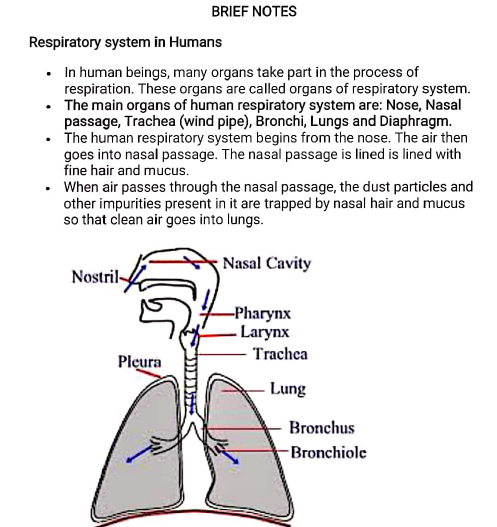
Question : 2 a) Draw the respiratory system of human beings
b) Label the following in the diagram drawn Larynx , Trachea , Primary bronchus , Lungs
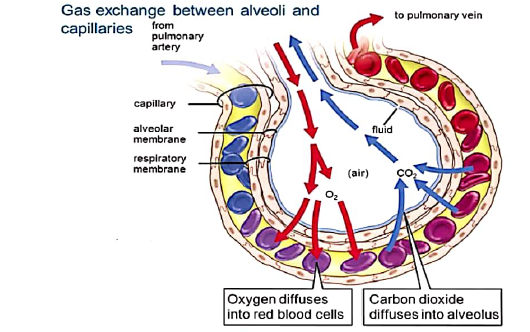
c ) What happens to the carbon dioxide which collect in the human tissues ?
Question : 3 Why is the rate of breathing in aquatic organisms much faster than that seen in terrestrial organisms? How does oxygenation of blood takes place in fish?
MCQ Questions for Class 10 Science Respiration :-
(B) liberation of carbon dioxide
(D) intake of oxygen
(B) ATP
(C) DNA
(D) RNA
(B) external respiration
(C) internal respiration
(D) expiration
(B) stop
(C) increase
(D) have no effect
(B) glottis
(C) bronchial tube
(D) larynx
(B) Lungs
(C) Bronchioles
(D) Nostrils
(B) Ribs
(C) Cartilaginous ring
(D) Muscles
(B) CO
(D) N2
(B) inspiratory capacity
(D) residual volume
(B) bicarbonates
(D) dissolved CO2
(B) hypothalamus
(C) medulla oblongata
(D) cerebellum
(B) CO2 is taken in
(C) O2 is given out
(D) CO2 is given out
(B) inflammation of trachea
(D) none of these above
(B) stomata
(C) plasmodesmata
(D) cuticle
(B) Large surface area
(D) Thick and dry surface
(B) yields lactic acid and carbon dioxide
(D) takes place only in darkness
(B) pyruvic acid
(C) alcohol
(D) cholesterol
(B) gills
(C) trachea
(D) lungs
(B) erythrocytes
(C) thrombocytes
(D) blood plasma
| CBSE Class 10 Physics Revision Assignment Set A |
| CBSE Class 10 Physics Revision Assignment Set B |
| CBSE Class 10 Science Assignment |
| CBSE Class 10 Science Assignments Collection |
| CBSE Class 10 Science Energy Crossword Puzzle Assignment |
Free study material for Science
CBSE Class 10 Biology Chapter 5 Life Processes Assignment
Access the latest Chapter 5 Life Processes assignments designed as per the current CBSE syllabus for Class 10. We have included all question types, including MCQs, short answer questions, and long-form problems relating to Chapter 5 Life Processes. You can easily download these assignments in PDF format for free. Our expert teachers have carefully looked at previous year exam patterns and have made sure that these questions help you prepare properly for your upcoming school tests.
Benefits of solving Assignments for Chapter 5 Life Processes
Practicing these Class 10 Biology assignments has many advantages for you:
- Better Exam Scores: Regular practice will help you to understand Chapter 5 Life Processes properly and you will be able to answer exam questions correctly.
- Latest Exam Pattern: All questions are aligned as per the latest CBSE sample papers and marking schemes.
- Huge Variety of Questions: These Chapter 5 Life Processes sets include Case Studies, objective questions, and various descriptive problems with answers.
- Time Management: Solving these Chapter 5 Life Processes test papers daily will improve your speed and accuracy.
How to solve Biology Chapter 5 Life Processes Assignments effectively?
- Read the Chapter First: Start with the NCERT book for Class 10 Biology before attempting the assignment.
- Self-Assessment: Try solving the Chapter 5 Life Processes questions by yourself and then check the solutions provided by us.
- Use Supporting Material: Refer to our Revision Notes and Class 10 worksheets if you get stuck on any topic.
- Track Mistakes: Maintain a notebook for tricky concepts and revise them using our online MCQ tests.
Best Practices for Class 10 Biology Preparation
For the best results, solve one assignment for Chapter 5 Life Processes on daily basis. Using a timer while practicing will further improve your problem-solving skills and prepare you for the actual CBSE exam.
You can download free PDF assignments for Class 10 Biology Chapter Chapter 5 Life Processes from StudiesToday.com. These practice sheets have been updated for the 2025-26 session covering all concepts from latest NCERT textbook.
Yes, our teachers have given solutions for all questions in the Class 10 Biology Chapter Chapter 5 Life Processes assignments. This will help you to understand step-by-step methodology to get full marks in school tests and exams.
Yes. These assignments are designed as per the latest CBSE syllabus for 2026. We have included huge variety of question formats such as MCQs, Case-study based questions and important diagram-based problems found in Chapter Chapter 5 Life Processes.
Practicing topicw wise assignments will help Class 10 students understand every sub-topic of Chapter Chapter 5 Life Processes. Daily practice will improve speed, accuracy and answering competency-based questions.
Yes, all printable assignments for Class 10 Biology Chapter Chapter 5 Life Processes are available for free download in mobile-friendly PDF format.