

Official Class 10 Science Worksheets: Practical Based Questions
Explore structured practice materials through the CBSE Class 10 Science Practical Based Questions Worksheet Set 02. Tailored for Class 10 learners, utilizing these Science worksheets ensures thorough preparation and strengthens problem-solving accuracy before final school evaluations.
Solved Practice Worksheets for Science
Access the complete worksheet PDF for Class 10 Science below. Regular practice with these targeted academic tasks builds familiarity with standard question patterns and helps secure higher marks in final school examinations.
GENERAL INSTRUCTIONS:
Read the following instructions very carefully and strictly follow them:
(i) There are 20 questions and all questions are compulsory.
(ii) Questions 1 to 15 are of 1 mark and comprises of multiple-choice questions.
(iii) Questions 16 to 20 are of 2 marks and comprises of short answer questions.
1) Studying the dependence of potential difference (V) across a resistor on the current (I) passing through it and determine its resistance.
Questions:
i) An ammeter has 20 divisions between mark 0 and mark 2 on its scale. The least count of the ammeter is –
a)0.02A
b)0.01A
c) 0.2A
d) 0.1A
Answer: d) least count = 2/20 = 0.1 A
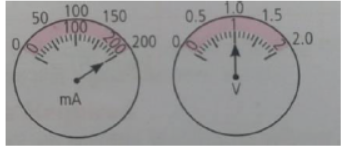
ii) The current flowing through a resistor and the potential difference developed across its end are shown in figures given below. The value of resistance of the resistor is
a) 0.5 ohms
b) 5.0ohms
c) 50 ohms
d) 500 ohms
Answer: b) 5.0ohms
iii) Why it is advised to clean the ends of the connecting wires before connecting them?
Answer: To remove the insulating layer from the ends of wire.
iv) What is zero error?
Answer: If the pointer of the meter does not coincide with the zero of the scale when the circuit is open, this type of error in reading of the scale is called zero error.
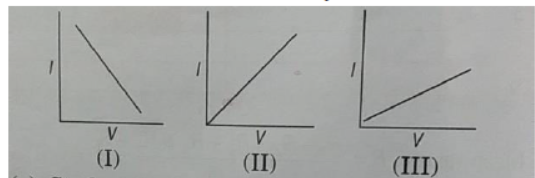
v) In the experiment to study the dependence of current and the potential difference, three students plotted the following graphs between V and I from their observations.
Which observation are likely to be correct –
a) Student (I) only
b) Student (II) only
c) Student (III) only
d) All the three students
Answer: b) Student (II) only
VI) Why it is advised to take out the key from the plug when the observations are not being taken.?
Answer: because heating effect is produced by current which may cause variation in the value of resistance and unnecessary heating of wire is caused.
2) a) Determination of the focal length of a concave mirror by obtaining the image of a distant object.
b) Determination of the focal length of a convex lens by obtaining the image of a distant object.
Questions:
i) The image of the distant object is formed at 30cm from a concave mirror. What is the focal length of the mirror?
a) 15cm
b) 30cm
c) 60cm
d) 10cm
Answer: b) 30cm, as image of a distant object is formed at the principal focus of the mirror, focal length of the mirror is 30cm.
ii) For a spherical mirror, the relation between u, v and f is
a) v – u = f
b) 1/v – 1/u = 1/ f
c) 1/v + 1/u = 1/f
d) v + u = f
Answer: c) mirror formula, ie. 1/v + 1/u = 1/f
iii) You are provided with a convex lens of a focal length 50cm. To obtain a smaller inverted image, the distance of the object from the lens should be
a) 50cm
b) 100cm
c) 20cm
d) 120cm
Answer: d) 120cm for smaller inverted image object has to be beyond 2f
iv) What is the nature the image formed by a thin convex lens for a distant object? What will the change if the lens replaced by a thicker lens?
Answer: The image formed by a thin convex lens for a distant object will be real and inverted. When the lens is thicker then decrease in focal length will be observed.
v) What is meant by focal plane?
Answer: Focal plane is vertical plane perpendicular to the principal axis and passing through focus.
vi) What is meant by optical centre of lens?
Answer: It is the point on principal axis of a lens, such that ray of light passing through it goes undeviated.
vii) On what factor, the ability of a lens to converge the light rays depends?
Answer: On its focal length.
3)Tracing the path of ray of light passing through a rectangular glass slab for different angle of incidence. Measure the angle of incidence, angle of refraction, angle of emergence and interpret the result.
Questions:
i) Mayank while tracing the path of ray of light passing through the glass slab, fixes Two pins vertically on an inclined straight line and looks at the images of these pins from the other side, he should fix two other pins such that:
a) his eye and feet of the pin are in straight line.
b) his eye and head of the pin are in straight line.
c) his eye and middle point of the pin are in straight line.
d) his eye and feet of the pins are in different line.
Answer: a) his eye and feet of the pin are in straight line.
ii) A teacher advises his students that they should take the angle of incidence not more than 60o. He instructs this because for higher angle of incidence, the emergent ray
a) Moves along the same path
b) Tends to graze along the side surface of glass slab
c)Tends to move along the normal
d) none of the above
Answer: b) Tends to graze along the side surface of glass slab
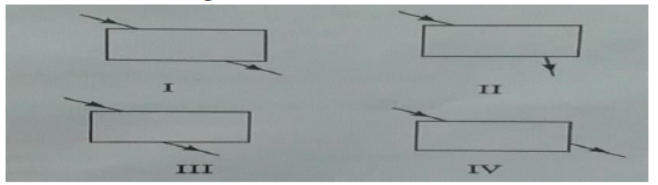
iii) Four students I, II, III, IV have traced the path of ray of light passing through a glass slab. Who traced it correct among them
a) I
b) II
c) III
d) IV
Answer: c) III
iv) On which factors does the refractive index of a medium depend?
Answer: Density of the medium and nature of the medium.
v) In the glass slab experiment which one is greater angle of incidence or angle of refraction?
Answer: When ray of light travels from rarer to denser medium <i > <r but when it travels from denser to rarer medium <i < <r
vi) Why do we measure perpendicular distance?
Answer: Because incidence ray and emergent ray both are parallel to each other.
4)Tracing the path of ray of light through a glass prism.
Questions:
i) If the emergent ray makes an angle of 40o with the second refracting surface of the prism, what is the angle of emergence
a) 40o
b) 50o
c) 60o
d) 30o
Answer: b) 50o , Angle of emergence <e = 90o – 40o =50o
ii) White light splits into seven colours , when it passes through a prism. Choose the correct statement.
a) Blue light deviates more than the green light.
b) Blue light deviates less than the green light.
c) Both deviates equally.
d) Blue light shows the least deviation.
Answer: a) Blue light deviates more than the green light.
iii) What do you mean by the refracting edge of the prism?
Answer: It is the edge where two rectangular refracting faces of the prism meet.
iv) State the relation between angle of incidence < i, angle of emergence <e, angle of deviation <d and angle of prism <A.
Answer: <A + <D = <i + <e
v) Which exciting phenomenon is shown by inclined refracting surfaces of glass prism?
Answer: Refracting surface show the phenomenon of dispersion of light, they split the incident white light into its component.
We hope you liked Physics Practical Class 10 Based Questions provided above. Please let us know if you have any questions
Free study material for Science
CBSE Class 10 Science Worksheets for Practical Based Questions
Mastering Practical Based Questions with Printable Worksheets
Review targeted practice exercises for Class 10 Science Practical Based Questions. Curated to match official CBSE guidelines, these printable problem sets support daily revision and improve overall test readiness.
Verified Solutions and NCERT Alignment
Built using official NCERT guidelines for Class 10 Science, these practice sheets provide reliable academic support. Cross-reference your completed work with our detailed solutions to learn standard answer-writing formats for CBSE exams.
Additional Study Resources for Class 10 Science
Follow up your worksheet practice by attempting the interactive online MCQ tests for Practical Based Questions to evaluate your execution speed. All printable assignments and revision sheets on our platform are updated for the 2026 session and available free of charge.
FAQs
You can download the latest chapter-wise printable worksheets for Class 10 Science Practical Based Questions for free from StudiesToday.com. These have been made as per the latest CBSE curriculum for this academic year.
Yes, Class 10 Science worksheets for Practical Based Questions focus on activity-based learning and also competency-style questions. This helps students to apply theoretical knowledge to practical scenarios.
Yes, we have provided solved worksheets for Class 10 Science Practical Based Questions to help students verify their answers instantly.
Yes, our Class 10 Science test sheets are mobile-friendly PDFs and can be printed by teachers for classroom.
For Practical Based Questions, regular practice with our worksheets will improve question-handling speed and help students understand all technical terms and diagrams.