

Official Class 10 Science Worksheets: Chapter 12 Magnetic Effects of Electric Current
Review targeted academic worksheets with the CBSE Class 10 Science Magnetic Effects of Electric Current Worksheet Set 03. Built according to official educational standards for the 2026-27 term, these downloadable Class 10 Science resources support effective daily practice and detailed self-evaluation for Chapter 12 Magnetic Effects of Electric Current.
Solved Practice Worksheets for Science
View or download the dedicated CBSE Class 10 Science Magnetic Effects of Electric Current Worksheet Set 03 resource below. Engaging with these practice papers under focused study conditions ensures continuous academic progress and mastery of the 2026-27 curriculum for Chapter 12 Magnetic Effects of Electric Current.
MCQ Questions for NCERT Class 10 Science Magnetic Effects Of Electric Current
Question. Consider the following statements and choose the correct are:
(a) A magnet is an object which attracts pieces of iron, Nickel and cobalt
(b) Magnetic effect of electric current means that an electric current flowing in a wire produces a magnetic field around it
(c) The end of a freely suspended magnet which points towards the north direction is called the north pole of the magnet
(d) All of the above
Answer: D
Question. Two wires are placed in parallel; repulsion force and current in these two wires are “f” and “i” respectively. What will be a force if the current is doubled in each wire ?
(a) 2f
(b) f/2
(c) 2f/4
(d) 4f
Answer: D
Question. The magnetic field inside a long straight solenoid-carrying current
(a) is zero.
(b) decreases as we move towards its end.
(c) increases as we move towards its end.
(d) is the same at all points.
Answer: D
Question. Which of the following property of a proton can change while it enters freely in a magnetic field? (There may be more than one correct answer.)
(a) mass
(b) speed
(c) velocity
(d) momentum
Answer : B
Question. The phenomenon of electromagnetic induction is:
(a) The process of charging a body
(b) The process of generating magnetic field due to a current passing through a coil
(c) Producing induced current in a coil to relative motion between a magnet and the coil
(d) The process of rotating a coil of an electric motor
Answer: C
Question. Mutual induction is a process in which current is induced in the neighbouring coil if current flows in a coil. In the figure shown below: 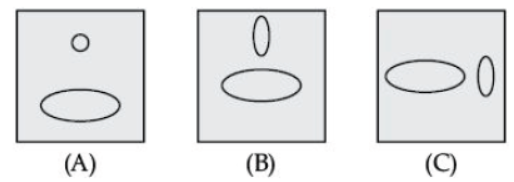
(a) Maximum in situation (A)
(b) Maximum in situation (B)
(c) Maximum in situation (C)
(d) Same in all situation
Answer: A
Question. A charged particle enters at right angle into a uniform field as shown. What should be the nature of charge on the particle if it begins to move in a direction pointing vertically out of the page due to its interaction with the magnetic field?
(a) Positive
(b) Negative
(c) Natural
(d) Can't decide
Answer: A
Question. For the current in a long straight solenoid N- and S-poles are created at the two ends. Among the following statements, the incorrect statement is
(a) The field lines inside the solenoid are in the form of straight lines which indicates that the magnetic field is the same at all points inside the solenoid
(b) The strong magnetic field produced inside the solenoid can be used to magnetise a piece of magnetic material like soft iron core, when placed inside the coil
(c) The pattern of magnetic field associated with the solenoid is different from the pattern of the magnetic field around a bar magnet
(d) The N- and S-poles exchange positions when the direction of current through the solenoid is reversed
Answer : C
Question. A current flows in a wire, running between the S and N poles of a magnet lying horizontally as shown in the figure below: 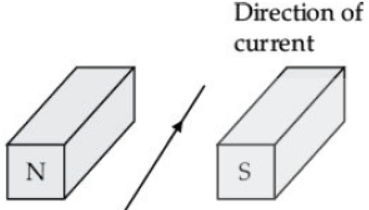
The force on the wire due the magnet is directed.
(a) From N to S
(b) From S to N
(c) Vertically downwards
(d) Vertically upwards
Answer: C
Question. A student learns that magnetic field strength around a bar magnet is different at every point which diagram shows the correct magnetic field lines around a bar magnet? 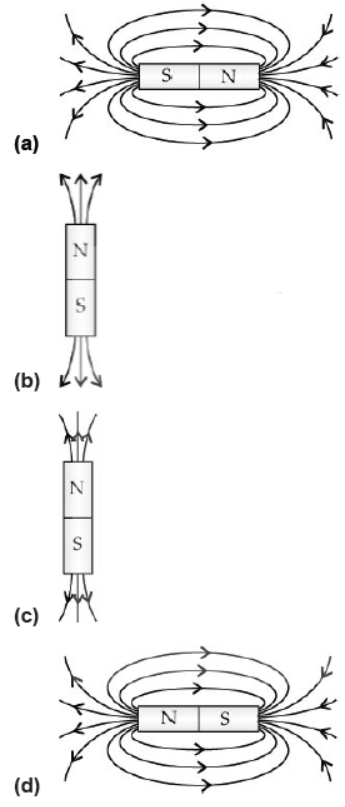
Answer: D
Question. Which of the following is not true?
(a) Induction proceeds attractions
(b) We cannot isolate a single pole
(c) We can magnetic an iron ring
(d) A permanent magnet retains its magnetism even when heated on a flame
Answer: D
Question. A finite straight wire carries a current of 3 A, where it is a 2 m long and weighs around 240 g. If it is suspended in the mid-air by a uniform magnetic field then calculate the field B. [Acceleration due to gravity = 9.8 m/s2]
(a) 0.39 T
(b) 0.42 T
(c) 0.61 T
(d) 0.37 T
Answer: A
Question. Which of the following correctly describes the magnetic field near a long straight wire?
(a) The field consists of straight lines perpendicular to the wire
(b) The field consists of straight lines parallel to the wire
(c) The field consists of radial lines originating from the wire
(d) The field consists of concentric circles centred on the wire
Answer: D
Question. The phenomenon of electromagnetic induction is
(a) the process of charging a body
(b) the process of generating magnetic field due to a current passing through a coil
(c) producing induced current in a coil due to relative motion between a magnet and the coil
(d) the process of rotating a coil of an electric motor
Answer: C
Question. The device used for producing electric current is called a
(a) generator
(b) galvanometer
(c) ammeter
(d) motor
Answer: A
Question. The essential difference between an AC generator and a DC generator is that
(a) AC generator has an electromagnet while a DC generator has permanent magnet.
(b) DC generator will generate a higher voltage.
(c) AC generator will generate a higher voltage.
(d) AC generator has slip rings while the DC generator has a commutator.
Answer: D
Question. At the time of short circuit, the current in the circuit
(a) reduces substantially
(b) does not change
(c) increases heavily
(d) vary continuously
Answer: C
Question. The process of inducing a current in a coil of wire by placing it ina region of changing magnetic field is:
(a) Electrical effect
(b) Heating effect of current
(c) Magnetic effect of current
(d) Electromagnetic induction
Answer: D
(a) Current only
(b) Distance of the point from the wire only
(c) Current, length and distance of the wire
(d) Length of the wire only
State whether the following statements are true or false.
(a) An electric motor converts mechanical energy into electrical energy.
Answer: False An electric motor converts electrical energy into mechanical energy.
(b) An electric generator works on the principle of electromagnetic induction.
Answer: True
(c) The field at the centre of a long circular coil carrying current will be parallel straight lines.
Answer: True
(d) A wire with a green insulation is usually the live wire of an electric supply.
Answer: False Live wire has red insulation cover, whereas earth wire has green insulation colour in the domestic circuits.
Assertion and Reasoning Based Questions :
Question. Assertion: A current carrying rod is suspended between Ushaped magnet, the rod deflects.
Reason: A force is exerted on the rod due to magnetic field.
(a) If both assertion and reason are true and reason is the correct explanation of assertion.
(b) If both assertion and reason are true, but reason is not the correct explanation of assertion.
(c) If assertion is true, but reason is false.
(d) If assertion is false, but reason is true.
Answer: A
Question. Assertion: Electric Motor converts electric energy into mechanical energy.
Reason: Electric Motor is based on the principle of Fleming's right hand rule.
(a) If both assertion and reason are true and reason is the correct explanation of assertion.
(b) If both assertion and reason are true, but reason is not the correct explanation of assertion.
(c) If assertion is true, but reason is false.
(d) If assertion is false, but reason is true.
Answer: C
Question. Assertion: Galvanometer is used to measure polarity.
Reason: Galvanometer is an instrument which is used to detect current in any circuit.
(a) If both assertion and reason are true and reason is the correct explanation of assertion.
(b) If both assertion and reason are true, but reason is not the correct explanation of assertion.
(c) If assertion is true, but reason is false.
(d) If assertion is false, but reason is true.
Answer: B
Question. Assertion: Current can be induced in a coil by changing the magnetic field around it.
Reason: A Galvanometer connected to a coil can deflect either to the left or right of the zero mark.
(a) If both assertion and reason are true and reason is the correct explanation of assertion.
(b) If both assertion and reason are true, but reason is not the correct explanation of assertion.
(c) If assertion is true, but reason is false.
(d) If assertion is false, but reason is true.
Answer: B
Question. Assertion: Iron filings are kept near a magnet it gets arranged in a particular fashion.
Reason: Magnetic field is a scalar quantity.
(a) If both assertion and reason are true and reason is the correct explanation of assertion.
(b) If both assertion and reason are true, but reason is not the correct explanation of assertion.
(c) If assertion is true, but reason is false.
(d) If assertion is false, but reason is true.
Answer: C
Question. A positively-charged particle (alpha-particle) projected towards west is deflected towards north by a magnetic field. The direction of magnetic field is
(a) towards south
(b) towards east
(c) downward
(d) upward
Answer: D
Question. Assertion: A compass is kept near a wire carrying current gets deflected.
Reason: Electric current is capable of producing a magnetic effect.
(a) If both assertion and reason are true and reason is the correct explanation of assertion.
(b) If both assertion and reason are true, but reason is not the correct explanation of assertion.
(c) If assertion is true, but reason is false.
(d) If assertion is false, but reason is true.
Answer: A
Question : A rectangular coil of copper wires is rotated in a magnetic field. The direction of the induced current changes once in each
(a) two revolutions
(b) one revolution
(c) half revolution
(d) one-fourth revolution
Answer : C
Question. Assertion: Deflection of the iron filings changes when current in the conductor varies.
Reason: Magnitude of the magnetic field does not change with the magnitude of current.
(a) If both assertion and reason are true and reason is the correct explanation of assertion.
(b) If both assertion and reason are true, but reason is not the correct explanation of assertion.
(c) If assertion is true, but reason is false.
(d) If assertion is false, but reason is true.
Answer: C
Free study material for Science
Chapter 12 Magnetic Effects of Electric Current Printable Worksheets and Exercises for Class 10 Science
Practice Exercises for Class 10 Science Chapter 12 Magnetic Effects of Electric Current
Review targeted practice exercises for Class 10 Science Chapter 12 Magnetic Effects of Electric Current. Curated to match official CBSE guidelines, these printable problem sets support daily revision and improve overall test readiness.
Step-by-Step Solutions and Practice Guidelines
Each worksheet draws directly from authorized standard textbooks to maintain academic accuracy. Evaluating your finished exercises against expert-verified solutions helps master the formal presentation standards expected in school evaluations.
Enhance Speed with Online Practice
Wrap up your chapter revision by testing your knowledge against standard objective question formats. Explore our full library of free, up-to-date printable assignments to maximize your academic results in upcoming CBSE evaluations.
FAQs
You can download the latest chapter-wise printable worksheets for Class 10 Science Chapter 12 Magnetic Effects of Electric Current for free from StudiesToday.com. These have been made as per the latest CBSE curriculum for this academic year.
Yes, Class 10 Science worksheets for Chapter 12 Magnetic Effects of Electric Current focus on activity-based learning and also competency-style questions. This helps students to apply theoretical knowledge to practical scenarios.
Yes, we have provided solved worksheets for Class 10 Science Chapter 12 Magnetic Effects of Electric Current to help students verify their answers instantly.
Yes, our Class 10 Science test sheets are mobile-friendly PDFs and can be printed by teachers for classroom.
For Chapter 12 Magnetic Effects of Electric Current, regular practice with our worksheets will improve question-handling speed and help students understand all technical terms and diagrams.