

Official Class 10 Science Worksheets: All Chapters
Access comprehensive chapter-wise worksheets for All Chapters using the CBSE Class 10 Science Physics Worksheet Set 01. Designed to align with the 2026-27 academic syllabus for Class 10 Science, these printable practice sets help students reinforce key concepts and improve their overall exam readiness.
Solved Practice Worksheets for Science
Navigate directly to the solved Science worksheets using the digital viewer below. Each practice set includes detailed step-by-step solutions, allowing students to instantly cross-check their work and identify areas requiring further revision.
ELECTRICITY
QUESTIONS BASED ON COMBINATION OF REGISTORS :-
Question. Solve for the equivalent resistance across the voltage V in the electrical circuit below:
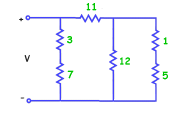
Solution.First we will total the two series resistors on the right (1 + 5 = 6) and on the left (3 + 7 = 10). Now we have reduced the circuit.
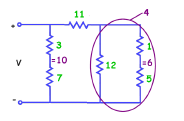
We see on the right that the total resistance 6 and the resistor 12 are now in parallel. We can solve for these parallel resistors to get the equivalent resistance of 4.
1/R = 1/6 + 1/12
1/R = 2/12 + 1/12
1/R = 3/12 = ¼
R = 4
The new circuit diagram is shown below.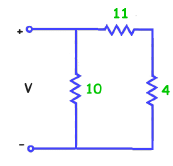
From this circuit we solve for the series resistors 4 and 11 to get 4 + 11 = 15.
Now we have two parallel resistors, 15 and 10.
1/R = 1/15 + 1/10
1/R = 2/30 + 3/30
1/R = 5/30 = 1/6
R = 6
The equivalent resistance across V is 6 ohms.
Question. Using the circuit diagram below, solve for the value of the missing resistance R.
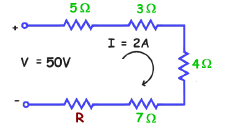
Solution. First we'll figure out the equivalent resistance of the entire circuit.
From Ohm's law we know that Resistance = Voltage/current, therefore
Resistance = 50volts/2amps
Resistance = 25 We can also figure out the resistance by adding up the resistors in series:
Resistance = 5 + 3 + 4 + 7 + R
Resistance = 19 + R
Now we plug in 25 for resistance and we get
25 = 19 + R
R = 6 ohms
Question. Draw a schematic diagram of a circuit consisting of a battery of three cells of 2 V each, a 5 Ω resistor, an 8 Ω resistor, and a 12 Ω resistor, and a plug key, all connected in series.
Solution. A battery of three cells of 2 V each equals to battery of potential 6 V.The circuit diagram below shows three resistors of resistance 12 Ω, 8 Ω and 5 Ω connected in series along with a battery of potential 6 V.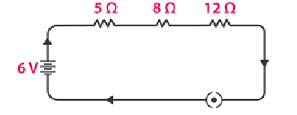
Question. Redraw the circuit of Question 1, putting in an ammeter to measure the current through the resistors and a voltmeter to measure the potential difference across the 12 Ω resistor. What would be the readings in the ammeter and the voltmeter
Solution. An ammeter should always be connected in series with resistors while the voltmeter should be connected in parallel to the resistor to measure the potential difference as shown in the figure below.
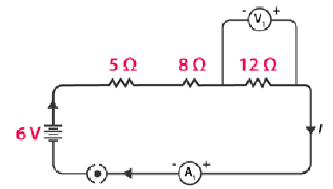
Using Ohm’s Law, we can obtain the reading of the ammeter and the voltmeter.
The total resistance of the circuit is 5 Ω + 8 Ω +12 Ω = 25 Ω.
We know that the potential difference of the circuit is 6 V, hence the current flowing through the circuit or the resistors can be calculated as follows:
I = V/R = 6/25 = 0.24A
Let the potential difference across the 12 Ω resistor be V1. From the obtained current V1 can be calculated as follows:
V1 = 0.24A × 12 Ω = 2.88 V
Therefore, the ammeter reading will be 0.24 A and the voltmeter reading be 2.88 V.
Question. Judge the equivalent resistance when the following are connected in parallel – (a) 1 Ω and 106 Ω, (b) 1 Ω, 103 Ω, and 106Ω.
Solution.
(a) When 1 Ω and 106 are connected in parallel, the equivalent resistance is given by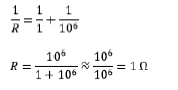
Therefore, the equivalent resistance is 1 Ω.
(b) When 1 Ω, 103 Ω, and 106 Ω are connected in parallel, the equivalent resistance is given by
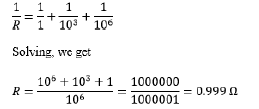
Therefore, the equivalent resistance is 0.999 Ω.
Question. An electric lamp of 100 Ω, a toaster of resistance 50 Ω, and a water filter of resistance 500 Ω are connected in parallel to a 220 V source. What is the resistance of an electric iron connected to the same source that takes as much current as all three appliances, and what is the current through it?
Solution. The electric lamp, the toaster and the water filter connected in parallel to a 220 V source can be shown as using a circuit diagram as follows:
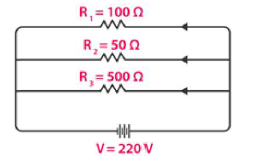
The equivalent resistance of the resistors can be calculated as follows: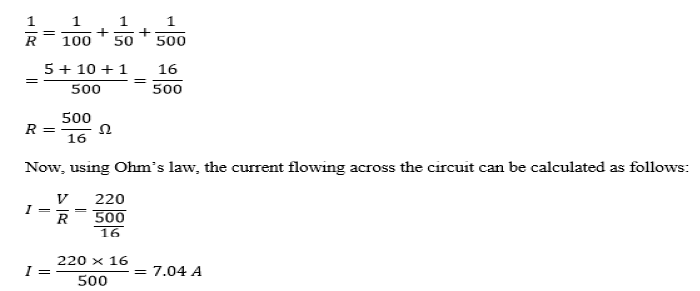
The resistance of the electric iron box is 31.25 Ω.
Question. What are the advantages of connecting electrical devices in parallel with the battery instead of connecting them in series?
Solution. When the electrical devices are connected in parallel there is no division of voltage among the appliances. The potential difference across the devices is equal to supply voltage. Parallel connection of devices also reduces the effective resistance of the circuit.
Question. How can three resistors of resistances 2 Ω, 3 Ω, and 6 Ω be connected to give a total resistance of (a) 4 Ω, (b) 1 Ω?
Solution. (a) The circuit diagram below shows the connection of three resistors
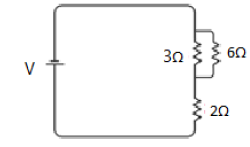
From the circuit above, it is understood that 3 Ω and 6 Ω are connected in parallel. Hence, their equivalent resistance is given by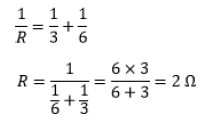
The equivalent resistor 2 Ω is in series with the 2 Ω resistor. Now the equivalent resistance can be calculated as follows:
Req= 2 Ω +2 Ω = 4 Ω
Hence, the total resistance of the circuit is 4 Ω.
(b) The circuit diagram below, shows the connection of three resistors.
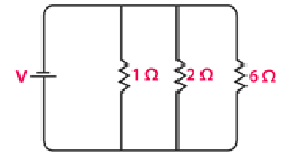
From the circuit, it is understood that all the resistors are connected in parallel.
Therefore, their equivalent resistance can be calculated as follows: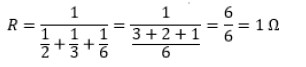
The total resistance of the circuit is 1 Ω.
Question. What is (a) the highest, (b) the lowest total resistance that can be secured by combinations of four coils of resistance 4 Ω, 8 Ω, 12 Ω, 24 Ω?
Solution.
(a) If the four resistors are connected in series, their total resistance will be the sum of their individual resistances and it will be the highest. The total equivalent resistance of the resistors connected in series will be 4 Ω + 8 Ω + 12 Ω + 24 Ω = 48 Ω.
(b) If the resistors are connected in parallel, then their equivalent resistances will be the lowest. Their equivalent resistance connected in parallel is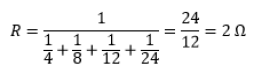
Hence, the lowest total resistance is 2 Ω
Question.What is Ohm’s law simplified?
Solution. Ohm’s law states that the current passing through a conductor is proportional to the voltage over the resistance..
Question. Do all metals obey Ohm’s law?
Solution. When the temperature of a metal increases, resistance decreases. Good conductors possess non-zero electrical resistances.
Question. Why is Ohm’s law important?
Solution. Ohm’s law formula is used to calculate electrical values so that we can design circuits and use electricity in a useful manner.
Question. If the resistance of an electric iron is 50Ω and 3.2A Current flows through the resistance. Find the voltage between two points.
Solution. If the value of Resistance is asked and the values of the current and voltage are given, then to calculate resistance simply cover the R.
Now, we are left with the V at the top and I to the bottom left or V ÷ I.
Given, Resistance (R) = 50Ω
Current (I) = 3.2A
Therefore,
Voltage (V) = I X R = 3.2A x 50 Ω =160V
Question. An EMF source of 8.0 V is connected to a purely resistive electrical appliance (a light bulb). An electric current of 2.0 A flows through it. Consider the conducting wires to be resistance-free. Calculate the resistance offered by the electrical appliance.
Solution. If the value of current is asked and the values of the resistance and voltage are given, then to calculate current simply cover the I. We are left with Voltage over Resistance or V ÷ R. So the equation for Current is Voltage divided by Resistance. Given,
Voltage (V) = 8.0 V Current (I) = 2.0 A
Therefore,
Resistance (R) = V ÷ I = =8/2 = 4ohm .
Question. If the filament resistance of an electric bulb is 330 Ω and Potential difference of two points 110V. Find the current flowing through the filament.
Solution. Given,
Resistance (R) = 330 Ω Voltage (V) = 110V
Therefore,
Current (I) = V ÷ R I = VR = 110330=0.3A
Free study material for Science
CBSE Class 10 Science Worksheets for All Chapters
Daily Practice Questions for Class 10 Science
Access structured practice worksheets for All Chapters aligned with the 2026 CBSE curriculum. These downloadable exercises for Class 10 Science help students build accuracy and reinforce core concepts for upcoming school tests.
Detailed Answers for Class 10 Science All Chapters
Built using official NCERT guidelines for Class 10 Science, these practice sheets provide reliable academic support. Cross-reference your completed work with our detailed solutions to learn standard answer-writing formats for CBSE exams.
Complete Your Chapter Revision
Follow up your worksheet practice by attempting the interactive online MCQ tests for All Chapters to evaluate your execution speed. All printable assignments and revision sheets on our platform are updated for the 2026 session and available free of charge.
FAQs
You can download the latest chapter-wise printable worksheets for Class 10 Science All Chapters for free from StudiesToday.com. These have been made as per the latest CBSE curriculum for this academic year.
Yes, Class 10 Science worksheets for All Chapters focus on activity-based learning and also competency-style questions. This helps students to apply theoretical knowledge to practical scenarios.
Yes, we have provided solved worksheets for Class 10 Science All Chapters to help students verify their answers instantly.
Yes, our Class 10 Science test sheets are mobile-friendly PDFs and can be printed by teachers for classroom.
For All Chapters, regular practice with our worksheets will improve question-handling speed and help students understand all technical terms and diagrams.