

Science Objective Questions and Answers: Force and Motion
Access targeted multiple-choice questions for Force and Motion designed to align with the latest CBSE academic syllabus for Class 3 Science. These objective practice sets help students evaluate their conceptual understanding and improve exam readiness.
Download Force and Motion MCQs with Answers
Navigate directly to the 50 objective questions for Force and Motion using the digital viewer below. Each practice set includes verified answer keys, allowing students to instantly cross-check their work and identify areas requiring further revision.
Question. A train going along the tracks at steady speed is an example of __________.
(a) force
(b) uniform motion
(c) non-uniform motion
(d) circular motion
Answer: B
Explanation: A train going along the tracks at steady speed is an example of uniform motion.
Question. When muscles are used to move a thing, __________ force is used.
(a) muscular
(b) frictional
(c) gravitational
(d) none of these
Answer: A
Explanation: Muscular force is used to move a thing.
Question. Ritika tied four rubber bands of different thickness on four identical boxes at identical positions. Which of these set ups will produce the loudest sound on striking the rubber band with the finger? 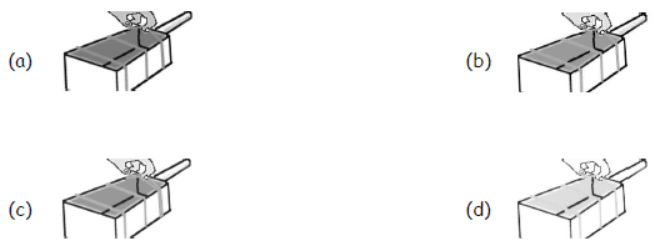
Answer: B
Explanation: Rubber band of minimum thickness will make loudest sound as it will strike more compare to thicker bands.
Question. A body moving in circular motion will travel in ________ path.
(a) straight
(b) zigzag
(c) circular
(d) triangular
Answer: C
Question. Taking a round on the many-go-round, Shruti felt drowsy. What would you do to make her feel comfortable?
(a) Ask her to take one more ride.
(b) Take her to the school.
(c) Give her some water and ask her to take rest.
(d) Take her to the zoo.
Answer: C
Explanation: Give some water to Shruti and ask her to take rest.
Question. Motion of wheel of a bicycle is_______________ .
(a) circular motion
(b) periodic Motion
(c) linear motion
(d) non-linear motion
Answer: A
Explanation: Motion of wheel of a bicycle is circular motion.
Question. Sir Isaac Newton is a famous __________.
(a) scientist
(b) traveler
(c) cook
(d) philosopher
Answer: A
Explanation: Sir Isaac Newton is a famous scientist.
Question. When any car takes a turn on a highway, then the motion experienced is _________.
(a) Uniform Motion
(b) Linear motion
(c) Circular Motion
(d) Non-uniform motion
Answer: C
Explanation: When any car takes a turn on a highway, it is experiencing a circular motion.
Question. The movement shown by a rotating fan is _______.
(a) linear motion
(b) uniform motion
(c) circular motion
(d) periodic motion
Answer: C
Question. Which of these is true for uniform motion?
(a) A body in uniform motion covers equal distance in equal interval of time.
(b) A force is required to set a body in uniform motion.
(c) All of these
(d) None of these
Answer: C
Explanation: Both the statements are true.
Question. Find the odd one out.
(a) Throwing a softball
(b) A racing horse
(c) Swing
(d) A space craft drifting between two galaxies
Answer: D
Explanation: All other options are examples of non-uniform motion.
Question. Who discovered the relationship between force and motion and gave the three laws of motion?
(a) Mahatma Gandhi
(b) Sir Graham Bell
(c) Sachin Tendulkar
(d) Sir Isaac Newton
Answer: D
Explanation: Sir Isaac Newton gave the three laws of motion after studying the relationship between force and motion.
Question. A car moving on such a road, would be in __________. 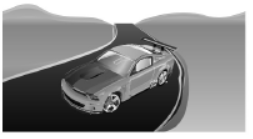
(a) circular motion
(b) linear motion
(c) non-Linear motion
(d) non-uniform motion
Answer: A
Explanation: The road is curvy so the car moving on such a road would be in circular motion.
Question. When you pull a toy car, you need to apply :
(a) Work
(b) Force
(c) Light
(d) Sound
Answer: B
Question. The figure shows which type of motion?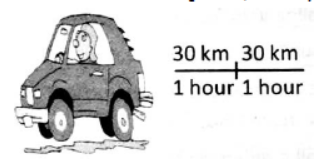
(a) Uniform motion
(b) Non-uniform motion
(c) Circular motion
(d) None of these
Answer: A
Explanation: Since equal distance is travelled in equal time it is a uniform motion.
Question. Roy wants to make a list of actions that show friction produces heat. Which of the following could he include in his list?
(a) Rubbing hands together
(b) Scratching a match stick against the box
(c) Sawing wood
(d) Drilling a hole into metal sheet
(e) Rubbing off some pencil marks with an eraser
(a) (a) and (e) only
(b) (a), (b) and (e) only
(c) (a), (b), (c) and (e) only
(d) (a), (b), (c), (d) and (e)
Answer: D
Explanation: As all these actions involve two surfaces rubbing against each other, thus force of friction comes into action which produces heat.
Question. Identify the wrong statement.
(a) Horse riding is an example of non-uniform motion.
(b) There are four types of motion.
(c) When force is applied, the object moves.
(d) Merry go round is an example of circular motion.
Answer: B
Explanation: There are three types of motion viz. uniform motion, non-uniform motion and circular motion.
Question. Match the following.
| List I | List II |
| A. Sir Isaac Newton | 1. Motion |
| B. Types of Motion | 2. Gravity |
| C. Change of position | 3. Three |
| D. Object falling down | 4. Scientist |
A B C D
(a) 4 3 1 2
(b) 1 2 3 4
(c) 2 4 3 1
(d) 4 3 2 1
Answer: A
Directions : Read the passage given below and answer the questions that follow.
Gravity causes the tides of the oceans– Because it is made of matter, the moon also has a gravitational pull, but it is not strong enough to move Earth. However, it is strong enough to move the oceans. Whenever the water on the beach recedes and comes back with the ebb and flow of the tide, the ocean is reacting to the pull of the moon’s gravity.
Question. Moon has gravity because ____________.
(a) it borrows gravity from sun
(b) moon is made up of matter
(c) it borrows gravity from earth
(d) none of the above
Answer: B
Question. Mark the statement based on true or false.
(i) Moon’s gravity is strong enough to pull earth.
(ii) Moon’s gravity is strong enough to move ocean.
(a) F T
(b) T F
(c) F F
(d) T T
Answer: A
Question. A car is moving in uniform motion. It covers 50 kms in one hour. How much time will it take to travel another 50 kms?
(a) 60 minutes
(b) 50 minutes
(c) 90 minutes
(d) 2 hrs
Answer: A
Question. There are _____ types of motion.
(a) 1
(b) 3
(c) 4
(d) 5
Answer: B
Explanation: There are three types of motion viz. Uniform motion, non-uniform motion and circular motion.
Question. The given grap shows Raju’s pulse rate. Which of the following is the most probable condition during which pulse rate was recorded? 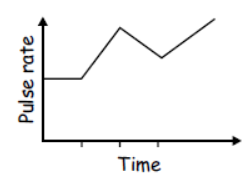
(a) Raju ran for 10 minutes, rested for 10 minutes and ran again
(b) Raju did warm up exercise for 10 minutes, rested for 20 minutes and ran again
(c) Raju slept for 1 hour, walked for 1 hour and slept again
(d) Raju walked for 1 hour, rested for half an hour and walked again
Answer: B
Explanation: From the given graph, it is clear that initially for sometime, Raju’s pulse rate was constant but thereafter it increased for sometime and then decreased. Time during which the pulse rate decreased is more than the time during which pulse rate increased. Finally his pulse rate increased again. This can be explained as follows.
In the beginning Raju was resting so his pulse rate was constant but when he started warm up exercise his pulse rate increased. His pulse rate dropped when he rested after warm up exercise and finally when he started running, his pulse rate again increased.
Question. Movement in a circular path is an example of:
(a) Rotatory motion
(b) Translatary force
(c) Rotational motion
(d) None of these
Answer: C
Question. A paint is marked on the blade of a ceiling fan. The ceiling fan is then switched ON. 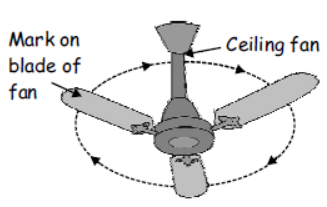
What type of motion is described by the point marked on the blade?
(a) Linear motion
(b) Periodic motion
(c) Circular motion
(d) None of these
Answer: C
Explanation: A ceiling fan remains at one place but its blade rotate round and round. If we mark a point on one of the blades of the fan and switch on the fan, then the point marked on the blade of rotating fan undergoes circular motion.
Question. From the following options choose which one is a pull action?
(a) Pushing a swing
(b) Working with a lawn
(c) Taking out a carrot from ground
(d) Pushing a pram
Answer: C
Question. A body is said to be in motion, if it changes its position. What is “position”?
(a) A certain location
(b) A force
(c) A motion
(d) None of these
Answer: A
Explanation: Position is referred to as certain location.
Question. A car is travelling with uniform motion. In the first hour it travels 50 km. How much distance it will travel in next one hour?
(a) 30 km
(b) 40 km
(c) 50 km
(d) 60 km
(e) None of these
Answer: C
Question. Match the following columns.
Column I Column II
A. Circular motion 1. March past of soldiers
B. Periodic motion 2. Movement of moon around the earth
C. Uniform motion 3. Car moving on a bumby road
D. Non-uniform motion 4. Pendulum clock
A B C D
(a) 3 2 1 4
(b) 1 3 2 4
(c) 2 4 1 3
(d) 4 2 1 3
Answer: C
Explanation: A. Circular motion 2. Movement of moon around the earth
B. Periodic motion 4. Pendulum clock
C. Uniform motion 1. March past of soldiers
D. Non-uniform motion 3. Car moving on a bumby road
Question. Find the odd one out.
(a) Swimming
(b) Playing
(c) Running
(d) Sleeping
Answer: D
Explanation: When a body is sleeping it is not in motion.
Question. Lata is going on a road trip with her family. The destination is 40 km away. The driver takes 1hour to cover 20 km and further 1 hour to cover another 20 km. In which motion is the driver driving the car?
(a) Uniform
(b) Non-Uniform
(c) Circular
(d) None of these
Answer: A
Explanation: Since the driver is taking equal interval of time to cover equal distance i.e. 1 hour each to cover 20 km, he is driving the car in a uniform motion.
Question. A moving body slows down or stops on its own due to __________ force.
(a) gravitational
(b) elastic
(c) mechanical
(d) frictional
Answer: D
Explanation: Frictional force is responsible to stop on slow down a moving object.
Question. Match the following.
| List I | List II |
| A. Uniform motion | 1. Merry-go-round |
| B. Non-Uniform Motion | 2. Push or pull |
| C. Circular Motion | 3. Car moving on a bumpy road |
| D. Force | 4. Car running with 50 km/hr. |
A B C D
(a) 4 3 1 2
(b) 2 4 3 1
(c) 1 2 3 4
(d) 4 1 2 3
Answer: A
Question. Which of the following statements are correct?
1. A force can change the direction of a moving object.
2. Echoes can be used to find the depth of the sea.
3. Sound travels faster than light.
4. Gravity is a force that pushes everything away from the Earth.
(a) 1 and 4 only
(b) 2 and 3 only
(c) 1 and 2 only
(d) 3 and 4 only
Answer: C
Explanation: Light travels faster than sound and gravity is the force by which the Earth pulls objects towards itself.
Question. Select the activity which requires a force different from the other three activities.
(a) Spinning a coin
(b) Turning the door knob
(c) Fitting a screw into the board
(d) Pumping air into a football
Answer: D
Explanation: Pumping air into a football does not involve rotational movement of hand as involved in other activities.
Question. When a body covers unequal distance in equal interval of times or vice- versa, then the body is said to describe____________.
(a) uniform motion
(b) non-uniform motion
(c) gravitational force
(d) circular motion
Answer: B
Explanation: When a body covers unequal distance in equal interval of times or vice- versa, then the body is said to describe non-uniform motion.
Question. There is no _________ in space.
(a) force
(b) gravity
(c) playground
(d) motion
Answer: B
Question. What can be the reason that a taxi driver has to be more careful when driving on a rainy day than driving on a hot summer day?
(a) Gravitational force between taxi and road is higher on a hot summer day.
(b) Frictional force between taxi and road is lower on a rainy day.
(c) Gravitational force between taxi and road is lower on a rainy day.
(d) Frictional force between taxi and road is lower on a hot summer day.
Answer: B
Question. How can you tell if an object is in motion?
(a) The object will look different.
(b) I’ll be able to see the forces.
(c) It will remain in the same position.
(d) It’s position will change in relation to other objects
Answer: D
Explanation: An object is said to be in motion if its position changes in relation to other objects.
Question. Movement of moon around the Earth is an example of _________. 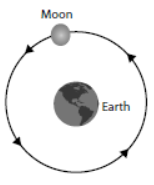
(a) Uniform Motion
(b) Non-Uniform Motion
(c) Uniform circular motion
(d) Non-uniform circular motion.
Answer: C
Explanation: The movement of moon around Earth is an example of uniform circular motion.
Question. Choose the correct options.
How can you say that an object is in motion?
(a) If it does not change its position with respect to time
(b) If it changes its position with respect to time
(c) The object changes its shape
(d) Some force is exerted on the object
Answer: B
Explanation: If it changes its position with respect to time then the object is in motion.
Other options are not correct.
When the object changes its shape, it is not called as motion. Change of shape is not a motion. Similarly, when some force is exerted on the object, then it is not a motion. In this action, it is not mentioned whether the objec t moves or not.
Question. Ajay went to a Diwali fair in his locality and took a ride on a merry-go-round. What motion did Ajay experience while having a ride?
(a) Uniform motion
(b) Non-uniform motion
(c) Circular motion
(d) None of these
Answer: C
Explanation: On a merry-go-round, Ajay experienced a circular motion.
Question. When _______ is applied, a body sets in motion.
(a) force
(b) mass
(c) matter
(d) speed
Answer: A
Explanation: When force is applied, a body sets in motion.
Question. Rohan is going on a road trip with his family. The destination is 50 km from their house. Rohan noticed that the driver took 1 h for the first 30 km and the next 20 km in another 1 h. In which motion is the driver driving the car?
(a) Uniform
(b) Non-uniform
(c) Circular
(d) None of these
Answer: B
Explanation: The driver covered unequal distances in equal interval of time, so its motion is non-uniform.
Question. Which of these is not true for motion?
(a) It is a state of change.
(b) A force is required to set a body in motion.
(c) There are 3 types of motion
(d) None of these
Answer: D
Explanation: All the statements are true regarding motion.
Question. A body is said to be in uniform motion if it covers ___________distance in _________intervals of time.
(a) equal, equal
(b) unequal, unequal
(c) equal, unequal
(d) unequal, equal
Answer: A
Explanation: A body is said to be in uniform motion if it covers equal distance in equal interval of time.
Question. Which of the following actions do NOT require a twisting force?
(a) Spinning a coin
(b) Pulling the rope in the tug of war
(c) Turning the water tap on
(d) Opening a water bottle
Answer: B
Explanation: Pulling the rope in the tug of war requires a pulling force, not a twisting force.
Question. An object will not change its location, until and unless you apply ____________
(a) motion
(b) force
(c) gravity
(d) all of these
Answer: B
Explanation: An object will not change its location, until and unless you apply force.
Question. __________ force pulls things towards the centre of the Earth.
(a) Frictional force
(b) Gravitational force
(c) Muscular force
(d) None of these
Answer: B
Explanation: Gravitational force pulls things towards the centre of the Earth.
Question. Which of these shows circular motion? 
(a) Planets moving around sun
(b) Car on a straight road
(c) Bullock cart moving on bumpy road.
(d) Boy swimming.
Answer: A
Explanation: Planets moving around the sun is an example of uniform circular motion.
Question. Which type of motion is possessed by the soldiers in a parade? 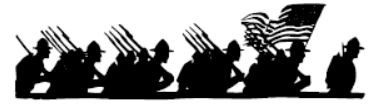
(a) Periodic motion
(b) Linear motion
(c) Circular motion
(d) None of these
Answer: B
Explanation: The march past of soldiers in a parade is a linear motion. Linear motion takes place in a fixed direction.
Question. Sanya applies some oil on the hinges of a door. What force is she trying to reduce by adding the oil on the hinges?
(a) Friction
(b) Gravity
(c) Magnetic force
(d) Elastic force
Answer: A
Explanation: By applying oil on the hinges of a door, Sanya tries to reduce the frictional force.
Frictional force develops when two surfaces rub (move) against each other. This force tends to stop or slow down the motion of object.
Question. The object falls down on the ground due to _________.
(a) magnets
(b) it is supposed to come down
(c) free-fall
(d) gravitational force
Answer: D
Explanation: The object falls on the ground because of gravitational force or gravity.
Question. Study the given flow chart and select the correct option regarding forces X, Y and Z. 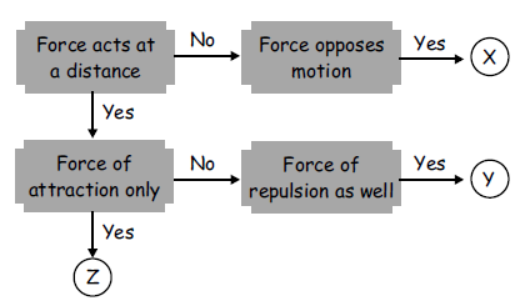
(a) Force ‘Y’ is caused by the pulling and pushing actions of magnets
(b) Force ‘Z’ causes objects to move slowly
(c) Force ‘X’ is lesser on smoother surface
(d) Both (a) and (c)
Answer: D
Explanation: Force X → Frictional force
Force Y → Magnetic force
Force Z → Force of gravity
Gravity causes objects to drop fast vertically but slows down upward movements.
It has no effect on horizontal movement.
Directions : Read the passage and fill up the blanks by choosing the correct option given below.
You must have seen a cricket match. The bowler uses —(44)— to bowl. The batsman uses force to —(45)— the ball. The fielder uses force to —(46)— it. These are three ways in which the cricketers use force. Force can be used to —(47)— or —(48)— something.
Question.
(a) kick
(b) hit
(c) stop
(d) none of these
Answer: C
Explanation: The fielders job is to stop the ball with force.
Question.
(a) push
(b) energise
(c) accelerate
(d) none of these
Answer: A
Explanation: Force can be used to push something.
Question.
(a) pull
(b) copy
(c) both
(a) & (b)
(d) none of these
Answer: A
Explanation: Force can be used to pull something.
Question.
(a) pressure
(b) energy
(c) force
(d) none of these
Answer: C
Explanation: The bowler uses force to bowl.
Question.
(a) pick
(b) hit
(c) catch
(d) none of these
Answer: B
Explanation: The batsman hits the ball with force.
Question. In science, push or pull is called a _________.
(a) force
(b) acceleration
(c) motion
(d) inertia
Answer: A
Explanation: In science, the push or pull is called force.
Question. A girl is sitting on a merry go round. What type of motion is she having? 
(a) Linear motion
(b) Periodic motion
(c) Circular motion
(d) Uniform motion
Answer: C
Explanation: A girl sitting on a merry go round exhibits circular motion.
Force and Motion Objective Questions & Solutions for Class 3 Science
Chapter MCQs with Answers for Class 3 Science
Test your conceptual understanding of Force and Motion with these targeted multiple-choice questions. Designed in alignment with the latest CBSE curriculum for Class 3 Science, these problem sets build accuracy and prepare students for objective exams.
Expert Practice Material for Class 3 Science
Built using the official NCERT book for Class 3, these Science objective sets provide reliable academic guidance. Pair your practice with our recommended NCERT solutions to master optimal problem-solving approaches.
Complete Your Chapter Revision
Follow up your worksheet practice by attempting the interactive online Science MCQ test for this chapter to evaluate your execution speed. All platform resources are free to access.
FAQs
You can get most exhaustive CBSE Class 3 Science Force and Motion MCQs for free on StudiesToday.com. These MCQs for Class 3 Science are updated for the 2026-27 academic session as per CBSE examination standards.
Yes, our CBSE Class 3 Science Force and Motion MCQs include the latest type of questions, such as Assertion-Reasoning and Case-based MCQs. 50% of the CBSE paper is now competency-based.
By solving our CBSE Class 3 Science Force and Motion MCQs, Class 3 students can improve their accuracy and speed which is important as objective questions provide a chance to secure 100% marks in the Science.
Yes, Science MCQs for Class 3 have answer key and brief explanations to help students understand logic behind the correct option as its important for 2026 competency-focused CBSE exams.
Yes, you can also access online interactive tests for CBSE Class 3 Science Force and Motion MCQs on StudiesToday.com as they provide instant answers and score to help you track your progress in Science.