

Science Objective Questions and Answers: Water
Access targeted multiple-choice questions for Water designed to align with the latest CBSE academic syllabus for Class 3 Science. These objective practice sets help students evaluate their conceptual understanding and improve exam readiness.
Download Water MCQs with Answers
Navigate directly to the 50 objective questions for Water using the digital viewer below. Each practice set includes verified answer keys, allowing students to instantly cross-check their work and identify areas requiring further revision.
Question. Find the odd one out.
(a) Shark
(b) Dog
(c) Octopus
(d) Sea Horse
Answer: B
Explanation: Dog is the odd one out as it is the only terrestrial animal among other aquatic animals.
Question. Read the given passage and select the correct option.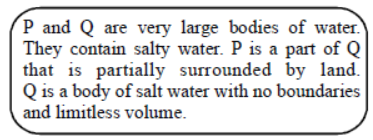
(a) Pacific, Atlantic, Indian, Arctic and Antarctic are five Qs.
(b) Water of P and Q is not fit for drinking
(c) P is Sea and Q is Ocean
(d) All of these
Answer: D
Question. People obtain groundwater from _______ and _______
(a) taps and waterfalls
(b) ponds and rivers
(c) wells and tubewells
(d) lakes and ponds
Answer: C
Explanation: People obtain groundwater from wells and tubewells.
Question. Study the table carefully. Which one of the following correctly shows how we can ‘Reduce, Reuse and Recycle’ water?
| Reduce | Reuse | Recycle | |
| 1. | Water the plants with water that was used to rinse rice. | Rainwater is collected to clean toilets. | Take a shower instead of a bath. |
| 2. | Rainwater is collected to clean toilets. | Waste water is purified to become drinking water. | Water the plants with water that was used to rinse rice. |
| 3. | Use bucket instead of shower while bathing. | Water the plants with water that was used to rinse rice. | Waste water is purified to become drinking water. |
| 4. | Waste water is purified to become drinking water. | Take a shower instead of a bath. | Rainwater is collected to clean toilets. |
(a) 1
(b) 2
(c) 3
(d) 4
Answer: C
Explanation: Reduce the water usage by using bucket instead of shower while bathing, reuse by watering the plants with water that was used to rinse rice and recycle waste water
to get purified water.
Question. Which of the following covers most of the Earth’s surface? 
(a) Sand
(b) Water
(c) Cities
(d) Mountains
Answer: B
Explanation: Water covers a major part of the Earth’s surface.
Question. The water content in which of these fruits is maximum 
Answer: C
Explanation: Watermelon has around 98% of water content.
Question. The natural source of pure water is __________.
(a) rain
(b) sea
(c) river
(d) wall
Answer: A
Question. The means of water transport is __________.
(a) Bus
(b) Ship
(c) Aeroplane
(d) Train
Answer: B
Explanation: Ship is a mode of water transport.
Question. Put some ice cubes or chilled water in a glass and place it on a table. After some time, which is the most likely to happen? 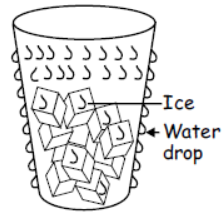
(a) No water in glass
(b) Stays as it is
(c) Water overflows
(d) Small droplets of water on the outer surface of glass
Answer: D
Explanation: These drops come from air. Air contains water vapour which gets cooled down due to ice or chilled water and gets converted into drops of water.
Question. Which is the best way to dispose waste water from our kitchen?
(a) Using it as drinking water
(b) Using it as bathing water
(c) Use it for watering plants
(d) Letting it to flow on to the road
Answer: C
Question. Which form of water is water vapour?
(a) Gas
(b) Liquid
(c) Solid
(d) All of these
Answer: A
Question. The given picture shows water cycle. Which processes are occurring in the direction of arrows starting from process S ? 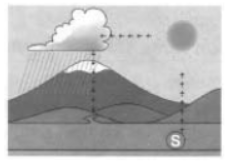
(a) Condensation, Evaporation, Precipitation
(b) Evaporation, Condensation, Precipitation
(c) Evaporation, Precipitation, Condensation
(d) Precipitation, Condensation, Evaporation
Answer: B
Question. Match the following.
| List I | List II |
| A. Indian port | 1. Spring |
| B. Property of water | 2. Ice |
| C. Source of water | 3. Vishakhapatnam |
| D. Solid state of water | 4. Odorless |
A B C D
(a) 1 2 3 4
(b) 3 4 1 2
(c) 2 3 1 4
(d) 1 4 2 3
Answer: B
Explanation: A= 3, B=4, C=1 D=2
Question. Wet clothes are left to dry in the sun. Which process help the clothes to dry?
(a) Freezing
(b) Condensation
(c) Precipitation
(d) Evaporation
Answer: D
Explanation: Wet clothes are left to dry in the sun. The process is termed as the evaporation.
In this process, the liquid changes into the gaseous phase.
Question. _________of a plant absorbs water.
(a) Roots
(b) Leaves
(c) Stem
(d) Flowers
Answer: A
Explanation: Roots of a plant absorb water from the ground.
Question. Which of the following is the best example of precipitation?
(a) Clouds
(b) Rain
(c) Evaporation
(d) Ice
Answer: B
Question. Which of the following is wrong?
(a) Solid heat → Liquid
(b) Solid cool → Gas
(c) Liquid cool → Solid
(d) Liquid heat→ Gas
Answer: B
Question. What causes precipitation?
(a) Evaporation
(b) The weight of the clouds
(c) The hot sun
(d) Plant transpiration
Answer: B
Question. Elephant is a very huge animal. But its body is made of maximum quantity of water.
What is the quantity of water in the body of an elephant.
(a) 68%
(b) 72%
(c) 75%
(d) 70%
Answer: D
Explanation: The body of an elephant is made up of 70% water.
Question. I am clourless and tasteless. I take the shape of the container. I am in no life on earth is possible without me. What am I?
(a) Food
(b) Water
(c) Air
(d) Milk
Answer: B
Explanation: Water is colourless and tasteless. It takes the shape of container. Without water, there is no life on Earth.
Question. Sarita while brushing her teeth left the tap open. What would you do if you see this ?
(a) Close the tap tightly
(b) Explain Sarita about importance of water and its conservation
(c) both a and b
(d) None of these
Answer: C
Question. The best way to save water at home is?
(a) Check your toilet valve for leaks and fix them.
(b) Don’t leave the tap running when you brush your teeth.
(c) Rinse vegetables in a pan of water rather than under the tap.
(d) All of the above.
Answer: D
Question. When water boils in a pot, we can see _ as mist.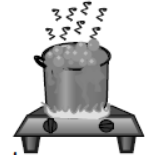
(a) steam
(b) oxygen
(c) water vapour
(d) water droplets
Answer: D
Explanation: when water boils, we see the water droplets as mist.
Question. Where does the energy that powers the water cycle come from?
(a) Plants
(b) Animals
(c) Electrical outlets
(d) The sun
Answer: D
Question. Some containers are given below. In which of the following container, the water will evaporate rapidly? 
Answer: B
Explanation: In this container, the water will evaporate most rapidly because it has more surface area as compared to other container.
Question. The temperature at which a liquid changes into gaseous form is known as boiling
point and the temperature at which it changes into the solid form is known as freezing point.
Water freezes at temperature ____(A)____ and boils at temperature ____ (B)____.
(a) A–10°C, B-100°C
(b) A-0°C, B-100°C
(c) A-36.7°C, B-0°C
(d) A-100°C, B-26°C
Answer: B
Explanation: Water freezes at temperatue 0°C and boils at temperature 100°C
Question. Nature recycles and reuses its resources. Water is one such resource which gets recycled. It gets recycled by a continuous process consisting of evaporation and condensation. In this process there is continuous movement of water from the Earth’s surface into the air and back to the Earth again. What is this process called?
(a) Water cycle
(b) Water evaporation
(c) Water condensation
(d) water recycling
Answer: A
Question. Which of these water body is not surrounding India?
(a) Arabian Sea
(b) Arctic Ocean
(c) Indian Ocean
(d) Bay of Bengal
Answer: B
Explanation: Arctic ocean does not surround India and its territories.
Question. Which of these activities wastes the MOST water per day in the average home?
(a) Running the tap while washing dishes
(b) Using a garbage disposal
(c) A leaky toilet
(d) Long showers
Answer: A
Explanation: A leaky toilet can waste about 200 gallons of water every day!
Question. Match the following.
| List I | List II |
| A. Rainwater harvesting | 1. VIBGYOR |
| B. Rainbow | 2. Water conservation |
| C. Amphibian | 3. Malaria |
| D. Monsoons | 4. Frog |
A B C D
(a) 4 2 3 1
(b) 3 4 1 2
(c) 2 1 4 3
(d) 1 3 2 4
Answer: C
Explanation: A = 2, B = 1, C = 4, D = 3
Question. Water has :
(a) fixed shape
(b) no fixed shape
(c) no weight
(d) strong well
Answer: B
Question. There are two main processes involved in the Water Cycle. These processes are
(a) Evaporation and Condensation
(b) Evaporation and Precipitation
(c) Condensation and Precipitation
(d) Condensation and Sublimation
Answer: A
Explanation: Water cycle consists of two processes- evaporation and condensation. From the Earth’s surface, water rises up due to sun’s heat(evaporation) and then on cooling down, it changes into drops of water (condensation).
Question. Which bird loves to dance in rain?
(a) Hen
(b) Pigeon
(c) Peacock
(d) Parrot
Answer: C
Explanation: Peacock loves to dance in rains.
Question. Which of the following statement is true?
(a) India is surrounded by water from all four sides.
(b) Water can exists in three states: gas ,liquid and solid.
(c) Plants do not need water.
(d) Boiled water contains germs.
Answer: B
Explanation: Water can exist in three states- solid as ice, liquid as water and vapor/ steam as gas.
Question. Animals that can live both on land and water are called _________.
(a) terrestrial animals
(b) aquatic animals
(c) amphibians
(d) none of these
Answer: C
Explanation: Those animals that can live on both the land and water are called amphibians. Ex.
Tortoise.
Question. What will happen if we leave a small piece of ice cube in the sun ?
(a) It will become black
(b) It will change into water
(c) Both A and B
(d) It will become bigger in size
Answer: B
Question. Read the statements carefully and choose the correct option.
A. Water is shapeless; it takes the shape of the container in which it is poured.
B. Rainwater, ocean, rivers, lakes, streams, ponds and springs are natural sources of water.
C. Our body fluids like blood, urine, tears and sweat are all made up of solids.
D. Plants do not require water for their survival.
(a) TTFF
(b) FFTT
(c) TFTF
(d) FTFT
Answer: A
Explanation: Both A and B Statements are right while Statements C and D are wrong.
Question. Large source of water is __________.
(a) pond
(b) ocean
(c) river
(d) spring
Answer: B
Question. To obtain water from water vapour, we should ______ the water vapour.
(a) heat
(b) evaporate
(c) condense
(d) do nothing
Answer: C
Question. Find the odd one out from the following:
(a) Blood
(b) Urine
(c) Sweat
(d) Chlorophyll
Answer: D
Explanation: Chlorophyll is the odd one out since all other three represents the fluids containing water in the human body.
Question. Look at the water cycle below and answer the following question.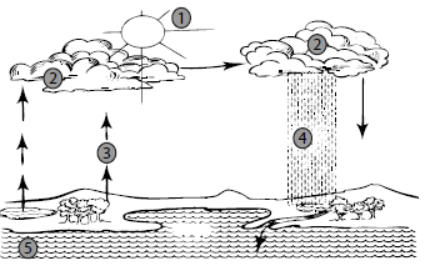
In the figure what process is depicted by (3)?
(a) Condensation
(b) Evaporation
(c) Cloud formation
(d) Precipitation
Answer: B
Explanation: the process depicted is evaporation wherein water from the lake is evaporated to form the clouds.
Question. In the figure of the above question, which process is depicted by (4)?
(a) Condensation
(b) Evaporation
(c) Cloud formation
(d) Precipitation
Answer: D
Explanation: the process depicted is precipitation wherein the droplets from the clouds are coming back on earth in the form of rain.
Question. Solid : Ice : : Gas : ?
(a) Steam/Vapour
(b) Water
(c) Ice
(d) None of these
Answer: A
Question. Which form of water can we feel, see and crush ?
(a) solid
(b) liquid
(c) gaseous
(d) none of these
Answer: A
Question. Which of these is not a property of water?
(a) Odorless
(b) Tasteless
(c) Shapeless
(d) Blue Colored
Answer: D
Explanation: Water is colorless.
Question. Arrange the following statements in order –
I. Water is carried to our homes by big pipes.
II. Water is pumped out of lakes and rivers or from under the ground.
III. Chlorine is added to kill the germs.
IV. Water is filtered.
(a) II, IV, III, I
(b) I, II, III, IV
(c) IV, III, II, I
(d) I, III, IV, I
Answer: A
Explanation: II. Water is pumped out of lakes and rivers or from under the g round.
IV. Water is filtered.
III. Chlorine is added to kill the germs.
I. Water is carried to our homes by big pipes.
Question. What are the three states of water on Earth?
(a) Groundwater, lakes and clouds
(b) Liquid water, frozen water, water vapour
(c) Gas, steam, vapour
(d) Groundwater, oceans and ice
Answer: B
Explanation: Liquid water (liquid state), frozen water(solid state), water vapor(gaseous state)
Question. Which of the following is the correct method of reusing used water?
(a) Using water that was used to clean vegetables for drinking
(b) Using stale water for washing clothes
(c) Using water from factories for cooking
(d) Using the water after bathing to water plants
Answer: B
Question. Big reservoir built on rivers for storing water is called __________.
(a) dam
(b) aquarium
(c) well
(d) rivers
Answer: A
Question. A big block of ice is left to melt on a piece of metal sheet as shown below.
Which of the following statements are true when the ice is melting?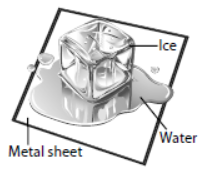
A: The temperature of the ice decreases.
B: The metal sheet is losing heat to the ice.
C: The water is gaining heat from the surroundings.
(a) A only
(b) A and B only
(c) B and C only
(d) A, B and C
Answer: C
Explanation: When the ice is melting, the metal sheet is losing heat to the ice and also the water is getting heat from the surrounding.
Question. What can be ground into a paste using a little water?
(a) A piece of newspaper
(b) A piece of plastic
(c) A piece of silk cloth
(d) A piece of a cycle tube
Answer: A
Question. Consider the following statements and choose the correct option
Statement A: Saving rain water and using it when there is water shortage is called Rainwater Harvesting.
Statement B: When water changes into vapour and rises up in the air is called precipitation.
(a) Statement A is correct and B is wrong
(b) Statement B is correct and A is wrong
(c) Both the statements are A correct
(d) Both the statements are B wrong.
Answer: A
Explanation: Statement A is right and B is wrong, because when water changes into vapour and rises up in the air is called evaporation and not precipitation.
Question. Why does water vapour rise upwards?
(a) It is cooler than the surrounding air
(b) It is heavier than the surrounding air
(c) It is lighter than the surrounding air
(d) It is attracted by the clouds in the sky
Answer: C
Question. Why should freshwater be conserved and used wisely?
1. Its store is limited in nature.
2. We have plenty of freshwater.
3. Only river has freshwater.
4. We cannot use salty water for drinking, instead of freshwater.
5. We can use sea water, instead of freshwater.
(a) 1, 3 and 5
(b) 2 and 4
(c) 1, 2 and 5
(d) 1 and 4
Answer: D
Explanation: On Earth, freshwater is available in a limited quantity as compared to salty water.
Freshwater is available in rivers, ponds and lakes while salty water is available in seas. We can only use freshwater for drinking and other purposes, salty water cannot be used. Thus, we should consume freshwater and use it wisely.
Question. Match the column I with column II and select the correct option.
Column I Column II
A. A rock put out under sun 1. Changes into solid
B. Coconut oil put in freezer 2. Changes into liquid
C. Water put on burning stove 3. Changes into gas
D. Ice cream kept on a table 4. No change
(a) A-1, B-2, C-3, D-4
(b) A-3, B-2, C-4, D-1
(c) A-4, B-1, C-3, D-2
(d) A-4, B-1, C-2, D-3
Answer: C
Explanation: A rock put out under Sun - No change
Coconut oil put in freezer - Changes into solid
Water put on burning stove - Changes into gas
Ice cream kept on a table - Changes into liquid
Question. Boiling water in a container and clouds are 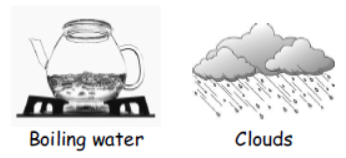
(a) Steam
(b) Oxygen
(c) Water vapour
(d) Droplets of water
Answer: D
Explanation: The steam that comes out from boiling water is actually droplets of water. In the formation of clouds, water vapour rises, meets cold air and changes into droplets of water, called clouds.
Question. What is condensation?
(a) Water vapor changing to liquid droplets in the air
(b) When it is raining
(c) The water in the lake
(d) None of these
Answer: A
Explanation: Condensation is the process in which water vapor condense to form water droplets.
Question. What are the three natural sources of water on the earth?
(a) Rivers, dams and wells
(b) Rivers, lakes and springs
(c) Rainwater, tube wells and oceans
(d) Spring canals and lakes
Answer: B
Explanation: Rainwater, oceans, rivers, lakes, streams, ponds and springs are natural sources of water. Dams, wells, tube wells, handpumps, canals, etc. ae man-made sources
of water.
Question. Madhuri kept some water in a refrigerator and after some time the water changed into ice. What is this process called?
(a) Condensation
(b) Evaporation
(c) Boiling
(d) Freezing
Answer: D
Question. What will happen, if the water is boiled to 100°C? 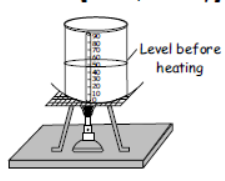
(a) Water will overflow
(b) Water will stay as it is
(c) Water will turn into ice
(d) Water will evaporate and will change into steam
Answer: D
Explanation: Water boils at 100°C. At this temperature, the atmospheric temperature becomes equals to the boiling temperature. At this stage, water vapours are formed, i.e. steam is formed.
Question. Read the passage and fill the blanks with correct options.
Just like plants, ___(1)___ also need water for their survival. Plants and animals that live in ___(2)___ are called as the aquatic plants and aquatic animals respectively. Animals that can live on both the land and water are called as the amphibians. Ex. ___(3)___ , toads and turtles.
1. (a) plants (b) insects (c) animals (d) none of the above
2. (a) water (b) sky (c) underground (d) trees
3. (a) tiger (b) frogs (c) lion (d) pigeons
Answer: 1. (c) Animals 2. (a) Water 3. (b) Frogs
Question. Which of the following is measured in litres?
(a) Flour
(b) Water
(c) Ice
(d) Watervapour
Answer: B
Question. Anuraag took a glass of cold water from the refrigerator and placed it on a table.
After few minutes he observed water drops on the outer surface of the glass.
What has happened ?
(a) Glass produced water droplets
(b) The water in the glass moved through the glass
(c) Water vapour present in the air is condensed
(d) Water came out from the gaps present in the glass
Answer: C
During the humid rainy season, the number of insects in the environment increases.
These insects cause several water-borne diseases. Rainwater is the main reason for this as these insects lay their eggs into the stagnant rain water.
Question. Which of the following disease is not caused by the mosquitoes?
(a) Malaria
(b) Cough and cold
(c) Chikunguniya
(d) Dengue
Answer: B
Question. Water borne diseases are spread through __________.
(a) dogs
(b) cats
(c) insects
(d) mouse
Answer: C
Multiple Choice Questions (MCQs) for Class 3 Science Water
Chapter MCQs with Answers for Class 3 Science
Test your conceptual understanding of Water with these targeted multiple-choice questions. Designed in alignment with the latest CBSE curriculum for Class 3 Science, these problem sets build accuracy and prepare students for objective exams.
Expert Practice Material for Class 3 Science
Each question includes structured solution keys mapped directly to standard CBSE textbooks, helping students evaluate their reasoning and correct mistakes early in their revision.
Complete Your Chapter Revision
Explore our broader library of printable assignments, chapter notes, and mock tests designed to support continuous revision and secure higher marks in CBSE assessments.
FAQs
You can get most exhaustive CBSE Class 3 Science Water MCQs for free on StudiesToday.com. These MCQs for Class 3 Science are updated for the 2026-27 academic session as per CBSE examination standards.
Yes, our CBSE Class 3 Science Water MCQs include the latest type of questions, such as Assertion-Reasoning and Case-based MCQs. 50% of the CBSE paper is now competency-based.
By solving our CBSE Class 3 Science Water MCQs, Class 3 students can improve their accuracy and speed which is important as objective questions provide a chance to secure 100% marks in the Science.
Yes, Science MCQs for Class 3 have answer key and brief explanations to help students understand logic behind the correct option as its important for 2026 competency-focused CBSE exams.
Yes, you can also access online interactive tests for CBSE Class 3 Science Water MCQs on StudiesToday.com as they provide instant answers and score to help you track your progress in Science.