

Practice MCQs for Class 3 Science NSO Olympiad
Explore reliable objective questions for NSO Olympiad tailored for Class 3 learners. Utilizing these Science multiple-choice formats ensures thorough preparation and strengthens problem-solving speed for upcoming school assessments.
Access NSO Olympiad Questions and Solutions
Navigate directly to the 50 objective questions for NSO Olympiad using the digital viewer below. Each practice set includes verified answer keys, allowing students to instantly cross-check their work and identify areas requiring further revision.
Question. Weather forecast for a particular day is given.
Weather Forecast
Temperature:
Maximum 43°C
Minimum 22°C
Humidity – 43%
Which of the following will Suraj wear on this day?

Answer : A
Question. Read the given statements.
1. Leaves in which the leaf blade is divided into many leaflets are called __________ leaves.
2. The largest living tree is a giant __________ tree.
3. _________ is a green colour substance present in leaves which helps the plants to prepare food.
Select the option which correctly fills the blanks.
1 2 3
A. Compound Sequoia Chlorophyll
B. Simple Bristlecone Stomata
C. Simple Sequoia Chlorophyll
D. Compound Bristlecone Stomata
Answer : A
Question. Identify the parts labelled as P, Q, R and S in the given figure and select the INCORRECT statement regarding them.
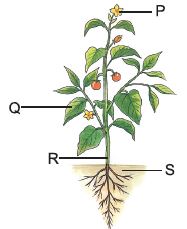
A. Q prepares food for the plant.
B. S anchors the plant in the soil.
C. P gives support to the plants.
D. R carries water and food to different parts of the plant.
Answer : C
Question. When we see more than half of the Moon, it is called __________.
A. Gibbous Moon
B. New Moon
C. Crescent Moon
D. None of these
Answer : A
Question. Which of the following statements is/are INCORRECT?
1. We rest and sleep in the kitchen.
2. We attend to our guests in the living room.
3. We cook food in the dining room.
4. We study in the study room.
A. 1 only
B. 3 and 4 only
C. 2 only
D. 1 and 3 only
Answer : D
Question. Rohan grouped some fruits into two different categories
X and Y as shown in the given flow chart. Identify X and Y.
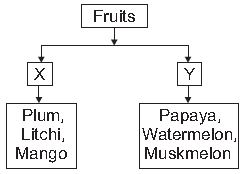
A. X → Two seeded, Y → Many seeded
B. X → One seeded, Y → Two seeded
C. X → Many seeded, Y → One seeded
D. X → One seeded, Y → Many seeded
Answer : D
Question. X are long, soft bodied beetles which are also called glow worms. They fly only at night. What are X?
A. Dragonflies
B. Houseflies
C. Fireflies
D. Butterflies
Answer : C
Question. Study the given food web and answer the following questions.
(a) How many omnivores are present in the food web?
(b) How many carnivores are present in the food web?
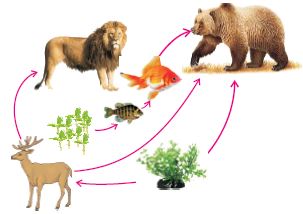
(a) (b)
A. 3 1
B. 1 2
C. 1 3
D. 2 1
Answer : B
Question. Which of the following statements are correct?
1. A short and hard beak of a parakeet, helps it to crack nuts.
2. A strong, sharp and hooked beak helps hawk in tearing flesh of small animals.
3. The woodpecker uses its spoon-like beak to gather shellfish and water insects.
4. A strong and chisel-shaped beak of hoopoe helps it to pull out insects from the tree holes.
A. 1 and 4
B. 2 and 3
C. 1 and 3
D. 2 and 4
Answer : D
Question. Identify which of these is 'X'?
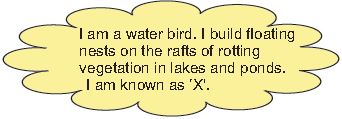
A. Partridges
B. Golden plover
C. Crane
D. Grebe
Answer : D
Question. Which of these methods can be used to preserve food?
1. Keep the food at high temperature. 3. Keep the food in water.
2. Keep the food in airtight container. 4. Salting and sugaring the food.
A. 1 and 3
B. 2 and 4
C. 2 and 3
D. 1 and 4
Answer : B
Question. Foods like rice, chapati and pulses are considered healthy because ______.
A. They contain lots of fat and carbohydrate and less of protein
B. They contain lots of protein and carbohydrate and less of fat
C. They contain lots of fat and protein and less carbohydrates
D. They contain less of fat, carbohydrate and protein
Answer : B
Question. Which is correct statement regarding the given vehicle?
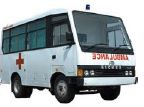
A. It is a special means of transport.
B. It carries sick or injured people.
C. It is equipped with life saving machines.
D. All of these
Answer : D
Question. Which among the following is a means of mass communication?

Answer : D
Question. Read the given statements made by three children.
Shweta : Ruhi, your hairs are so rough!
Ruhi : Shweta, I like the fragrance of your perfume.
Priyanka : Why you both are making noise?
Which of the following correctly matches the senses used by the children?
Shweta Ruhi Priyanka
A. Sight Touch Hearing
B. Smell Hearing Touch
C. Touch Smell Hearing
D. Touch Sight Hearing
Answer : C
Question. Which of the following organ systems controls all our actions like hearing, walking and learning?
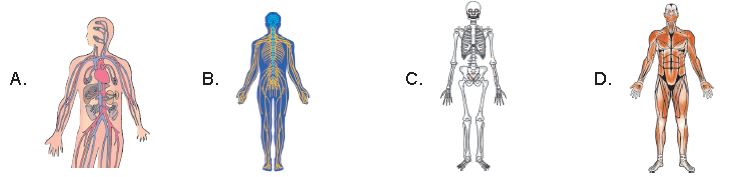
Answer : B
Question. Select the INCORRECT match from the following.
A. Kidney – Urine
B. Skin – Sweat
C. Lungs – Carbon dioxide
D. None of these
Answer : D
Question. Which of the following statements are INCORRECT regarding ‘X’ in the given figure?
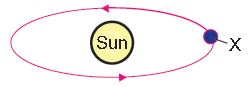
1. It is a star.
2. It revolves around a planet.
3. It shows rotation.
4. It always follows a fixed path.
A. 1 and 2
B. 1, 2 and 3
C. 2, 3 and 4
D. 1, 3 and 4
Answer : A
Question. The Earth goes around the Sun. This movement of Earth is called ________. Earth follows a fixed path during its journey around the Sun. This path is called the ______of the Earth.
A. Rotation, axis
B. Revolution, orbit
C. Revolution, axis
D. Rotation, orbit
Answer : B
Question. Rohan took two dishes and poured equal amount of water in them. He then placed the dish P in the sunlight and the dish Q in a closed container in a dark room.
What will he observe?
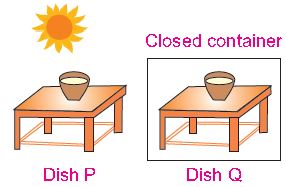
A. The water in dish Q evaporates faster than that in dish P.
B. The water in dish P evaporates faster than the water in dish Q.
C. Equal amount of water will evaporate from both the dishes, P and Q.
D. None of these
Answer : B
Question. Read the given conversation and select the correct option regarding it.

A. Rajan gave incorrect explanation of Divya's statement.
B. Rajan gave correct explanation of Divya's statement.
C. Both Divya and Rajan made incorrect statements.
D. Only Rajan made incorrect statement.
Answer : B
Question. Vinay took some milk in a measuring cylinder as shown in figure 1. He then poured some milk out of the cylinder and the volume of remaining milk is shown in figure 2.
How much milk was poured out?
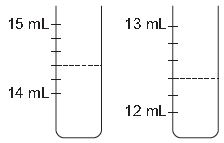
A. 1.8 mL
B. 2.1 mL
C. 2.0 mL
D. 2.4 mL
Answer : C
Question. Four children made statements about the shadow.
Sunita : Shadow is formed on the opposite side of light source.
Amit : Shadow can be formed of different sizes.
Vikas : Shadow can be formed only if there is light.
Who made correct statement?
A. Sunita only
B. Vikas only
C. Vikas and Amit only
D. Sunita, Amit and Vikas
Answer : D
Question. A torch is shone on a glass cube and a rubber ball as shown in the figure given below.
The glass cube and the ball are in line with the torch.
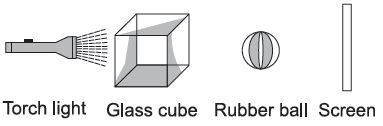
What will be the shape of shadow observed on the screen?

Answer : A
Question. Which of these actions requires both push and pull ?

Answer : D
Question. In which of the following actions, the friction will be least ?
A. Rapidly writing down notes on a paper.
B. Getting a good grip on the handle of a tennis racket.
C. Walking in a garden.
D. Raindrops falling onto a newly cleaned window and sliding down as round drops.
Answer : D
Question. Which one of the following is NOT an example of water pollution?
A. Chemicals from farms being washed into a canal.
B. Releasing water stored in dams.
C. Human waste released into a river.
D. Water used to wash cars being released into a river.
Answer : B
Question. Which of these activities pollutes the air and water respectively?
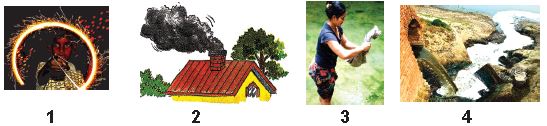
Air Water
A. 1 and 3 2 and 4
B. 1 and 4 2 and 3
C. 1 and 2 3 and 4
D. 2 and 4 1 and 3
Answer : C
Question. X is the hardest rock on earth. It is used for making jewellery. What is X?
A. Ruby
B. Sapphire
C. Diamond
D. None of these
Answer : C
Question. Which of the following objects can be used during the weather shown in the given figure?
1. Shorts
2. Sunglasses
3. Raincoat
4. Gloves
5. Cotton shirt
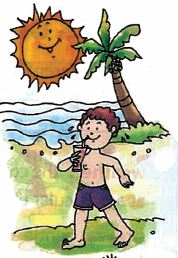
A. 1, 2 and 3
B. 2, 3 and 4
C. 1, 3 and 5
D. 1, 2 and
Answer : D
ACHIEVERS SECTION
Question. Study the given flow chart carefully.
Which of the following are classified correctly?
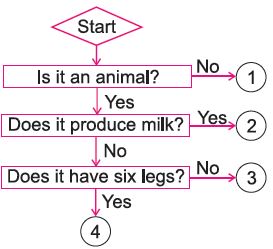
1 2 3 4
A. Petunia Swallow Cow Butterfly
B. Swallow Mango Butterfly Cow
C. Mango Cow Pigeon Butterfly
D. Pigeon Cow Butterfly Mango
Answer : C
Question. Refer to the given flow chart and identify the organs P, Q and R.
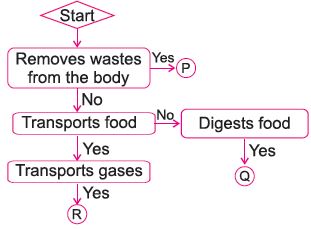
P Q R
A. Kidney Small intestine Blood
B. Muscle Nerves Lung
C. Nerve Blood Kidney
D. Kidney Small intestine Lung
Answer : A
Question. Study the given flow chart carefully.
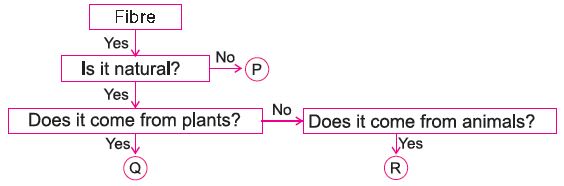
What can be placed at P, Q and R respectively?
A. Nylon, Cotton, Wool
B. Cotton, Jute, Silk
C. Jute, Wool and Nylon
D. Silk, Cotton, Nylon
Answer : A
Question. Navpreet pushed a block from four slides each made up of different surfaces but of similar shape as shown in the given figure. The time taken by the block to move down from point X to Y in four slides was noted.
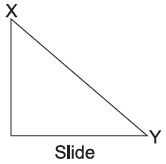
Which of the following options is correct regarding the type of surface used and the time taken (in seconds) by block to come down from point X to Y?
| Polished wood | Planed wood | Sand paper | Oily Surface | |
| A | 17 | 30 | 55 | 2 |
| B | 2 | 17 | 55 | 30 |
| C | 55 | 6 | 4 | 70 |
| D | 5 | 10 | 70 | 60 |
Answer : A
Question. Study the given diagram carefully.
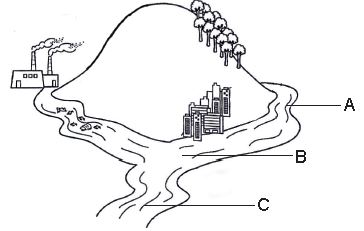
Which one of the following graphs, most accurately shows the effect on the fish population at points A, B and C?

Answer : D
Free study material for Science Olympiad NSO
NSO Olympiad Objective Questions & Solutions for Class 3 Science
Class 3 Science NSO Olympiad Objective Test Questions
Review structured objective questions for Class 3 Science NSO Olympiad. Built according to official CBSE guidelines, these MCQ sets support daily revision and core concept reinforcement.
NCERT-Aligned Objective Questions and Solutions
Each question includes structured solution keys mapped directly to standard CBSE textbooks, helping students evaluate their reasoning and correct mistakes early in their revision.
Next Steps in Your Exam Preparation
Wrap up your chapter revision by testing your knowledge against standard question formats. Everything on our platform is provided free of charge.
FAQs
You can get most exhaustive CBSE Class 3 Science NSO Olympiad MCQs with Answers Set 05 for free on StudiesToday.com. These MCQs for Class 3 Science are updated for the 2026-27 academic session as per CBSE examination standards.
Yes, our CBSE Class 3 Science NSO Olympiad MCQs with Answers Set 05 include the latest type of questions, such as Assertion-Reasoning and Case-based MCQs. 50% of the CBSE paper is now competency-based.
By solving our CBSE Class 3 Science NSO Olympiad MCQs with Answers Set 05, Class 3 students can improve their accuracy and speed which is important as objective questions provide a chance to secure 100% marks in the Science.
Yes, Science MCQs for Class 3 have answer key and brief explanations to help students understand logic behind the correct option as its important for 2026 competency-focused CBSE exams.
Yes, you can also access online interactive tests for CBSE Class 3 Science NSO Olympiad MCQs with Answers Set 05 on StudiesToday.com as they provide instant answers and score to help you track your progress in Science.