

Science Objective Questions and Answers: NSO Olympiad
Access targeted multiple-choice questions for NSO Olympiad designed to align with the latest CBSE academic syllabus for Class 3 Science. These objective practice sets help students evaluate their conceptual understanding and improve exam readiness.
Download NSO Olympiad MCQs with Answers
Navigate directly to the 50 objective questions for NSO Olympiad using the digital viewer below. Each practice set includes verified answer keys, allowing students to instantly cross-check their work and identify areas requiring further revision.
Question. Study the given diagram.
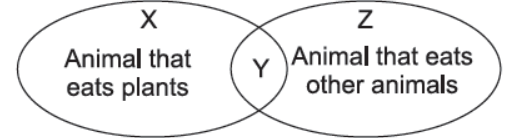
Which of the following is true for X, Y and Z ?
A. Animal X has sharp and pointed front teeth for tearing its food.
B. Animal X has well-developed digestive system that can digest hard plant parts.
C. Z could be a bear or a grasshopper.
D. Y could be a rabbit or a squirrel.
Answer. B
Question. Study the given food web carefully.
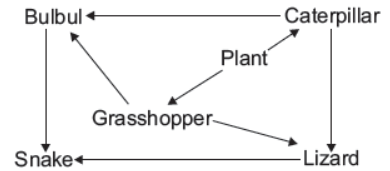
Which of the following statements is INCORRECT regarding this?
A. If all caterpillar population dies, then more plants will be available for grasshopper population to feed on.
B. Bulbul and lizard compete with each other for similar foods.
C. A decrease in snake population is likely to cause an increase in bulbul and lizard populations.
D. None of these
Answer. D
Question. The given classification chart classifies birds according to certain characteristics P, Q, R, S, T and U.
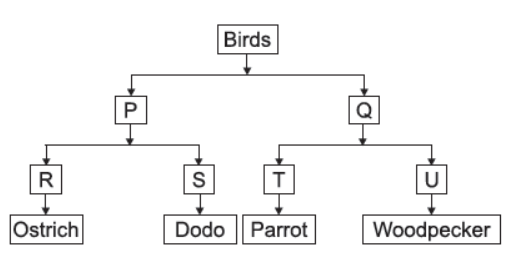
Select the option that correctly identifies any three of these characteristics.
A. P – Flightless birds, S – Extinct, T – Curved beak
B. Q – Flight birds, R – Extinct, U – Broad and flat beak
C. P – Flight birds, R – Living, U – Hooked beak
D. Q – Flightless birds, S – Living, T – ChiseI–shaped beak
Answer. A
Question. Read the given statement.
Bird 'X' has strong, sharp and hooked beak, whereas, bird 'Y' has short, hard and pointed beak.
Which of the following holds true for X and Y?
A. Bird X could be a carnivorous bird that has strong sharp claws called talons.
B. Bird Y could be a wading bird that digs out worms from the ground.
C. Bird X could be a herbivorous bird that has webbed feet.
D. Bird Y could be a running bird having feet with two toes instead of four.
Answer. A
Question. Read the following statements given by three friends.
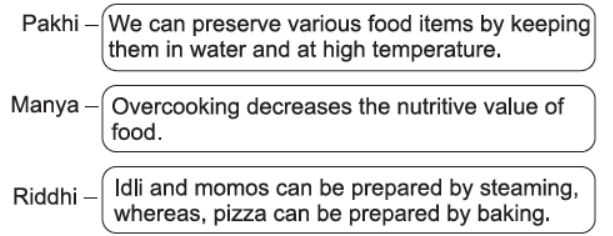
Which of these friends is/are right?
A. Pakhi and Manya only
B. Pakhi and Riddhi only
C. Manya and Riddhi only
D. Pakhi only
Answer. C
Question. Which of the following options on unscrambling gives the name of a method of food preservation?
A. OSTNRAIG
B. IKIGPCLN
C. ILNGLIRG
D. TAIGSMNE
Answer. B
Question. Which of the following means of communication can be used by a person with hearing

Answer. C
Question. Which of the following options on unscrambling gives the name of the means of transport that is specially used to carry sick people to hospital?
A. RCOTATR
B. BLNCAUAME
C. IERENFGENI
D. ALOTSIBA
Answer. B
Question. Select an INCORRECT option.
Organ system Function
A. Circulatory system Transports nutrients and oxygen to all parts of the body.
B. Excretory system Removes waste materials from the body.
C. Skeletal system Provides support and helps in movement and locomotion.
D. Reproductive system Controls all our actions.
Answer. D
Question. Refer to the given figure with parts labelled as P, Q, R and S.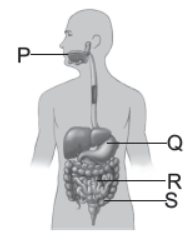
In which of the following parts do mostly absorption of digested food and water takes place respectively?
A. P and Q
B. Q and R
C. R and S
D. Q and S
Answer. C
Question. Read the given statements and select the correct option.
A. Skeletal system is made up of brain and spinal cord.
B. In the digestive system, food comes to stomach from intestine.
C. The excretory system consists of a pair of kidneys, skin and pair of lungs.
D. Nervous system circulates blood throughout our body.
Answer. C
Question. The phase of the Moon shown in the given figure was observed by Divya on 2nd January.
Which phase of moon will most likely she observe on 15th January?


Answer. B
Question. Refer to the given figure.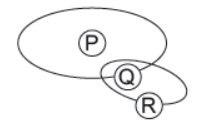
Which of the following is correct regarding P, Q and R?
A. Q is slightly tilted over its axis and rotates from west to east.
B. P rotates around Q to cause four different seasons on Q.
C. R appears to change its shape due to revolution of Q around P.
D. P and R shine as they give light of their own, whereas, Q shines because it reflects the light of P.
Answer. A
Question. Unscramble the names of planets given in column I and match them with their characteristics in column II.
Column I Column II
1. I T P J R E U a. Second largest planet
2. S N U E V b. Smallest planet in solar system
3. U A T N R S c. Fifth planet from the sun
4. E R Y M C R U d. Hottest and brightest planet
A. 1 - c, 2 - d, 3 - a, 4 - b
B. 1 - b, 2 - d, 3 - c, 4 - a
C. 1 - d, 2 - b, 3 - a, 4 - c
D. 1 - a, 2 - c, 3 - b, 4 - d
Answer. A
Question. Select the correct statement related to the picture shown here.
A. We can send parcels anywhere in the world from here.
B. We cannot deposit money here.
C. We can send instant messages from here.
D. All of these
Answer. A
Question. Select the INCORRECT match from the following.
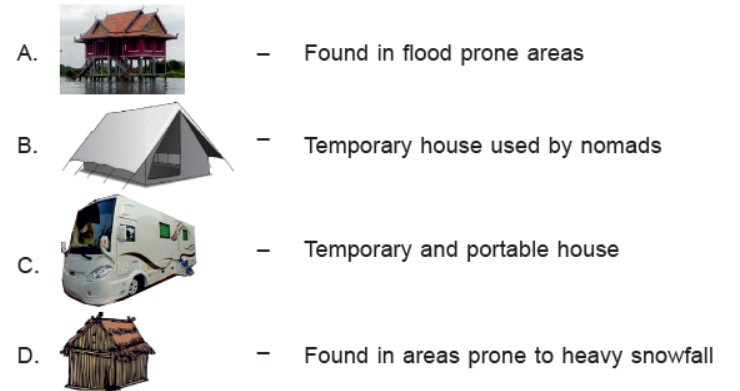
Answer. D
Question. Study the given flow chart and select the correct option for P, Q and R.
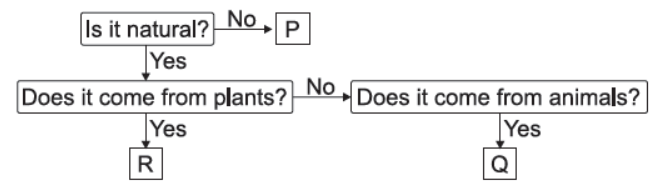
A. P can be used for making raincoats.
B. Q could be silk or wool.
C. R is preferred for summer clothing.
D. All of these
Answer. D
Question. Which of the following is made up of only one material?

Answer. A
Question. Process 'X' is responsible for drying of wet clothes under the Sun, while process 'Y' is responsible for cloud formation. Identify processes 'X' and 'Y'.
X Y
A. Boiling Freezing
B. Evaporation Condensation
C. Condensation Freezing
D. Melting Condensation
Answer. B
Question. Three different materials are shown in the given picture.
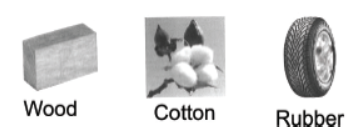
What is common among these materials?
I. They are waterproof.
II. They come from plants.
III. They are soft.
A. II only
B. I only
C. I, II and III
D. III only
Answer. A
Question. The characteristics of material A is described by the chart below :
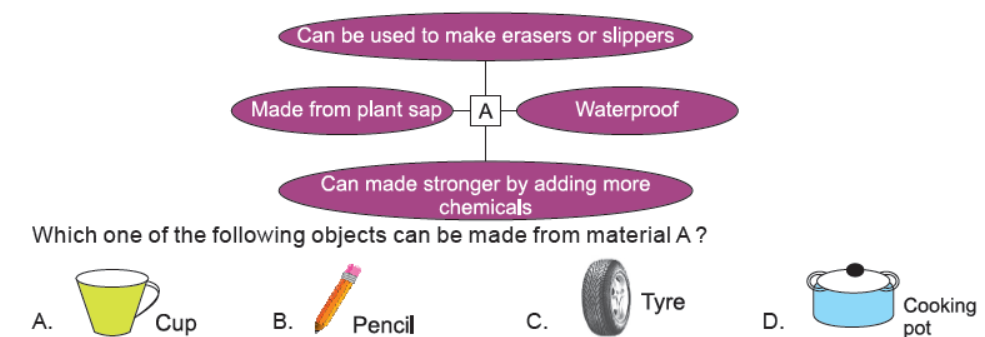
Answer. C
Question. In which of the following set up the sound of alarm will not be heard by those standing nearby it?
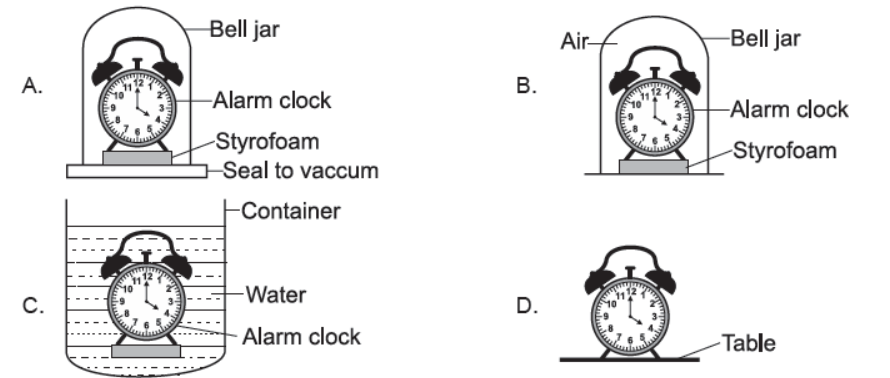
Answer. A
Question. Refer to the given figure and select the INCORRECT option for X, Y and Z.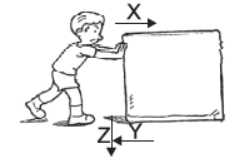
A. When a ball is thrown up high in air, force Z continuously acts on it to bring it down.
B. Force Z allows us to stand properly on a surface and force Y allows us to walk properly on a surface.
C. Force X causes wear and tear of bicycle tyres.
D. All of these
Answer. C
Question. Select an option which on unscrambling gives the name of a rock that when cut and polished, can be used for making jewellery.
A. APHRSPIE
B. RNTGAIE
C. OLCA
D. ABLMRE
Answer. A
Question. Read the following paragraph.
'X' soil cannot hold much water, 'Y' soil is sticky and can hold a lot of water and 'Z' soil can hold both air and water and has lot of humus. Which of the following is true for X, Y, and Z?
A. X is found in deserts and seashores.
B. Y is mostly used for making pots and toys.
C. Z is best for plant growth.
D. All of theseRS SECTION
Answer. D
Question. Study the given relationship between plants regarding their edible parts.
Carrot : Mango : : Beetroot : X
Which of the following plants can be placed at X?
A. Tomato
B. Spinach
C. Onion
D. Potato
Answer. C
Question. The given picture shows the beak of a bird.
Which of the following is most likely the food of this bird?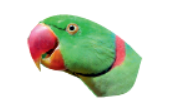
A. Fish
B. Nectar
C. Nuts
D. Both B and C
Answer. C
Question. The given picture shows Priya's shadow at some time of the day.
Which of the following activities she can most likely do at this time?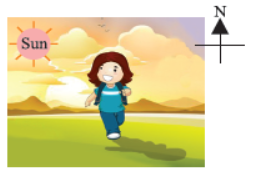
A. Have lunch
B. Have dinner
C. Play in the park
D. Both A and C
Answer. C
Question. We can keep the environment clean by _______.
A. Throwing waste here and there
B. Reusing plastic bottles
C. Bathing our animals with soap in a river
D. Burning dry leaves
Answer. B
Question. Which of the following food chains is possible in nature?
A. Fish → Plants → Birds
B. Plants → Rabbit → Wolf
C. Plants → Snake → Lion
D. Rat → Grass → Grasshopper
Answer. B
Question. Refer to the given figure and select the correct option regarding the parts labelled V, W, X, Y and Z.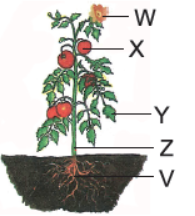
A. Cauliflower is obtained from part W, whereas, cabbage is obtained from part Y of a plant.
B. We eat X of tomato and Y of apple.
C. We eat Z of orange and V of carrot.
D. Lettuce, okra and mint are obtained from part X of a plant.
Answer. A
Question. Study the given flow chart carefully.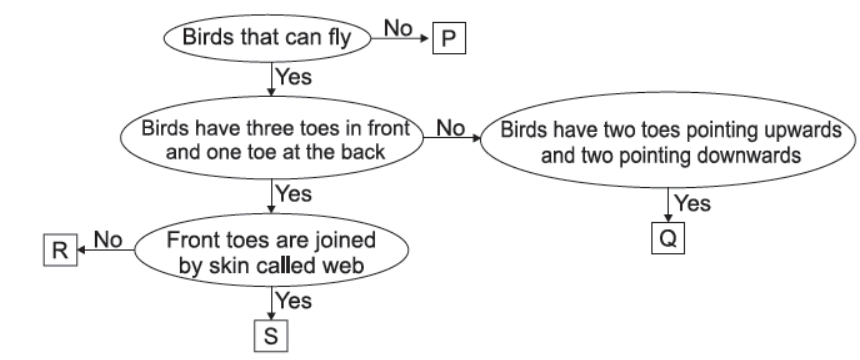
Which of the following is INCORRECT regarding P, Q, R and S?
A. P could be an ostrich or a penguin.
B. Q could be woodpecker or parakeet.
C. R could be sparrow or mynah.
D. S could be a duck or a hen.
Answer. D
Question. The given graph shows the amount of nutrients in a food X. Which of the following can be X?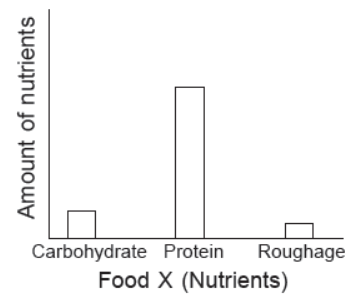
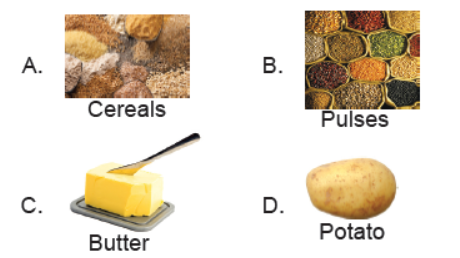
Answer. B
Question. Study the given word grid.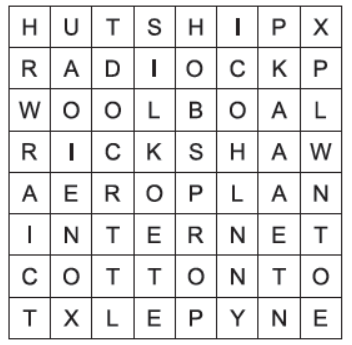
Which of the following is NOT present in the above given word grid?
A. A temporary house made up of mud and straw.
B. Natural fibre obtained from animals, used in winter clothing.
C. A means of communication that cannot be used by hearing disabled people.
D. A means of transportation that is driven by animals.
Answer. D
Question. Ritu conducted an experiment as shown using a torch and cardboards made up of opaque material.
In which of the following set ups the torch light will reach the eyes of an observer?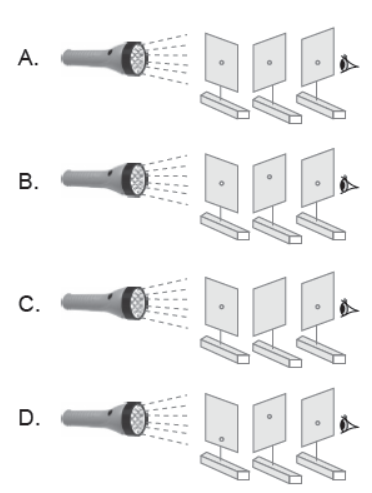
Answer. A
Free study material for Science Olympiad NSO
Multiple Choice Questions (MCQs) for Class 3 Science NSO Olympiad
Class 3 Science NSO Olympiad Objective Test Questions
Test your conceptual understanding of NSO Olympiad with these targeted multiple-choice questions. Designed in alignment with the latest CBSE curriculum for Class 3 Science, these problem sets build accuracy and prepare students for objective exams.
NCERT-Aligned Objective Questions and Solutions
Each question includes structured solution keys mapped directly to standard CBSE textbooks, helping students evaluate their reasoning and correct mistakes early in their revision.
Next Steps in Your Exam Preparation
Follow up your worksheet practice by attempting the interactive online Science MCQ test for this chapter to evaluate your execution speed. All platform resources are free to access.
FAQs
You can get most exhaustive CBSE Class 3 Science NSO Olympiad MCQs with Answers Set 04 for free on StudiesToday.com. These MCQs for Class 3 Science are updated for the 2026-27 academic session as per CBSE examination standards.
Yes, our CBSE Class 3 Science NSO Olympiad MCQs with Answers Set 04 include the latest type of questions, such as Assertion-Reasoning and Case-based MCQs. 50% of the CBSE paper is now competency-based.
By solving our CBSE Class 3 Science NSO Olympiad MCQs with Answers Set 04, Class 3 students can improve their accuracy and speed which is important as objective questions provide a chance to secure 100% marks in the Science.
Yes, Science MCQs for Class 3 have answer key and brief explanations to help students understand logic behind the correct option as its important for 2026 competency-focused CBSE exams.
Yes, you can also access online interactive tests for CBSE Class 3 Science NSO Olympiad MCQs with Answers Set 04 on StudiesToday.com as they provide instant answers and score to help you track your progress in Science.