

Science Objective Questions and Answers: Our Body
Review structured MCQ sets for Class 3 Science Our Body . Built according to official CBSE guidelines, these downloadable questions support daily revision and core concept reinforcement.
Download Our Body MCQs with Answers
View or download the dedicated Our Body MCQ resource below. Practicing these 50 objective questions regularly builds familiarity with standard exam patterns and helps secure higher marks in final Science evaluations.
Question. 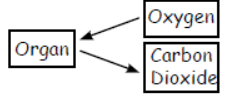
Above diagram represents an organ which takes in oxygen and gives out carbon dioxide.
Name the organ.
(a) Small intestine
(b) Kidneys
(c) Lungs
(d) Stomach
Answer: C
Question. _________ is the only organ system that consists of different organs in a man and a woman.
(a) Nervous system
(b) Reproductive system
(c) Circulatory system
(d) Respiratory system
Answer: B
Explanation: Reproductive system helps in producing young ones. It consists of different organs in man and woman.
Question. Match the following
| List I | List II |
| A. Kidneys | 1. Sweat |
| B. Lungs | 2. Urine |
| C. Skin | 3. Carbon dioxide |
A B C
(a) 1 2 3
(b) 2 3 1
(c) 3 1 2
(d) 3 2 1
Answer: B
Question. The organ illustrated in the following diagram is __________ . 
(a) heart
(b) lungs
(c) kidneys
(d) stomach
Answer: A
Explanation: The organ illustrated in the given diagram is heart.
Question. Find the odd one out.
(a) Eyes
(b) Nose
(c) Ears
(d) Heart
Answer: D
Explanation: Except heart all the other three are sense organs.
Question. Rita could not have babies. There is a problem in her ________.
(a) Respiratory system
(b) Circulatory system
(c) Reproductive system
(d) Digestive system
Answer: C
Explanation: Reproductive system is responsible for producing babies. As Rita could not have babies so, she must have a problem in her reproductive system.
Question. Which one of the following systems is responsible for producing young ones of its own kind?
(a) Excretory system
(b) Circulatory system
(c) Muscular system
(d) Reproductive system
Answer: D
Question. Naveen fainted in school playground while playing. The doctor said that his brain did not get proper oxygen supply.
It means that his __________ system may have a problem.
(a) Reproductive
(b) Circulatory
(c) Skeletal
(d) Excretory
Answer: B
Explanation: Circulatory system transports blood from heart to various parts of body including brain. Blood carries oxygen and nutrients to different parts of body and receives carbon dioxide and wastes from them.
Question. __________ makes our bones and muscles strong.
(a) Swimming
(b) Sleeping
(c) Listening to music
(d) Playing games like ludo
Answer: A
Explanation: Activities like swimming, cycling, etc. and various exercises make our muscles strong.
Question. Read the given conversation and select the INCORRECT option regarding them. 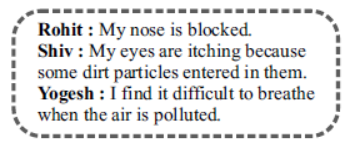
(a) Rohit will not be able to distinguish fish curry and cardamom kheer by smelling them.
(b) Yogesh will not be able to distinguish silk cloth and jute sack.
(c) It is difficult for Shiv to distinguish black and blue colours.
(d) Both B and C
Answer: B
Question. Select the correct match among the following. 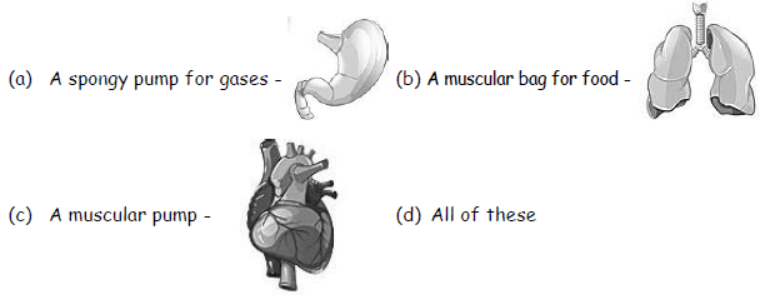
Answer: (c) Figure (c) is of heart, a muscular pump which pumps blood throughout the body.
Figure (a) is stomach which is a muscular bag for digestion of food and figure (b) is of lungs which is a spongy organ for exchange of gases.
Question. Select the option which on unscrambling gives the term used for the supporting framework of our body.
(a) NKEOLSET
(b) USEMLCS
(c) TNJSOI
(d) SBENO
Answer: A
Explanation: The supporting framework of our body is skelet on and it is formed by unscrambling option A. Option B, C and D on unscrambling give the terms MUSCLES,
JOINTS and BONES respectively, which constitute the skeletal system.
Question. Which of these are used mainly for the sense of smell?
Answer: B
Question. Sameer uses dumbbell to exercise daily. Which body systems are involved in bending and straightening of his arm? 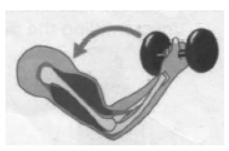
(a) Muscular and Excretory systems
(b) Digestive and Nervous systems
(c) Muscular and Skeletal systems
(d) Skeletal and Reproductive systems
Answer: C
Explanation: Muscular and skeletal systems of our body are involved in different body movements, e.g., bending and straightening of arms, etc.
Question. Support, movement, protection, blood cell production, calcium storage- they all are part of which system.
(a) Skeletal System
(b) Nervous system
(c) Muscular system
(d) Respiratory system
Answer: A
Explanation: Support, movement, protection, blood cell production, calcium storage-they all are part of skeletal system.
Question. Digestive system : Digestion :: Muscular system : ?
(a) Respiration
(b) Muscles
(c) Excretion
(d) Bones
Answer: B
Explanation: Digestive system : Digestion :: Muscular system : Muscles
Question. To break a glass tile by hands, on needs to use one’s _________ system.
(a) Reproductive
(b) Skeletal
(c) Muscular
(d) Both (b) and (c)
Answer: D
Explanation: To break a glass tile, we need to move our hand forcefully. For this we need to use our skeletal and muscular system.
Question. The system which forms the framework for the body is __________ .
(a) circulatory system
(b) excretory system
(c) reproductive system
(d) skeletal system
Answer: D
Explanation: Skeletal system forms the framework for the body.
Question. The organ in the diagram helps us in __________ . 
(a) seeing
(b) hearing
(c) smelling
(d) eating
Answer: B
Explanation: The organ shown is ear and it helps in hearing.
Question. Read the given statement.
‘X’ is the only organ system which comprises of a different set of organs in male and female individuals. Which of the following is X ?
(a) Respiratory system
(b) Circulatory system
(c) Reproductive system
(d) Digestive system
Answer: B
Question. Which of the following organs is NOT used during digestion?
(a) pancreas
(b) stomach
(c) lungs
(d) liver
Answer: C
Question. Blood is important to body because _________ .
(a) it picks up useful parts of food from the intestine.
(b) it helps to break down food into small pieces
(c) it picks up oxygen from the lungs
(d) both (a) and (c)
Answer: D
Question. Read the given conversation of ms. Zarrin’s pupils.
Garima : Priya, Your hair is so silky!
Priya : Garima! I like the fragrance of your perfume.
Beena : Why you both are making noise ?
Latika : Let them talk, we will watch this video.
Sense used by which pupil will also help her in differentiating hot coffee and cold drink.
(a) Beena
(b) Garima
(c) Latika
(d) Priya
Answer: B
Explanation: Rough and smooth objects can be differentiated by touching them. since, Garima used her sense of touch to identify whether, Priya’s hair were silky or rough. She can use the same (sense of touch) to differentiate between rough and smooth surface of the objects.
Question. What is the main function of the respiratory system?
(a) To break food down
(b) Supply the blood with oxygen
(c) Circulate the blood
(d) To digest the food
Answer: B
Question. Study the given flow chart. Which group does organ belong to ?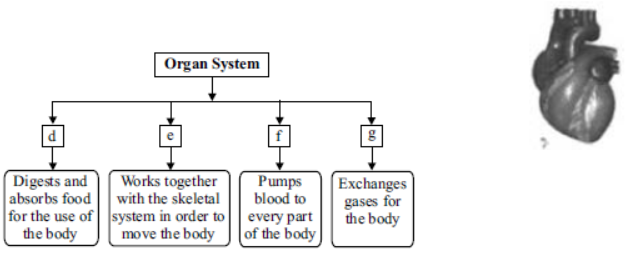
(a) d
(b) f
(c) g
(d) e
Answer: C
Question. Which organs are parts of the digestive system?
I. Stomach II. Small intestine III. Lungs IV. Blood
(a) I and IV
(b) II and IV
(c) I and II
(d) I, II and IV
Answer: C
Explanation: Stomach and small intestine are parts of the digestive system. Lungs are the part of respiratory system and blood is a part of circulatory system.
Question. How many bones are present in a human body?
(a) 200
(b) 150
(c) 206
(d) 350
Answer: C
Explanation: The human skeleton has a total of 206 bones. Number of bones are more in an infant which fuses and becomes 206 as it grows older. Therefore, option (c) is correct.
Question. Pick the incorrect match
(a) A blocked nose → the breathing system
(b) An upset stomach → the digestive system
(c) A heart attack → the muscular system
(d) A fractured leg → the skeletal system
Answer: C
Explanation: The heart is the key organ in the circulatory system. In a heart attack the heart muscle becomes damaged by lack of oxygen.
Question. Kidneys : Excretory system :: Intestine : ?
(a) Respiratory
(b) Muscular
(c) Digestive
(d) Circulatory
Answer: C
Explanation: Kidneys are associated with Excretory system and Intestine are with digestive system.
Question. Which organ of our body belongs to both the respiratory and the excretory system?
(a) Lungs
(b) Skin
(c) Kidneys
(d) Intestine
Answer: A
Question. On average 40% of your body weight is in______.
(a) Bones
(b) Nerves
(c) Muscles
(d) Blood
Answer: C
Explanation: On average 40% of your body weight is in muscles.
Question. The heart pumps blood into tubes called ______ .
(a) blood vessels
(b) cells
(c) nerves
(d) all of the above
Answer: A
Question. Which one of the following organs can be compared with the pump?
(a) Heart
(b) Lungs
(c) Kidney
(d) Brain
Answer: A
Question. How does the respiratory system deliver oxygen to different parts of the body?
(a) By breathing
(b) Through circulation
(c) By inhaling carbon-dioxide
(d) By inhaling nitrogen
Answer: B
Question. Which of the following is required by our body?
(a) Oxygen
(b) Urine
(c) Sweat
(d) Carbon-dioxide
Answer: A
Directions: Using the clues unscramble the letters and find the organ systems.
Question. Our body gets its shape from 
(a) nervous
(b) circulatory
(c) skeletal
(d) reproductive
Answer: C
Question. Young ones are produced by _________. 
(a) circulatory
(b) reproductive
(c) nervous
(d) skeleton
Answer: B
Question. Look at the following picture carefully. Which of the following organs is/are completely protected inside the following structure? 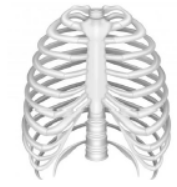
1. Heart 2. Stomach 3. Liver 4. Lungs
(a) 1 and 2 both
(b) Only 4
(c) Only 2
(d) 3 and 4
Answer: B
Question. Read the given sentences.
Air contains important gases like P and Q. We breathe in P and breathe out Q. Identify the gases P and Q and select the correct option.
(a) P-Oxygen, Q-Carbon dioxide
(b) P-Nitrogen, Q-Carbon dioxide
(c) P-Oxygen, Q-Nitrogen
(d) P-Carbon dioxide, Q-Oxygen
Answer: A
Explanation: P-Oxygen, Q-Carbon dioxide. We breathe in oxygen. Oxygen helps in breaking down of food, which gives us energy. Exhaled air (air we breathe out) has carbon dioxide.
Question. Our stomach is located :
(a) in the head.
(b) in the left side of the body.
(c) in the right side of the body.
(d) below the abdomen.
Answer: B
Explanation: in the left side of the body.
Question. Match the columns and select the correct option.
Column I Column II
(A) Excretory system 1. Kidney
(B) Digestive System 2. Blood
(C) Nervous system 3. Liver
(D) Circulatory system 4. Brain
(E) Skeletal system 5. Heart
6. Bones
7. Lungs
(a) (A)-2, (B)-3, (C)-4, (D)-5, (E)-6
(b) (A)-1, (B)-3, (C)-6, (D)-2, (E)-5
(c) (A)-3, (B)-6, (C)-4, (D)-5, (E)-2
(d) (A)-1, (B)-3, (C)-4, (D)-2, (E)-6
Answer: D
Question. Heart beats faster when which of the following activity is performed? 
Answer: A
Question. Each bone has a particular job. What is the job of the skull?
(a) Pumps blood to the brain
(b) Tells the brain what to do
(c) Helps the body to make decisions
(d) Protects the brain
Answer: D
Question. Our stomach expands when the food enters and contracts when it goes out.
Thus the stomach can expand and contract. This is possible because our stomach is made of:
(a) bones
(b) muscles
(c) blood
(d) iron
Answer: B
Question. The bone present inside the head is called __________ .
(a) skull
(b) spine
(c) rib cage
(d) vertebral column
Answer: A
Explanation: Skull is an immovable bone, spine lies below it. rib cage is the cage of bone in the chest and vertebral column lies at the back. Therefore option (a) is correct.
Question. What controls all our activities of seeing, hearing, learning, thinking and feeling?
(a) Skeletal system
(b) Muscular system
(c) Nervous system
(d) Circulatory system
Answer: C
Question. The number of muscles present in our body is :
(a) 700
(b) 600
(c) 106
(d) 206
Answer: B
Question. Sameer uses dumbbell to exercise daily. Which body systems are involved in bending and straightening of his arm? 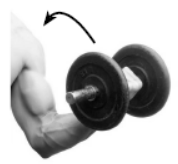
(a) Muscular and Excretory systems
(b) Digestive and Nervous systems
(c) Muscular and Skeletal systems
(d) Skeletal and Reproductive systems
Answer: C
Explanation: Muscular and skeletal systems of our body are involved in different body movements, e.g., bending and straightening of arms, etc.
Question. Our sense organs take messages from outside and send them to our brain. Our brain after receiving these messages order different organs to work accordingly. 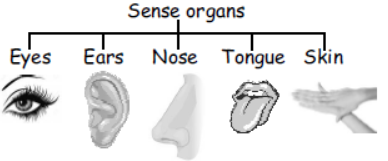
Which one of the following organs sends message to the brain?
(a) Heart
(b) Lungs
(c) Skin
(d) Nerves
Answer: D
Explanation: Sense organs take messages from outside and send them to our brain through nerves. The nervous system controls all our actions like seeing, hearing, walking and learning.
Question. Which one of the following organs does the skull protects?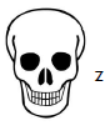
(a) Ears
(b) Nose
(c) Eyes
(d) Brain
Answer: D
Explanation: Brain is protected by the skull. Skull is the hard cranium which does not affect the brain whenever injury takes place.
Question. Consider the following statements as true or false and mark the correct option
A. Our skeleton helps to protect delicate organs in our body.
B. Different parts of the tongue are sensitive to different tastes.
C. Some of our sense organs do not have nerves in them.
D. Light enters the eye through the iris.
(a) FFTT
(b) TFTF
(c) TTFF
(d) FTFT
Answer: C
Explanation: All sense organs have nerves. Light enters the eye through cornea.
Question. Vijay got stomachache. Which of the following could be the reason ?
(a) He ate food at seven in the evening
(b) He drank water after eating food.
(c) He did not chew the food properly
(d) He did not wash his hands properly after eating food.
Answer: C
Explanation: Uneasiness and indigestion causes due to overeating or not chewing food properly.
Food should not be eaten fast; rather it should be chewed properly. Vijay did not chew the food properly.
Question. Which of the following organs help us in the sense of sight? 
Answer: A
Question. The flow diagram given below represents which one of the following system?
Mouth → Food pipe → Stomach → Small intestine → large intestine
(a) Digestive System
(b) Respiratory System
(c) Sensory System
(d) Nervous System
Answer: A
Explanation: The flow diagram given in the question represents Digestive System.
Question. Sohan went for a party with his family. Suddenly his younger sister started crying and said that she is having stomachache. What should Sohan do to make her feel comfortable?.
(a) Take her to the doctor.
(b) Take her to the police station
(c) Get some spicy food for her.
(d) None of the above.
Answer: A
Question. Roshan wants to become healthier. Which of these would not help him ?
(a) Regular exercise
(b) Eating healthy food
(c) Using car instead of walking
(d) Drinking lots of water and juice.
Answer: C
Question. Select the one that does not belong to that organ system to which the other three belong.
(a) Brain
(b) Spinal cord
(c) Nerves
(d) Lungs
Answer: D
Explanation: Lungs are part of the respiratory system while brain, spinal cord and nerves are all parts of nervous system.
Question. Riya is running fast to overtake his brother Ayush who is 100 metre ahead of her. Her heart beat __________.
(a) would be slower
(b) would be faster
(c) would beat 72 times a minute
(d) none of these
Answer: B
Question. Number of bones in human skeletal system is :
(a) 206
(b) 208
(c) 306
(d) 308
Answer: A
Question. Riddhi ran to open the door when her father rang the bell. She used her sense of _______.
(a) Hearing
(b) Seeing
(c) Touching
(d) Tasting
Answer: A
Explanation: Riddhi heard the sound of bell using her ears and then ran to open the door.
Question. Look at the picture of the human skeletal system below.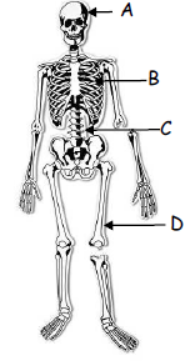
Which one of the following represents the parts of the skeletal system correctly?
A B C D
(a) Skull Backbone Hip bone Leg bone
(b) Skull Ribcage Backbone Thigh bone
(c) Skull Backbone Ribcage Leg bone
(d) Cheek bone Ribcage Backbone Thigh bone
Answer: B
Explanation: In the given picture of human skeletal system, A is the skull and it is a part of the skeletal system that protects the brain and sense organs. B is the ribcage that protects the lungs and heart. C is the backbone and D is the thigh bone.
Other options are wrong.
Question. Harmful substances are eliminated through the :
(a) Kidney
(b) Lungs
(c) Skin
(d) All of the above
Answer: A
Question. Rohan was playing with his friends suddenly he fell down and broke his ribcage.
Which of his organs are now in danger?
I. Small intestine II. Large intestine III. Heart IV. Lungs
(a) I and II
(b) II and III
(c) II and IV
(d) III and IV
Answer: D
Explanation: Rohan got injured and broke his ribcage. The function of ribcage is to protect the vital organs such as heart, lungs and liver. According to the options, heart and lungs are in danger. Small intestine and large intestine are generally unaffected as they are present below the stomach.
Question. How many kidneys do we have?
(a) Three
(b) Two
(c) Four
(d) One
Answer: B
Try solving the following riddles and choose the best option?
Question. We take oxygen that your body needs from the air and put it in your blood stream.
We also take carbon dioxide that is in your blood and send it out of your body. What are we ?
(a) Stomach
(b) Heart
(c) Kidneys
(d) Lungs
Answer: D
Question. We give your body support and structure. We also protect your body’s softer organs.
We have a substance filled inside called ‘marrow’. What are we ?
(a) Veins
(b) Nerves
(c) Bones
(d) None of these
Answer: C
Question. I hold your body parts. I have pores so sweat can escape your body. I am filled with nerves that help you to sense temperature and feel the things around you. What am I ?
(a) Large intestine
(b) Skin
(c) Lungs
(d) Liver
Answer: B
Question. I am always moving and I never get tired. I pump blood to all parts of your body. What am I ?
(a) Liver
(b) Heart
(c) Kidneys
(d) Stomach
Answer: B
Fill in the blanks with the most suitable word.
There are ___(A)___ bones in a grown up skeleton. The largest bone in our skeleton is called the ___(B)___ and it is located on the upper part of our leg. Our feet and ___(C)___ have almost half of all of the bones in our body. Joints are where the bones meet, our ___(D)___ allow us to move and bend. We have bone marrow inside our bones.
The bone marrow is what makes our ___(E)___ .
Question. A.
(a) 208
(b) 206
(c) 209
(d) 205
Answer: A
Question. B.
(a) femur
(b) lemur
(c) patella
(d) tibia
Answer: A
Question. C.
(a) skull
(b) face
(c) hands
(d) legs
Answer: C
Question. D.
(a) eyes
(b) legs
(c) waist
(d) joints
Answer: D
Question. E.
(a) blood
(b) sugar
(c) salt
(d) urine
Answer: A
Which sense organ will help you to :
Question. find if sugar has been added to your cold coffee or not.
(a) Ear
(b) Eyes
(c) Tongue
(d) Skin
Answer: C
Question. find a candle in a dark room.
(a) Ear
(b) Eyes
(c) Tongue
(d) Skin
Answer: D
Explanation: Skin can touch and feel.
Our Body Objective Questions & Solutions for Class 3 Science
Class 3 Science Our Body Objective Test Questions
Explore reliable practice questions for Our Body tailored for Class 3 Science learners. Use these multiple-choice formats to evaluate preparedness and strengthen problem-solving skills.
NCERT-Aligned Objective Questions and Solutions
Each question includes structured solution keys mapped directly to standard CBSE textbooks, helping students evaluate their reasoning and correct mistakes early in their revision.
Next Steps in Your Exam Preparation
Follow up your worksheet practice by attempting the interactive online Science MCQ test for this chapter to evaluate your execution speed. All platform resources are free to access.
FAQs
You can get most exhaustive CBSE Class 3 Science Our Body MCQs for free on StudiesToday.com. These MCQs for Class 3 Science are updated for the 2026-27 academic session as per CBSE examination standards.
Yes, our CBSE Class 3 Science Our Body MCQs include the latest type of questions, such as Assertion-Reasoning and Case-based MCQs. 50% of the CBSE paper is now competency-based.
By solving our CBSE Class 3 Science Our Body MCQs, Class 3 students can improve their accuracy and speed which is important as objective questions provide a chance to secure 100% marks in the Science.
Yes, Science MCQs for Class 3 have answer key and brief explanations to help students understand logic behind the correct option as its important for 2026 competency-focused CBSE exams.
Yes, you can also access online interactive tests for CBSE Class 3 Science Our Body MCQs on StudiesToday.com as they provide instant answers and score to help you track your progress in Science.