

Official Class 11 Chemistry Revision Material: CBSE Class 11 Chemistry Equilibrium Notes Set 05
Review targeted revision notes for Class 11 Chemistry with the CBSE Class 11 Chemistry Equilibrium Notes Set 05. Built according to official educational guidelines for the 2026-27 academic year, these downloadable summaries for Chapter 06 Equilibrium support daily study and last-minute exam readiness.
Chapter-wise Concept Summaries: Chapter 06 Equilibrium
View or download the dedicated Chapter 06 Equilibrium revision resource below. Engaging with these structured concept notes daily ensures continuous academic progress and mastery of the 2026-27 curriculum for Chemistry.
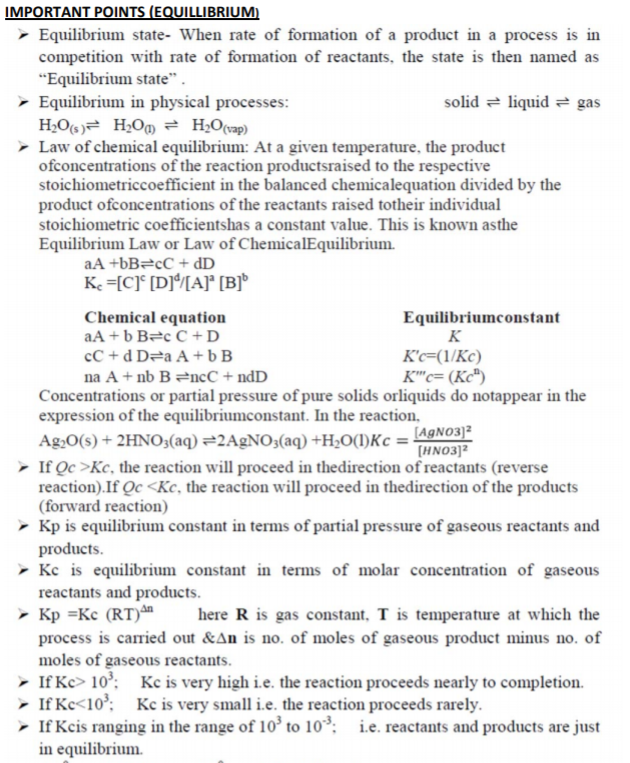
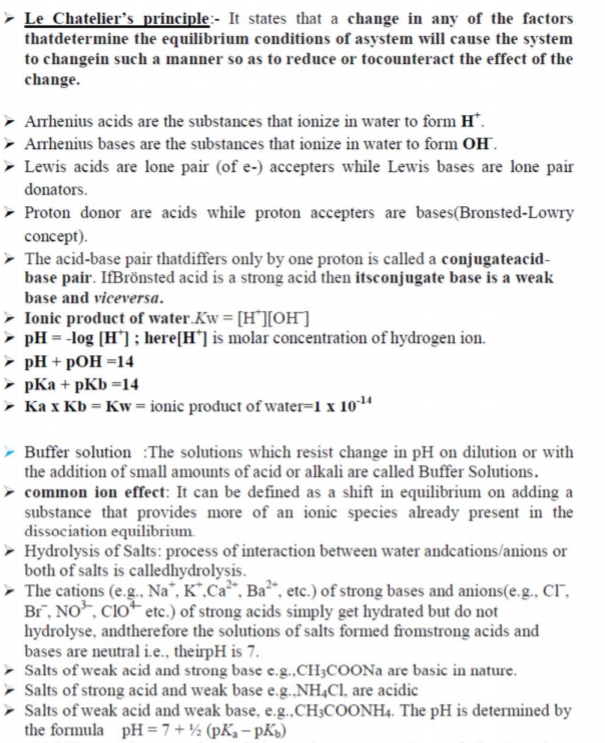
IMPORTANT QUESTIONS CHAPTER‐ EQUILIBRIUM
1. Equilibrium constant helps in predicting the direction in which a given reaction will proceed at any stage.
a) In which one of the following conditions a chemical reaction Proceeds in the forward direction?
i) QC < KC
ii) QC > KC
iii) QC = 1/KC
IV) QC = ‐ KC
b) Write whether the following statement is true or false:
"High value of equilibrium constant suggests high concentration of the reactants in the equilibrium mixture”.
c) State the Le‐Chatliers principle. Applying this principle, explain the effect of pressure in the following
CO(g) + 3 H2(g) → CH4(g) + H2O(g) (3)
2. a) i) Give the Arrhenius concept about acids and bases.
ii) Give one example each for Arrhenius acid and
b) i) Write the expression for equilibrium constant Kp for the following
2NOCl(g) 2NO(g) + Cl2(g)
ii) Find the value of Kc for the above equilibrium if the value of Kp is 8 x 10‐2 atm at 600 K. (R= 0.0821 Latm K‐1mol‐1)
3. Le‐Chatlier’s principle makes a qualitative prediction about the change in conditions on equilibrium.
a) State Le‐Chatlier’s principle.
b) N2(g) + O2(g) 2NO(g).
What is the effect of pressure on the above equilibrium?
c) The species HCO3‐ and HSO4‐ can act both as Bronsted acids and bas Write the corresponding conjugate acid and conjugate base of the above species.
4.a) Write an equation for equilibrium constant in terms of concentration (Kc) for the equilibrium reaction given below.
Ag2O(s) + 2HNO3(aq) 2 AgNO3(aq) + H2O(l) (1)
b) What are buffer solutions? Give an example for a buffer solution
c) The concentration of H+ ion in a sample of soft drink is 3.8 x 10‐3M. Determine its pH.
4.a) What is conjugate acid – base pair? Illustrate with an example.
b) Define the pH The pH of a soft drink is 2.42. Give the nature of the solution.
c) An aqueous solution of CuSO4 is acidic while that of Na2SO4 is neutral. Explain.
5. Equilibrium is possible only in a closed system at a given temperature.
6. a) Write the expression for equilibrium constant, Kc for the reaction
4 NH3(g) + 5 O2(g) 4 NO(g) + 6 H2O(l)
b) What happens to the value of the equilibrium constant (Kc) when the above reaction is reversed?
7. Weak acids are partially ionized in aqueous solutions.
a) The ionization constants of some acids are given below: Acid Ionisation constant (Ka)
Formic acid (HCOOH) 1.8 x 10‐4
Hypochlorous acid (HClO) 3.0 x 10‐8
Nitrous acid (HNO2) 4.5 x 10‐4
Hydrocyanic acid (HCN) 4.9 x 10‐10
Arrange the above acids in the increasing order of their acid strength.
b) Calculate the pH of a 01 M acetic acid solution with the degree of ionization 0.045.
8. Salts can be classified into different categories on the basis of their solubility.
a) Identify the solubility range of sparingly soluble salts from the following:
(Between 0.01 M and 0.1 M, less than 0.01 M, greater than 0.1 M).
b) Calculate the solubility (S) of CaSO4 at 298 K, if its solubility product constant (Ksp) at this temperature is 9 x 10‐6.
9. a) During a class room discussion one of your friends argues that equilibrium constant is not altered with change in temperature. What is your view towards this argument? Justify.
b) Dissociation of CaCO3 in a closed vessel is given as CaCO3(s) CaO(s) + CO2(g)
i) Write an expression for Kc
ii) Explain the effect of increase in pressure on the above reaction. Name the principle behind thi
10. Le‐Chatlier’s principle helps to explain the effect of change in conditions on equilibrium. Discuss the effect of pressure in the following equilibrium on the basis of Le‐Chatlier’s principle:
CO(g) + 3 H2(g) CH4(g) + H2O(g)
11. The behaviour of acids and bases can be explained by using different concepts.
a) Select the Lewis acid from the following: (NH3, OH‐, BCl3, Cl‐)
b) What are conjugate acid – base pairs? Illustrate using a suitable
12. The pH of a salt solution depends on the hydrolysis of its ions.
a) Out of the following, which can produce an acidic solution in water? (CH3COONa, NH4Cl, CH3COONH4, NaCl) (1)
b) Explain the phenomenon of common ion effect with a suitable
13. The principal goal of chemical synthesis is to maximize the conversion of reactants into products. Le‐Chatlier’s principle can be applied to achieve this goal.
a) State Le‐Chatlier’s principle.
b) Predict the conditions to be applied to maximize the production of ammonia in the following reaction.
N2(g) + 3 H2(g) 2 NH3(g); ΔH = ‐92.38 kJ/mol (3)
c) Comment on the effect of increasing pressure in the reaction, 2 SO3(g) 2 SO2(g) + O2(g)
14. Common ion effect is a phenomenon based on Le‐Chatlier’s principle.
a) Illustrate the common ion effect with an example.
b) If the concentration of hydrogen ion in a soft drink is 3 x 10‐3 M, calculate its pH.
c) Identify the Lewis acids from the following: OH‐, BCl3, NH3, H+
15.Lowry‐Bronsted concept of acid and bases is based on the exchange of H+ during a reaction.
a) Illustrate with an example of the conjugate acid – base pair.
b) Explain the Lewis concept of acids and
c) According to Lewis theory, classify the following into acids and bases: H2O, NH3, AlCl3, OH‐
16. When some sodium acetate is added to a solution of acetic acid, the concentration of unionized acetic acid increases.
a) What is the phenomenon involved? Subs
b) Consider the equilibrium, AgCl(s) Ag+(aq) + Cl‐(aq)
The solubility of AgCl is 1.06 x 10‐5 mol/L at 298K. Find out its Ksp at this temperature.
c) What happens to the value of solubility and solubility product when HCl is passed through AgCl solution?
17. The aqueous solutions of the ionic compounds NaCl, CH3COONa and NH4Cl show different pH.
a) Identify the acidic, basic and neutral solutions among these.
b) Justify your answe
18. CaCO3(s) CaO(s) + CO2(g)
a) Write down the expression for
b) What is the relation between Kp and Kc in the above reaction?
19. PCl5(g) PCl3(g) + Cl2(g)
a) What happens to Kp of the above system if more chlorine is added to the system in equilibrium.
b) Give the relation between Kp and Kc in the above
Please click the link below to download pdf file for CBSE Class 11 Chemistry-Equilibrium
Free study material for Chemistry
Chapter 06 Equilibrium Concepts and Summary for Class 11 Chemistry
Key Concepts and Summary for Class 11 Chemistry Chapter 06 Equilibrium
Access structured revision notes for Chapter 06 Equilibrium designed in alignment with the latest CBSE curriculum for Class 11 Chemistry. These summaries help clarify core themes and support effective daily study.
NCERT-Aligned Chapter Summary and Notes
Each chapter summary is structured around standard CBSE textbooks, allowing students to check their understanding and clarify complex ideas early in their revision.
Next Steps in Your Exam Preparation
Wrap up your chapter revision by testing your knowledge against standard question formats. Everything on our platform is provided free of charge.
FAQs
You can download the teacher prepared revision notes for CBSE Class 11 Chemistry Equilibrium Notes Set 05 from StudiesToday.com. These notes are designed as per 2026-27 academic session to help Class 11 students get the best study material for Chemistry.
Yes, our CBSE Class 11 Chemistry Equilibrium Notes Set 05 include 50% competency-based questions with focus on core logic, keyword definitions, and the practical application of Chemistry principles which is important for getting more marks in 2026 CBSE exams.
Yes, our CBSE Class 11 Chemistry Equilibrium Notes Set 05 provide a detailed, topic wise breakdown of the chapter. Fundamental definitions, complex numerical formulas and all topics of CBSE syllabus in Class 11 is covered.
These notes for Chemistry are organized into bullet points and easy-to-read charts. By using CBSE Class 11 Chemistry Equilibrium Notes Set 05, Class 11 students fast revise formulas, key definitions before the exams.
No, all study resources on StudiesToday, including CBSE Class 11 Chemistry Equilibrium Notes Set 05, are available for immediate free download. Class 11 Chemistry study material is available in PDF and can be downloaded on mobile.