

Chemistry Concept Notes for Class 11: Chapter 14 Environmental Chemistry
Explore reliable concept summaries and revision materials through the CBSE Class 11 Chemistry Environmental Chemistry Notes Set 04. Tailored for Class 11 learners, utilizing these notes for Chemistry Chapter 14 Environmental Chemistry ensures thorough preparation and strengthens core academic definitions before final evaluations.
Download Chapter 14 Environmental Chemistry Revision Notes PDF
View or download the dedicated Chapter 14 Environmental Chemistry revision resource below. Engaging with these structured concept notes daily ensures continuous academic progress and mastery of the 2026-27 curriculum for Chemistry.
CBSE Class 9 Chemistry-Environmental chemistry. Learning the important concepts is very important for every student to get better marks in examinations. The concepts should be clear which will help in faster learning. The attached concepts made as per NCERT and CBSE pattern will help the student to understand the chapter and score better marks in the examinations.
Environmental pollution
Important points
•ENVIRONMENTAL CHEMISTRY Environmental chemistry deals with the study of the origin, transport, reactions, effects, fates of chemical species in the environment.
•ENVIRONMENTAL POLLUTION:‐Environmental pollution is the effect of undesirable changes in our surroundings that have harmful effects on plants, animals and human beings. A substance which causes pollution is called a pollutant. They can be solid, liquid or in the gaseous state.
•ATMOSPHERIC POLLUTION:‐The atmosphere that surrounds the earth is not of the same thickness at different heights. Atmospheric pollution is generally studied as tropospheric and stratospheric pollution. The ozone layer prevents about 99.5%of the sun’s UV rays. T
•TROPOSPHERIC POLLUTION:‐Tropospheric pollution occurs due to the presence of undesirable solid or gaseous particles in the air. The following are the major gaseous and particulate pollutants present in the troposphere;
Gaseous air pollutants: These are oxides of sulphur, nitrogen and carbon, hydrogen sulphide, hydrocarbons, ozone and other oxidants.
Particulate pollutants; these are dust, mist, fumes, smoke, smog etc.
Particulates are of two types:
1. Viable particulates: are living on minute organism dispersed in air.
2. Non‐viable particulate: as metals particle, metal oxides, lead salts etc.
•GLOBAL WARMING AND GREENHOUSE EFFECT:‐About 75% of the solar energy reaching the earth is absorbed by the earth’s surface, which increases it’s temperature. The rest of the heat radiates back to the atmosphere. Some of the heat is trapped by the gases such as carbon dioxide, methane, ozone, CFCS and Water vapour. They add to the heating of the atmosphere causing Global warming In a greenhouse, visible light passes through the transparent glass and heats up the soil and the plants. The warm soil and plants emit infrared rays,it partly reflects and partly absorbs these radiations, this mechanism keeps the energy of the sun trapped in the greenhouse
•ACID RAIN: When the pH of the rain water drops below5.6, it is called acid rain. Acid rain is harmful for agriculture, trees and plants as it dissolves and washes away nutrients needed for their growth. It causes respiratory ailments 187 in human beings and animals. When acid rain falls and flows as ground water to reach rivers, lakes etc. it affects plants and animal life in aquatic ecosystem
•SMOG: The word smog is derived from smoke and fog. There are two types of smog:
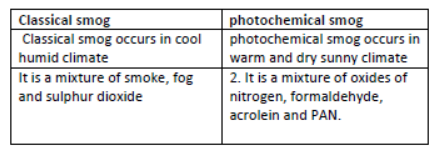
•OZONE HOLE: Depletion of ozone layer is known as ozone hole.
•EFFECTS OF DEPLETION OF THE OZONE LAYER: With the depletion of ozone layer:
→More UV radiation filters into troposphere.
→UV radiations lead to ageing of skin, cataract, sunburn, skin cancer,
→killing of many phytoplankton’s,
→Damage to fish productivity etc.
•WATER POLLUTION:‐contamination of water by foreign substances which make it harmful for health of animals or plants or aquatic life and make it unfit for domestic, industrial and agriculture use.
•Fluorosis: is a cosmetic condition that affects teeth it occurs due to over exposure to fluoride ions. It is water born disease due increased level of F‐ ions in water.
•SOURCES/ CAUSES OF WATER POLLUTION:
(i) Sewage and domestic wastes
(ii) Industrial effluents
(iii) Agriculture effluents Siltation‐mixing of soil or rock into water
(iv) Thermal pollutants Radioactive discharge
•EUTROPHICATION: The process in which nutrient enriched water bodies support a dense plant population, which kills animal life by depriving it of oxygen and results in subsequent loss of biodiversity is known as Eutrophication
•BOD: The amount of oxygen required by bacteria to break down the organic matter present in a certain volume of a sample of water is called Biochemical Oxygen Demand (BOD)
•COD: Chemical oxygen demand is a measure of the capacity of water to consume oxygen during the decomposition of inorganic chemicals such as ammonia, & nitrite.
SOIL POLLUTION: Any factor which deteriorates the quality of soil. Insecticides, pesticides and herbicides cause soil pollution.
•GREEN CHEMISTRY: Green chemistry us a way of thinking and is about utilizing the existing knowledge and principles of chemistry and other sciences to reduce the adverse impact on environment. Green chemistry is a production process that would bring out minimum pollution or deterioration to the environment. Utilization of existing knowledge base for reducing the chemical hazards along with the development of activities is the foundation of green chemistry.
(i) In dry cleaning ,use of liquefied CO2 in place of tetrachloroethene (Cl2C=CCl2)
(ii) In bleaching of paper using H2O2 in place of chlorine.
(iii) In the manufacture of chemicals like ethanal using environment‐friendly chemicals and conditions
Please click the link below to download pdf file forCBSE Class 9 Chemistry-Environmental chemistry
Free study material for Chemistry
Chapter 14 Environmental Chemistry Concepts and Summary for Class 11 Chemistry
Quick Revision Notes: Chapter 14 Environmental Chemistry (CBSE)
Access structured revision notes for Chapter 14 Environmental Chemistry designed in alignment with the latest CBSE curriculum for Class 11 Chemistry. These summaries help clarify core themes and support effective daily study.
Expert Study Material for Class 11 Chemistry
Each chapter summary is structured around standard CBSE textbooks, allowing students to check their understanding and clarify complex ideas early in their revision.
Complete Your Chapter Revision
Wrap up your chapter revision by testing your knowledge against standard question formats. Everything on our platform is provided free of charge.
FAQs
You can download the teacher prepared revision notes for CBSE Class 11 Chemistry Environmental Chemistry Notes Set 04 from StudiesToday.com. These notes are designed as per 2026-27 academic session to help Class 11 students get the best study material for Chemistry.
Yes, our CBSE Class 11 Chemistry Environmental Chemistry Notes Set 04 include 50% competency-based questions with focus on core logic, keyword definitions, and the practical application of Chemistry principles which is important for getting more marks in 2026 CBSE exams.
Yes, our CBSE Class 11 Chemistry Environmental Chemistry Notes Set 04 provide a detailed, topic wise breakdown of the chapter. Fundamental definitions, complex numerical formulas and all topics of CBSE syllabus in Class 11 is covered.
These notes for Chemistry are organized into bullet points and easy-to-read charts. By using CBSE Class 11 Chemistry Environmental Chemistry Notes Set 04, Class 11 students fast revise formulas, key definitions before the exams.
No, all study resources on StudiesToday, including CBSE Class 11 Chemistry Environmental Chemistry Notes Set 04, are available for immediate free download. Class 11 Chemistry study material is available in PDF and can be downloaded on mobile.