

Download Class 11 Chemistry Concept Summaries: CBSE Class 11 Chemistry Classification Of Elements Notes Set 01
Access comprehensive revision notes for Chapter 03 Classification of Elements and Periodicity in Properties using the CBSE Class 11 Chemistry Classification Of Elements Notes Set 01. Designed to align with the 2026-27 academic syllabus for Class 11 Chemistry, these concept summaries help students streamline their exam preparation and review complex topics efficiently.
Access Chapter 03 Classification of Elements and Periodicity in Properties Notes and Study Material
Navigate directly to the revision notes for Chapter 03 Classification of Elements and Periodicity in Properties using the digital viewer below. Each summary is structured to highlight high-weightage sections, allowing students to instantly access critical definitions and focus on core exam topics.
CHAPTER-3
CLASSIFICATION OF ELEMENTS AND PERIODICITY IN
PROPERTIES OF ELEMENTS
Mendeleev’s Periodic Law:- The properties of the elements are the periodic function of their atomic masses.
Moseley, the English physicist showed that atomic number i+s more fundamental property of an element than its atomic mass. Therefore, the position of an element in the periodic table depends on its atomic number than its atomic mass.
Modern Periodic Law: The physical and chemical properties of elements are the periodic functions of their atomic numbers.
Types of Elements: s-, p-, d- and f- blocks.
MAIN GROUP ELEMENTS/ REPRESENTATIVE ELEMENTS:
The s- and p- block elements are called main group elements or representative elements.
s- block elements: Group-1 (Alkali metals) and Group-2 elements (Alkaline earth metals) which respectively have ns1 and ns2 outermost electronic configurations.
p- Block elements: They belongs to group- 13 to 18. The outer most electronic configuration is ns2 np1 -6. He (1s2) is a s- block element but is positioned
with the group 18 elements (ns2 np6) because it has completely filled valence shell and as a result, exhibits properties characteristic of other noble gases.
d- block elements (Transition elements) are the elements of group 3 to 12 having outer electronic configuration (n-1) d1-10 ns1-2. Four transition series are 3d, 4d, 5d and 6d. The 6d- series is incomplete. Atomic radius generally decreases across a period and increases as we descend the group.
f-Block elements (Inner- transition Series)
Lanthanides characterized by the filling of4 f-orbitals, are the elements following lanthanum from 58Ce to 71Lu. Actinides characterized by filling of 5f-orbitals, are the elements following actinium from 70Th to 103Lr. Characteristic outer
electronic configuration is (n-2) f
1-14 (n-1) d0-1 ns2.
1Noble Gases: The gaseous elements of group 18 are called noble gases. The general outermost electronic configuration of noble gases (except He) is ns2 np6.
He exceptionally has 1s2 configuration. Thus the outermost shell of noble gases is completely filled.
PERIODICITY: The repetition of similar properties after regular intervals is called periodicity.
Cause of Periodicity: The properties of elements are the periodic repetition of similar electronic configuration of elements as the atomic number increases.
ATOMIC PROPERTIES: The physical characteristics of the atom of an element are called atomic properties. The properties such as atomic radius, ionic radius, ionisation energy, electro-negativity, electron affinity and valence etc., called atomic properties.
ATOMIC RADIUS- The distance from the center of the nucleus to the outermost shell of the electrons in the atom of any element is called its atomic radius.
Periodicity- (a) In period- Atomic radius of elements decreases from left to right in a period.
(b) In Group- Atomic radius of elements increases on moving top to bottom in a group.
COVALENT RADIUS- Half the inter-nuclear distance between two similar atoms of any element which are covalently bonded to each other by a single covalent bond is called covalent radius.
VAN DER WAALS’ RADIUS: Half the inter-nuclear separation between two similar adjacent atoms belonging to the two neighbouring molecules of the same substance in the solid state is called the van der waals’radius of that atom.
METALLIC RADIUS: Half the distance between the nuclei of the two adjacent metal atoms in a close packed lattice of the metal is called its metallic radius. Van der Waals’radius > Metallic radius > Covalent radius
IONIC RADIUS: The effective distance from the centre of the nucleus of an ion upto which it has an influence on its electron cloud is called its ionic radius.
A cation is smaller but the anion is larger than the parent atom. In case of iso-electronic species, the cation with greater positive charge has smaller radius but anion with greater negative charge has the larger radii.
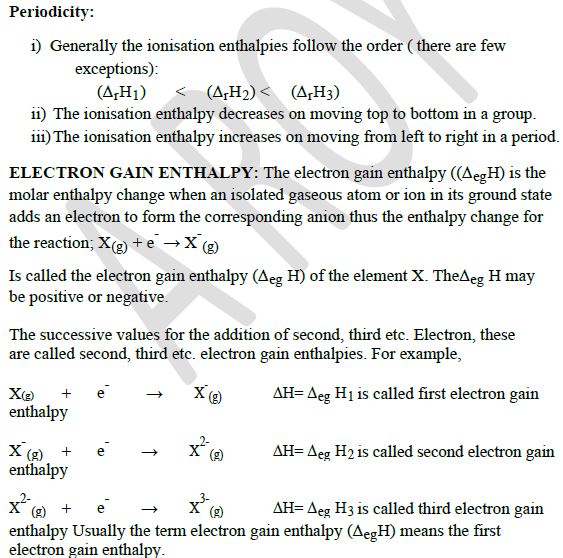
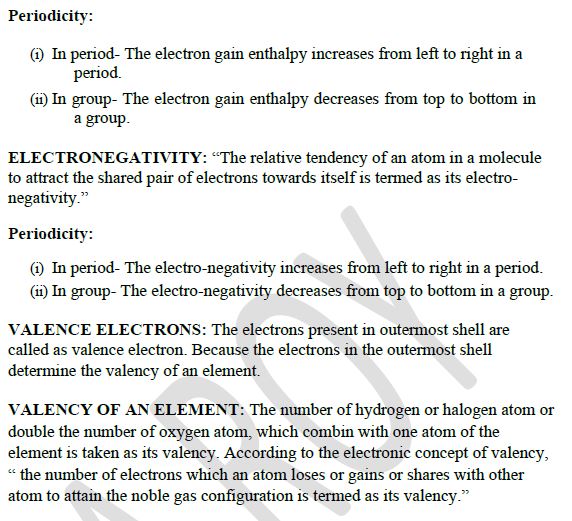
IONISATION ENTHALPY: The ionisation enthalpy is the molar enthalpy change accompanying the removal of an electron from a gaseous phase atom or ion in its ground state. Thus enthalpy change for the reaction; M(g)→ M+(g) + e-
Is the ionisation enthalpy of the element M. Like ionisation energies for successive ionisation, the successive ionisation enthalpy may also be termed as 2nd ionisation enthalpy (ΔrH2), third ionisation enthalpy (ΔrH3) etc. The term ionisation enthalpy is taken for the first ionisation enthalpy, (ΔrH1) is expressed in kg mol- or in eV.
Please click the link below to download pdf file for CBSE Class 11 Chemistry Classification Of Elements Notes Set A
Free study material for Chemistry
Download CBSE Revision Notes: Class 11 Chemistry Chapter 03 Classification of Elements and Periodicity in Properties
Quick Revision Notes: Chapter 03 Classification of Elements and Periodicity in Properties (CBSE)
Access structured revision notes for Chapter 03 Classification of Elements and Periodicity in Properties designed in alignment with the latest CBSE curriculum for Class 11 Chemistry. These summaries help clarify core themes and support effective daily study.
Expert Study Material for Class 11 Chemistry
Built using the official NCERT book for Class 11 Chemistry, these notes provide reliable academic guidance. Pair your summary review with our recommended NCERT solutions to master optimal problem-solving approaches.
Complete Your Chapter Revision
Follow up your revision by attempting the interactive online Chemistry MCQ test and practice worksheets for this chapter to verify your mastery. All platform resources are free to access.
FAQs
You can download the teacher prepared revision notes for CBSE Class 11 Chemistry Classification Of Elements Notes Set 01 from StudiesToday.com. These notes are designed as per 2026-27 academic session to help Class 11 students get the best study material for Chemistry.
Yes, our CBSE Class 11 Chemistry Classification Of Elements Notes Set 01 include 50% competency-based questions with focus on core logic, keyword definitions, and the practical application of Chemistry principles which is important for getting more marks in 2026 CBSE exams.
Yes, our CBSE Class 11 Chemistry Classification Of Elements Notes Set 01 provide a detailed, topic wise breakdown of the chapter. Fundamental definitions, complex numerical formulas and all topics of CBSE syllabus in Class 11 is covered.
These notes for Chemistry are organized into bullet points and easy-to-read charts. By using CBSE Class 11 Chemistry Classification Of Elements Notes Set 01, Class 11 students fast revise formulas, key definitions before the exams.
No, all study resources on StudiesToday, including CBSE Class 11 Chemistry Classification Of Elements Notes Set 01, are available for immediate free download. Class 11 Chemistry study material is available in PDF and can be downloaded on mobile.