

Revision Notes for Class 11 Chemistry: Chapter 02 Structure of Atom
Explore reliable concept summaries and revision materials through the CBSE Class 11 Chemistry Structure Of Atom Notes Set 03. Tailored for Class 11 learners, utilizing these notes for Chemistry Chapter 02 Structure of Atom ensures thorough preparation and strengthens core academic definitions before final evaluations.
Review Chapter 02 Structure of Atom for Class 11 Chemistry
Access the complete concept summary PDF for Chapter 02 Structure of Atom below. Regular review of these targeted notes builds familiarity with complex Class 11 Chemistry themes and helps secure higher marks in final school evaluations.
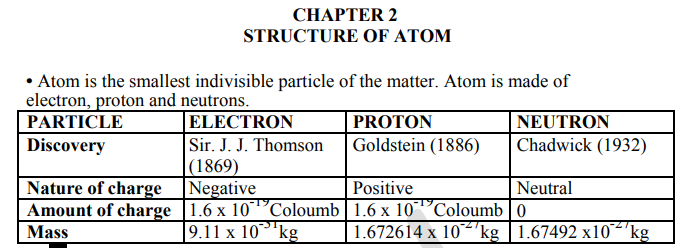
Electrons were discovered using cathode ray discharge tube experiment. Nucleus was discovered by Rutherford in 1911.
Cathode ray discharge tube experiment: A cathode ray discharge tube made of glass is taken with two electrodes. At very low pressure and high voltage, current starts flowing through a stream of particles moving in the tube from cathode to anode. These rays were called cathode rays. When a perforated anode was taken, the cathode rays struck the other end of the glass tube at the fluorescent coating and a bright spot on the coating was developed
Results:
a. Cathode rays consist of negatively charged electrons.
b. Cathode rays themselves are not visible but their behavior can be observed with help of fluorescent or phosphorescent materials.
c. In absence of electrical or magnetic field cathode rays travel in straight lines
d. In presence of electrical or magnetic field, behavior of cathode rays is similar to that shown by electrons
e. The characteristics of the cathode rays do not depend upon the material of the electrodes and the nature of the gas present in the cathode ray tube.
Charge to mass ratio of an electron was determined by Thomson. The charge to mass ratio of an electron as 1.758820 x 10¹¹ C kg-1 Charge on an electron was determined by R A Millikan by using an oil drop experiment.
The value of the charge on an electron is -1.6 x 10⁻¹⁹C.The mass on an electron was determined by combining the results of Thomson’s experiment and Millikan’s oil drop experiment. The mass of an electron was determined to be 9.1094 x 10⁻³¹kg.
Discovery of protons and canal rays: Modified cathode ray tube experiment was carried out which led to the discovery of protons. Characteristics of positively charged particles:
a. Charge to mass ratio of particles depends on gas from which these originate
b. The positively charged particles depend upon the nature of gas present in the cathode ray discharge tube
c. Some of the positively charged particles carry a multiple of fundamental of electrical charge.
d. Behaviour of positively charged particles in electrical or magnetic field is opposite to that observed for cathode rays
Neutrons were discovered by James Chadwick by bombarding a thin sheet of beryllium by α- particles. They are electrically neutral particles having a mass slightly greater than that of the protons.
Atomic number (Z) : the number of protons present in the nucleus (Moseley1913).
Mass Number (A) :Sum of the number of protons and neutrons present in thenucleus.
Thomson model of an atom: This model proposed that atom is considered asa uniform positively charged sphere and electrons are embedded in it.An important feature of Thomson model of an atom was that mass of atom isconsidered to be evenly spread over the atom.Thomson model of atom is also called as Plum pudding, raisin pudding orwatermelon modelThomson model of atom was discarded because it could not explain certainexperimental results like the scattering of α- particles by thin metal foils.
Observations from α- particles scattering experiment by Rutherford:
a. Most of the α- particles passed through gold foil un deflected
b. A small fraction of α- particles got deflected through small angles
c. Very few α- particles did not pass through foil but suffered large deflection nearly180o
Conclusions Rutherford drew from α- particles scattering experiment:
a. Since most of the α-particles passed through foil undeflected, it means most of the space in atom is empty
b. Since some of the α-particles are deflected to certain angles, it means that there is positively mass present in atom
c. Since only some of the α-particles suffered large deflections, the positively charged mass must be occupying very small space
d. Strong deflections or even bouncing back of α-particles from metal foil were due to direct collision with positively charged mass in atom
Rutherford’s model of atom: This model explained that atom consists ofnucleus which is concentrated in a very small volume. The nucleus comprisesof protons and neutrons. The electrons revolve around the nucleus in fixedorbits. Electrons and nucleus are held together by electrostatic forces ofattraction.
Drawbacks of Rutherford’s model of atom:
a. According to Rutherford’s model of atom, electrons which are negatively charged particles revolve around the nucleus in fixed orbits. Thus,
b. theelectrons undergo acceleration. According to electromagnetic theory of Maxwell, a charged particle undergoing acceleration should emitelectromagnetic radiation. Thus, an electron in an orbit should emitradiation. Thus, the orbit should shrink. But this does not happen.
c. The model does not give any information about how electrons aredistributed around nucleus and what are energies of these electrons
Isotopes: These are the atoms of the same element having the same atomicnumber but different mass number.e g 1H1,1H2,1H3
Isobars: Isobars are the atoms of different elements having the same massnumber but different atomic number.e g 18Ar40 , 20Ca40
Isoelectronic species: These are those species which have the same numberof electrons.
Electromagnetic radiations: The radiations which are associated withelectrical and magnetic fields are called electromagnetic radiations. When anelectrically charged particle moves under acceleration, alternating electricaland magnetic fields are produced and transmitted. These fields aretransmitted in the form of waves. These waves are called electromagneticwaves or electromagnetic radiations.
Properties of electromagnetic radiations:
a. Oscillating electric and magnetic field are produced by oscillating charged particles. These fields are perpendicular to each other and both areperpendicular to the direction of propagation of the wave.
b. They do not need a medium to travel. That means they can even travel in vacuum.
Characteristics of electromagnetic radiations:
a. Wavelength: It may be defined as the distance between two neighbouring crests or troughs of wave as shown. It is denoted by λ.
b. Frequency (ν): It may be defined as the number of waves which passthrough a particular point in one second.
c. Velocity (v): It is defined as the distance travelled by a wave in
onesecond. In vacuum all types of electromagnetic radiations travel with thesame velocity. Its value is 3 X10⁸m sec-1. It is denoted by v
d. Wave number: Wave number is defined as the number of wavelengths per unit length.
Velocity = frequency x wavelength c = νλ
Planck's Quantum Theory-
o The radiant energy is emitted or absorbed not continuously but discontinuously in the form of small discrete packets of energy called ‘quantum’. In case of light , the quantum of energy is called a ‘photon’
o The energy of each quantum is directly proportional to the frequency of the radiation, i.e. E α υ or E= hυ where h= Planck’s constant = 6.626 x 10⁻²⁷ Js
o Energy is always emitted or absorbed as integral multiple this quantum. E=nhυ Where n=1,2,3,4,.....
Black body: An ideal body, which emits and absorbs all frequencies, is calleda black body. The radiation emitted by such a body is called black bodyradiation.
Photoelectric effect: The phenomenon of ejection of electrons from thesurface of metal when light of suitable frequency strikes it is calledphotoelectric effect. The ejected electrons are called photoelectrons.
Experimental results observed for the experiment of Photoelectric effect-
o When beam of light falls on a metal surface electrons are ejectedimmediately.
o Number of electrons ejected is proportional to intensity or brightness of light
o Threshold frequency (vo): For each metal there is a characteristicminimum frequency below which photoelectric effect is not observed. Thisis called threshold frequency.
o If frequency of light is less than the threshold frequency there is noejection of electrons no matter how long it falls on surface or how high isits intensity.
Photoelectric work function (Wo): The minimum energy required to ejectelectrons is called photoelectric work function.Wo= hvo Energy of the ejected electrons :
h(v-v 0)=1/2mev 2
Dual behavior of electromagnetic radiation- The light possesses both particle and wave like properties, i.e., light has dual behavior . whenever radiation interacts with matter, it displays particle like properties.(Black body radiation and photoelectric effect) Wave like properties are exhibited when it propagates(interference an diffraction)
When a white light is passed through a prism, it splits into a series ofcoloured bands known as spectrum.
Spectrum is of two types: continuous and line spectrum
a. The spectrum which consists of all the wavelengths is called continuous spectrum.
b. A spectrum in which only specific wavelengths are present is known as a line
spectrum. It has bright lines with dark spaces between them.
Electromagnetic spectrum is a continuous spectrum. It consists of a range ofelectromagnetic radiations arranged in the order of increasing wavelengths ordecreasing frequencies. It extends from radio waves to gamma rays. Spectrum is also classified as emission and line spectrum.
o Emission spectrum: The spectrum of radiationemitted by a substance that has absorbed energy is called an emissionspectrum.
o Absorption spectrum is the spectrum obtained when radiation is passedthrough a sample of material. The sample absorbs radiation of certainwavelengths. The wavelengths which are absorbed are missing and comeas dark lines.
Please click the link below to download pdf file for CBSE Class 11 Chemistry Structure of Atom.
Free study material for Chemistry
Chapter 02 Structure of Atom Concepts and Summary for Class 11 Chemistry
Quick Revision Notes: Chapter 02 Structure of Atom (CBSE)
Explore reliable chapter overviews for Chapter 02 Structure of Atom tailored for Class 11 learners. Use these structured points to grasp difficult themes and ensure solid preparation for upcoming assessments.
Expert Study Material for Class 11 Chemistry
Built using the official NCERT book for Class 11 Chemistry, these notes provide reliable academic guidance. Pair your summary review with our recommended NCERT solutions to master optimal problem-solving approaches.
Complete Your Chapter Revision
Explore our broader library of printable assignments, chapter notes, and mock tests designed to support continuous revision and secure higher marks in CBSE assessments.
FAQs
You can download the teacher prepared revision notes for CBSE Class 11 Chemistry Structure Of Atom Notes Set 03 from StudiesToday.com. These notes are designed as per 2026-27 academic session to help Class 11 students get the best study material for Chemistry.
Yes, our CBSE Class 11 Chemistry Structure Of Atom Notes Set 03 include 50% competency-based questions with focus on core logic, keyword definitions, and the practical application of Chemistry principles which is important for getting more marks in 2026 CBSE exams.
Yes, our CBSE Class 11 Chemistry Structure Of Atom Notes Set 03 provide a detailed, topic wise breakdown of the chapter. Fundamental definitions, complex numerical formulas and all topics of CBSE syllabus in Class 11 is covered.
These notes for Chemistry are organized into bullet points and easy-to-read charts. By using CBSE Class 11 Chemistry Structure Of Atom Notes Set 03, Class 11 students fast revise formulas, key definitions before the exams.
No, all study resources on StudiesToday, including CBSE Class 11 Chemistry Structure Of Atom Notes Set 03, are available for immediate free download. Class 11 Chemistry study material is available in PDF and can be downloaded on mobile.