

Official Class 11 Chemistry Revision Material: CBSE Class 11 Chemistry Equilibrium Notes Set 02
Access comprehensive revision notes for Chapter 06 Equilibrium using the CBSE Class 11 Chemistry Equilibrium Notes Set 02. Designed to align with the 2026-27 academic syllabus for Class 11 Chemistry, these concept summaries help students streamline their exam preparation and review complex topics efficiently.
Chapter-wise Concept Summaries: Chapter 06 Equilibrium
View or download the dedicated Chapter 06 Equilibrium revision resource below. Engaging with these structured concept notes daily ensures continuous academic progress and mastery of the 2026-27 curriculum for Chemistry.
7.Equilibrium(Part-I)
Some Important Points and Terms of the Chapter
1. Equilibrium represents the state of a process in which the properties like temperature, pressure etc do not show any change with the passage of time
2. Chemical equilibrium: When the rates of the forward and reverse reactions become equal, the concentrations of the reactants and the products remain constant. This is the stage of chemical equilibrium. This equilibrium is dynamic in nature as it consists of a forward reaction in which the reactants give product(s) and reverse reaction in which product(s) gives the original reactants. Equilibrium is possible only in a closed system at a given temperature. A mixture of reactants and products in the equilibrium state is called an equilibrium mixture.
3. In a Homogeneous system, all the reactants and products are in the same phase. For example, in the gaseous reaction, N2 (g) + 3H2(g) 2NH3(g), reactants and products are in the homogeneous phase.
4. Equilibrium in a system having more than one phase is called heterogeneous equilibrium. The equilibrium between water vapor and liquid water in a closed container is an example of heterogeneous equilibrium. H2O(l) H2O(g)
5. Henry Law:-It states that the mass of a gas dissolved in a given mass of a solvent at any temperature is proportional to the pressure of the gas above the solvent
6. Law of Chemical Equilibrium: It may be stated as, at a given temperature the ratio of product of equilibrium concentration of the products to that of the reactants with each concentration terms raised to power equal to the respective stoichiometric coefficient in the balanced chemical reaction has a constant value.This constant value is known as Equilibrium constant. For a general reaction of the
type aA + bB cC + dDKc = [C]c[D]d /[A]a [B]b This expression is known as Law Of Chemical Equilibrium
7. Relationship between Kp and Kc: Kp = Kc(RT)n
8. Units of Equilibrium Constant: The value of equilibrium constant Kc can be calculated by substituting the concentration terms in mol/L and for Kp partial pressure is substituted in Pa, kPa, bar or atm. This results in units of equilibrium constant based on molarity or pressure, unless the exponents of both the numerator and denominator are same. For the reactions (i)H2(g) + I2(g) 2HI, Kc and Kp have no unit.(ii)N2O4(g) 2NO2(g), Kc has unit mol/L and Kp has unit bar
9. Characteristics Of Equilibrium Constant
1. Equilibrium constant is applicable only when concentrations of the reactants and products have attained their equilibrium state.
2. The value of equilibrium constant is independent of initial concentrations of the reactants and products.
3. Equilibrium constant is temperature dependent having one unique value for aparticular reaction represented by a balanced equation at a given temperature.
4. The equilibrium constant for the reverse reaction is equal to the inverse of the equilibrium constant for the forward reaction.
5. The equilibrium constant K for a reaction is related to the equilibrium constant of the corresponding reaction, whose equation is obtained by multiplying or dividing the equation for the original reaction by a smallinteger.
10. Applications of equilibrium constant :
• Predict the extent of a reaction on the basis of its magnitude
• Predict the direction of the reaction, and
• Calculate equilibrium concentrations.
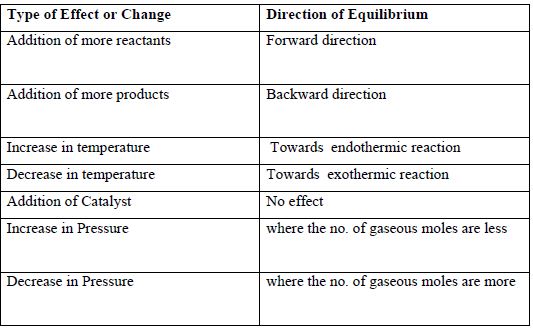
11. Le Chatelier’s Principle: It states that if a system in equilibrium is subjected to a change of concentration, temperature or pressure, the equilibrium shifts in a direction that tends to undo the effect of the change imposed.
• Effect of change of concentration: When the concentration of any of the reactants or products in a reaction at equilibrium is changed, the composition of the equilibrium mixture changes so as to minimize the effect of concentration change. For eg:- H2(g) + I2(g) → 2HI(g) If H2 is added to the reaction mixture at equilibrium, the equilibrium of the reaction is disturbed. In order to restore it, the reaction proceeds in a direction whereas H2 is consumed i.e more of H2 and I2 react to form HI and finally the equilibrium shifts in forward direction.
• Effect of change of pressure: When the pressure is increased the equilibriumshifts in the direction in which the number of moles of the gas decreases.
Consider the reaction, CO (g) + 3H2 (g) → CH4 (g) + H2O (g) Here, 4 mol of gaseous reactants (CO + 3H2) become 2 mol of gaseous products (CH4 (g) + H2O).
so by Le Chatelier‘s principle. The increase in pressure will shift the equilibrium in the forward direction, a direction in which the number of moles of the gas or pressure decreases.
• Effect of change of Temperature: When a change in temperature occurs, the value of equilibrium constant changes. In general, the temperature dependence of the equilibrium constant depends on the sign of ΔH for the reaction. The equilibrium constant for an exothermic reaction (-ve ΔH) decreases as the temperature increases. The equilibrium constant for an endothermic reaction (+ve ΔH) increases as the temperature increases. When the Temperature is increased the equilibrium shifts in the direction in of endothermic reaction.
Consider a reaction N2(g) + 3H2(g) → 2NH3(g) ΔH = -92.38Kj/mol According to Le Chatelier‘s principle, raising the temperature shifts the equilibrium to left (backward direction i.e direction of endothermic reaction) and decreases the equilibrium concentration of ammonia.
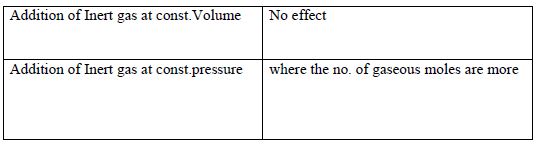
• Effect of Inert Gas Addition: If the volume is kept constant and an inert gas such as argon is added which does not take part in the reaction, the equilibrium remains undisturbed. It is because the addition of an inert gas at constant volume does not change the partial pressures or the molar concentrations of the substance involved in the reaction. The reaction quotient changes only if the added gas is a reactant or product involved in the reaction.
• Effect of a Catalyst: A catalyst increases the rate of the chemical reaction by making available a new low energy pathway for the conversion of reactants to products. It increases the rate of forward and reverse reactions that pass through the same transition state and does not affect equilibrium. Catalyst lowers the activation energy for the forward and reverse reactions by exactly the same amount. Catalyst does not affect the equilibrium composition of a reaction mixture. It does not appear in the balanced chemical equation or in the equilibrium constant expression.
Please refer to attached file for CBSE Class 11 Chemistry-Equilibrium
Free study material for Chemistry
Revision Notes and Key Concepts for Class 11 Chemistry Chapter 06 Equilibrium
About Chapter 06 Equilibrium Revision Notes
Access structured revision notes for Chapter 06 Equilibrium designed in alignment with the latest CBSE curriculum for Class 11 Chemistry. These summaries help clarify core themes and support effective daily study.
How to Use These Revision Notes
Cross-reference your comprehension with comprehensive NCERT solutions for Class 11 to ensure absolute clarity across all sub-topics in this chapter.
Enhance Practice with MCQs and Worksheets
Wrap up your chapter revision by testing your knowledge against standard question formats. Everything on our platform is provided free of charge.
FAQs
You can download the teacher prepared revision notes for CBSE Class 11 Chemistry Equilibrium Notes Set 02 from StudiesToday.com. These notes are designed as per 2026-27 academic session to help Class 11 students get the best study material for Chemistry.
Yes, our CBSE Class 11 Chemistry Equilibrium Notes Set 02 include 50% competency-based questions with focus on core logic, keyword definitions, and the practical application of Chemistry principles which is important for getting more marks in 2026 CBSE exams.
Yes, our CBSE Class 11 Chemistry Equilibrium Notes Set 02 provide a detailed, topic wise breakdown of the chapter. Fundamental definitions, complex numerical formulas and all topics of CBSE syllabus in Class 11 is covered.
These notes for Chemistry are organized into bullet points and easy-to-read charts. By using CBSE Class 11 Chemistry Equilibrium Notes Set 02, Class 11 students fast revise formulas, key definitions before the exams.
No, all study resources on StudiesToday, including CBSE Class 11 Chemistry Equilibrium Notes Set 02, are available for immediate free download. Class 11 Chemistry study material is available in PDF and can be downloaded on mobile.