

Official Class 11 Chemistry Revision Material: CBSE Class 11 Chemistry Hydrocarbon Summary
Explore reliable concept summaries and revision materials through the CBSE Class 11 Chemistry Hydrocarbon Summary. Tailored for Class 11 learners, utilizing these notes for Chemistry Chapter 09 Hydrocarbons ensures thorough preparation and strengthens core academic definitions before final evaluations.
Chapter-wise Concept Summaries: Chapter 09 Hydrocarbons
View or download the dedicated Chapter 09 Hydrocarbons revision resource below. Engaging with these structured concept notes daily ensures continuous academic progress and mastery of the 2026-27 curriculum for Chemistry.
HYDROCARBON SUMMARY
HYDROCARBON ARE COMPOSED OF HYDROGEN AND CARBON
TYPES— 1) SATURATED 2) UNSATURATED
SATURATED ---- ALKANE (CnH2n+2) SINGLE BONDED (C-C)
UNSATURATED ---- ALKENE (CnH2n) DOUBLE BONDED (C=C)
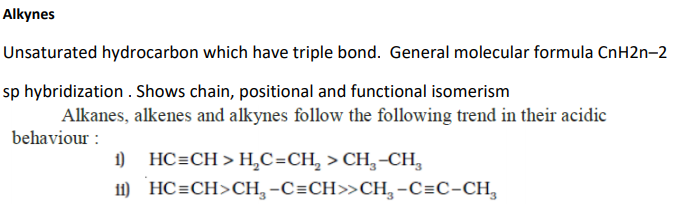
ALKYNE (CnH2n-2) TRIPLE BONDED (C-C)
ALKANE
HALOGENATION REACTIONS
Features of Halogenations:-
(i) The reactivity of Halogens:- F2 > Cl2 > Br2 > I2.
(ii) The rate of replacement of Hydrogens of alkanes is: 3° > 2° > 1°
(iii) Mechanism:- halogenations reaction take place by free radical mechanism. The reaction proceeds in the following steps: Initiation (i) Chain initiation step:- (ii) Chain Propagation step:- (iii) Chain Termination
SULPHONATION:-
Replacement of hydrogen atom of alkane by –SO3H group, this method is also called dehydrogenation or hydroforming similarly, heptane gives toluene, n-Octane give o-xylene and 2, methyl heptane give m-xylene.
AEROMATISATION
Thermal decomposition or Pyrolysis or cracking or Fragmentation: - when higher alkanes are heated at high temp (about 700-800k) in the presence of alumina or silica catalysts, the alkanes break down to lower alkanes and alkenes.
CONFORMATIONAL ISOMERISM: The different molecular arrangements arising as a result of rotation around carbon carbon single bonds are called conformational isomers or rotational isomers and the phenomenon is called conformational isomerism. Numerous possible arrangements of ethane are possible. Two extreme conformations are known. These are eclipsed conformation and staggered conformation.
Alkenes
Unsaturated hydrocarbon which have double bond. General molecular formula CnH2n C–C bond 1.34 A0 , sp 2 hybridization When we treated Alkene with chlorine, oily products are obtained. So Alkenes are also known as Olefins. (Greek olefin meaning oil forming). These Show chain, positional and geometrical isomerism
Addition reaction of HBr to unsymmetrical alkenes takes place according to Markovnikov Rule
Markownikov rule:- negative part of the addendum (adding molecule) gets attached to that carbon atom which possesses lesser number of hydrogen atoms Peroxide effect or Kharasch (Anti Markownikoff’s addition):- In 1933 Kharasch and Mayo observed that when HBr is added to an unsymmetrical double bond in the presence of organic peroxide, the reaction take places opposite to the Markovnikov rule.
Noted :- peroxide effect is applicable only to HBr and not to HF, HCl and HI. Addition of HF, HCl and HI takes place according to Markovnikov’s rule even in the presence of peroxide The alkaline potassium permanganate solution is known as Baeyer’s reagent. It has bright pink colour. It oxidizes alkenes to glycols which is colour less. This reaction is used as a test for the presence of double bond in a molecule. This is also known as Baeyer test Bromine water test and Baeyer’s test are used to detect the presence of double bond while ozonolysis is used to detect the position of double bond.
AEROMATI HYDROCARBON
Aromatic compounds containing benzene ring are known as benzenoids and those not containing a benzene ring are known as non-benzenoids.
The orbital overlapping picture benzene- All the six carbon atoms in benzene are sp 2 hybridized and these hybrid orbitals form sigma bonds
The six π electrons are delocalized and can move freely about the six carbon nuclei. The delocalized π electron cloud is attracted more strongly by the nuclei of the carbon atoms than the electron cloud localized between two carbon atoms. Therefore, presence of delocalized π electrons in benzene makes it more stable .
Aromaticity:- The compounds that follow the following features are to be considered aromatic. (i) Planarity (ii) Complete delocalisation of the π electrons in the ring (iii) Presence of (4n + 2) π electrons in the ring where n is an integer (n = 0, 1, 2, . . .). This is often referred to as Hückel Rule.
Arenes are characterized by electrophilic substitution reactions proceed via the following three steps: (a) Generation of the eletrophile (b) Formation of carbocation intermediate (c) Removal of proton from the carbocation intermediate
CARCINOGENICITY AND TOXICITY-Benzene and polynuclear hydrocarbons containing more than two benzene rings fused together are toxic and said to possess cancer producing (carcinogenic) property.
Please click the link below to download pdf file for CBSE Class 11 Chemistry Hydrocarbon Summary.
Free study material for Chemistry
Study Material and Revision Notes for Class 11 Chemistry Chapter 09 Hydrocarbons
About Chapter 09 Hydrocarbons Revision Notes
Explore reliable chapter overviews for Chapter 09 Hydrocarbons tailored for Class 11 learners. Use these structured points to grasp difficult themes and ensure solid preparation for upcoming assessments.
How to Use These Revision Notes
Cross-reference your comprehension with comprehensive NCERT solutions for Class 11 to ensure absolute clarity across all sub-topics in this chapter.
Enhance Practice with MCQs and Worksheets
Explore our broader library of printable assignments, chapter notes, and mock tests designed to support continuous revision and secure higher marks in CBSE assessments.
FAQs
You can download the teacher prepared revision notes for CBSE Class 11 Chemistry Hydrocarbon Summary from StudiesToday.com. These notes are designed as per 2026-27 academic session to help Class 11 students get the best study material for Chemistry.
Yes, our CBSE Class 11 Chemistry Hydrocarbon Summary include 50% competency-based questions with focus on core logic, keyword definitions, and the practical application of Chemistry principles which is important for getting more marks in 2026 CBSE exams.
Yes, our CBSE Class 11 Chemistry Hydrocarbon Summary provide a detailed, topic wise breakdown of the chapter. Fundamental definitions, complex numerical formulas and all topics of CBSE syllabus in Class 11 is covered.
These notes for Chemistry are organized into bullet points and easy-to-read charts. By using CBSE Class 11 Chemistry Hydrocarbon Summary, Class 11 students fast revise formulas, key definitions before the exams.
No, all study resources on StudiesToday, including CBSE Class 11 Chemistry Hydrocarbon Summary, are available for immediate free download. Class 11 Chemistry study material is available in PDF and can be downloaded on mobile.