

Download Class 11 Chemistry Concept Summaries: CBSE Class 11 Chemistry Structure Of Atom Notes Set 06
Access comprehensive revision notes for Chapter 02 Structure of Atom using the CBSE Class 11 Chemistry Structure Of Atom Notes Set 06. Designed to align with the 2026-27 academic syllabus for Class 11 Chemistry, these concept summaries help students streamline their exam preparation and review complex topics efficiently.
Access Chapter 02 Structure of Atom Notes and Study Material
Access the complete concept summary PDF for Chapter 02 Structure of Atom below. Regular review of these targeted notes builds familiarity with complex Class 11 Chemistry themes and helps secure higher marks in final school evaluations.
Class XI: Chemistry
Chapter 2: Structure Of Atom
Top Concepts
1. Atomic theory of matter was proposed by John Dalton
2. Electrons were discovered by Michael Faraday.
3. Electrons were discovered using cathode ray discharge tube experiment.
4. Cathode ray discharge tube experiment: A cathode ray discharge tube made of glass is taken with two electrodes. At very low pressure and high voltage, current starts flowing through a stream of particles moving in the tube from cathode to anode. These rays were called cathode rays. When a perforated anode was taken, the cathode rays struck the other end of the glass tube at the fluorescent coating and a bright spot on the coating was develope Results:
a. Cathode rays consist of negatively charged electrons.
b. Cathode rays themselves are not visible but their behavior can be observed with help of fluorescent or phosphorescent materials.
c. In absence of electrical or magnetic field cathode rays travel in straight lines
d. In presence of electrical or magnetic field, behaviour of cathode rays is similar to that shown by electrons
e. The characteristics of the cathode rays do not depend upon the material of the electrodes and the nature of the gas present in the cathode ray tube.
5. Charge to mass ratio of an electron was determined by Thomson. The charge to mass ratio of an electron as 1.758820 x 10¹¹ C kg-1
6. Charge on an electron was determined by R A Millikan by using an oil drop experiment. The value of the charge on an electron is -1.6 x 10⁻¹⁹ C.
7. The mass on an electron was determined by combining the results of Thomson’s experiment and Millikan’s oil drop experiment. The mass of an electron was determined to be 9.1094 x 10⁻³¹ kg.
8. Discovery of protons and canal rays: Modified cathode ray tube experiment was carried out which led to the discovery of protons.
9. Canal rays are positively charged particles called protons
10. Characteristics of positively charged particles:
a. Charge to mass ratio of particles depends on gas from which these originate
b. The positively charged particles depend upon the nature of gas present in the cathode ray discharge tube
c. Some of the positively charged particles carry a multiple of fundamental of electrical charge.
d. Behaviour of positively charged particles in electrical or magnetic field is opposite to that observed for cathode rays
11. Neutrons were discovered by James Chadwick by bombarding a thin sheet of beryllium by a - particles. They are electrically neutral particles having a mass slightly greater than that of the protons.
12. Thomson model of an atom: This model proposed that atom is considered as a uniform positively charged sphere and electrons are embedded in it.
13. An important feature of Thomson model of an atom was that mass of atom is considered to be evenly spread over the atom.
14. Thomson model of atom is also called as Plum pudding, raisin pudding or watermelon model
15. Thomson model of atom was discarded because it could not explain certain experimental results like the scattering of a - particles by thin metal foils
16. Observations from a - particles scattering experiment by Rutherford:
a. Most of the a - particles (nearly 99 %) passed through gold foil undeflected
b. A small fraction of a - particles got deflected through small angles
c. Very few a - particles did not pass through foil but suffered large deflection nearly o 180
17. Observations Rutherford drew from a - particles scattering experiment:
a. Since most of the a -particles passed through foil undeflected, it means most of the space in atom is empty
b. Since some of the a -particles are deflected to certain angles, it means that there is positively mass present in atom
c. Since only some of the a -particles suffered large deflections, the positively charged mass must be occupying very small space
d. Strong deflections or even bouncing back of a -particles from metal foil were due to direct collision with positively charged mass in atom
18. Rutherford’s model of atom:
This model explained that atom consists of nucleus which is concentrated in a very small volume. The nucleus comprises of protons and neutrons. The electrons revolve around the nucleus in fixed orbits. Electrons and nucleus are held together by electrostatic forces of attraction.
19. Drawbacks of Rutherford’s model of atom: a. According to Rutherford’s model of atom, electrons which are negatively charged particles revolve around the nucleus in fixed orbits. Thus, the electrons undergo acceleration. According to electromagnetic theory of Maxwell, a charged particle undergoing acceleration should emit electromagnetic radiation. Thus, an electron in an orbit should emit radiation. Thus, the orbit should shrink. But this does not happen.
b. The model does not give any information about how electrons are distributed around nucleus and what are energies of these electrons
20. Atomic number (Z): It is equal to the number of protons in an atom. It is also equal to the number of electrons in a neutral atom.
21. Mass number (A): It is equal to the sum of protons and neutrons.
22. Isotopes: These are the atoms of the same element having the same atomic number but different mass number.
23. Isobars: Isobars are the atoms of different elements having the same mass number but different atomic number.
24. Isoelectronic species: These are those species which have the same number of electrons.
25. Electromagnetic radiations: The radiations which are associated with electrical and magnetic fields are called electromagnetic radiations. When an electrically charged particle moves under acceleration, alternating electrical and magnetic fields are produced and transmitted. These fields are transmitted in the form of waves. These waves are called electromagnetic waves or electromagnetic radiations.
26. Properties of electromagnetic radiations: a. Oscillating electric and magnetic field are produced by oscillating charged particles. These fields are perpendicular to each other and both are perpendicular to the direction of propagation of the wave.
b. They do not need a medium to travel. That means they can even travel in vacuum.
27. Characteristics of electromagnetic radiations:
a. Wavelength: It may be defined as the distance between two neighbouring crests or troughs of wave as shown. It is denoted byl.
b. Frequency (v): It may be defined as the number of waves which pass through a particular point in one second.
c. Velocity (v): It is defined as the distance travelled by a wave in one second. In vacuum all types of electromagnetic radiations travel with the same velocity. Its value is 3 X10⁸ m sec-1. It is denoted by v
d. Wave number: Wave number ( v ) is defined as the number of wavelengths per unit length.
28. Relationship between velocity, frequency and wavelength Velocity = frequency x wavelength c = vλ
29. Black body: An ideal body, which emits and absorbs all frequencies, is called a black body. The radiation emitted by such a body is called black body radiation.
30. Planck’s quantum theory: Max Planck suggested that atoms and molecules could emit or absorb energy only in discrete quantities and not in a continuous manner. Planck gave the name quantum, meaning ‘fixed amount’ to the smallest quantity of energy that can be emitted or absorbed in the form of electromagnetic radiation.

Where:
E is the energy of a single quantum
n is the frequency of the radiation
h is Planck’s constant
h= 6.626 X 10⁻³⁴ Js
31. Quantisation of energy: Energy is always emitted or absorbed as integral multiple of this quantum. E=nhv Where n=1,2,3,4,.....
32. Photoelectric effect: The phenomenon of ejection of electrons from the surface of metal when light of suitable frequency strikes it is clled
photoelectric effect. The ejected electrons are called photoelectrons.
33. Experimental results observed for the experiment of Photoelectric effect observed Hertz:
a. When beam of light falls on a metal surface electrons are ejected immediately i.e. there is not time lag between light striking metal surface and ejection of electrons
b. Number of electrons ejected is proportional to intensity or brightness of light
c. Threshold frequency ( ov ): For each metal there is a characteristic minimum frequency below which photoelectric effect is not observed. This is called threshold frequency.
d. If frequency of light is less than the threshold frequency there is no ejection of electrons no matter how long it falls on surface or how high is its intensity.
34. Photoelectric work function (Wo): The minimum energy required to eject electrons is called photoelectric work function. Wo =hno
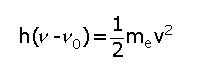
35. Energy of the ejected electrons :
36. When a white light is passed through a prism, it splits into a series of coloured bands known as spectrum.
37. Spectrum is of two types: continuous and line spectrum
a. The spectrum which consists of all the wavelengths is called continuous spectrum.
b. A spectrum in which only specific wavelengths are present is known as a line spectrum. It has bright lines with dark spaces between them.
38. Electromagnetic spectrum is a continuous spectrum. It consists of a range of electromagnetic radiations arranged in the order of increasing wavelengths or decreasing frequencies. It extends from radio waves to gamma rays.
39. Spectrum is also classified as emission and line spectrum.
• Emission spectrum: A substance absorbs energy and moves to a higher energy state. The atoms, molecules or ions that have absorbed radiation are said to be excited. Since the higher energy state is unstable they return to the more stable energy state by emitting the absorbed radiation in various regions of electromagnetic spectrum. The spectrum of radiation emitted by a substance that has absorbed energy is called an emission spectrum.
• Absorption spectrum is the spectrum obtained when radiation is passed through a sample of material. The sample absorbs radiation of certain wavelengths. The wavelengths which are absorbed are missing and come
as dark lines.
40. The study of emission or absorption spectra is referred as spectroscopy.
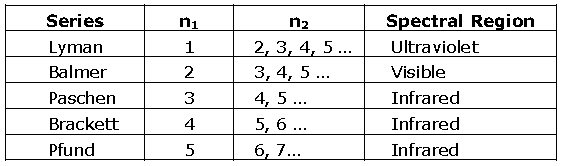
41. Spectral Lines for atomic hydrogen:
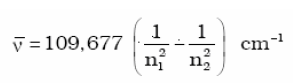
42. Rydberg equation: It allows the calculation of the wavelengths of all the spectral lines of hydrogen.
43. Bohr’s model for hydrogen atom:
a. An electron in the hydrogen atom can move around the nucleus in a circular path of fixed radius and energy. These paths are called orbits or energy levels. These orbits are arranged concentrically around the nucleus.
b. As long as an electron remains in a particular orbit, it does not lose or gain energy and its energy remains constant.
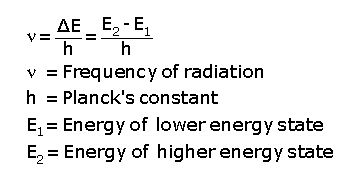
c. When transition occurs between two stationary states that differ in energy, the frequency of the radiation absorbed or emitted can be calculated.
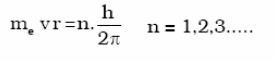
d. An electron can move only in those orbits for which its angular momentum is an integral multiple of h/2p
44. Bohr’s theory for hydrogen atom:
a. Stationary states for electron are numbered in terms of Principal Quantum numbered as n=1, 2, 3…
b. For hydrogen atom: The radii of the stationary states is expressed as rn = n2a0 where a0= 52.9 pm
c. Energy of stationary state
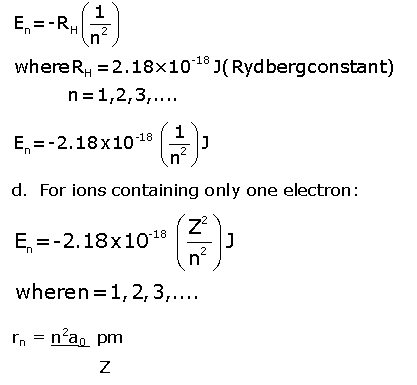
Where Z is the atomic number
45. Limitations of Bohr’s model of atom:
a. Bohr’s model failed to account for the finer details of the hydrogen spectrum. For instance splitting of a line in the spectrum into two closely spaced lines.
b. Bohr’s model was also unable to explain spectrum of atoms containing more than one electron.
c. Bohr’s model was unable to explain Zeeman effect i.e. splitting of spectral line in presence of magnetic effect.
d. Bohr’s model also failed to explain Stark effect i.e. splitting of spectral line in presence of electric field.
e. Bohr’s model could not explain the ability of atoms to form molecules by chemical bonds
46. Dual behavior of matter: de Broglie proposed that matter exhibits dual behavior i.e. matter shows both particle and wave nature.
Please refer to attached file for CBSE Class 11 Chemistry Structure Of Atom Notes Set F
Free study material for Chemistry
Download CBSE Revision Notes: Class 11 Chemistry Chapter 02 Structure of Atom
Key Concepts and Summary for Class 11 Chemistry Chapter 02 Structure of Atom
Explore reliable chapter overviews for Chapter 02 Structure of Atom tailored for Class 11 learners. Use these structured points to grasp difficult themes and ensure solid preparation for upcoming assessments.
NCERT-Aligned Chapter Summary and Notes
Cross-reference your comprehension with comprehensive NCERT solutions for Class 11 to ensure absolute clarity across all sub-topics in this chapter.
Next Steps in Your Exam Preparation
Explore our broader library of printable assignments, chapter notes, and mock tests designed to support continuous revision and secure higher marks in CBSE assessments.
FAQs
You can download the teacher prepared revision notes for CBSE Class 11 Chemistry Structure Of Atom Notes Set 06 from StudiesToday.com. These notes are designed as per 2026-27 academic session to help Class 11 students get the best study material for Chemistry.
Yes, our CBSE Class 11 Chemistry Structure Of Atom Notes Set 06 include 50% competency-based questions with focus on core logic, keyword definitions, and the practical application of Chemistry principles which is important for getting more marks in 2026 CBSE exams.
Yes, our CBSE Class 11 Chemistry Structure Of Atom Notes Set 06 provide a detailed, topic wise breakdown of the chapter. Fundamental definitions, complex numerical formulas and all topics of CBSE syllabus in Class 11 is covered.
These notes for Chemistry are organized into bullet points and easy-to-read charts. By using CBSE Class 11 Chemistry Structure Of Atom Notes Set 06, Class 11 students fast revise formulas, key definitions before the exams.
No, all study resources on StudiesToday, including CBSE Class 11 Chemistry Structure Of Atom Notes Set 06, are available for immediate free download. Class 11 Chemistry study material is available in PDF and can be downloaded on mobile.