

Download Class 11 Chemistry Concept Summaries: CBSE Class 11 Chemistry Chemical Bonding And Molecular Structure Notes Set 03
Explore reliable concept summaries and revision materials through the CBSE Class 11 Chemistry Chemical Bonding And Molecular Structure Notes Set 03. Tailored for Class 11 learners, utilizing these notes for Chemistry Chapter 04 Chemical Bonding and Molecular Structure ensures thorough preparation and strengthens core academic definitions before final evaluations.
Access Chapter 04 Chemical Bonding and Molecular Structure Notes and Study Material
Access the complete concept summary PDF for Chapter 04 Chemical Bonding and Molecular Structure below. Regular review of these targeted notes builds familiarity with complex Class 11 Chemistry themes and helps secure higher marks in final school evaluations.
Points to Remember
Class: XI
Chapter Name: Chemical Bonding and Molecular Structure
Top Concepts
1. The attractive force which holds together the constituent particles (atoms,ions or molecules) in chemical species is known as chemical bond.
2. Tendency or urge atoms of various elements to attain stable configurationof eight electrons in their valence shell is cause of chemical combination.
3. The principle of attaining a maximum of eight electrons in the valenceshell or outermost shell of atoms is known as octet rule.
4. Electronic Theory: Kossel-Lewis approach to chemical Bonding: Atomsachieve stable octet when they are linked by chemical bonds. The atoms do so either by transfer or sharing of valence electrons. Inner shell electrons are not involved in combination process.
5. Lewis Symbols or electron dot symbols: The symbol of the elementrepresents the whole of the atom except the valence electrons (i.e. nucleus and the electrons in the linear energy shells). The valence electrons are represented by placing dots (.) or crosses (x) around the symbol.
6. Significance of Lewis Symbols: The Lewis symbols indicate the number ofelectrons in the outermost or valence shell which helps to calculate common or group valence.
7. The common valence of an element is either equal to number of dots orvalence electrons in the Lewis symbol or it is equal to 8 minus the number of dots or valence electrons.
8. The bond formed by mutual sharing of electrons between the combining atoms of the same or different elements is called a covalent bond.
9. If two atoms share one electron pair, bond is known as single covalentbond and is represented by one dash (–).
10.If two atoms share two electron pairs, bond is known as double covalent bond and is represented by two dashes (=)
11. If two atoms share three electron pairs, bond is known as triple covalent bond and is represented by three dashes ( ).
12.The formal charge of an atom in a polyatomic ion or molecule is defined as the difference between the number of valence electrons in an isolated (or free) atom and the number of electrons assigned to that atom in a Lewis structure. It may be expressed as:
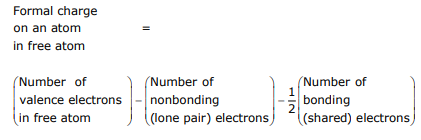
13.Significance of Formal charge: The formal charges help in selection of lowest energy structure from a number of possible Lewis structures for a given molecule or ion. Lowest energy structure is the one which has lowest formal charges on the atoms.
14.Expanded octet: Compounds in which central atom has more than eight electrons around it, atom is said to possess an expanded octet.
15.Exceptions to the Octet Rule:
Hydrogen molecule: Hydrogen has one electron in its first energy shell (n =1). It needs only one more electron to fill this shell, because the first shell cannot have more than two electrons. This configuration (1s2) is similar to that of noble gas helium and is stable. In this case, therefore, octet is not needed to achieve a stable configuration.
Incomplete octet of the central atom: The octet rule cannot explain the formation of certain molecules of lithium, beryllium, boron, aluminum, etc.
(LiCl, BeH2, BeCl2, BH3, BF3) in which the central atom has less than eight electrons in the valence shell as shown below:
Expanded octet of the central atom: There are many stable molecules which have more than eight electrons in their valence shells. For example, PF5, has ten; SF6 has twelve and IF7 ha fourteen electrons around the central atoms, P, S, and I respectively.
Odd electron molecules: There are certain molecules which have odd number of electrons, like nitric oxide, NO and Nitrogen dioxide, NO2. In these cases, octet rule is not satisfied for all the atoms.
It may be noted that the octet rule is based upon the chemical inertness of noble gases. However, it has been found that some noble gases (especially xenon and krypton) also combine with oxygen and fluorine to form a large number of compounds such a XeF2, KrF2, XeOF2, XeOF4, XeF6, etc.
This theory does not account for the shape of the molecules.
It cannot explain the relative stability of the molecule in terms of the energy.
16.General Properties of Covalent Compounds
1. The covalent compounds do not exist as ions but they exist asmolecules.
2. The melting and boiling points of covalent compounds are generallylow.
3. Covalent compounds are generally insoluble or less soluble in waterand other polar solvents. However, these are soluble in non- polar solvents.
4. Since covalent compounds do not give ions in solution, these arepoor conductors of electricity in the fused or dissolved state.
5. Molecular reactions are quite slow because energy is required tobreak covalent bonds.
6. Since the covalent bond is localized in between the nuclei of atoms, itis directional in nature.
17.Co- Ordinate Covalent Bond:
Covalent type bond in which both the electrons in the shared pair come from one atom is called a coordinate covalent bond.
Co- Ordinate Covalent Bond is usually represented by an arrow (→) pointing from donor to the acceptor atom.
Co- Ordinate Covalent bond is also called as dative bond, donor – acceptor bond, semi- polar bond or co-ionic bond.
18. The electrostatic force of attraction which holds the oppositely chargedions together is known as ionic bond or electrovalent bond.
19.Ionic compounds will be formed more easily between the elements withcomparatively low ionization enthalpy and elements with comparatively high negative value of electron gain enthalpy.
20.A quantitative measure of the stability of an ionic compound is providedby its lattice enthalpy and not simply by achieving octet of electrons around the ionic species in the gaseous state
21.Lattice enthalpy may also be defined as the energy required to completelyseparating one mole of a solid ionic compound into gaseous ionic constituents.
22. Factor affecting lattice enthalpy:
Size of the ions: Smaller the size of the ions, lesser is the internuclear distance and higher will be lattice enthalpy.
Larger the magnitude of charge on the ions, greater will be the attractive forces between the ions. Consequently, the lattice enthalpy will be high.
23. General Properties of Ionic Compounds
Ionic compounds usually exist in the form of crystalline solids.
Ionic compounds have high melting and boiling points.
Ionic compounds are generally soluble in water and other polar solvents having high dielectric constants.
Ionic compounds are good conductors of electricity in the solutions or in their molten states.
The chemical reactions of ionic compounds are characteristic of the constituent ions and are known as ionic reactions.
In ionic – compounds, each ion is surrounded by oppositely charged ions uniformly distributed all around the ion and therefore, electrical field is non- directional.
24.Bond length: It is defined as the average distance between the nuclei of the nuclei of two bonded atoms in a molecule.
25. Covalent radius is half of the distance between two similar atoms joined by single covalent bond in same molecule.
26. Van der Waals radius is one half of the distance between two similar adjacent atoms belonging to two nearest neighbouring molecules of the same substance in the solid state. It is always larger than covalent radii.
27. Bond angle: It is defined as the average angle between orbitals containing bonding electron pairs around the central atom in a molecule.
28. Bond enthalpy: It is defined as amount of energy required to break one mole of bonds of a particular type between atoms in gaseous state
Please click the link below to download pdf file for CBSE Class 11 Chemistry Notes - Chemical Bonding and Molecular Structure.
Free study material for Chemistry
Download CBSE Revision Notes: Class 11 Chemistry Chapter 04 Chemical Bonding and Molecular Structure
Download Chapter Summary: Class 11 Chemistry Chapter 04 Chemical Bonding and Molecular Structure
Access structured revision notes for Chapter 04 Chemical Bonding and Molecular Structure designed in alignment with the latest CBSE curriculum for Class 11 Chemistry. These summaries help clarify core themes and support effective daily study.
Concept Clarification for Chapter 04 Chemical Bonding and Molecular Structure
Built using the official NCERT book for Class 11 Chemistry, these notes provide reliable academic guidance. Pair your summary review with our recommended NCERT solutions to master optimal problem-solving approaches.
Additional Study Resources for Class 11 Chemistry
Follow up your revision by attempting the interactive online Chemistry MCQ test and practice worksheets for this chapter to verify your mastery. All platform resources are free to access.
FAQs
You can download the teacher prepared revision notes for CBSE Class 11 Chemistry Chemical Bonding And Molecular Structure Notes Set 03 from StudiesToday.com. These notes are designed as per 2026-27 academic session to help Class 11 students get the best study material for Chemistry.
Yes, our CBSE Class 11 Chemistry Chemical Bonding And Molecular Structure Notes Set 03 include 50% competency-based questions with focus on core logic, keyword definitions, and the practical application of Chemistry principles which is important for getting more marks in 2026 CBSE exams.
Yes, our CBSE Class 11 Chemistry Chemical Bonding And Molecular Structure Notes Set 03 provide a detailed, topic wise breakdown of the chapter. Fundamental definitions, complex numerical formulas and all topics of CBSE syllabus in Class 11 is covered.
These notes for Chemistry are organized into bullet points and easy-to-read charts. By using CBSE Class 11 Chemistry Chemical Bonding And Molecular Structure Notes Set 03, Class 11 students fast revise formulas, key definitions before the exams.
No, all study resources on StudiesToday, including CBSE Class 11 Chemistry Chemical Bonding And Molecular Structure Notes Set 03, are available for immediate free download. Class 11 Chemistry study material is available in PDF and can be downloaded on mobile.