

Official Class 11 Chemistry Revision Material: CBSE Class 11 Chemistry Chemical Bonding Notes
Explore reliable concept summaries and revision materials through the CBSE Class 11 Chemistry Chemical Bonding Notes. Tailored for Class 11 learners, utilizing these notes for Chemistry Chapter 04 Chemical Bonding and Molecular Structure ensures thorough preparation and strengthens core academic definitions before final evaluations.
Chapter-wise Concept Summaries: Chapter 04 Chemical Bonding and Molecular Structure
Navigate directly to the revision notes for Chapter 04 Chemical Bonding and Molecular Structure using the digital viewer below. Each summary is structured to highlight high-weightage sections, allowing students to instantly access critical definitions and focus on core exam topics.
Remedial action plan :-
Chemical bonding
# focus on important topic
1. Octet rule
2. Lewis structure
Q.7. The skeletal structure of CH3COOH as shown below is correct, but some of the bonds are shown incorrectly. Write the correct Lewis structure for acetic acid.
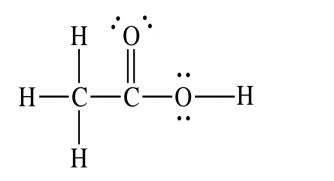
.Definition AND practice of various type of bonds.
CHEMICAL BOND- the chemical force which keeps the atoms in any molecule Together is called a chemical bond.
IONIC BOND- The columbic force of attraction which holds the appositively Charged ions together is called an ionic bond. An ionic bond is formed by the Complete transfer of one or more electrons from the atom of a metal to an atom of Non- metal.
COVALENT BOND: A covalent bond formed by the mutual sharing of one pair of electrons is called a single covalent bond, or simply a single bond. A single covalent bond is represented by a small line (−) between the two atoms.
Types - Polar and non-polar covalent bond
SIGMA BOND: A covalent bond formed due to the overlapping of orbitals of the two atoms along the line joining the two nuclei (orbital axis) is called sigma (σ) bond. For example, the bond formed due to s-s and s-p, p-p overlapping along the orbital axis are sigma bonds.
Pi- BOND: A covalent bond formed by the side wise overlapping of p- or dorbitals of two atoms is called as pi (π) bond. For example, the bond formed due to the sideways overlapping of the two p- orbitals is a pi- bond.
Q.1. What is the total number of sigma and pi bonds in the following molecules?
(a) C2H2 (b) C2H4
Ans- there are three sigma and two pi-bonds in C2H2.
there are five sigma bonds and one pi-bond in C2H4.
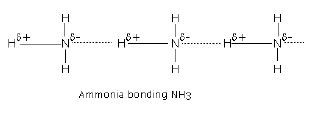
HYDROGEN BOND: The bond between the hydrogen atom of one molecule and a more electro- negative element of same or another molecule is called as hydrogen bond.
Q.1. Define hydrogen bond. Is it weaker or stronger than the van der Waals forces?
Ans- A hydrogen bond is defined as an attractive force acting between the hydrogen attached to an electronegative atom of one molecule and an electronegative atom of a different molecule (may be of the same kind).
There are two types of H-bonds:
Focus on free education
(i) Intermolecular H-bond e.g., HF, H2O etc.
(ii) Intramolecular H-bond e.g., o-nitrophenol
Hydrogen bonds are stronger than Van der Walls forces since hydrogen bonds are
Q. why ammonia is liquid
regarded as an extreme form of dipole-dipole interaction.
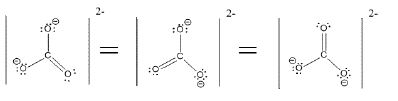
Resonance: whenever a single Lewis structure cannot describe a molecule Accurately a number of structures with similar energy, positions of nuclei, bonding and non-bonding pairs of electrons are taken as the canonical structures of the hybrid which describes the molecule accurately
HYBRIDIZATION: The process of mixing of the atomic orbitals to form new hybrid orbitals is called hybridization. All hybrid orbitals of a particular kind have equal energy, identical shapes and are symmetrically oriented in shape.
The hybrid orbitals are designed according to the type and the atomic orbitals merging together,
Q. show hybridization in methane
Q which type of hybridization present in ammonia? Ans. Sp3
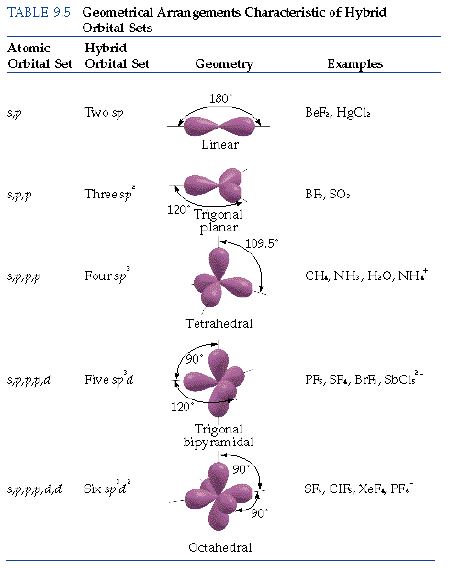
Practice of problem based on v.s.e.p.r . theory
In order to predict the geometry of molecules, Nyholm and Gillespie developed a qualitative model known as Valence Shell Electron Pair Repulsion Theory (VSEPR Theory). The basic assumptions of this theory are summarized below.
1) The electron pairs in the valence shell around the central atom of a molecule repel each other and tend to orient in space so as to minimize the repulsions and maximize the distance between them.
2) There are two types of valence shell electron pairs viz.,
i) Bond pairs and ii) Lone pairs
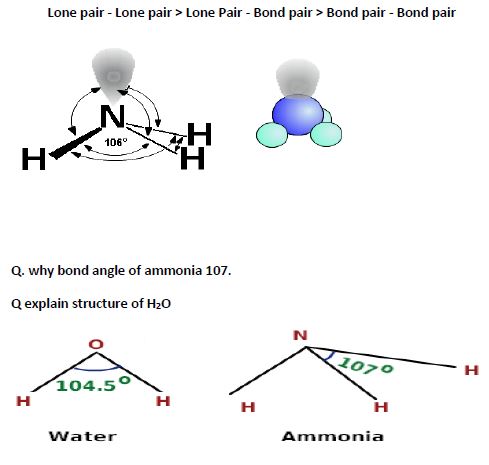
Bond pairs are shared by two atoms and are attracted by two nuclei. Hence they occupy less space and cause less repulsion.
Lone pairs are not involved in bond formation and are in attraction with only one nucleus. Hence they occupy more space. As a result, the lone pairs cause more repulsion. The order of repulsion between different types of electron pairs is as follows:
Lone pair - Lone pair > Lone Pair - Bond pair > Bond pair - Bond pair
Molecular orbital teory:-
Practice of energy level diagram of N2 molecules
Practice of energy level diagram of O2 molecules
CALCULATIN of bond order
Paramagnetic and diamagnetic nature of molecules
Please click the link below to download pdf file for CBSE Class 11 Chemistry Chemical Bonding Notes.
Free study material for Chemistry
Chapter 04 Chemical Bonding and Molecular Structure Concepts and Summary for Class 11 Chemistry
About Chapter 04 Chemical Bonding and Molecular Structure Revision Notes
Explore reliable chapter overviews for Chapter 04 Chemical Bonding and Molecular Structure tailored for Class 11 learners. Use these structured points to grasp difficult themes and ensure solid preparation for upcoming assessments.
How to Use These Revision Notes
Each chapter summary is structured around standard CBSE textbooks, allowing students to check their understanding and clarify complex ideas early in their revision.
Enhance Practice with MCQs and Worksheets
Wrap up your chapter revision by testing your knowledge against standard question formats. Everything on our platform is provided free of charge.
FAQs
You can download the teacher prepared revision notes for CBSE Class 11 Chemistry Chemical Bonding Notes from StudiesToday.com. These notes are designed as per 2026-27 academic session to help Class 11 students get the best study material for Chemistry.
Yes, our CBSE Class 11 Chemistry Chemical Bonding Notes include 50% competency-based questions with focus on core logic, keyword definitions, and the practical application of Chemistry principles which is important for getting more marks in 2026 CBSE exams.
Yes, our CBSE Class 11 Chemistry Chemical Bonding Notes provide a detailed, topic wise breakdown of the chapter. Fundamental definitions, complex numerical formulas and all topics of CBSE syllabus in Class 11 is covered.
These notes for Chemistry are organized into bullet points and easy-to-read charts. By using CBSE Class 11 Chemistry Chemical Bonding Notes, Class 11 students fast revise formulas, key definitions before the exams.
No, all study resources on StudiesToday, including CBSE Class 11 Chemistry Chemical Bonding Notes, are available for immediate free download. Class 11 Chemistry study material is available in PDF and can be downloaded on mobile.