

Chemistry Concept Notes for Class 11: All topics
Explore reliable concept summaries and revision materials through the CBSE Class 11 Chemistry Revision Notes Set 04. Tailored for Class 11 learners, utilizing these notes for Chemistry All topics ensures thorough preparation and strengthens core academic definitions before final evaluations.
Download All topics Revision Notes PDF
Access the complete concept summary PDF for All topics below. Regular review of these targeted notes builds familiarity with complex Class 11 Chemistry themes and helps secure higher marks in final school evaluations.
SOME BASIC CONCEPTS OF CHEMISTRY Chemistry:
Chemistry is the branch of science that deals with the composition, structure and properties of matter. Chemistry is called the science of atoms and molecule .
Branches of Chemistry
Organic Chemistry -This branch deals with study of carbon compounds especially hydrocarbons and their derivatives.
Inorganic Chemistry-This branch deals with the study of compounds of all other elements except carbon. It largely concerns itself with the study of minerals found in the Earth's crust.
Physical Chemistry-The explanation of fundamental principles governing various chemical phenomena is the main concern of this branch. It is basically concerned with laws and theories of the different branches of chemistry.
Industrial Chemistry-The chemistry involved in industrial processes is studied under this branch.
Analytical Chemistry-This branch deals with the qualitative and quantitative analysis of various substances.
Biochemistry-This branch deals with the chemical changes going on in the bodies of living organisms; plants and animals.
Nuclear Chemistry-Nuclear reactions, such as nuclear fission, nuclear fusion, transmutation processes etc. are studied under this branch.
PROPERTIES OF MATTER AND THEIR MEASUREMENT--
Every substance has unique or characteristic properties. These properties can be classified into two categories – physical properties and chemical properties.
Physical properties are those properties which can be measured or observed without changing the identity or the composition of the substance. E.g. colour, odour, melting point, boiling point, density etc.
The measurement or observation of chemical properties requires a chemical change to occur. e.g. Burning of Mg-ribbon in air .
Chemical properties are characteristic reactions of different substances; these include acidity or basicity, combustibility etc.Many properties of matter such as length, area, volume, etc., are quantitative in nature.
Metric System was based on the decimal system.
The International System of Units (SI) The International System of Units (in French Le Systeme International d’Unites– abbreviated as SI) was established by the 11th General Conference on Weights and Measures (CGPM from ConferenceGenerale des Poids at Measures). The SI system has seven base units
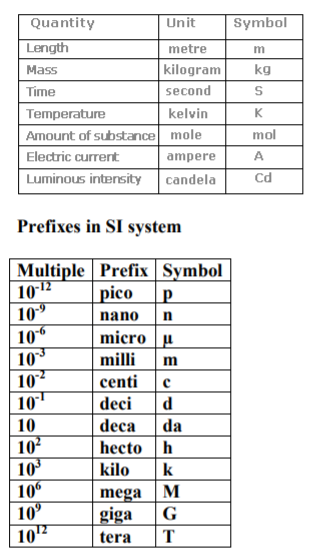
Mass and Weight-- Mass of a substance is the amount of matter present in it while weight is the force exerted by gravity on an object. The mass of a substance is constant whereas its weight may vary from one place to another due to change in gravity. The mass of a substance can be determined very accurately by using an analytical balance
Volume-- Volume has the units of (length)3. So volume has units of m3 or cm3 or dm3.A common unit, litre (L) is not an SI unit, is used for measurement of volume of liquids. 1 L = 1000 mL, 1000 cm3 = 1 dm3
Density: Density of a substance is its amount of mass per unit volume.SI unit of density = SI unit of mass/SI unit of volume = kg/m3 or kg m–3This unit is quite large and a chemist often expresses density in g cm–3.
Temperature--There are three common scales to measure temperature — °C (degree celsius), °F (degree Fahrenheit) and K (kelvin). Here, K is the SI unit.
0F = 9/5(C0) +32
K = °C + 273.15 Note—Temperature below 0 °C (i.e. negative values) are possible in Celsius scale but in Kelvin scale, negative temperature is not possible.
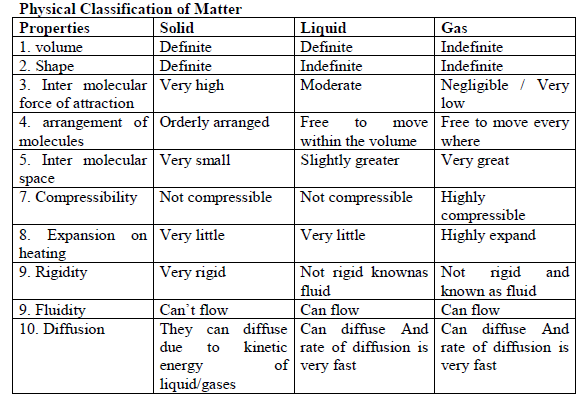
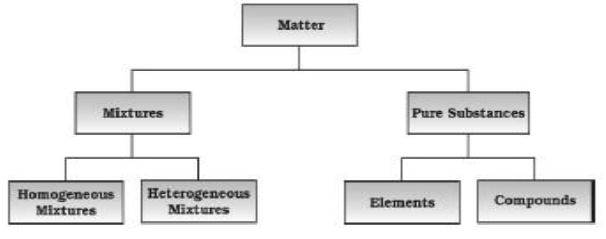
Please click the link below to download pdf file for CBSE Class XI Some Basic Concepts of Chemistry.
Free study material for Chemistry
Revision Notes and Key Concepts for Class 11 Chemistry All topics
About All topics Revision Notes
Explore reliable chapter overviews for All topics tailored for Class 11 learners. Use these structured points to grasp difficult themes and ensure solid preparation for upcoming assessments.
How to Use These Revision Notes
Built using the official NCERT book for Class 11 Chemistry, these notes provide reliable academic guidance. Pair your summary review with our recommended NCERT solutions to master optimal problem-solving approaches.
Enhance Practice with MCQs and Worksheets
Explore our broader library of printable assignments, chapter notes, and mock tests designed to support continuous revision and secure higher marks in CBSE assessments.
FAQs
You can download the teacher prepared revision notes for CBSE Class 11 Chemistry Revision Notes Set 04 from StudiesToday.com. These notes are designed as per 2026-27 academic session to help Class 11 students get the best study material for Chemistry.
Yes, our CBSE Class 11 Chemistry Revision Notes Set 04 include 50% competency-based questions with focus on core logic, keyword definitions, and the practical application of Chemistry principles which is important for getting more marks in 2026 CBSE exams.
Yes, our CBSE Class 11 Chemistry Revision Notes Set 04 provide a detailed, topic wise breakdown of the chapter. Fundamental definitions, complex numerical formulas and all topics of CBSE syllabus in Class 11 is covered.
These notes for Chemistry are organized into bullet points and easy-to-read charts. By using CBSE Class 11 Chemistry Revision Notes Set 04, Class 11 students fast revise formulas, key definitions before the exams.
No, all study resources on StudiesToday, including CBSE Class 11 Chemistry Revision Notes Set 04, are available for immediate free download. Class 11 Chemistry study material is available in PDF and can be downloaded on mobile.