

Download Class 11 Chemistry Concept Summaries: CBSE Class 11 Chemistry Equilibrium Notes Set 03
Access comprehensive revision notes for Chapter 06 Equilibrium using the CBSE Class 11 Chemistry Equilibrium Notes Set 03. Designed to align with the 2026-27 academic syllabus for Class 11 Chemistry, these concept summaries help students streamline their exam preparation and review complex topics efficiently.
Access Chapter 06 Equilibrium Notes and Study Material
View or download the dedicated Chapter 06 Equilibrium revision resource below. Engaging with these structured concept notes daily ensures continuous academic progress and mastery of the 2026-27 curriculum for Chemistry.
Subject: Chemistry
Class: XI
Chapter: Equilibrium
Top concepts
1. When the reactants in a closed vessel at a particular temperature react to give products, the concentrations of the reactants keep on decreasing, while those of products keep on increasing for some time after which there is no change in the concentrations of either of the reactants or products. This stage of the system is the dynamic equilibrium. At equilibrium rates of the forward and reverse reactions become equal.
2. General characteristics of equilibrium involving physical processes
• Measurable properties of system becomes constant at equilibrium Equilibrium can be established only in case of closed system
• Equilibrium is always dynamic in nature i.e. the process does not stop but changes take place in forward and reverse direction with same rate
• When equilibrium is attained for a physical process, it is characterised by constant value of one of its parameters at a given temperature. For example for equilibrium 2 2 H O(l) H O(g) , the pressure becomes constant
• The magnitude of the constant value of the concentration related expression gives an indication of the extent to which the reaction proceeds before acquiring equilibrium.
3. During a chemical reaction when the rates of the forward and reverse reactions become equal, the concentrations of the reactants and the products remain constant. This is the stage of chemical equilibrium. Chemical equilibrium is dynamic in nature.
4. General characteristics of equilibrium involving chemical processes
• Chemical equilibrium is dynamic in nature
• Properties of system becomes constant at equilibrium and remains unchanged thereafter
• Equilibrium can be established only in case of closed system
• Equilibrium can be approached from either direction
• A catalyst does not alter the equilibrium point
5. Law of mass action: Rate of a chemical reaction is directly proportional to the product of molar concentration of the reactants at a constant temperature at any given time.
6. Equilibrium Law or Law of Chemical Equilibrium: At a given temperature, the product of concentrations of the reaction products raised to the respective stoichiometric coefficient in the balanced chemical equation divided by the product of oncentrations of the reactants raised to their individual stoichiometric coefficients has a constant value.
7. Equilibrium reactions in which all reactants and products are in same phase are called homogeneous equilibrium reactions.
8. Equilibrium reactions in which all reactants and products are in different phases are called heterogeneous equilibrium reactions
9. For a general reaction of the type:
aA + bB cC + dD
The equilibrium constant may be represented as
K=[C]c[D]d/[A]a[B]b
A and B are reactants C and D are products Expo nents a,b,c and d have same values as in balanced chemical equation If the concentration expressed is in molar concentrations then K=Kc
i.e. K = K=[C]c[D]d/[A]a[B]b
10. For a gaseous reaction of the type:
aA + bB cC + dD
The equilibrium constant may be represented as
Kp=[PC]c[PD]d/[PA]a[PB]b
11. Relation between pK and cK
Kp =KC (RT)Δn
Δn=(number of moles of gaseous products) - (number of moles of gaseous reactants) in the balanced chemical equation.
12. In heterogeneous equilibrium pure solids or liquids are present but their concentrations or partial pressures do not appear in the expression of the equilibrium constant.
13.Characteristic of equilibrium constant
• Equilibrium constants is applicable only when the concentration of reactantsand products have attained their equilibrium state
• The value of equilibrium constant is independent of initial concentrations of the reactants and products
• Equilibrium constant has a definite value for every reaction at a particular temperature
• Equilibrium constant for the reverse reaction is the inverse of the equilibrium constant for the reaction in the forward direction
• The value of equilibrium constant tells the extent to which a reaction proceeds in forward or reverse reaction
• Equilibrium constant is independent of presence of catalyst
14.Applications of equilibrium constant
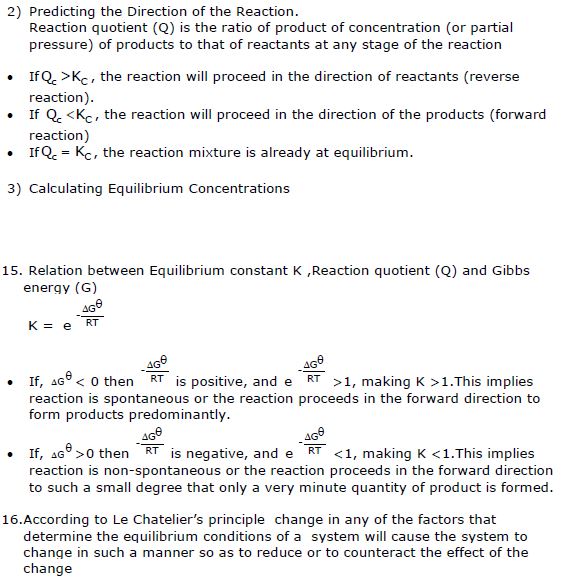
1) Predicting the Extent of a Reaction
• If C K > 103, products predominate over reactants, i.e., if C K is very large, the reaction proceeds nearly to completion
• If C K < 10-3, reactants predominate over products, i.e., if C K is very small, the reaction proceeds rarely
• If C K is in the range of 10-3 to 103, considerable concentrations of both reactants and products are present
Please click the link below to download pdf file for CBSE Class 11 Chemistry Equilibrium Notes Set C.
Free study material for Chemistry
Study Material and Revision Notes for Class 11 Chemistry Chapter 06 Equilibrium
About Chapter 06 Equilibrium Revision Notes
Explore reliable chapter overviews for Chapter 06 Equilibrium tailored for Class 11 learners. Use these structured points to grasp difficult themes and ensure solid preparation for upcoming assessments.
How to Use These Revision Notes
Built using the official NCERT book for Class 11 Chemistry, these notes provide reliable academic guidance. Pair your summary review with our recommended NCERT solutions to master optimal problem-solving approaches.
Enhance Practice with MCQs and Worksheets
Follow up your revision by attempting the interactive online Chemistry MCQ test and practice worksheets for this chapter to verify your mastery. All platform resources are free to access.
FAQs
You can download the teacher prepared revision notes for CBSE Class 11 Chemistry Equilibrium Notes Set 03 from StudiesToday.com. These notes are designed as per 2026-27 academic session to help Class 11 students get the best study material for Chemistry.
Yes, our CBSE Class 11 Chemistry Equilibrium Notes Set 03 include 50% competency-based questions with focus on core logic, keyword definitions, and the practical application of Chemistry principles which is important for getting more marks in 2026 CBSE exams.
Yes, our CBSE Class 11 Chemistry Equilibrium Notes Set 03 provide a detailed, topic wise breakdown of the chapter. Fundamental definitions, complex numerical formulas and all topics of CBSE syllabus in Class 11 is covered.
These notes for Chemistry are organized into bullet points and easy-to-read charts. By using CBSE Class 11 Chemistry Equilibrium Notes Set 03, Class 11 students fast revise formulas, key definitions before the exams.
No, all study resources on StudiesToday, including CBSE Class 11 Chemistry Equilibrium Notes Set 03, are available for immediate free download. Class 11 Chemistry study material is available in PDF and can be downloaded on mobile.