CBSE Class 11 Chemistry Thermodynamics Notes Set C

Download the latest CBSE Class 11 Chemistry Thermodynamics Notes Set C in PDF format. These Class 11 Chemistry revision notes are carefully designed by expert teachers to align with the 2025-26 syllabus. These notes are great daily learning and last minute exam preparation and they simplify complex topics and highlight important definitions for Class 11 students.

Chapter-wise Revision Notes for Class 11 Chemistry Chapter 5 Thermodynamics

To secure a higher rank, students should use these Class 11 Chemistry Chapter 5 Thermodynamics notes for quick learning of important concepts. These exam-oriented summaries focus on difficult topics and high-weightage sections helpful in school tests and final examinations.

Chapter 5 Thermodynamics Revision Notes for Class 11 Chemistry


Class: XI

Chapter: Thermodynamics

Top concepts

1. The branch of science which deals with study of different forms of energy and their interconversion is called thermodynamics.

2. A system in thermodynamics refers to that part of universe in which observations are made.

3. The remaining portion of universe which is not part of system constitutes the surroundings. The surroundings include everything other than the system.

4. The wall (real or imaginary) that separates the system from the surroundings is called boundary. 

5. Types of the System
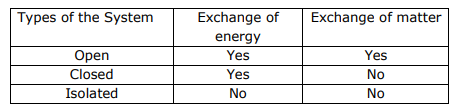
class_11_chemistry_concept_24

6. The state of a thermodynamic system is described by its measurable or macroscopic (bulk) properties. The state of the surroundings can never be completely specified.

7. State variables are the measurable properties of system required to describe the state of the system. Examples are temperature, pressure, volume etc. 

8. Various types of processes 
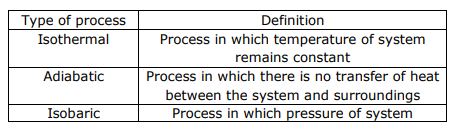
class_11_chemistry_concept_24a

CBSE Class 11 Chemistry Notes - Thermodynamics 1


9. Every substance possesses definite amount of energy which depends on factors such as chemical nature, temperature and pressure etc.Internal energy, U of the system represents the total energy of the system


10. Work done in a adiabatic process and sign convention

CBSE Class 11 Chemistry Notes - Thermodynamics 2


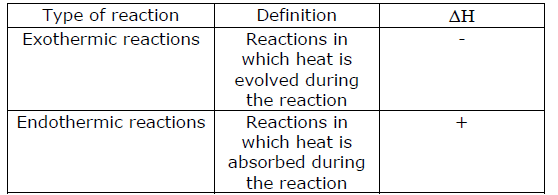
12. First Law of Thermodynamics: ΔU = q + w


13. First law of thermodynamics is also called as law of conservation of energy i.e. energy can neither be created nor destroyed. It also states that the energy of an isolated system is constant.


14.Absolute value of the internal energy can never be determined only change in internal energy can be determined.


15.A process or change is said to be reversible, if a change is brought out in such a way that the process could, at any moment, be reversed by an infinitesimal change.


16.For an isothermal reversible process

CBSE Class 11 Chemistry Notes - Thermodynamics 3


17.For isothermal irreversible change  ex f i q= -w =pex  (Vf -Vi)


18.Expansion of a gas in vacuum (pex = 0) is called free expansion. No work is done during free expansion of an ideal gas whether the process is reversible or irreversible
 
19.For adiabatic change, q = 0 and ΔU = wad
 
20.The enthalpy of a system may be defined as the sum of the internal energy and the product of its pressure and volume. It is denoted by the symbol H and is given by H = U + PV
 
21.Change in enthalpy ΔH =ΔU + pΔV
 
22.Enthalpy change and sign convention

CBSE Class 11 Chemistry Notes - Thermodynamics 4

23.An extensive property is a property whose value depends on the quantity or size of matter present in the system. Examples are mass, volume, internal energy, enthalpy, heat capacity, etc
 
24.An intensive property is a property whose value does not depend on the quantity or size of matter present in the system. Examples are temperature, density, pressure etc.
 
25.Specific heat, also called specific heat capacity is the quantity of heat required to raise the temperature of one unit mass of a substance by one degree Celsius (or one Kelvin).
 
26.Relation between amount of heat, q, required to raise the temperatures of a sample, specific heat of the substance, c and change in temperatures is given as q = mc ΔT = CΔT
 
27.At constant pressure as  qp = Cp  ΔT =Δ H
 
28. At constant volume as  qV = C V T =Δ U
 
29. For a mole of an ideal gas, C p -C v = R
 
30. Calorimetry is an experimental technique that helps determining
energy changes associated with chemical or physical processes
 
31.The enthalpy change accompanying a reaction is called the reaction enthalpy (Δ r H )
Δ r H= (sum of enthalpies of products)- (sum of enthalpies of reactants)
 
32.The standard enthalpy of reaction is the enthalpy change for a reaction when all the participating substances are in their standard states. The standard state of a substance at a specified temperature is its pure form at pressure of 1 bar.
 
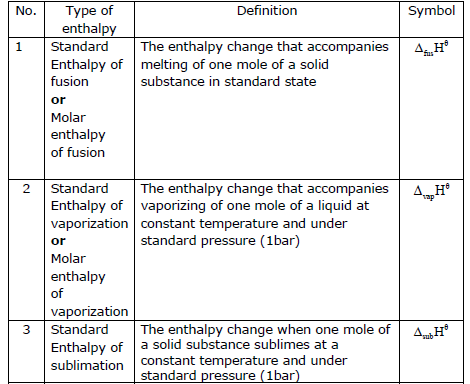
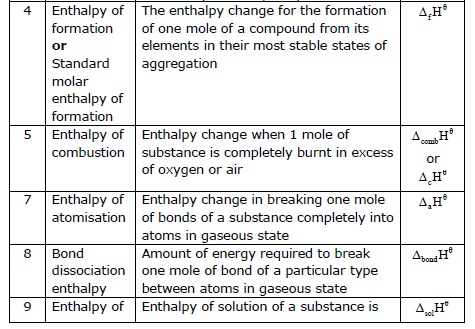
33.Different types of enthalpy
CBSE Class 11 Chemistry Notes - Thermodynamics 5
CBSE Class 11 Chemistry Notes - Thermodynamics 6


Please click the link below to download pdf file for CBSE Class 11 Chemistry Notes - Thermodynamics.

CBSE Class 11 Chemistry Chapter 5 Thermodynamics Notes

Students can use these Revision Notes for Chapter 5 Thermodynamics to quickly understand all the main concepts. This study material has been prepared as per the latest CBSE syllabus for Class 11. Our teachers always suggest that Class 11 students read these notes regularly as they are focused on the most important topics that usually appear in school tests and final exams.

NCERT Based Chapter 5 Thermodynamics Summary

Our expert team has used the official NCERT book for Class 11 Chemistry to design these notes. These are the notes that definitely you for your current academic year. After reading the chapter summary, you should also refer to our NCERT solutions for Class 11. Always compare your understanding with our teacher prepared answers as they will help you build a very strong base in Chemistry.

Chapter 5 Thermodynamics Complete Revision and Practice

To prepare very well for y our exams, students should also solve the MCQ questions and practice worksheets provided on this page. These extra solved questions will help you to check if you have understood all the concepts of Chapter 5 Thermodynamics. All study material on studiestoday.com is free and updated according to the latest Chemistry exam patterns. Using these revision notes daily will help you feel more confident and get better marks in your exams.

Where can I download the latest PDF for CBSE Class 11 Chemistry Thermodynamics Notes Set C?

You can download the teacher prepared revision notes for CBSE Class 11 Chemistry Thermodynamics Notes Set C from StudiesToday.com. These notes are designed as per 2025-26 academic session to help Class 11 students get the best study material for Chemistry.

Are these Chemistry notes for Class 11 based on the 2026 board exam pattern?

Yes, our CBSE Class 11 Chemistry Thermodynamics Notes Set C include 50% competency-based questions with focus on core logic, keyword definitions, and the practical application of Chemistry principles which is important for getting more marks in 2026 CBSE exams.

Do these Class 11 notes cover all topic-wise concepts for Chemistry?

Yes, our CBSE Class 11 Chemistry Thermodynamics Notes Set C provide a detailed, topic wise breakdown of the chapter. Fundamental definitions, complex numerical formulas and all topics of CBSE syllabus in Class 11 is covered.

How can I use CBSE Class 11 Chemistry Thermodynamics Notes Set C for quick last-minute revision?

These notes for Chemistry are organized into bullet points and easy-to-read charts. By using CBSE Class 11 Chemistry Thermodynamics Notes Set C, Class 11 students fast revise formulas, key definitions before the exams.

Is there any registration required to download Class 11 Chemistry notes?

No, all study resources on StudiesToday, including CBSE Class 11 Chemistry Thermodynamics Notes Set C, are available for immediate free download. Class 11 Chemistry study material is available in PDF and can be downloaded on mobile.