

Revision Notes for Class 11 Chemistry: Chapter 04 Chemical Bonding and Molecular Structure
Review targeted revision notes for Class 11 Chemistry with the CBSE Class 11 Chemistry Chemical Bonding And Molecular Structure Notes Set 05. Built according to official educational guidelines for the 2026-27 academic year, these downloadable summaries for Chapter 04 Chemical Bonding and Molecular Structure support daily study and last-minute exam readiness.
Review Chapter 04 Chemical Bonding and Molecular Structure for Class 11 Chemistry
View or download the dedicated Chapter 04 Chemical Bonding and Molecular Structure revision resource below. Engaging with these structured concept notes daily ensures continuous academic progress and mastery of the 2026-27 curriculum for Chemistry.
CHEMICAL BONDING AND MOLECULAR STRUCTURE
OCTET RULE- During a chemical reaction the atoms tend to adjust their electronic arrangement in such a way that they achieve 8 e- in their outermost electron. This is called octet rule.
CHEMICAL BOND- the chemical force which keeps the atoms in any molecule together is called a chemical bond.
IONIC BOND- The columbic force of attraction which holds the appositively charged ions together is called an ionic bond. An ionic bond is formed by the complete transfer of one or more electrons from the atom of a metal to an atom of non- metal.
LATTICE ENTHALPY- The molar enthalpy change accompanying the complete separation of the constituent particles that compose of the solids (such as ions for ionic solid, molecules for molecular solids) under standard conditions is called lattice enthalpy (ΔlHo). The lattice enthalpy is a positive quantity.
ELECTRO VALENCY: The number of electrons lost or gain by an atom of an element is called as electrovalency. The element which give up electrons to form positive ions are said to have positive valency, while the elements which accept electrons to form negative ions are said to have negative valency.
FORMATION OF AN IONIC BOND: It is favoured by, (i) the low ionisation enthalpy of a metallic element which forms the cations, (ii) High electron gain enthalpy of non- metallic element which forms the anions, (iii) Large lattice enthalpy i.e; the smaller size and the higher charge of the atoms.
COVALENCY:The number of electrons which an atom contributes towards mutual sharing during the formation of a chemical bond called its covalency in that compound.
SINGLE COVALENT BOND: A covalent bond formed by the mutual sharing of one pair of electrons is called a single covalent bond, or simply a single bond. A single covalent bond is represented by a small line (−) between the two atoms.
DOUBLE COVALENT BOND: A covalent bond formed by the mutual sharing of two pair of electrons is called a double covalent bond, or simply a double bond. A double covalent bond is represented by two small horizontal lines (=) between the two atoms. E.g. O=O, O=C=O etc.
TRIPLE COVALENT BOND: A covalent bond formed by the mutual sharing of three pair of electrons is called a triple covalent bond, or simply a triple bond. A triple covalent bond is represented by three small horizontal lines (≡) between the two atoms. E.g. N≡N, H-C≡C-H etc.
FORMATION OF A COVALENT BOND: Formation of a covalent bond is favoured by
(i) High ionisation enthalpy of the combining elements.
(ii)Nearly equal electron gain enthalpy and equal electro-negativities of combining elements.
(iii) High nuclear charge and small atomic size of the combining elements.
POLAR COVALENT BOND: The bond between two unlike atoms which differ in their affinities for electrons is said to be polar covalent bond. E.g. H-Cl
COORDINATE BOND: The bond formed when one sided sharing of electrons take place is called a coordinate bond. Such a bond is also known as dative bond. It is represented by an arrow (→) pointing towards the acceptor atom. E.g. H3N→BF3
Bond Length: Bond length is defined as the equilibrium distance between the nuclei of two bonded atoms in a molecule
Bond Angle: It is defined as the angle between the orbitals containing bonding electron pairs around the central atom in a molecule/complex ion
Bond Enthalpy: It is defined as the amount of energy required to break one mole of bonds of a particular type between two atoms in a gaseous state.
Bond Order: In the Lewis description of covalent bond, the Bond Order is given by the number of bonds between the two atoms in a molecule
Resonance:whenever a single Lewis structure cannot describe a molecule accurately, a number of structures with similar energy, positions of nuclei, bonding and non-bonding pairs of electrons are taken as the canonical structures of the hybrid which describes the molecule accurately
Dipole moment : The product of the magnitude of the charge and the distance between the centres of positive and negative charge.It is a vector quantity and is represented by an arrow with its tail at the positive centre and head pointing towards a negative centre. Dipole moment (μ) = charge (Q) × distance of separation (r)
SIGMA BOND: A covalent bond formed due to the overlapping of orbitals of the two atoms along the line joining the two nuclei (orbital axis) is called sigma (σ) bond. For example, the bond formed due to s-s and s-p, p-p overlapping along the orbital axis are sigma bonds.
Pi- BOND: A covalent bond formed by the side wise overlapping of p- or d- orbitals of two atoms is called as pi (π) bond. For example, the bond formed due to the sideways overlapping of the two p- orbitals is a pi- bond.
HYDROGEN BOND: The bond between the hydrogen atom of one molecule and a more electro- negative element of same or another molecule is called as hydrogen bond.
HYBRIDIZATION: The process of mixing of the atomic orbitals to form new hybrid orbitals is called hybridization. All hybrid orbitals of a particular kind have equal energy, identical shapes and are symmetrically oriented in shape. The hybrid orbitals are designed according to the type and the atomic orbitals merging together, e.g.,
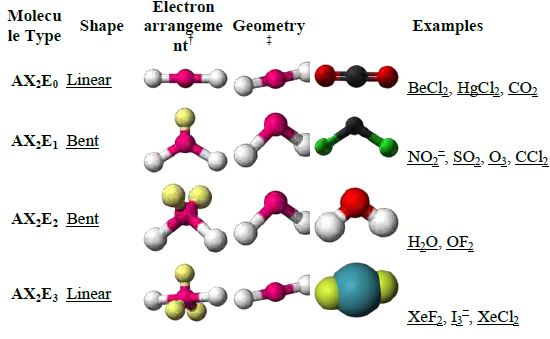
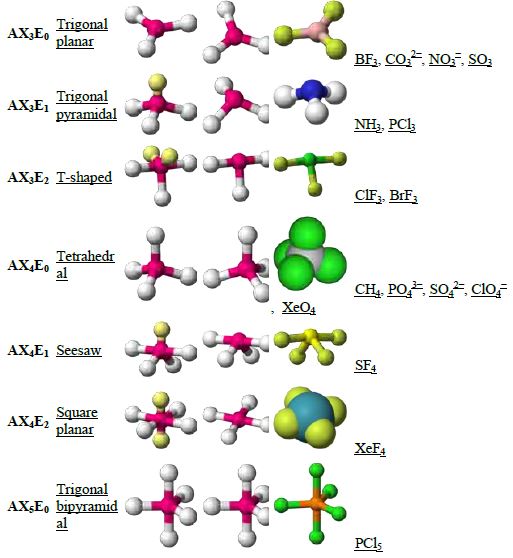
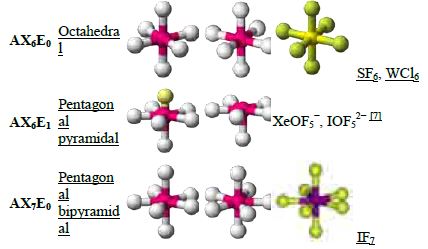
QUESTIONS
Q.1. What is the total number of sigma and pi bonds in the following molecules? (a) C2H2 (b) C2H4 Ans- there are three sigma and two pi-bonds in C2H2. there are five sigma bonds and one pi-bond in C2H4.
Q.2. Write the significance of a plus and a minus sign shown in representing the orbitals. Ans- Molecular orbitals are represented by wave functions. A plus sign in an orbital indicates a positive wave function while a minus sign in an orbital represents a negative wave function.
Q.3. How do you express the bond strength in terms of bond order?
Ans- Bond strength represents the extent of bonding between two atoms forming a molecule. The larger the bond energy, the stronger is the bond and the greater is the bond order.
Q.5. Define the bond length. Ans- Bond length is defined as the equilibrium distance between the nuclei of two bonded atoms in a molecule.
Please click the link below to download pdf file for CBSE Class XI Chemistry Chemical Bonding and Molecular Structure Concepts.
Free study material for Chemistry
Download CBSE Revision Notes: Class 11 Chemistry Chapter 04 Chemical Bonding and Molecular Structure
About Chapter 04 Chemical Bonding and Molecular Structure Revision Notes
Explore reliable chapter overviews for Chapter 04 Chemical Bonding and Molecular Structure tailored for Class 11 learners. Use these structured points to grasp difficult themes and ensure solid preparation for upcoming assessments.
How to Use These Revision Notes
Cross-reference your comprehension with comprehensive NCERT solutions for Class 11 to ensure absolute clarity across all sub-topics in this chapter.
Enhance Practice with MCQs and Worksheets
Follow up your revision by attempting the interactive online Chemistry MCQ test and practice worksheets for this chapter to verify your mastery. All platform resources are free to access.
FAQs
You can download the teacher prepared revision notes for CBSE Class 11 Chemistry Chemical Bonding And Molecular Structure Notes Set 05 from StudiesToday.com. These notes are designed as per 2026-27 academic session to help Class 11 students get the best study material for Chemistry.
Yes, our CBSE Class 11 Chemistry Chemical Bonding And Molecular Structure Notes Set 05 include 50% competency-based questions with focus on core logic, keyword definitions, and the practical application of Chemistry principles which is important for getting more marks in 2026 CBSE exams.
Yes, our CBSE Class 11 Chemistry Chemical Bonding And Molecular Structure Notes Set 05 provide a detailed, topic wise breakdown of the chapter. Fundamental definitions, complex numerical formulas and all topics of CBSE syllabus in Class 11 is covered.
These notes for Chemistry are organized into bullet points and easy-to-read charts. By using CBSE Class 11 Chemistry Chemical Bonding And Molecular Structure Notes Set 05, Class 11 students fast revise formulas, key definitions before the exams.
No, all study resources on StudiesToday, including CBSE Class 11 Chemistry Chemical Bonding And Molecular Structure Notes Set 05, are available for immediate free download. Class 11 Chemistry study material is available in PDF and can be downloaded on mobile.