

Official Class 11 Chemistry Revision Material: CBSE Class 11 Chemistry Redox Reactions Notes Set 03
Review targeted revision notes for Class 11 Chemistry with the CBSE Class 11 Chemistry Redox Reactions Notes Set 03. Built according to official educational guidelines for the 2026-27 academic year, these downloadable summaries for Chapter 07 Redox Reactions support daily study and last-minute exam readiness.
Chapter-wise Concept Summaries: Chapter 07 Redox Reactions
Navigate directly to the revision notes for Chapter 07 Redox Reactions using the digital viewer below. Each summary is structured to highlight high-weightage sections, allowing students to instantly access critical definitions and focus on core exam topics.
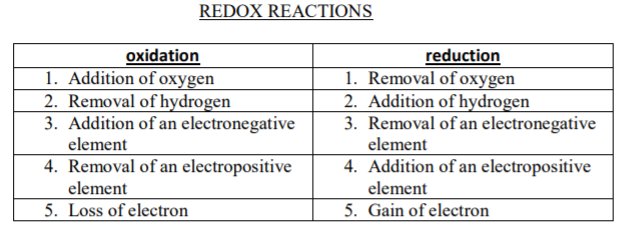
Oxidation number denotes theoxidation state of an element in a compound ascertained according to a setof rules formulated on the basis thatelectron in a covalent bond belongsentirely to more electronegative element.
Calculation of oxidation number-
1. O. S. of all the elements in their elemental form (in standard state) is taken as zero O. S. of elements in Cl2, F2, O2, P4, O3, Fe(s), H2, N2, C(graphite) is zero.
2. Common O. S. of elements of group one (1st) is one. Common O. S. of elements of group two (2nd) is two.
3. For ions composed of only one atom, theoxidation number is equal to the chargeon the ion.
4. The oxidation number of oxygen in most compounds is –2.While in peroxides (e.g., H2O2, Na2O2), eachoxygen atom is assigned an oxidationnumber of –1, in superoxides (e.g., KO2,RbO2) each oxygen atom is assigned anoxidation number of –(½).
5. In oxygendifluoride (OF2) and dioxygendifluoride (O2F2), the oxygen is assignedan oxidation number of +2 and +1,respectively.
6. The oxidation number of hydrogen is +1 but in metal hydride its oxidation no. is–1.
7. In all its compounds, fluorine has anoxidation number of –1.
8. The algebraic sum of the oxidation numberof all the atoms in a compound must bezero.
9. In polyatomic ion, the algebraic sumof all the oxidation numbers of atoms ofthe ion must equal the charge on the ion.
Stocknotation: the oxidationnumber is expressed by putting a Romannumeral representing the oxidation numberin parenthesis after the symbol of the metal inthe molecular formula. Thus aurous chlorideand auric chloride are written as Au(I)Cl andAu(III)Cl3. Similarly, stannous chloride andstannic chloride are written as Sn(II)Cl2andSn(IV)Cl4.
Oxidation: An increase in the oxidationnumber
Reduction: A decrease in the oxidationnumber
Oxidising agent: A reagent which canincrease the oxidation number of an elementin a given substance. These reagents are calledas oxidants also.
Reducing agent: A reagent which lowers the oxidation number of an element in a givensubstance. These reagents are also called asreductants.
Redox reactions: Reactions which involvechange in oxidation number of the interactingspecies.
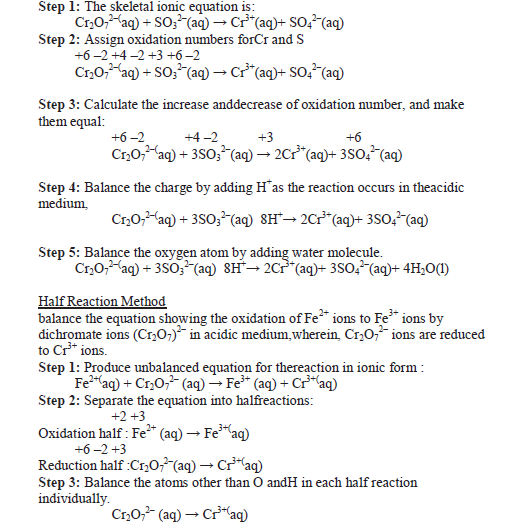
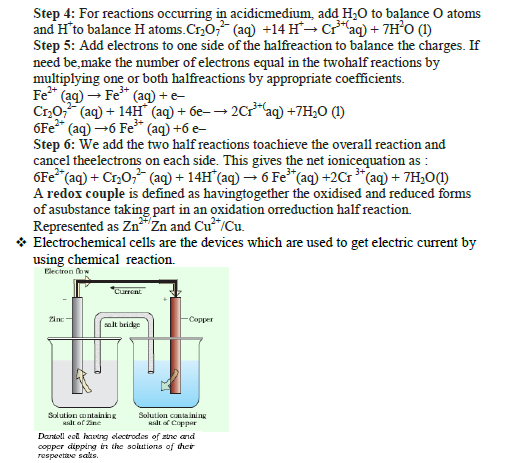
Balancing of redox reactions: Oxidation Number Method: Write the net ionic equation for the reaction of potassium dichromate(VI), K2Cr2O7 with sodium sulphite,Na2SO3, in an acid solution to give chromium(III) ion and the sulphate ion.

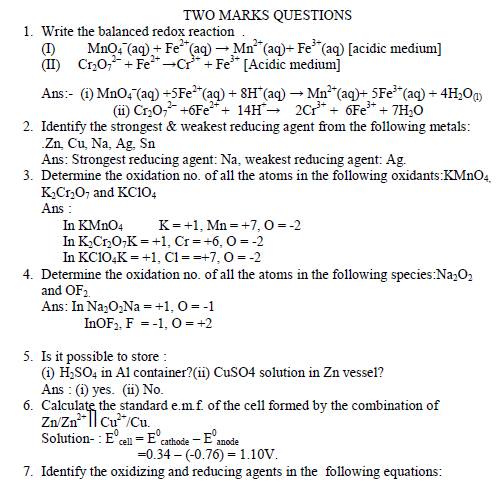
Please click the link below to download pdf file for CBSE Class XI Chemistry Redox Reactions Concepts.
Free study material for Chemistry
Study Material and Revision Notes for Class 11 Chemistry Chapter 07 Redox Reactions
About Chapter 07 Redox Reactions Revision Notes
Review targeted chapter notes for Class 11 Chemistry Chapter 07 Redox Reactions. Built according to official CBSE guidelines, these summaries highlight high-yield topics frequently tested in school evaluations.
How to Use These Revision Notes
Built using the official NCERT book for Class 11 Chemistry, these notes provide reliable academic guidance. Pair your summary review with our recommended NCERT solutions to master optimal problem-solving approaches.
Enhance Practice with MCQs and Worksheets
Follow up your revision by attempting the interactive online Chemistry MCQ test and practice worksheets for this chapter to verify your mastery. All platform resources are free to access.
FAQs
You can download the teacher prepared revision notes for CBSE Class 11 Chemistry Redox Reactions Notes Set 03 from StudiesToday.com. These notes are designed as per 2026-27 academic session to help Class 11 students get the best study material for Chemistry.
Yes, our CBSE Class 11 Chemistry Redox Reactions Notes Set 03 include 50% competency-based questions with focus on core logic, keyword definitions, and the practical application of Chemistry principles which is important for getting more marks in 2026 CBSE exams.
Yes, our CBSE Class 11 Chemistry Redox Reactions Notes Set 03 provide a detailed, topic wise breakdown of the chapter. Fundamental definitions, complex numerical formulas and all topics of CBSE syllabus in Class 11 is covered.
These notes for Chemistry are organized into bullet points and easy-to-read charts. By using CBSE Class 11 Chemistry Redox Reactions Notes Set 03, Class 11 students fast revise formulas, key definitions before the exams.
No, all study resources on StudiesToday, including CBSE Class 11 Chemistry Redox Reactions Notes Set 03, are available for immediate free download. Class 11 Chemistry study material is available in PDF and can be downloaded on mobile.