

Official Class 10 Social Science Revision Material: CBSE Class 10 Social Science Water Resources Notes Set 01
Access comprehensive revision notes for Contemporary India Chapter 03 Water Resources using the CBSE Class 10 Social Science Water Resources Notes Set 01. Designed to align with the 2026-27 academic syllabus for Class 10 Social Science, these concept summaries help students streamline their exam preparation and review complex topics efficiently.
Chapter-wise Concept Summaries: Contemporary India Chapter 03 Water Resources
Access the complete concept summary PDF for Contemporary India Chapter 03 Water Resources below. Regular review of these targeted notes builds familiarity with complex Class 10 Social Science themes and helps secure higher marks in final school evaluations.
• Dam-Embankments or structures built across the river to store rain water for various uses.
• Inundation Canal -Canal meant for diverting flood water mainly during the rainy season.
• Rain water Harvesting- It is a technique of increasing the recharge of ground water by capturing and storing rainwater by construction of dug well, ercolation pit etc.
• Guls/Kuls-Diversion channel for agriculture in the hill and mountain regions.
• Khadins-Johads-Rain fed storage structures in agricultural fields that allow water to stand and moisten the soil.
• Bamboo Drip Irrigation-A type of irrigation where water gets dropped in the form of drops near the roots of the plant mainly to conserve the moisture.
Question and Answer (3 Marks)
1.Why are multi-purpose River Valley Projects called the ‘temples of modern India?
• Economic prosperity-agriculture, urbanization, Promotion of tourism
• Integrate the development of agriculture and the village economy with rapid industrialization
2. Why is it necessary to conserve water resources in India? Give three reasons?
• To ensure food security.
• To control over exploitation and mismanagement
• To safeguard ourselves from health hazard as quality
3.. How are dams classified?
• Dams are classified according to structure and height like timber dams, embankments, masonry, large medium height or low dams.
4.Why was the Narmada Bachao Andolan started?
• Andolan focused on environmental issue, rehabilitation of displaced people against the building of Sardar Sarovar Dam.
5. Write a note on the traditional method of rain water harvesting in western Himalayas, Bengal and Rajasthan?
• In hill and mountainous regions, people built diversion channels like the ‘guls’ or ‘kuls’ of the Western Himalayas for agriculture.In the flood plains of Bengal, people developed inundation channels to irrigate their fields.
• In Rajasthan - The tankas were part of the well-developed rooftop rainwater harvesting system and were built inside the main house of the courtyard. They were connected to the sloping roofs of the houses through a pipe.
Summary :
Hydraulic Structure in Ancient India :
- In the first century B.C. Sringaverapura near Allahabad had sophisticated water harvesting system channeling the flood water of the river Ganga.
- During the time of Chandragupta Mauriya, dams lakes and irrigation systems were extensively built.
- Evidences of sophisticated irrigation works have also been found in Kalinga, Nagarjuna Konda, Bennur, Kohlapur etc.
- In 11th century, Bhopal lake, one of the larest artificial lakes of its time was built.
- In 14th century, the tank of Hauz Khas, Delhi, was constructed by Iltutmish for supplying water of Siri Fort area.
Dam :
A dam is a barrier across flowing water that obstructs, directs or retards the flow, often creating a reservoir, lake or impoundment.
- Classification of dams according to structure, intended purpose or height.
- Based on structure or material used, dams are classified as timber dams, embankment dams or masonry dams, with several sub-types.
- According to the height dams can be categories as large dams and major dams or alternatively as low dams, medium height dams and high dams.
3. Rain Water Harvesting :
- In hill and mountainous regions, people built diversion channels like the ‘guls’ or ‘kuls’ of the western Himalayas for agriculture.
- Rooftop rain water harvesting was commonly practiced to store drinking water, in Rajasthan.
- In the flood plains of Bengal, people developed inundation channels to irrigate their fields.
- In arid and semi arid regions, agricultural fields were converted into rain fed storage structures that allowed the water to stand and moisten the soil like the ‘khadins’ in Jaisalmer and ‘Johads’ in other parts of Rajasthan.
- Tankas - underground tanks ro tankas for storing drinking water.
- In Bikaner, phalodi and Barmer.
- The tanks could be as large as a big room.
- Roof top rainwater harvesting as drinking water.
- The first spell of rain was usually not collected as this would clean the roofs and the pipes
- Rain water called as Palar Pani.
- Many houses constructed underground rooms adjoining the ‘tankas’ to beat the summer heat as it would keep the room cool.
- Some houses still maintain the tanks since they do not like the taste of tap water.
- In Gendathur, a remote backward village in Mysore, Karnataka, villagers have installed, in their house hold’s roof top, rainwater harvesting system to meet their water needs.
Question and Answer (5Marks)
1. Explain any five main causes of water pollution.
• Industrial effluents dumped without treatment, Thermal pollution-Polluted hot water is pumped into the river, Domestic waste, Use of washy, oily spills from the ships.
• Use of excessive fertilizers- Drip into the soil- Underground water get polluted.
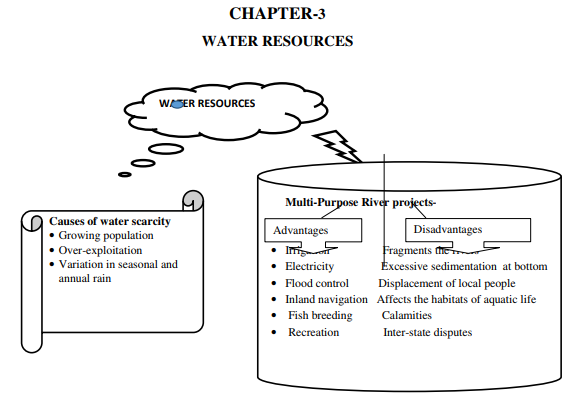
2 .In recent years, multi-purpose projects and large dams have come under great scrutiny and opposition – Why?
• a) Excessive sedimentation,
• b)Difficult for aquatic fauna to migrate,
• c )Large scale displacement of local communities,
• d) Unsuccessful in control of floods at the time of excessive rain fall,
• e) Induced earth quakes, Caused water borne diseases and pests pollution.
• f) Eg. Release of water from dams during heavy rains.
Please click the link below to download pdf file for CBSE Class 10 Social Science Water Resources Notes
Free study material for Social Science
Study Material and Revision Notes for Class 10 Social Science Contemporary India Chapter 03 Water Resources
Quick Revision Notes: Contemporary India Chapter 03 Water Resources (CBSE)
Explore reliable chapter overviews for Contemporary India Chapter 03 Water Resources tailored for Class 10 learners. Use these structured points to grasp difficult themes and ensure solid preparation for upcoming assessments.
Expert Study Material for Class 10 Social Science
Cross-reference your comprehension with comprehensive NCERT solutions for Class 10 to ensure absolute clarity across all sub-topics in this chapter.
Complete Your Chapter Revision
Explore our broader library of printable assignments, chapter notes, and mock tests designed to support continuous revision and secure higher marks in CBSE assessments.
FAQs
You can download the teacher prepared revision notes for CBSE Class 10 Social Science Water Resources Notes Set 01 from StudiesToday.com. These notes are designed as per 2026-27 academic session to help Class 10 students get the best study material for Social Science.
Yes, our CBSE Class 10 Social Science Water Resources Notes Set 01 include 50% competency-based questions with focus on core logic, keyword definitions, and the practical application of Social Science principles which is important for getting more marks in 2026 CBSE exams.
Yes, our CBSE Class 10 Social Science Water Resources Notes Set 01 provide a detailed, topic wise breakdown of the chapter. Fundamental definitions, complex numerical formulas and all topics of CBSE syllabus in Class 10 is covered.
These notes for Social Science are organized into bullet points and easy-to-read charts. By using CBSE Class 10 Social Science Water Resources Notes Set 01, Class 10 students fast revise formulas, key definitions before the exams.
No, all study resources on StudiesToday, including CBSE Class 10 Social Science Water Resources Notes Set 01, are available for immediate free download. Class 10 Social Science study material is available in PDF and can be downloaded on mobile.