

Download Class 10 Social Science Concept Summaries: CBSE Class 10 Social Science Federalism Notes Set 01
Access comprehensive revision notes for Democratic Politics II Chapter 02 Federalism using the CBSE Class 10 Social Science Federalism Notes Set 01. Designed to align with the 2026-27 academic syllabus for Class 10 Social Science, these concept summaries help students streamline their exam preparation and review complex topics efficiently.
Access Democratic Politics II Chapter 02 Federalism Notes and Study Material
Access the complete concept summary PDF for Democratic Politics II Chapter 02 Federalism below. Regular review of these targeted notes builds familiarity with complex Class 10 Social Science themes and helps secure higher marks in final school evaluations.
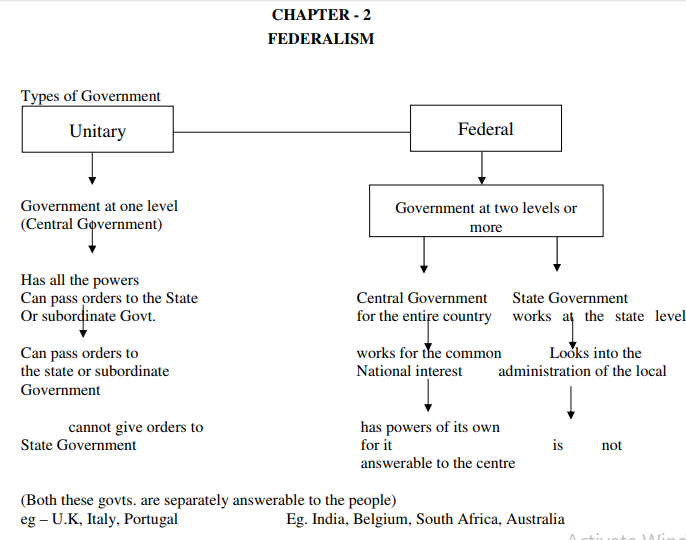
Features of Federalism
- There are two or more levels of Govt.
- Different tiers of Govt. govern the same citizens, but each tier has its own jurisdiction in specific matters of legislation, taxation and administration.
- The jurisdictions of the respective levels or tiers of Govt are specified in the constitution.
- Require the consent of both the levels of Govt.
- Courts have the power to interpret the constitution and the powers of different levels of Govt.
- An ideal federal system has both aspects : mutual trust and agreement to live together.
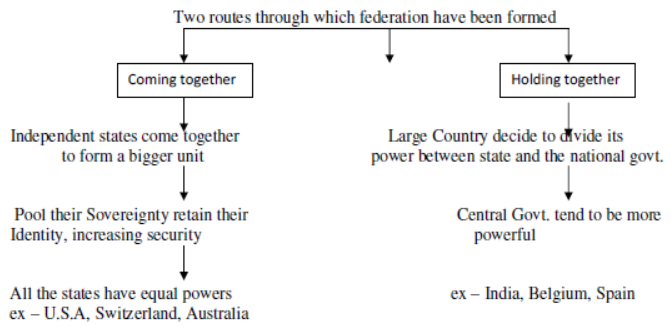
- The first route involves independent states coming together on their own to form a bigger unit.
- The second route is where a large country decides to divide its power between the constituent states and the national Govt.
Federalism in India
- The constitution originally provided for a two tier system of Govt the union Govt or what we call the Central Govt, representing the union of India and the state Govt. later, a third tier of federalism was added in the form of Panchayats and Municipalities.
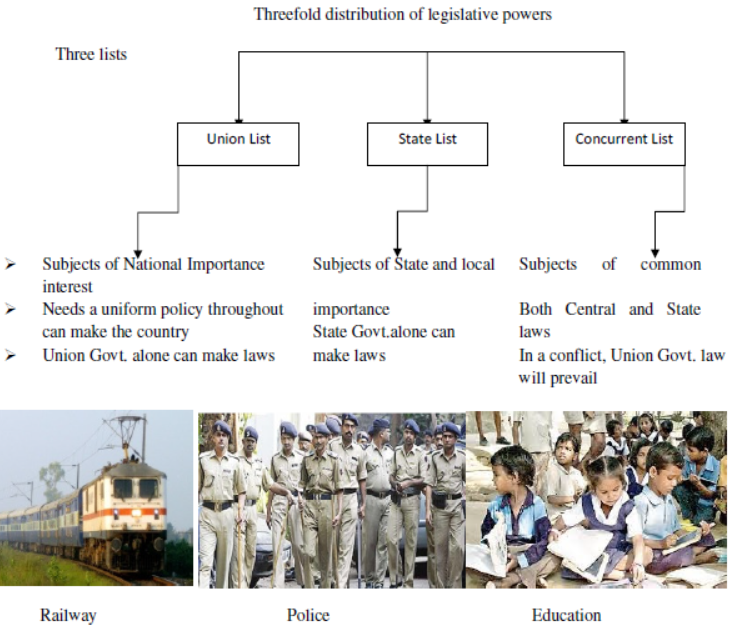
- Constitution clearly provided a three fold distribution of legislative powers between the union Govt and the state Govt :
1. Union list :- Defence of the country foreign affairs, banking.
2. State List : Police, trade, commerce, agriculture.
3. Concurrent List : Education, Forest, Trade Union, Marriage.
4. Residuary Subject : Computer software
- Only Jammu & Kashmir has their own constitution.
Decentralization in India
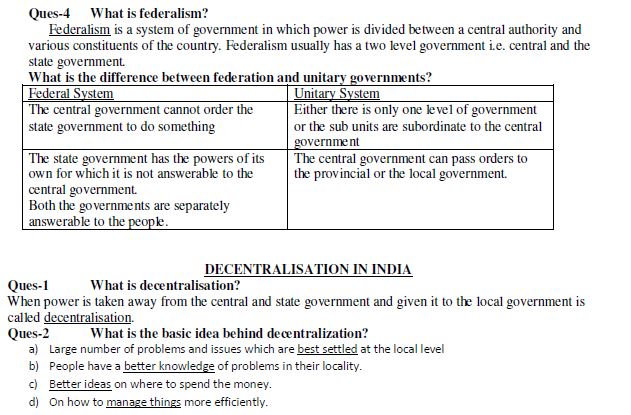
- When power is taken away from central and State Govt. and given to local Govt. it is called decentralisation.
- The basic idea behind decentralisation is that there are a large number of problems and issues which are best settled at the local level.
- Local govt. get constitutional importance in democracy.
- And representation of women may also increased with this role played by women in democracy became more stronger.
Features of Federalism:-
• Two or more levels of government
• Each level has its own jurisdiction (power)
• Jurisdictions Specified in the Constitution
• Changes in the provisions of Constitution require the consent of both the govt’s.
• Courts acts as an umpire if any dispute arise between the levels of government.
• Sources of revenue specified (Financial autonomy) – Every state has its own revenue to look after its welfare.
• Dual objective – promote the unity of the country by accommodating regional diversity
Residuary Subjects:
♦ Computers
• Subjects that do not fall in any of the three lists, laws of union Govt. will prevail. How is federalism practiced?
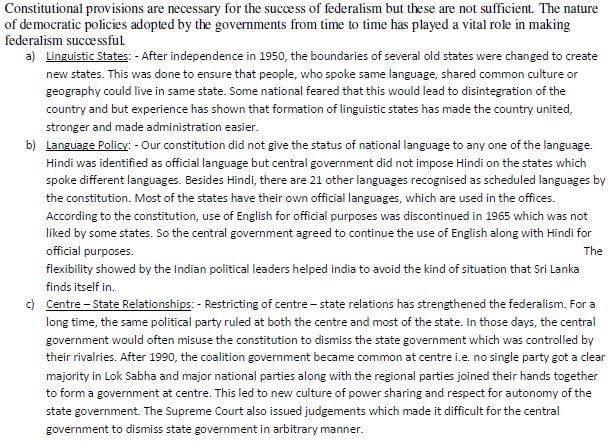
• Linguistic states- People who spoke the same language lived in the same state.
• Some states were created not on the basis of language, but to recognize differences based on culture, ethnicity or geography.
• Formation of linguistic states has made the country united, made administration easier. Decentralization Power taken away from centre and State given to local government Reason for Decentralization in India –
• Large country
• Three - Tier govt., - local govt. formed
• Large no: of problems and issues
• Local people-better knowledge of local problems
• Democratic participation – local self – govt.
• 1992- Amendment – third tier made – more powerful Steps taken to make third-tier more powerful
• Regular elections
• Reservation of seats for SC, ST, OBC
• Reservation for women
• Creation of state EC to control elections
• State govt. to share power & revenue with local govt.
Formation of Panchayati Raj (Rural local government)-
• Group of each village have a panchayat
• President or Sarpanch
• Directly elected by the people
• Works under the supervision of gramasabha (all voters of the village)
• Meets twice or thrice a year to approve the budget of Grama Panchayat
ANSWER THE FOLLOWING- [3-MARKS]
1. What are the two routes through which federation have been formed?
• There are two kinds of routes through which federations can be formed.
• First one is ‘Coming together Federation’ in which independent units comes closely to each other to form a union in which both centre and states vis-à-vis powerful.
• Second one is ‘Holding together Federation’- here a large country decides to divide its powers between the constituent states and the national government.
2. What is the importance of Local Self government?
• The matter of local interest like water supply, the cleaning and lighting of streets, maintenance of drainage system, etc are best settled at the local level.
• It is possible for the people to directly participate in decision making at the local levels like people can take part in panchayat meetings held in their area.
• The money spend and the to manage things more efficiently are seen here.
3. What is the real reason for the success of federalism in India?
• The constitutional provisions are laid out very clearly
• The nature of democratic politics has ensured its success
• There is respect for diversity
• The creation of Linguistic States , the flexibility shown by the Indian political leaders in Language policy and the significant changes made in the Centre –State relationships
4. What was the relationship between the centre and state when different parties ruled at the centre and state levels till 1990?
• When different parties ruled at the centre and state levels the parties at the centre tried
to undermine the power of states.
• The central government misused the constitution often to dismiss the state governments that were controlled by other parties. This is against the spirit of federalism.
5. Write a note on the Local bodies that exist in Urban areas?
• Municipalities are setup in towns. Big cities have Municipal Corporations .
• Both Municipalities and Municipal Corporations are controlled by elected bodies consisting of the people’s representatives.
• C]Municipal Chairman is the head of the Municipality and Mayor for Municipal Corporation.
LONG ANSWERS QUESTIONS : [5 MARKS]
1.What are the main features of Federalism ?
• 1.In federalism there are two or more tires of government but both of the tiers rule over the same citizens.
• Powers of every level are clearly written in the constitution and no one is authorized to cross its limits.
• The fundamental provisions of the Constitution cannot be unilaterally changed by one level of government.
• In federalism, courts are known as the guardians of constitution.
• Source of revenue of each level of government are clearly specified.
• The dual objectives of federal system -[a]To safeguard and promote unity of the country [b] accommodate regional diversity.
2 What are the three-fold distribution of Legislative powers between the Union and the State governments. What are ‘Residuary Subjects’?
Constitution has clearly demarcated the powers between different levels. Every level is given certain subjects to make laws related to its jurisdiction.
• Union List: Union List is a list of certain subjects on which Central government can make laws.
• State List : State list is a list of certain subjects on which state government can make laws.
• Concurrent List : Concurrent list is a list of subjects which are of common interest for both central and state government.
• Residuary Subjects : There are certain subjects which are not included in any of the three lists only central government can make laws on these subjects.
3. What major steps were taken in 1992 towards decentralization?
• A three tier democracies were introduced in 1992.
• A step was taken towards creating rural local self govt.
• Regular elections to be held for panchayats.
• Seats reserved for SC’s and STs OBCs
• One third seats reserved for women
• State govt. to share power and revenue with local bodies.
4. Explain the flexibility shown in the language policy in Indian federation?
• Our Constitution did not give the status of national language to any one language.
• A candidate in an examination conducted for Central government positions may opt to take the examination in any of the the languages. States too have their own official language.
• English along with Hindi is used for official purposes.
• Promotion of Hindi continues to be the official policy of Government of
India.Here, promotion does not mean that Central government can impose Hindi on states where people speak a different language.
QUESTION BANK -
Q.1- Explain the composition of Panchayathi Raj in India?
Q.2- Trace the history of the formation of the Linguistic States in India?
Q.3- Does a country like India need decentralization – Justify?
Q.4- What are Union Territories? Name two Union Territories of India.
Q.5- Define ‘Coalition Government’? How has this led to a new culture of Pwer Sharing?
Important Questions NCERT Class 10 Social Science Chapter 2 Federalism
Question. What is the official post for the chaiperson of a Municipal Corporation?
Ans. Mayor
Question. How is a federal government different from the unitary form of government? Why are federations preferred these days?
Ans. Difference between federal and unitary forms of government:
(i) Unitary government has only one level of government whereas a federal government has two or more levels of government.
(ii) In unitary government, the sub-units are subordinate to the centre, whereas in a federation, central government cannot encroach on the rights of state governments.
(iii) In Unitary system, centre can order the sub- units with cannot happen in federation.
A federation is preferred because :
(i) It helps in making administration effective and efficient.
(ii) It helps to accommodate all diverse groups.
Question. Highlight any three steps taken by India towards making it a federation.
Ans. (i) Reorganisation of states on linguistic basis.
(ii) Centre state relations are well defined.
(iii) Decentralisation at Panchayat level.
Question. Describe any three provisions of amendment made in Indian Constitution in 1992 for making three tier government more effective and powerful.
Ans. The various provisions of the constitutional amendment of 1992, made the third tier of our democracy more powerful. Its provisions include –
(a) Now it is constitutionally mandatory to hold regular elections to local government bodies.
(b) Seats are reserved in the elected bodies and the executives of these institutions for the Scheduled Castes, Scheduled Tribes and other Backward Classes.
(c) At least one-third of all positions are reserved for women.
(d) An independent institution called the State Election Commission has been created in each state to conduct panchayat and municipal elections.
(e) The State governments are required to share some powers and revenue with local government bodies. The nature of sharing varies from state to state.
Question. How are the powers divided between the states and centre? Explain with examples.
Ans. (i) There is three-fold distribution of legislative powers :
(a) Union list : Union lists consist of 97 subjects. It includes subjects of national importance such as defence of the country, foreign affairs, banking, communication and currency.
(b) State list : State list consists of 66 subjects. It contains subjects of state and local importance such as police, trade, commerce, agriculture and irrigation.
(c) Concurrent list : Concurrent list consists of 47 subjects. It includes subjects of common interest to both such as education, forest trade unions, marriage, adoption and succession.
(ii) Union Government can make laws on the subjects which are not covered under these lists. These subjects are put in residuary list.
Question. Much of the official work in Indian state is done in which language?
Ans. Much of the official work in Indian states is done in the language of the state.
INDIA - A FEDERAL COUNTRY….
India is a federal country in the following ways: Why is India called a Federal country?
1. Division of power-In India constitution has divided the powers of Union and state govt. in accordance of the following lists:
a. Union list- subjects of national importance like defense, foreign affairs, railways, post and telegraph etc. are included in the union list. Only union govt. can pass laws on subjects mentioned in this list as these are important for the whole country. This
list has 97 subjects.
b. State list- it has 66 subjects on which the state govt. has passed laws. E.g. police, local govt., trade, agriculture.
c. Concurrent list- it has 47 subjects which are of common concern to both union and state list and both can make laws on subjects mentioned in these lists. However, if there is conflict between centre and state over a subject, then central and union law will be effective. This list includes subjects like civil and criminal procedures, economic planning, education structure etc.
d. Residuary list of powers- Matters which are not included in any list are known as residuary powers. The central government has been given the power to legislate on residual subjects.
2. Three Tier System
In India, we have a three tier system of government, i.e union government, state government, local government.
3. No equal power to all administrative units.
There are some units of Indian union, which enjoy very little power. These are areas which are too small to become independent states and cannot be merged with any of the existing states. These areas, like Chandigarh or Lakshadweep are called union territories. These territories do not have the power of state. The central government has special powers in running these areas.
4. Consent of both level of government
The constitution cannot be changed unilaterally by one level of the government. Any change or amendment to constitution has to be first passed by both the houses of parliament with at least 2 / 3rd majority. After this majority, it has to be ratified by state legislatures of at least half the total states.
5. Supremacy of judiciary
In Indian federation, the judiciary is supreme. Any dispute between center and state are to be referred to the Supreme Court and its verdict is final 6. Separate source of income There are separate sources of income for central and state governments e.g. income tax,
excise duty etc. are collected by union govt. whereas slam revenue, slam duty etc. are collected by state govt.
KEY FEATURES OF FEDERAL GOVT.
Discuss the key features of a federal government?
a. Two or more levels of govt.: it is a system of govt. in which power is divided between central authority and various constituent units. E.g. in India, there are three levels of govt. i.e. union state and local.
b. Separate jurisdiction: different tiers of the govt. govern the same citizen but each tier has its own jurisdiction (area of working and control) in specific matters of taxation,
legislation and administration.
c. Specification of jurisdiction: the jurisdiction of different levels of govt. are specified in the constitution so that existence and authority of each level of govt. is constitutionally guaranteed.
d. Rigid constitution: the fundamental provisions of the constitution cannot be changed by one level of the govt. Such changes require consent of both the levels of govt.
e. Separate sources of income: sources of revenue for each level of govt. are clearly specified to ensure financial autonomy.
f. Dual objective: federal system has dual objective for:-
i. To safeguard and promote unity of the country
ii. To accommodate the regional diversity
g. Supremacy of judiciary
In federal government judiciary is given supremacy over the above organ of the government for:
i. Protecting the constitution
ii. Interpreting the constitution
iii. Deciding the dispute between center and state
Ques-3 How is federalism practised in India?
Important Questions NCERT Class 10 Social Science Chapter 2 Federalism
Question. Differentiate between 'Coming Together Federation' and 'Holding Together Federation', with examples.
Ans. Holding together federation :
(i) Large countries decide to divide its power between states and the centre.
(ii) Central government tends to be more powerful.
(iii) Federating units have unequal power.
(iv) India, Spain, Belgium are examples.
Coming together federation :
(i) Independent states coming together on their own to form a bigger unit.
(ii) All the states have equal power and are strong.
(iii) By pooling sovereignty and retaining identity, they increase their security.
(iv) U.S.A, Switzerland, Australia are examples.
Question. Explain the factors that make federal government in India so attractive.
Ans. (i) The Jurisdictions of different arms of the government are defined.
(ii) Administrative interference is absent because there is financial autonomy.
(iii) Problems are solved as per jurisdiction. The federal structure ensures 'unity amongst the people'.
Question. What is a Gram Sabha? Describe any four functions of a Gram Sabha.
Ans. Gram Sabha : A body comprising of all adult members of a village or a group of villages.
Functions of Gram Sabha :
(i) It elects the members of the Gram Panchayat.
(ii) The Gram Sabha supervises the work of the village panchayat.
(iii) It approves the annual budget of the panchayat.
(iv) It reviews the performance of the Gram Panchayat.
Question. In which list of the Indian constitution does education come? Why?
Ans. Education comes under the concurrent list; so both the states and the centre can legislate on any aspect of education.
Question. Explain any five advantages of decentalization of power.
Ans. Advantages of Decentralization are as follows :
(i) Sharing of power between centre, states and local government reduces conflict.
(ii) Large number of problems and issues can be best settled at local level. People have better knowledge of problems in their localities.
(iii) People have better knowledge of local issues so solutions can be found.
(iv) They know better as where to spend money and how to manage things efficiently.
(v) People at the local level participate directly in decision making.
Question. Why was States Reorganization Commission formed ?
Ans. State Reorganization Commission was formed in 1954, to recommend creation of states in India on linguistic basis.
Free study material for Social Science
Democratic Politics II Chapter 02 Federalism Concepts and Summary for Class 10 Social Science
About Democratic Politics II Chapter 02 Federalism Revision Notes
Explore reliable chapter overviews for Democratic Politics II Chapter 02 Federalism tailored for Class 10 learners. Use these structured points to grasp difficult themes and ensure solid preparation for upcoming assessments.
How to Use These Revision Notes
Each chapter summary is structured around standard CBSE textbooks, allowing students to check their understanding and clarify complex ideas early in their revision.
Enhance Practice with MCQs and Worksheets
Explore our broader library of printable assignments, chapter notes, and mock tests designed to support continuous revision and secure higher marks in CBSE assessments.
FAQs
You can download the teacher prepared revision notes for CBSE Class 10 Social Science Federalism Notes Set 01 from StudiesToday.com. These notes are designed as per 2026-27 academic session to help Class 10 students get the best study material for Social Science.
Yes, our CBSE Class 10 Social Science Federalism Notes Set 01 include 50% competency-based questions with focus on core logic, keyword definitions, and the practical application of Social Science principles which is important for getting more marks in 2026 CBSE exams.
Yes, our CBSE Class 10 Social Science Federalism Notes Set 01 provide a detailed, topic wise breakdown of the chapter. Fundamental definitions, complex numerical formulas and all topics of CBSE syllabus in Class 10 is covered.
These notes for Social Science are organized into bullet points and easy-to-read charts. By using CBSE Class 10 Social Science Federalism Notes Set 01, Class 10 students fast revise formulas, key definitions before the exams.
No, all study resources on StudiesToday, including CBSE Class 10 Social Science Federalism Notes Set 01, are available for immediate free download. Class 10 Social Science study material is available in PDF and can be downloaded on mobile.